.png)
 AWS
AWS Microsoft Azure
 Google Cloud


That creates two questions:
- How can the company make a strong commitment decision?
- What happens if an unexpected change makes that decision less economical later?
Usage.ai first optimizes how the commitment is purchased and managed. If an unforeseen reduction in usage still creates an eligible financial loss, cashback provides an additional layer of protection.
What Is an Insured Cloud Commitment?
An insured cloud commitment is a native cloud-provider commitment combined with optimization, management, and a defined cashback mechanism.The underlying purchase may be an AWS Savings Plan or Reserved Instance, an Azure Reservation, or a Google Cloud committed use discount.
These remain native cloud-provider pricing mechanisms. Usage.ai adds a layer around them that:
- Analyzes the available savings opportunity
- Optimizes the commitment purchase
- Manages the commitment as consumption changes
- Provides cashback for eligible financial downside
Why the Category Exists
Cloud commitments exchange flexibility for a lower rate.Suppose a workload normally costs $100 per hour On-Demand. A commitment reduces the cost to $70 per hour.
| Cost measurement | Amount |
|---|---|
| On-Demand-equivalent cost | $100/hour |
| Commitment cost | $70/hour |
| Gross savings | $30/hour |
Now suppose an unexpected migration or change in demand reduces the workload to an On-Demand-equivalent cost of $60 per hour. The commitment still costs $70 per hour.
| Cost measurement | Amount |
|---|---|
| New On-Demand-equivalent cost | $60/hour |
| Commitment cost | $70/hour |
| Loss compared with On-Demand | $10/hour |
This does not automatically mean the original purchase was poorly optimized. The customer’s circumstances may have changed after a reasonable commitment decision was made.
That remaining uncertainty is what the insured-commitment model is designed to address.
How an Insured Commitment Works
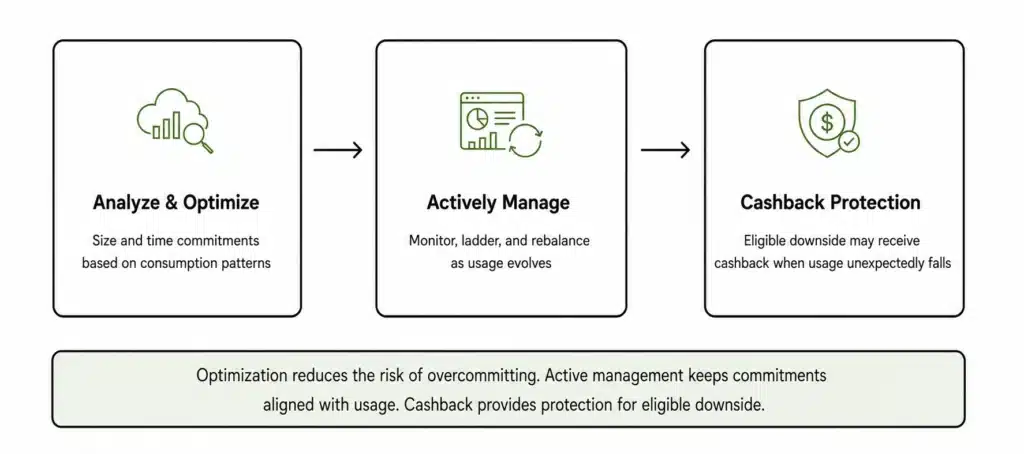
1. Usage.ai analyzes the savings opportunity
Usage.ai connects at the cloud billing layer and analyzes the customer’s consumption, existing commitments, and available savings opportunities.The objective is to identify usage that can benefit from commitment pricing without relying unnecessarily on uncertain future growth.
2. FlexCadence optimizes the purchase
Usage.ai’s proprietary FlexCadence process helps determine the appropriate timing, sizing, and sequencing of commitment purchases.Rather than treating commitment purchasing as one large decision based on a static forecast, FlexCadence uses actual consumption patterns to support a more measured purchasing strategy.
This reduces the likelihood and potential size of overcommitment before the purchase is made.
3. The customer chooses how to proceed
Customers can approve individual recommendations or enable Autopilot for selected accounts, regions, services, or commitment types.After approval, Usage.ai purchases the commitment through the relevant cloud provider’s API and identifies it as a Flex Commitment in the Usage.ai dashboard.
4. Usage.ai manages the commitment
Usage.ai monitors the managed commitment portfolio as cloud consumption changes.The platform handles ongoing purchasing, timing, laddering, and rebalancing while giving customers visibility into coverage, performance, and realized savings.
5. Cashback protects eligible downside
If an unexpected change causes an eligible Flex Commitment to cost more than equivalent On-Demand usage, the qualifying difference may accrue as cashback.Returning to the earlier example:
- Commitment cost: $70 per hour
- On-Demand-equivalent cost after usage falls: $60 per hour
- Financial loss: $10 per hour
See the Usage.ai cashback guide for the current calculation and payment process.
Optimization and Cashback Solve Different Problems
The strength of an insured commitment comes from combining prevention with protection.| Capability | Purpose |
|---|---|
| Purchase optimization | Improve commitment sizing, timing, and expected savings |
| Active management | Keep the portfolio aligned with changing consumption |
| Cashback protection | Reduce eligible downside caused by unexpected usage changes |
Cashback sits behind that process. It is intended to protect the customer from eligible financial consequences when future business or infrastructure changes could not be fully anticipated.
The message is not:
If the commitment is purchased incorrectly, the customer receives cashback.
The message is:
The commitment is carefully optimized and actively managed. If an unforeseen usage reduction still occurs, Usage.ai has the customer’s back.
Commitment Management Versus an Insured Commitment
Traditional commitment management and insured commitments overlap, but they do not produce the same customer outcome.| Dimension | Commitment management | Insured commitment |
|---|---|---|
| Primary objective | Improve commitment performance | Deliver savings with defined downside protection |
| Purchase strategy | Forecasting and utilization analysis | FlexCadence-optimized purchasing |
| Ongoing operation | Monitor coverage and utilization | Purchase, manage, ladder, and rebalance |
| If usage unexpectedly falls | Customer generally retains the loss | Qualifying downside may receive cashback |
| Customer outcome | Better-managed commitments | Optimized commitments with financial protection |
What Can Cause an Unexpected Usage Reduction?
Even a carefully optimized commitment may be affected by events that occur after purchase, including:- An application migration
- An unplanned rightsizing initiative
- A product shutdown
- A sudden decline in customer demand
- A more efficient infrastructure architecture
- A merger, acquisition, or reorganization
- A decision to move workloads between cloud providers
Which Commitments Are Protected?
Not every commitment in a customer’s environment automatically qualifies.Cashback generally applies to eligible Flex Commitments that Usage.ai recommends, purchases, manages, and bills for under the applicable program.
Existing customer-owned commitments remain separately visible and should not be assumed to receive the same protection.
Customers should confirm:
- Whether a purchase will be designated as a Flex Commitment
- Eligible services, regions, and commitment types
- How a financial loss is calculated
- Applicable exclusions and holding periods
- Payment method and timing
- How independently purchased commitments may affect eligibility
How to Evaluate an Insured Commitment
A customer should evaluate the entire model, not only the headline cloud-provider discount or the availability of cashback.A practical evaluation should ask:
How is the commitment opportunity analyzed?
How are purchases sized, timed, and staged?
How is the portfolio managed after purchase?
What qualifies as an eligible financial loss?
How is cashback calculated and paid?
What exclusions or limits apply?
What are the final net savings after fees?
How Usage.ai Charges
Usage.ai charges an agreed percentage of realized savings generated through eligible Flex Commitments.Billing occurs monthly in arrears after the cloud provider finalizes the relevant usage and billing data. This aligns Usage.ai’s commercial model with the savings delivered to the customer.
See the Usage.ai pricing guide.
The Bottom Line
An insured cloud commitment is more than a cashback promise.It is a complete approach to commitment risk:
- Optimize the purchase through FlexCadence
- Manage the commitment as consumption evolves
- Protect eligible downside when an unexpected usage reduction occurs
Together, they allow customers to pursue commitment savings with greater confidence and less exposure to unexpected financial downside.
See how Usage.ai optimizes commitments and protects against usage changes.
Frequently asked questions
What is an insured cloud commitment?
An insured cloud commitment combines a cloud-provider commitment with optimized purchasing, active management, and a defined financial protection mechanism for eligible downside. With Usage.ai, that protection is provided through cashback under the applicable program terms.
How is an insured commitment different from commitment management?
Commitment management focuses on forecasting, optimizing, and managing cloud commitments. An insured commitment adds a financial protection layer that may provide cashback when eligible usage changes create a defined financial loss.
Does an insured cloud commitment replace AWS Savings Plans or Reserved Instances?
No. An insured cloud commitment is not a new cloud-provider pricing construct. It adds a protection layer around an underlying commitment-based pricing mechanism, such as an AWS Savings Plan or Reserved Instance.
Does commitment optimization eliminate commitment risk?
No. Forecasting, rightsizing, utilization monitoring, and automation can reduce the likelihood and potential size of underutilization, but they cannot eliminate the financial exposure created when cloud usage changes unexpectedly.
What should I look for when evaluating an insured commitment?
Evaluate how commitments are sized and managed, what is protected, the conditions that make downside eligible, how the financial loss and cashback are calculated, applicable exclusions and fees, payment timing, approval requirements, and any relevant limits.
How does Usage.ai protect Flex Insured Commitments?
Usage.ai combines commitment optimization and management with cashback protection for eligible Flex Commitments. If an eligible commitment costs more than equivalent On-Demand usage because of a qualifying usage change, the difference may accrue as cashback under the applicable program terms. See how cashback works.
Is an insured commitment the same as a flexible commitment?
No. Flexibility can make a commitment easier to manage as usage changes, but flexibility alone does not provide financial protection. An insured commitment includes a defined protection mechanism with specific eligibility requirements and terms.