.png)
 AWS
AWS Microsoft Azure
 Google Cloud


What both platforms actually solve
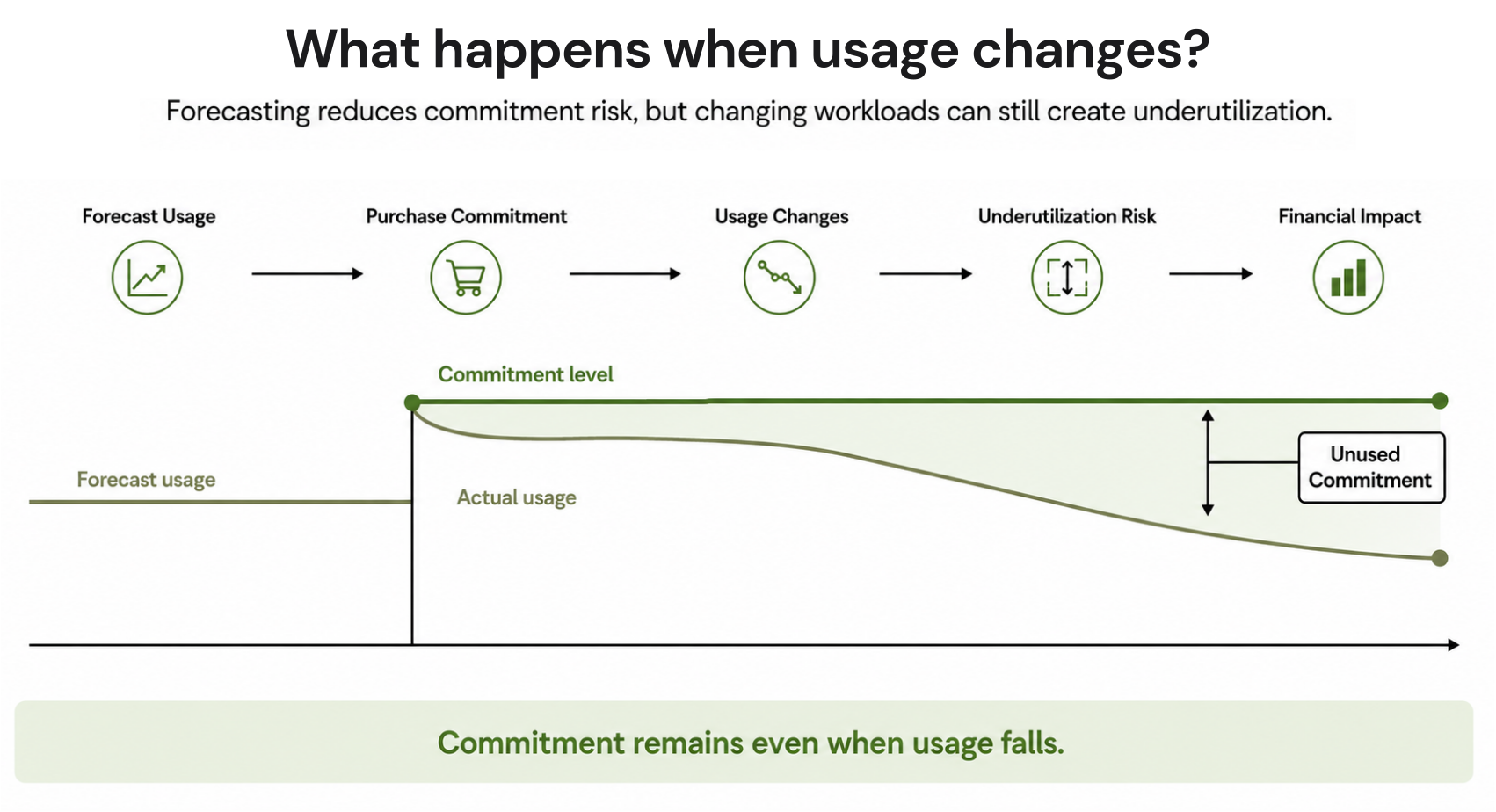
That tradeoff becomes harder to manage as cloud environments change. A workload can be migrated, rightsized, consolidated, or shut down after a commitment has already been purchased. So, a workload change does not automatically eliminate the cloud-provider commitment attached to it.
At scale, this turns commitment management into an ongoing portfolio problem.
Both Usage.ai and nOps help automate that process. Usage.ai analyzes usage and manages eligible commitments through its Flex Commitment Program. nOps provides automated AWS commitment management through its Commitment Management Program.
The important question is what happens after the commitment decision is made.
Forecasting can reduce the probability of overcommitting. Portfolio management can help adapt coverage as usage changes. But neither can guarantee that a commitment will remain fully utilized after an unexpected change in demand.
That is where financial protection becomes relevant.
Usage.ai vs nOps at a glance
| Capability | Usage.ai | nOps |
|---|---|---|
| Autonomous optimization | Included | Included |
| Commitment management | AWS, Azure & GCP | AWS, Azure & GCP |
| Multi-cloud visibility | AWS, Azure & GCP | Unified Multi-cloud |
| Underutilization protection | Cashback Protection | 100% utilization guarantee |
| Protection mechanism | Non-Usage Rebate | Fee credit |
| Existing commitments | Considered / worked alongside | Considered in coverage |
| Fee model | % of realized net savings | % of realized net savings |
The three layers of commitment risk
The cleanest way to compare both the platforms is to separate commitment risk into three layers.1. Usage can change faster than a portfolio can adapt
Both platforms monitor demand and help customers manage commitment coverage as usage changes.A well-managed portfolio can reduce exposure through conservative coverage, staggered purchases, adjustments to future purchases, and the exchange or modification options available for particular cloud-provider instruments.
These techniques handle many normal changes in demand.
They cannot guarantee that every commitment will remain fully utilized after a sudden product shutdown, migration, reorganization, or major rightsizing program.
That distinction matters because a better forecast reduces risk; it does not eliminate it.
2. Lower usage does not cancel the cloud-provider obligation
Retiring a workload does not necessarily retire the commitment attached to it.The available exchange, modification, transfer, or reallocation options depend on the cloud provider and the specific commitment instrument. If compatible usage disappears, the customer can still owe the committed amount.
This risk exists regardless of which management platform is used because the underlying commitments are cloud-provider instruments held in the customer’s account.
nOps makes this point explicitly in its Terms of Service, which state that customers remain responsible for cloud-spend commitments purchased before termination, including associated costs incurred after termination.
Usage.ai works the same way at the infrastructure level. A Flex Commitment does not cause the underlying cloud-provider commitment to disappear. The difference is that eligible Flex Commitments can also carry a defined financial protection mechanism.
3. Residual underutilization determines the real difference
Optimization is designed to reduce the probability and amount of underutilization. Protection addresses the exposure that remains when usage changes despite those optimization efforts.This is where Usage.ai and nOps take different approaches.
Usage.ai provides Cashback Protection for eligible Flex Commitments through its contractual Non-Usage Rebate mechanism. nOps provides a 100% utilization guarantee for eligible nOps-managed commitments, with unused commitment value credited against nOps fees.
The headline outcome may sound similar, but the economic mechanics are different.
With Usage.ai, qualifying protection can ultimately result in a refund after applicable fees are offset. With nOps, the published mechanism operates as a credit against nOps fees, with excess credits carried forward to future invoices.
Buyers should therefore ask:
What exactly is protected?
How is the protected amount calculated?
Is the value returned as a refund or fee credit?
When does the customer receive the value?
What happens when the management relationship ends?
How Usage.ai manages commitment risk
Usage.ai combines commitment optimization with a choice of operating models.The platform analyzes cloud usage and helps determine an appropriate level of commitment coverage.
Customers can use Autopilot when they want selected commitment decisions automated, while CoPilot provides a recommendation-and-approval workflow when the customer wants to retain control over execution.
That gives teams the ability to apply different levels of automation across their environment.
For example, a stable production workload may be suitable for automated management. A newly launched product, business unit undergoing restructuring, or workload expected to migrate may warrant additional review.
Usage.ai also separates existing customer commitments from Flex Commitments managed through its program. Our Flex Commitment eligibility documentation explains the requirements for commitments to qualify.
The second layer is financial protection.
Eligible Flex Commitments can include Cashback Protection when actual usage later creates qualifying underutilization.
Also read: Usage.ai vs Archera: Which Cloud Commitment Platform Delivers Better Value?
How nOps manages commitment risk
nOps takes a similar portfolio-management approach to commitment optimization, with its Commitment Management automating the purchase and management of AWS Reserved Instances and Savings Plans.Its current product documentation describes a 100% utilization guarantee for commitments purchased and managed through the program.
The important distinction is how that protection is delivered.
nOps says that unused hours from ShareSave commitments are credited against the customer’s monthly nOps fees. Its current product documentation describes the guarantee as a credit for the difference when a managed commitment is not fully utilized.
That creates a different economic mechanism from Usage.ai’s Cashback Protection. nOps applies the protection as a fee credit, while Usage.ai’s eligible Non-Usage Rebate can result in a refund after applicable fees are offset.
Compare net economics, not headline savings
Two platforms can produce similar gross savings and still produce different financial outcomes.The comparison should include:
- cloud-provider commitment cost;
- savings generated by the commitment;
- vendor fee;
- treatment of existing commitments;
- eligible protection;
- timing of credits or refunds; and
- financial obligations after termination.
For example, compare the expected case with scenarios where eligible demand falls by 10%, 25%, and 40%.
The purpose is not to predict exactly how usage will behave. It is to identify how sensitive the economics are when the forecast is wrong.
This is especially important when comparing both the vendor fee models.
Usage.ai’s pricing is based on a percentage of net realized savings generated through the Flex Commitment Program. The platform distinguishes those savings from savings already being generated by customer-owned commitments.
When evaluating nOps, buyers should ask for the complete fee calculation for their specific Commitment Management arrangement and identify exactly which savings are included in the fee base.
The comparison should always use the same billing baseline.
Also read: Usage.ai vs ProsperOps: Which Platform Fits Your Risk Model?
Governance: automation should match the operating model
Automation can remove a significant amount of manual work, but commitment purchases still have financial consequences.The right operating model depends on how much control the FinOps team wants to retain.
Usage.ai supports both autonomous execution through Autopilot and customer approval through CoPilot. That makes it possible to automate predictable environments while retaining review for higher-risk workloads.
nOps also emphasizes automated commitment management.
During an evaluation, ask both vendors to demonstrate:
where automation can be enabled or restricted;
which commitment actions require customer approval;
how purchases can be paused;
how existing commitments are treated;
what happens when usage changes suddenly; and
how purchases, recommendations, and configuration changes are audited.
Cancellation and exit economics
The commitment does not disappear when the management relationship ends. This makes cancellation terms an important part of the buying decision.nOps’ general Terms of Service state that either party can terminate the service agreement, while also making the customer responsible for charges and cloud commitments purchased before termination.
However, the Commitment Management MSA contains more specific provisions for the commitment-management service, including a 45-day termination-for-convenience notice provision. Buyers should therefore review the MSA and Order Form governing their specific engagement rather than relying on the general Terms of Service alone.
Usage.ai takes a different approach with Flex Commitments. The Flex Commitment Program is designed around flexibility, with Cashback Protection available for eligible commitments while the applicable program terms remain in effect. The Flex terms specify that termination ends eligibility for the program and Non-Usage Rebates.
For both platforms, the important question is therefore what happens to the active commitment portfolio, applicable fees, and protection when the relationship ends.
Before signing either agreement, ask for a one-page exit schedule showing:
active commitments at termination;
remaining cloud-provider obligations;
outstanding vendor fees;
treatment of eligible underutilization;
when protection ends; and
who assumes management responsibility after termination.
Which platform is the better fit?
Choose Usage.ai when
- You want automated commitment optimization with the option to retain approval over selected decisions.
- Commitment underutilization is a material concern and you want a defined financial protection mechanism alongside optimization.
- You want to evaluate Cashback as part of the economics of an eligible Flex Commitment.
- You want the vendor fee tied to realized savings generated through the Flex Commitment Program.
- You want to compare expected savings and downside protection in the same economic model.
Choose nOps when
- You want automated AWS commitment management as part of a broader cloud cost optimization platform.
- nOps’ 100% utilization guarantee and credit-based protection fit your preferred approach to unused commitments.
- You want a credit-based protection mechanism for eligible unused commitment value.
- The commercial terms in your Commitment Management MSA and Order Form provide the savings, fees, and exit economics you want.
The meaningful difference is how each platform manages that risk before and after the commitment is purchased, and how its protection mechanism changes the customer’s financial exposure when usage falls.
See how Usage.ai combines cloud savings with protection against commitment risk.
Frequently asked questions
Does Usage.ai really pay Cashback in cash?
Eligible Cashback is ultimately paid as money rather than cloud credits. See our Cashback documentation which describes payment to the customer's preferred bank account by wire transfer after the applicable payout period. Contractually, the Non-Usage Rebate is first applied against applicable Usage.ai fees, with any remaining eligible balance refunded.
Is Cashback available for every unused commitment?
No. Cashback applies to eligible Flex Commitments and is subject to the program's eligibility requirements, exclusions, and the applicable customer agreement. It should not be described as an unconditional refund for every unused dollar.
Does cancellation eliminate the AWS commitment?
No. Terminating a management service does not automatically terminate the underlying cloud-provider commitment. nOps explicitly states in its Terms of Service that customers remain responsible for commitments purchased before termination. Usage.ai Flex Commitments are also underlying cloud-provider commitments held in the customer's account.
Does Usage.ai charge fees on savings from commitments I already own?
Usage.ai's Flex Commitment eligibility distinguishes existing customer commitments from Usage Flex Commitments. Its pricing model is based on realized savings generated through the Flex Commitment Program, rather than simply charging on all savings visible in the customer's environment.
Which platform is safer for commitment-heavy environments?
It depends on the type of risk you want to transfer. Both platforms provide commitment optimization and a mechanism designed to address unused commitments. Usage.ai provides a contractual Non-Usage Rebate through eligible Insured Flex Commitments, while nOps provides its Credit Back Guarantee. Compare the eligibility rules, calculation method, payment or credit treatment, fees, and termination terms before deciding.
If you notice any material information that is incorrect, outdated, or no longer applicable, please contact us at [email protected]. We’ll review the information and update the article where appropriate.