.png)
Complete lifecycle automation now live for every AWS managed database service eligible for Database Savings Plans, including OpenSearch Service and Neptune Analytics added by AWS in March 2026.
New York, USA, June 16, 2026: Usage.ai, a cloud cost optimization platform specializing in automated AWS commitment management, today announced full support for AWS Database Savings Plans (DSP) across all 10 AWS managed database services currently eligible under the program. Usage.ai customers can now automate the complete DSP lifecycle, including spend analysis, commitment sizing, purchase, utilization monitoring, and cashback on underutilized commitments for every service AWS covers under Database Savings Plans.
What’s Now Live
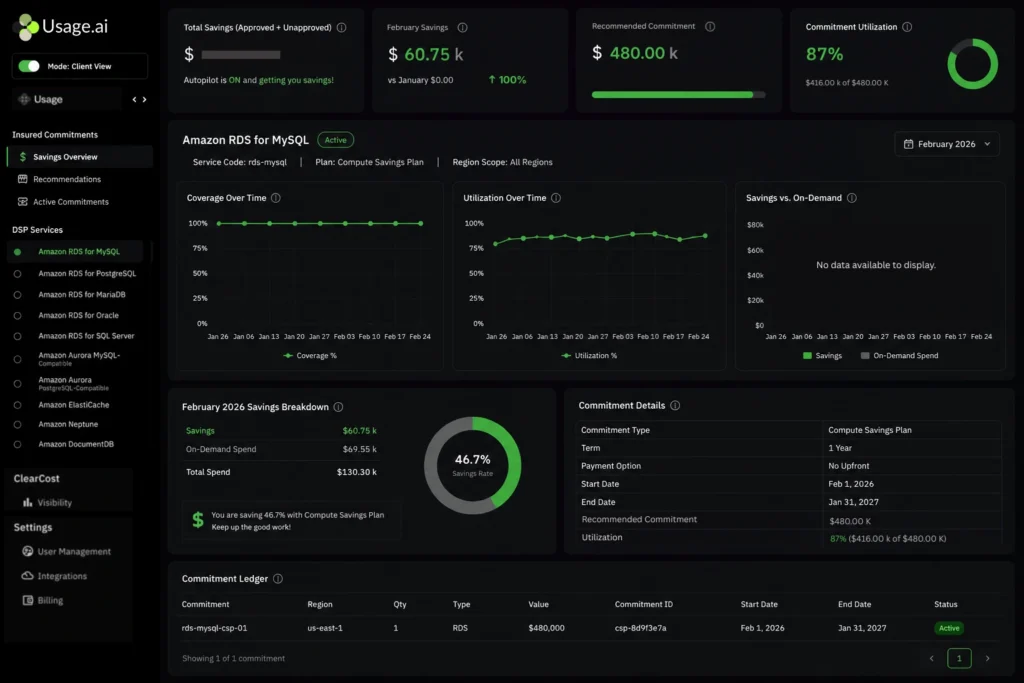
Usage.ai’s Database Savings Plans support is fully live across:
- Amazon RDS: Gen 7+ provisioned instances (db.r7, db.r8g, db.m7, db.m7g families)
- Amazon Aurora: Gen 7+ provisioned instances, Aurora Serverless v2, and Aurora DSQL
- Amazon DynamoDB: on-demand throughput (up to 18% savings) and provisioned capacity (up to 12% savings)
- Amazon ElastiCache: Valkey engine only, covering Gen 7+ provisioned clusters and ElastiCache Serverless for Valkey
- Amazon DocumentDB: Gen 7+ provisioned instances and DocumentDB Serverless
- Amazon Neptune: Gen 7+ provisioned instances, Neptune Serverless, and Neptune Analytics (added by AWS on March 5, 2026)
- Amazon Keyspaces: on-demand throughput (up to 18% savings) and provisioned throughput (up to 12% savings); no Reserved Instances available for this service, making DSP the only commitment discount path
- Amazon Timestream: Timestream for InfluxDB instances (LiveAnalytics is no longer the active product line; Timestream for InfluxDB is the current offering)
- Amazon OpenSearch Service: Serverless and Gen 7+ provisioned instances (added by AWS on March 5, 2026)
- AWS Database Migration Service (DMS): Gen 7+ replication instances and DMS Serverless
“FinOps started with EC2. It matured into Savings Plans and Reserved Instances across compute. The next phase is database and it’s more complex because the eligibility rules, the instance families, and the discount waterfall all behave differently across 10 services.”
“The teams that get this right balance engineering judgment with financial discipline, and that balance is where cloud economics are won or lost”, says Kaveh Khorram, CEO of Usage.ai.
For a complete breakdown of coverage, discount rates, and service-specific eligibility details, see the AWS Database Savings Plans: Complete Guide for 2026.
How Usage.ai Automates the Full D6SP Lifecycle
Purchasing a Database Savings Plan at the right commitment level requires knowing your consistent floor of eligible hourly spend, the amount your eligible database costs never drop below across all hours. Over-commit and you pay for capacity you don’t use. Under-commit and you leave savings on the table. Getting this right manually, across 10 services with different eligibility rules, is operationally expensive.
Usage.ai handles the full process:
- Analysis. The platform pulls Cost and Usage Report (CUR) data and identifies DSP-eligible spend across all 10 services. It separates DSP-eligible spend (Gen 7+ instances, Valkey engine, serverless workloads) from RI-eligible spend (older-generation instances like db.r5, db.r6g, standard Redis and Memcached), so the DSP recommendation is correctly scoped and doesn’t double-count.
- Commitment sizing. Usage.ai calculates the consistent hourly floor spend on DSP-eligible usage across the past 60 days. This is the correct DSP commitment level: large enough to capture savings on the predictable baseline, without over-committing on variable peak spend.
- Purchase. Usage.ai purchases the DSP commitment through billing-layer access. The commitment activates immediately and applies to the next billing hour.
- Monitoring. The platform monitors DSP utilization on a 24-hour refresh cycle. AWS Cost Explorer refreshes every 72+ hours; Usage.ai’s 24-hour cycle means teams can act on utilization changes before they compound.
- Cashback on underutilization. If a DSP commitment becomes underutilized, because a database cluster is decommissioned, migrated, or downsized, Usage.ai provides cashback on the unused committed amount in real money. This applies to DSP commitments the same way it applies to Savings Plans and Reserved Instances across the rest of the platform.
Fee structure is a percentage of realized savings only.
The Correct Order of Operations
Usage.ai recommends a specific sequence for database cost optimization before purchasing DSP commitments:
- Right-size instances: confirm CPU and memory utilization justify the current instance type.
- Migrate to current-generation instances: Gen 7+ for RDS and Aurora; Valkey engine for ElastiCache. Older-generation instances are not DSP-eligible and continue to require Reserved Instances.
- Evaluate storage configuration: for Aurora and DocumentDB, Standard vs. I/O-Optimized storage has meaningfully different cost profiles depending on actual I/O consumption.
- Purchase DSP on the confirmed, right-sized, current-generation spend floor.
Teams that skip steps 1–3 and jump directly to DSP purchase lock in commitments on oversized or ineligible infrastructure. The DSP discount is applied, but it discounts a spend level higher than necessary.
About AWS Database Savings Plans
AWS Database Savings Plans are a spend-based commitment model covering 10 AWS managed database services. Key facts:
- Term: 1-year only (no 3-year option)
- Payment: No Upfront only (no All Upfront or Partial Upfront options, unlike Compute Savings Plans)
- Maximum savings: up to 35% for serverless workloads (Aurora Serverless v2, Neptune Serverless, DocumentDB Serverless, ElastiCache for Valkey Serverless); up to 20% for most provisioned workloads; up to 18% for on-demand throughput workloads (DynamoDB, Keyspaces); up to 12% for DynamoDB and Keyspaces provisioned capacity
- Application order: DSP applies after Reserved Instances in the discount waterfall. Cannot be combined with RIs or reserved capacity on the same workload in the same billing hour.
- DynamoDB note: DSP cannot be combined with DynamoDB reserved capacity on the same table.
- ElastiCache note: Only the Valkey engine is covered. Standard Redis OSS and Memcached continue to require Reserved Nodes.
Getting Started
Teams managing AWS database workloads can run a free savings analysis at usage.ai/savings-calculator to see DSP-eligible spend across their AWS account in under 60 seconds.
To see how Usage.ai automates DSP alongside Reserved Instances and Compute Savings Plans across a full AWS environment, book a demo.
About Usage.ai
Usage.ai is a cloud cost optimization platform that helps engineering and finance teams cut AWS, Azure, and GCP spend by 30 to 50 percent without infrastructure changes, long-term contracts, or stranded commitments. Its Insured Commitments model provides cashback and credit guarantees on every dollar of unused capacity. Usage.ai is SOC 2 Type II certified and headquartered in New York City.