.png)
 AWS
AWS Microsoft Azure
 Google Cloud

Autonomous Commitment Management: How to Stop Managing Cloud RIs Manually
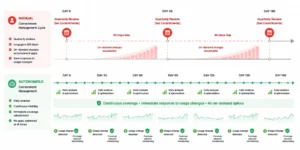
Most FinOps teams manage cloud commitments the same way they managed email in 2003: by hand, on a schedule, with whatever information was available at the time. A senior engineer opens AWS Cost Explorer on the first Monday of the quarter, pulls a Savings Plans and Reserved Instances report, eyeballs coverage gaps, and submits a purchase request to finance. Three weeks later, if approval comes through, the purchases are made.
By then, the usage patterns that informed the analysis are six weeks old. The instances that drove the gap may have been resized. New workloads have launched that were not in the original model. The commitments that were purchased reflect a point-in-time snapshot of a continuously changing system.
This is not a process problem. It is an architecture problem. Manual commitment management is the wrong tool for a continuously changing environment. Autonomous commitment management is what replaces it.
What Is Autonomous Commitment Management?
Autonomous commitment management is the continuous, automated operation of your entire cloud commitment portfolio: analyzing usage, identifying coverage gaps, purchasing the optimal commitment instruments, monitoring for underutilization, and adjusting coverage as workloads change — all without requiring manual review cycles or human approval for each transaction.
The word ‘autonomous’ is precise here. It does not mean ‘makes recommendations for humans to approve.’ It means the system executes purchasing decisions within defined parameters based on observed usage data, the same way auto-scaling executes instance launches based on observed CPU metrics. The human role shifts from executing commitment purchases to setting the parameters and reviewing outcomes.
What Autonomous Commitment Management Covers
A complete autonomous commitment management system operates across the full commitment lifecycle:
Analysis: Continuous evaluation of on-demand versus committed usage, identifying coverage gaps and over-commitment positions. Operating on hourly or daily data rather than the 72+ hour refresh cycles that AWS Cost Explorer provides.
Purchasing: Automated acquisition of the correct commitment type (Savings Plan, Reserved Instance, or cloud-specific equivalent), term length, and payment option based on workload stability signals.
Monitoring: Tracking utilization of each commitment against coverage thresholds and detecting when usage patterns shift in ways that affect commitment efficiency.
Adjustment: Modifying the commitment portfolio as workloads change — exchanging Convertible RIs, letting commitments expire, or purchasing additional coverage when baseline usage grows.
Protection: Providing insurance or buyback guarantees on underutilized commitments, removing the financial risk that makes engineering teams hesitant to commit at all.
Also read: AWS Cost Explorer: Advanced Guide for FinOps Teams
Why Manual Commitment Management Fails at Scale
The case against manual commitment management is not about laziness or incompetence. It is about information latency, cognitive load, and risk tolerance. The three structural failures of the manual approach are:
Failure 1: 72-Hour Data Lag Compounds Into Weeks of Missed Savings
AWS Cost Explorer’s recommendations refresh every 72 hours or longer. A team that reviews Cost Explorer on Monday morning is looking at data that was current on Friday — three days ago. If a new RDS cluster launched Saturday afternoon, it is not in Monday’s recommendations. If a major instance type change happened Friday at 3pm, the recommendation model has not fully incorporated it.
Usage.ai refreshes its commitment analysis every 24 hours. Against AWS Cost Explorer’s 72-hour refresh, the gap is 3 days per review cycle. At $6,000-12,000 per day in uncovered on-demand spend for a mid-size fleet, a 3-day lag compounds to $18,000-36,000 in avoidable charges per analysis cycle. Over a year of quarterly reviews (4 cycles x $18,000-36,000) = $72,000-144,000 in unnecessary spend from data lag alone.
Failure 2: Fear of Over-Commitment Limits Coverage to 25-40%
FinOps teams asked to justify a commitment purchase to a finance team face an asymmetric risk: if usage drops, they are blamed for wasting committed spend. If they under-commit, nobody notices the missed savings. This asymmetry creates a systematic bias toward conservative commitments.
The data bears this out. Research from nOps published in 2026 finds that manual management teams typically achieve 25-40% savings on compute, compared to 45-55% for teams using automated commitment management. The gap is not explained by tool quality — it is explained by the human risk aversion that manual processes require. A person approving a $200,000 three-year RI purchase carries career risk if the workload changes. An autonomous system operating within pre-approved parameters carries no such risk.
Autonomous commitment management eliminates the over-commitment fear by providing a financial backstop. When commitments are backed by buyback guarantees and cashback on underutilized capacity — as Usage.ai Insured Flex Commitments provide — the engineering team’s risk of recommending a commitment drops to zero. The insurance structure replaces human risk aversion with a contractual backstop.
Failure 3: The Commitment Surface Is Now Too Large for Manual Management
When RI management meant EC2 Reserved Instances, manual management was difficult but tractable. In 2026, the commitment surface has expanded dramatically:
AWS alone: EC2 Reserved Instances, Compute Savings Plans, EC2 Instance Savings Plans, RDS Reserved Instances (6 engines), ElastiCache Reserved Nodes (3 engines), DynamoDB Reserved Capacity, OpenSearch Reserved Instances, Redshift Reserved Nodes, Database Savings Plans, and SageMaker Savings Plans. Each has different eligibility rules, term lengths, payment options, and size flexibility mechanics.
Add Azure Reservations and GCP Committed Use Discounts for multi-cloud environments and the manual tracking burden becomes untenable. A FinOps team with one or two engineers cannot optimize the full commitment surface manually and still have time for architectural work.
Autonomous systems do not have this constraint. A well-designed autonomous commitment platform manages EC2, RDS, ElastiCache, DynamoDB, and database Savings Plans simultaneously, applying the same continuous analysis to each service.
How Autonomous Commitment Management Works: The Technical Mechanics
Understanding what makes autonomous commitment management technically different from recommendation-based tooling is important for evaluating platforms.
Continuous Usage Signal Ingestion
The foundation is hourly (or better) ingestion of your actual cloud usage data, not Cost Explorer’s aggregated recommendations. This means pulling from the Cost and Usage Report or equivalent billing API, parsing hourly on-demand usage by service, instance type, region, and account, and maintaining a rolling time series of consumption patterns.
The usage signal must be granular enough to distinguish between a stable baseline (eligible for 3-year commitment) and a variable peak (not eligible). An average daily CPU utilization of 40% does not tell you whether you have a stable 40% baseline or a 20% baseline with daily spikes to 60%. Hourly data tells you. Quarterly averages do not.
Baseline Extraction and Commitment Sizing
The autonomous system extracts the commitment-eligible baseline from the hourly signal. This is typically the P50-P70 of hourly usage: the consumption level you are at or below for 50-70% of hours. Committing to the P50 ensures the commitment is fully utilized in the majority of hours while allowing the remaining hours to overflow to on-demand.
The sizing algorithm must also account for service-specific mechanics. For RDS, size flexibility means a family-level reservation covers any size in the family proportionally. For DynamoDB, reservations are purchased in 100 RCU/WCU blocks. For ElastiCache, the Valkey migration bonus means Redis OSS reservations cover 20% more Valkey nodes. These mechanics change the optimal commitment quantity for each service.
24-Hour Refresh and Continuous Adjustment
The commitment portfolio is re-evaluated every 24 hours against the latest usage signal. If baseline usage grows — a new service launched, a workload scaled up, a seasonal traffic increase — the system identifies uncovered on-demand spend and purchases additional commitments. If baseline usage shrinks — a service was deprecated, instances were right-sized, a workload migrated — the system identifies over-committed positions and responds via available adjustment mechanisms (exchanges, natural expiration, or buyback).
Cashback and Buyback Protection
The structural risk of commitment automation is that usage changes unpredictably. An autonomous system that purchases aggressively without downside protection can lock a team into commitments that generate waste for months.
Usage.ai Insured Flex Commitment: An SP/RI-equivalent discount structure delivering 30-60% savings without multi-year lock-in, $0 upfront, and cancel-anytime with a buyback guarantee. Underutilized commitments are returned as cashback (real money, not credits) — the only platform offering this protection.
The buyback guarantee is what makes autonomous purchasing safe at scale. When underutilized commitments generate cashback rather than waste, the system can purchase commitments at the correct utilization level without the conservative bias that manual processes require. The result is higher coverage, higher savings, and lower financial risk simultaneously.
The Business Case for Autonomous Commitment Management
The financial case for switching from manual to autonomous commitment management has three components: additional savings from higher coverage, engineering time recovered, and reduced financial risk.
Component 1: Coverage Gap Closure
Most organizations running manual commitment management have a coverage gap: a portion of their on-demand spend that qualifies for commitment discounts but is not currently covered. The gap exists because manual analysis is conservative, infrequent, and often blocked by approval cycles.
Typical coverage gap for manual management: 30-40% of committable spend is uncovered on-demand. Savings potential: 30-69% depending on service and commitment type. For a team with $500,000/month in committable AWS spend: 35% coverage gap = $175,000/month on-demand. At 50% average savings rate: $87,500/month in avoidable spend, $1,050,000/year.
Autonomous management targeting 90%+ coverage: coverage gap shrinks to 10% or less. Monthly on-demand saving: $87,500 – $25,000 = $62,500 additional savings from coverage gap closure alone. Annual additional savings: $750,000.
Component 2: Engineering Time Recovery
A committed FinOps engineer managing RDS Reserved Instances, ElastiCache Reserved Nodes, Savings Plans, and EC2 RIs manually spends 8-16 hours per month on commitment analysis, purchase preparation, finance approval coordination, and utilization monitoring. At $150,000/year fully-loaded cost for a senior FinOps engineer, that is $12,500-25,000 per month in engineering time on a task that autonomous systems handle without human intervention.
The recovered engineering time is reallocated to architectural optimization, cost allocation improvements, and strategic FinOps work that automation cannot replace: policy design, organizational influence, and cross-team accountability programs.
Component 3: Risk Reduction
Manual commitment management carries three categories of financial risk that autonomous systems eliminate or transfer:
Over-commitment risk: purchasing more commitments than usage supports, generating waste that runs to term. Managed by buyback guarantees.
Under-commitment risk: leaving committable on-demand spend uncovered due to conservative analysis. Managed by continuous coverage analysis and automated purchasing.
Expiration risk: failing to renew or replace expiring commitments before the term ends. Managed by continuous monitoring with automated renewal recommendations and purchases.
Autonomous Commitment Management Across the AWS Data Tier
Usage.ai’s autonomous commitment management platform covers the full AWS database and analytics commitment surface alongside compute. Here is how it operates across each service.
RDS Reserved Instances
Usage.ai monitors RDS instance utilization across all engines (MySQL, PostgreSQL, MariaDB, Oracle, SQL Server) and refreshes the commitment analysis every 24 hours. For each engine, the platform evaluates instance family utilization, identifies stable baseline consumption eligible for 1-year or 3-year terms, and purchases the optimal reserved instance configuration. Size flexibility mechanics for MySQL, PostgreSQL, and Oracle BYOL are factored into the purchase sizing, ensuring family-level reservations are purchased at the right level to benefit from cross-size coverage.
RDS Reserved Instances: Engine-by-Engine Pricing and Commitment Guide
For teams on EOL engine versions in Extended Support, Usage.ai surfaces the Extended Support surcharge as an urgent cost alert: MySQL 5.7 and PostgreSQL 11 entered Year 3 Extended Support in March 2026, doubling the per-vCPU surcharge that is not reduced by reserved instances.
RDS Extended Support Pricing: Staying on Old Engine Versions
ElastiCache Reserved Nodes
ElastiCache reserved nodes for Redis OSS, Valkey, and Memcached are optimized using the same continuous analysis. Since October 2024, ElastiCache reserved nodes offer size flexibility within the same instance family — Usage.ai incorporates this mechanic into the purchase sizing, buying family-level reservations that cover the baseline across all node sizes in use. The Valkey migration bonus is also factored: Redis OSS reservations cover 20% more Valkey nodes via normalization units after engine migration.
ElastiCache Reserved Nodes: Redis, Valkey and Memcached Pricing Guide
DynamoDB Reserved Capacity
DynamoDB reserved capacity for read and write capacity units is purchased in 100 RCU/WCU blocks. Usage.ai monitors ConsumedReadCapacityUnits and ConsumedWriteCapacityUnits metrics via CloudWatch to identify the stable P60 baseline and purchases the appropriate number of 100-unit blocks. GSI write amplification is factored into the write capacity analysis: a table with 3 GSIs consumes 4x the application write volume, requiring 4x the reservation relative to application-level write metrics.
DynamoDB Reserved Capacity: Read and Write Throughput Pricing Guide
Manual vs Autonomous Commitment Management: The Full Comparison
Here is the definitive comparison between the two approaches across every dimension that matters for a FinOps or cloud architecture team.
| Dimension | Manual Management | Autonomous Management (Usage.ai) | Business Impact | Dollar Impact | Winner |
| Analysis frequency | Quarterly or monthly (human-scheduled) | Every 24 hours (automated) | Faster response to usage changes | $18K-36K less per 3-day lag | Autonomous |
| Data freshness | 72+ hours (Cost Explorer cycle) | 24 hours (direct usage data) | Recommendations based on current state | Eliminates 3-day data lag | Autonomous |
| Coverage rate | 25-40% of committable spend | 85-95% of committable spend | Higher savings on more spend | $750K/yr additional on $500K/mo fleet | Autonomous |
| Over-commitment risk | High (no protection, finance approval delays) | Managed by cashback and buyback guarantee | Teams commit confidently at higher levels | Eliminates under-commitment bias | Autonomous |
| Lock-in terms | 1-3 year rigid, non-cancellable AWS RIs | Zero lock-in, cancel anytime, quarterly adjustments | No financial risk if usage changes | Eliminates stranded commitment cost | Autonomous |
| Engineering hours | 8-16 hrs/month per FinOps engineer | Near zero (oversight and parameter setting) | Engineers focus on higher-value work | $12.5K-25K/month labor recovered | Autonomous |
| Multi-service coverage | Usually EC2-only; DB tier manual or uncovered | EC2, RDS, ElastiCache, DynamoDB, OpenSearch, Redshift | Full commitment surface optimized | Captures DB tier savings left on table | Autonomous |
| Underutilization handling | Waste runs to term expiration | Cashback paid in real money — not credits | Underutilized commitments return value | Zero stranded commitment cost | Autonomous |
| Fee model | Engineering salary + opportunity cost | % of realized savings only — $0 if nothing saved | Aligned incentives — pay only for results | No cost if no savings | Autonomous |
The Zero Lock-In Architecture of Autonomous Commitment Management
The most common objection to any commitment management system — manual or autonomous — is lock-in risk. What if usage drops 40% after a major customer churns? What if the team migrates from MySQL to Aurora? What if a cost-cutting initiative forces a 30% fleet reduction?
Usage.ai Insured Flex Commitments carry no multi-year lock-in obligation. The commitments are quarterly-adjustable, cancel-anytime structures backed by a buyback guarantee. If usage patterns shift, commitments adjust in the next quarterly cycle. If a commitment becomes underutilized because a workload is deprecated, Usage.ai buys it back and returns the value as cashback in real money, not credits.
Zero Lock-In Guarantee: Usage.ai Insured Flex Commitments adjust quarterly. Scale down? No penalty. Scale up? Adjusts automatically. Underutilized? Cashback paid in real money. No multi-year obligation. Cancel anytime with buyback guaranteed on every commitment.
This architecture is structurally different from buying native AWS Reserved Instances directly. AWS RIs are non-refundable and non-cancellable. A 3-year All Upfront RI on an instance that gets deprecated in month 6 costs you 2.5 years of committed spend on a non-existent workload. Usage.ai’s buyback guarantee eliminates this risk, making it possible to commit aggressively at the utilization levels that maximize savings without the tail risk of stranded commitments.
See how much you can save with autonomous commitment management from Usage.ai
What the Data Shows: Manual vs Autonomous Commitment Outcomes
The performance gap between manual and autonomous commitment management is not theoretical. It shows up directly in savings rates, coverage percentages, and wasted spend across real fleets.
Coverage Rates
Research published by nOps in May 2026, analyzing commitment coverage across their managed fleet, found that teams relying on manual RI purchasing achieve an average commitment coverage of 40% of their committable compute spend. Teams using automated management platforms reach 85-95% coverage. The 45-55 percentage point gap is the direct result of the three structural failures described earlier: data lag, risk aversion, and surface complexity.
For a $1M/month AWS bill where 60% is committable compute and database spend: manual coverage at 40% = $240K/month in commitments, $360K/month on-demand. Autonomous coverage at 90% = $540K/month in commitments, $60K/month on-demand. The 50-point coverage improvement at a 50% average discount rate: ($360K – $60K) x 50% = $150K/month in additional savings, $1.8M/year from coverage gap closure alone.
Time to First Savings
Manual commitment management cycles are quarterly at most. The first RI purchase under a manual program typically takes 4-8 weeks from the start of the analysis: 2 weeks to analyze, 2-4 weeks for finance approval, 1 week for purchase execution. Commitments then take effect immediately but the analysis was based on 6-week-old data.
Autonomous commitment management delivers first purchases within 24-48 hours of enabling. The baseline analysis runs against the last 30-60 days of data, and the system purchases the identified coverage immediately. Teams moving from manual to autonomous typically see first savings in the first billing cycle.
The Database Tier Gap
One of the most consistent findings in cloud cost benchmarking is that database tier commitments are dramatically underpurchased relative to compute commitments. Teams that have strong EC2 RI coverage of 70-80% often have RDS RI coverage of 20-40% and ElastiCache coverage in single digits.
The reason is prioritization: EC2 is the largest and most visible cost center, so FinOps attention goes there first. RDS, ElastiCache, DynamoDB, and other data tier services are considered secondary and reviewed less frequently. The data tier represents 20-35% of total AWS spend for most production applications, meaning 20-35% of spend has a fraction of the RI coverage that compute receives.
Usage.ai’s unified coverage approach treats the data tier with identical analysis rigor to compute. A team onboarding to Usage.ai with strong EC2 coverage but weak database coverage typically sees the largest immediate savings from database tier commitment purchases in the first 30 days, because the gap is widest there.
The Multi-Cloud Commitment Surface in 2026
Autonomous commitment management is not only an AWS problem. As organizations operate workloads across AWS, Azure, and GCP simultaneously, the commitment surface multiplies in complexity.
AWS: EC2 Reserved Instances, Compute Savings Plans, EC2 Instance Savings Plans, RDS Reserved Instances, ElastiCache Reserved Nodes, DynamoDB Reserved Capacity, OpenSearch Reserved Instances, Redshift Reserved Nodes, Database Savings Plans, SageMaker Savings Plans. Each with unique eligibility, term lengths, and mechanics.
Azure: Reserved VM Instances, Azure Savings Plans, SQL Database Reserved Capacity, Cosmos DB Reserved Throughput. Azure reservations have a different size flexibility model than AWS, using a unit-based normalization system for VM families.
GCP: Committed Use Discounts (CUDs) for Compute Engine, Cloud SQL, and Cloud Spanner. GCP CUDs are resource-based (specific vCPUs and memory) or flex (spend-based), with 1-year or 3-year terms.
A FinOps engineer trying to maintain optimal coverage across all three providers manually — tracking separate dashboards, understanding different eligibility rules, coordinating separate approval processes — is doing the work that autonomous systems were built to replace. Usage.ai’s platform covers AWS, Azure, and GCP under a unified autonomous management approach, applying the same 24-hour refresh and cashback protection across providers.
How to Get Started with Autonomous Commitment Management
Moving from manual to autonomous commitment management does not require a long implementation project. The transition is designed to be operational within 30 minutes.
Step 1: Connect at the Billing Layer
Usage.ai connects to AWS, Azure, and GCP through billing-layer access: read permissions on cost and usage data, and write permissions to purchase commitment instruments. No infrastructure access, no agent installation, no changes to your running workloads. The connection is identical to connecting Cost Explorer or any cloud billing analytics tool.
Step 2: Set Coverage Parameters
Define the parameters for autonomous purchasing: which accounts and services to cover, the utilization threshold for commitment eligibility (typically P60-P70 of hourly consumption), the preferred payment options (Partial Upfront vs All Upfront for each service), and any exclusions (services under architectural review, accounts in freeze periods).
Step 3: Review the Baseline Analysis
Usage.ai analyzes your last 30-60 days of usage data and presents the commitment opportunity: current coverage rate, gap to optimal coverage, projected additional savings from autonomous management, and the specific commitment purchases it would make in the first 24 hours. Review this analysis before enabling automated purchasing.
Step 4: Enable Autonomous Purchasing
Switch the platform from recommendation mode to autonomous mode. From that point, commitment purchases execute automatically within the parameters you set. You review weekly summary reports showing purchases made, coverage rate changes, savings delivered, and any cashback from underutilized commitments.
What to Expect in the First 30 Days
Most teams see significant coverage gap closure in the first 7-14 days as the platform addresses the most obvious uncovered baseline spend. By day 30, the commitment portfolio reflects the current usage baseline with 85-95% coverage. The realized savings rate — effective savings on total committable spend — typically increases by 15-25 percentage points versus the manual baseline.
Frequently Asked Questions
What is autonomous commitment management?
Autonomous commitment management is the automated, continuous operation of your cloud commitment portfolio. It analyzes usage data every 24 hours, purchases the optimal mix of Reserved Instances and Savings Plans without manual intervention, monitors utilization, and adjusts commitments as workloads change. It replaces the quarterly manual RI review cycle with a continuous engine backed by financial protection against underutilization.
How is autonomous commitment management different from RI recommendations?
Recommendations tell humans what to buy. Autonomous management buys it. Recommendations refresh every 72+ hours. Autonomous analysis refreshes every 24 hours. Recommendations carry over-commitment risk that makes teams conservative. Autonomous management backed by cashback and buyback guarantees allows purchasing at the utilization level that maximizes savings without conservative bias.
What is an Insured Flex Commitment?
Usage.ai’s Insured Flex Commitments are SP/RI-equivalent discount structures delivering 30-60% savings without multi-year lock-in, $0 upfront, and cancel-anytime with a buyback guarantee. Every commitment is fully insured: underutilized portions are returned as cashback in real money, not credits. It is the only commitment structure in the industry with this protection.
Does autonomous commitment management work for RDS and ElastiCache?
Yes. Usage.ai Flex Reserved Instances cover RDS (all engines: MySQL, PostgreSQL, MariaDB, Oracle, SQL Server), ElastiCache (Redis OSS, Valkey, Memcached), DynamoDB, OpenSearch, and Redshift. The Flex DB Savings Plan covers ElastiCache and RDS under a spend-based model. Both products operate autonomously with 24-hour refresh cycles.
What does autonomous commitment management cost?
Usage.ai’s fee is a percentage of realized savings only. If Usage.ai saves you nothing, you pay nothing. There is no subscription fee, no per-seat charge, and no minimum commitment. The platform’s incentive is fully aligned with yours: it only earns when you save.
How long does it take to set up?
30 minutes. Usage.ai connects at the billing layer with read and write access to your cloud accounts. No infrastructure changes, no agent installation, no workload modifications. Review the baseline analysis, set your coverage parameters, and enable autonomous purchasing. The platform handles everything from that point.
What happens if my usage drops significantly after commitments are purchased?
Usage.ai’s buyback guarantee covers this scenario. If a commitment purchased through the platform becomes underutilized because your usage drops, Usage.ai buys it back and returns the value as cashback in real money. Commitments also adjust quarterly, so significant usage drops are incorporated into the next quarterly coverage recalculation without penalty.
Is autonomous commitment management safe for production environments?
Yes. Usage.ai operates at the billing layer only. It purchases commitment instruments — the same Reserved Instances and Savings Plans you could buy manually — but it does not modify, restart, resize, or access your running infrastructure in any way. The only effect on production is a lower cloud bill.