.png)



This guide covers how cloud providers price infrastructure, the three levers for cutting spend, and how to use commitments like Savings Plans and Reserved Instances without stranding budget as workloads change.
Most organizations know discounts exist; the harder problem is knowing how much to commit, and how to protect against over-commitment.
The short answer
Cloud cost optimization means reducing what you spend on AWS, Azure, and GCP without sacrificing performance or flexibility by tightening usage, making smarter architecture choices, and shifting stable workloads onto discounted Savings Plans or Reserved Instances instead of on-demand pricing.
What Is Cloud Cost
Optimization?
Cloud cost optimization is the ongoing practice of reducing cloud spend while maintaining required performance, reliability, and scalability.
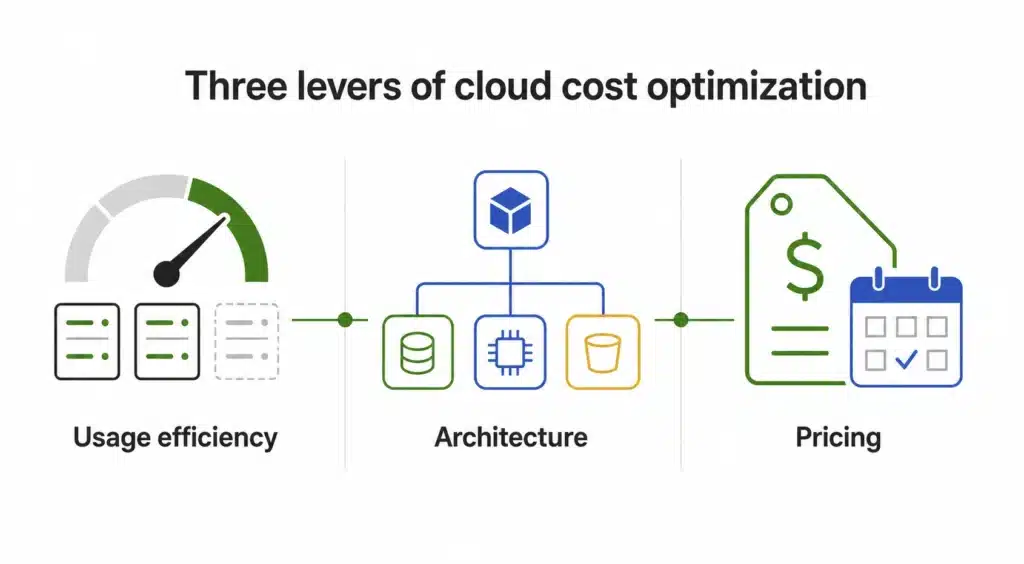
It focuses on aligning cloud consumption and pricing choices with real business demand, rather than simply reacting to monthly bills. It typically involves three dimensions:
- Improving usage efficiency: ensuring resources are sized appropriately, idle or unused services are removed, and consumption reflects actual workload needs.
- Making informed architectural and service choices: selecting services, regions, and configurations that balance performance, resilience, and cost.
- Choosing the right pricing models: deciding when to pay fully variable, pay-as-you-go rates versus when to commit to discounted pricing in exchange for predictability.
Many organizations associate cost optimization with dashboards, tagging, or budget alerts. But those tools are better understood as cost management, which simply answers “Where is our money going?”
Cost optimization goes further, asking “How do we structurally spend less over time without increasing operational risk?”
Also read: Cloud Cost Analysis: How to Measure, Reduce, and Optimize Spend
Why Cloud Costs Grow
Faster Than Expected
The on-demand pricing trap
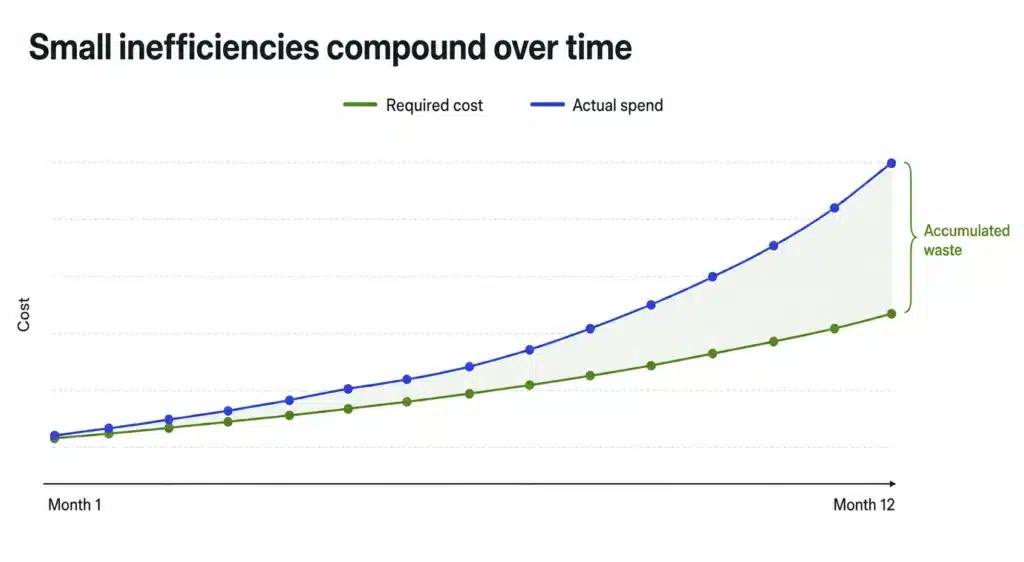
On-demand pricing feels safe because it preserves flexibility, but it’s intentionally the most expensive way to consume cloud resources. As workloads stabilize, organizations often keep paying variable rates for infrastructure that’s effectively become predictable.
Elasticity without guardrails
Fragmented ownership
Complexity compounds over time
Together, these factors explain why cloud costs often grow faster than revenue or usage, even in well-run organizations.
Also read: Why Cloud Cost Optimization Is a Top Priority for Modern Businesses
These are not merely different interfaces around the same engine. One product makes a financial protection mechanism central to the offer; the other emphasizes continuous management of the customer’s native commitment portfolio.
The Core Levers of
Cloud Cost Optimization
Lever 1: Usage Efficiency
- Identifying idle or underutilized resources
- Rightsizing compute instances
- Scheduling non-production environments to shut down when unused
- Applying storage lifecycle policies
These produce fast, visible savings, but the gains flatten once obvious waste is gone, an important lever, but not sufficient alone.
Lever 2: Architectural and Service Choices
This lever covers higher-level decisions about system design and service selection. Managed services cut operational overhead but often cost more per unit; self-managed alternatives trade that convenience for more control.
Regional choices, data transfer patterns, and redundancy strategies also shape spend in non-obvious ways. Early decisions database engines, compute platforms, replication models can lock in cost structures for years, so revisiting them as usage evolves matters.
Also read: How Cloud Cost Optimization Actually Works (Beyond Dashboards & Discounts)
Lever 3: Pricing Models and Commitments
The first two levers determine what’s used and how it’s built; pricing determines what you ultimately pay for it. Skipping any of the three leaves savings on the table.
Most teams try to do everything at once and make progress on nothing. A four-phase sequence works better, prioritizing impact and reversibility:
- Stop the bleed: terminate idle resources, delete orphaned snapshots, shut down non-prod environments after hours. Same-day reversible; 5–15% reduction.
- Rightsize: match instance size to actual p95 utilization over 30 days. Reversible with testing; 10–20% reduction.
- Commit: purchase Savings Plans and RIs against your confirmed baseline. Only partially reversible; 20–40% reduction.
- Govern: tag resources, set budget alerts, assign cost ownership. Fully reversible; prevents regression.
Committing before rightsizing locks in waste at a discount; rightsizing before stopping idle spend inflates your baseline.
Sequence matters more than any single tactic.
Also read: 20 Cloud Cost Optimization Best Practices (2026)
Understanding Cloud Commitments:
Savings Plans & RIs
When customers commit to a minimum usage level over a defined period, providers can plan capacity and revenue more effectively and pass some of that savings back as lower rates, often reducing compute costs by 30–60% versus on-demand.
Most cloud commitments fall into two broad categories:
| Decision area | Savings Plans | Reserved Instances |
|---|---|---|
| Commitment basis | Hourly spend ($/hr) | Specific instance config |
| Flexibility | High applies across EC2, Fargate, Lambda | Low locked to family, region, OS |
| Max discount (compute) | Up to 66% (Compute SP) / up to 72% (EC2 Instance SP, 3-yr) | Up to 72% (Standard RI, 3-yr All Upfront) |
| Best for | Variable or modernizing workloads | Stable, predictable, single-config workloads |
| Stranded-spend risk | Lower | Higher config changes kill the discount |
| AWS database coverage | Yes, Database Savings Plans (launched Dec 2025), up to 35%, 1-year term only. The Gen 7+ requirement applies to RDS, Aurora, and DocumentDB; DynamoDB and ElastiCache (Valkey) aren't generation-restricted. | Yes all generations, all engines |
Also read: Multi-Cloud Cost Optimization Guide: AWS, Azure, and GCP
Why Commitments Matter for
Cost Optimization
This is why teams that focus exclusively on rightsizing or architectural changes often hit a savings ceiling.
Yet commitments aren’t universally adopted or fully utilized. The reason is risk: committing to future usage assumes workloads will keep running at similar levels.
When usage declines due to seasonality, product changes, or architectural shifts, committed capacity goes unused, and that unused portion doesn’t disappear. It keeps incurring cost regardless of consumption.
Also read: 7 AWS Savings Plan KPIs Every FinOps Team Should Track for Better Cost Efficiency
The Hidden Risk in Cloud Cost Optimization
Cloud usage is rarely static. Even stable businesses see shifts from seasonality, product launches, customer growth, or infrastructure refactoring.
When usage declines after a commitment is made, organizations can end up paying for capacity they no longer need:
- Committed capacity goes unused
- The effective cost per unit of actual usage increases
- Total spend may exceed what on-demand pricing would have cost
Also read: How to Choose Between 1-Year and 3-Year AWS Commitments
Many organizations respond by under-committing, which limits exposure but leaves savings unrealized.
Recognizing this efficiency-versus-flexibility tradeoff explicitly, rather than avoiding commitments or relying on intuition, is a key step toward more mature cloud cost optimization.
How Usage.ai Applies These
Principles
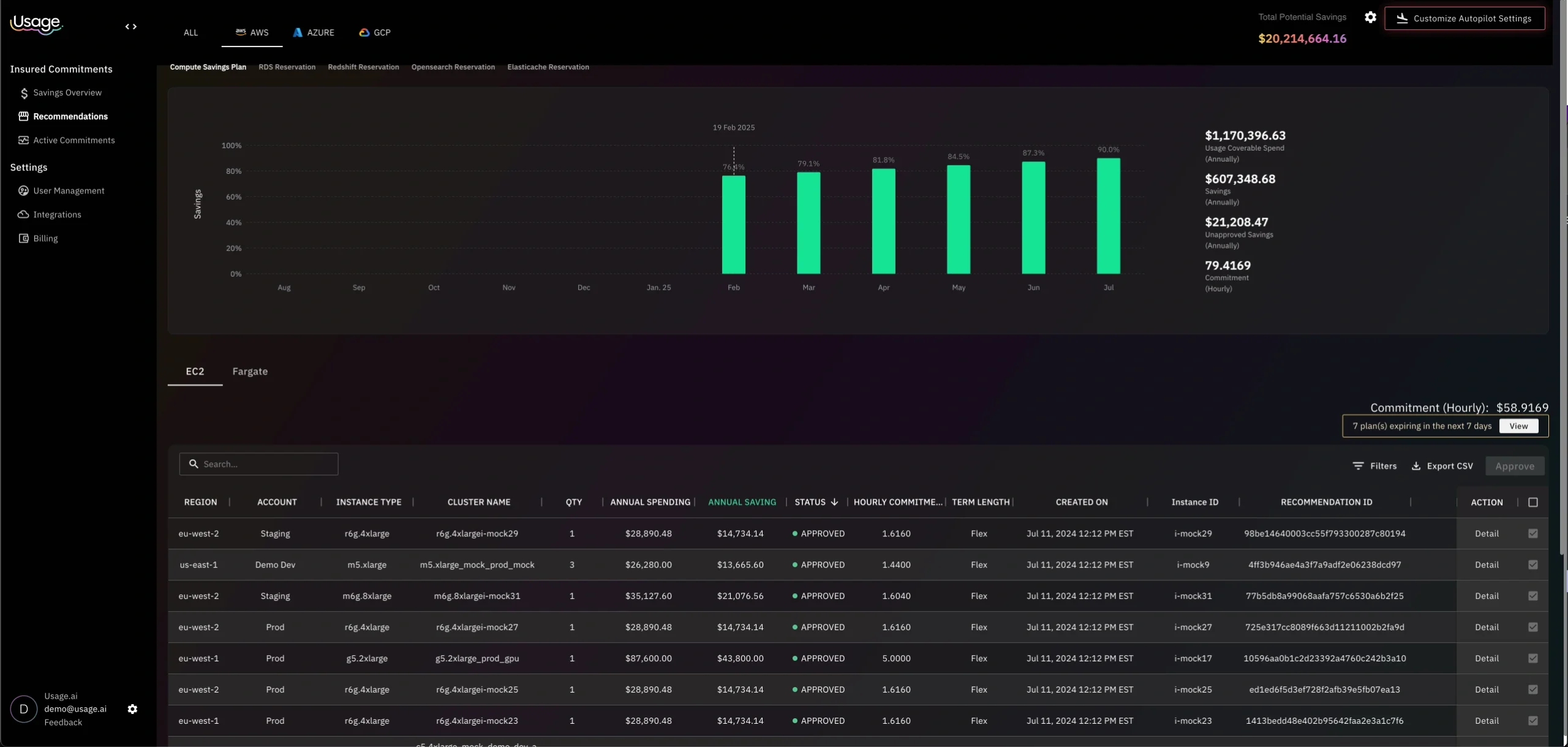
- Automates the full lifecycle: discovery, purchase, and ongoing management of Savings Plans, Reserved Instances, and flexible commitments, with recommendations refreshed every 24 hours instead of relying on outdated forecasts.
- Separates savings from risk: provides cashback and credits when committed usage isn’t fully consumed, so teams can raise coverage without absorbing the downside themselves.
- Charges only on realized savings: keeping its incentives tied to actual outcomes, not projections.
Sign up for Usage.ai to run a free savings analysis and see how much discounted coverage you can safely unlock in your cloud environment.
Conclusion
Cloud cost optimization isn’t a project with an end date usage shifts, workloads migrate, and pricing models change, so today’s commitment decisions need revisiting continuously, not quarterly.
The sequence still applies: stop idle spend, rightsize against real usage data, then commit against your confirmed baseline. Skipping straight to commitments is the most common reason organizations end up with stranded reservations and shrinking margins.
Sustained savings come from treating this as an ongoing discipline, clear ownership, automated execution, and a backstop against forecast error, not a quarterly finance exercise. The fastest way to start is building your commitment baseline from real usage data before your next billing cycle closes.
Connect in 15 minutes. No contracts, no infrastructure changes. See your savings before committing.
Frequently asked questions
What is cloud cost optimization?
The ongoing practice of reducing cloud spend while maintaining performance, reliability, and scalability improving usage efficiency, making cost-aware architectural decisions, and choosing the right pricing models (on-demand versus discounted commitments) based on actual business demand.
What is the most effective way to reduce cloud costs?
It depends on workload maturity. Early savings usually come from eliminating waste and rightsizing resources; at scale, the largest and most durable savings come from discounted pricing models like Savings Plans and Reserved Instances on stable workloads.
How is cloud cost optimization different from cloud cost management?
Cloud cost management focuses on visibility and control tracking spend, allocating costs, setting budgets, monitoring usage. Cloud cost optimization goes further, actively changing how resources are used and paid for to structurally reduce costs, not just observe them.
Are Savings Plans and Reserved Instances Risky?
Not inherently, but they require confidence in future usage. If usage declines significantly after a commitment, unused committed capacity can reduce or eliminate expected savings which is why many organizations adopt conservative strategies or revisit decisions frequently.
How often should cloud cost optimization be reviewed?
Continuously rather than quarterly or annually. Usage patterns can change daily, so frequent analysis helps keep optimization decisions aligned with current demand and architecture.