 AWS
AWS Microsoft Azure
 Google Cloud

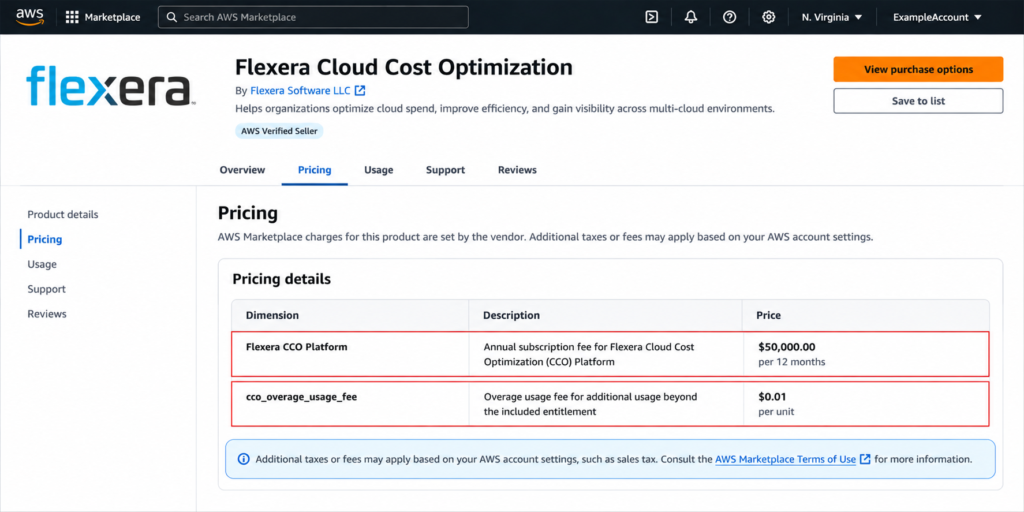
Flexera routes pricing to a sales conversation. But real figures exist, published by Flexera itself in two places most buyers never check: its AWS Marketplace listings, and its own subscription and product terms. This guide draws on those documents alongside independent customer feedback.
It covers what Flexera publishes, what the fee is measured against, how that measurement changes, which contract terms move total cost, and which costs land outside the Flexera invoice.
The goal isn’t to say whether Flexera is right for you. It’s to show how the pricing works, so you can judge that yourself.
Flexera pricing at a glance
Flexera One is not one metered product. Per the Flexera One Product-Specific Terms, Cloud Cost Optimization bills on spend and IT Asset Management on devices. SaaS Management bills on users, and Cloud License Management on cloud instances.That is why there is no single Flexera price.
Figures below come from Flexera’s own Marketplace listings, September 2026.
| Offering | Billable unit | Published price | Effective rate (and basis) |
|---|---|---|---|
| Cloud Cost Optimization spend-tiered | Spend Under Management | $50,000/year, up to $1M annual SUM | 5.0% of SUM |
| Cloud Cost Optimization fixed annual | Monthly AWS spend tier | $40,681/year at $125,000/month | ~2.7% of AWS spend |
| Cloud Cost Optimization percent of spend | % of monthly spend | Not published; $1,000 minimum monthly charge | — |
| CCO overage | Incremental SUM | $0.01 per unit of incremental spend | Not determinable publicly; unit defined in contract |
| IT Asset Management Standard | Servers + Clients | $486,000/36 months for 1,000 servers, 5,000 clients | ~$27/asset/year, blended |
| Spot by Flexera | vCPU-hours | $1.415 per 100 vCPU-hours (one of five dimensions) | — |
The two effective-rate calculations use different bases: the 5% is measured against Spend Under Management at the listing’s $1 million threshold, the fixed-annual figure against AWS spend. The percent-of-spend option’s $1,000 monthly minimum sets a floor of $12,000 a year before any usage.
Spot is the portfolio exception: 14-day free trial, freemium up to 20 virtual machines, monthly billing, cancel anytime. Core Flexera One products route to demo requests instead.
Does Flexera publish its pricing?
Not as a rate card. These listings are Flexera-published and carry real dimensions. But each also offers 12-, 24- and 36-month terms plus a private-offer path.Treat them as list prices, not your price.
Verified September 2026. Marketplace dimensions change to confirm current figures with Flexera before purchasing.
ProsperOps+ and outcome-based pricing
Flexera acquired ProsperOps and Chaos Genius in 2026. In June it announced ProsperOps+, bundling ProsperOps commitment management with any Flexera FinOps product on a purely outcome-based charge.Flexera says it collects a small portion of either savings generated through autonomous commitment management, or of costs avoided through its usage-optimization tools.
No percentage is published. Which model applies depends on how your deal is packaged.
What you’re actually billed on
For Cloud Cost Optimization, the billable unit is Spend Under Management. How Flexera defines it matters more than the percentage applied to it.The Product-Specific Terms define Spend Under Management as the gross total cost in each connected bill source, measured three ways that raise the figure:
- Unamortized and as-incurred. Prepayments, committed-use and reserved-capacity purchases are not spread across their term.
- Before deduction of credits, discounts or refunds. The meter reads your gross bill, not your net invoice.
- Inclusive of taxes, support charges and every other line item in the bill source.
This is a disclosed definition, not a hidden fee. But the consequence is real: reducing usage can lower measured Spend Under Management, although it may not reduce a committed or fixed fee during the term. Credits, discounts and refunds do not reduce the Spend Under Management measurement.
Non-spend metrics are counted at peak, not average.
| Metric | How it is counted |
|---|---|
| Clients | Highest number at any point in time |
| Servers | Highest number at any point in time |
| Cloud Instances | Highest daily total |
| Containers | Average daily total over trailing 90 days (10 containers = 1 server) |
| Users | Highest number at any point in time |
That has three consequences:
- A migration running old and new estates in parallel can set your license level for the year.
- Container averaging is the buyer-friendly exception.
- Flexera’s definition of “User” also covers service accounts, bots and AI agents — relevant if you are buying SaaS Management.
Get one sentence in writing before you model anything: can Spend Under Management be defined net of your discounts, and can committed-use purchases be amortized?
How the meter grows
Two documented mechanisms move your measured quantity.Overage inside the term. If usage exceeds your license level, you must correct it within 30 days by buying additional licenses. If you don’t, Flexera may suspend the affected product on 15 days’ notice. Additional licenses are priced at the rates committed in your Order, or Flexera’s then-current rates if your Order specifies none.
The annual true-up ratchet. On each anniversary, both parties review measured usage against the license level. If measurement is higher, you purchase it within 30 days. The terms also state the license level cannot be set below the preceding year’s level.
That asymmetry is the model’s most consequential mechanic. Combined with peak counting, one load test or migration cutover can raise a license level permanently. Usage can go up and the license level follows. Usage can come down and it does not.
Contract terms that affect cost
These come from the Flexera Subscription Agreement (January 2026). On balance it is better than average. Flexera notes TermScout certified it more customer-favorable than 99% of 2,500-plus comparable agreements as of September 2025.These clauses still move the total cost.
- Term and renewal (§8.5). Unless your Order says otherwise, licenses auto-renew for successive three-year periods.
- The agreement states that fees for the renewal term equal the immediately preceding year’s fees plus an 8% uplift applicable to each year of the renewal term.
- Notice to decline is due 90 days before term ends.
- Confirm the annual fee schedule in the Order.
- Termination for convenience (§9.3.2, §9.4.3). You may terminate an Order at any time, but all fees for the remaining Subscription Term become immediately due. Pro-rata refunds apply only where you terminate for cause.
- Payment (§8.1–8.2). Invoiced annually in advance, net 30. Fees non-refundable except as stated. Overdue amounts carry 1% per month.
- Pass-throughs. Require Flexera to use your invoicing portal and its portal fees are billed back to you (§8.2). Services cancelled inside five business days are billable at the Order day rate (§4.3).
- Data at exit (§9.4.5). Thirty calendar days from termination to retrieve data, retrieval only.
What are Flexera’s hidden costs?
“Hidden” would be wrong if it implied undisclosed fees, and the evidence doesn’t support that. The contractual conditions and product boundaries below are published, although the resulting charges are not always publicly priced. The useful question is what isn’t obvious from a rate.1. Implementation is excluded from Support
The Flexera One Support Terms state that installation, implementation, configuration and training are not part of Support. When purchased from Flexera, they are separately ordered Services. G2’s review-derived pricing data, last updated in August 2025, puts average implementation at around five months, and time to ROI at around 15 months.Support scope is also narrower than 24/7: live-answer hours run 6:00 pm Sunday to 6:00 pm Friday local time, English only. Service levels cap uptime credits at 15% of the monthly fee.
2. Internal ownership is unbilled cost
Allocation logic, tag governance, policy thresholds and approval routing sit with you. Custom integrations delivered as Services carry no Support or service levels unless post-implementation support is bought separately (§4.5). Without internal ownership, a broad platform becomes an expensive reporting layer.3. Avoided-cost pricing needs verification
Under ProsperOps+, part of the fee is a share of costs avoided. That differs from a share of realized savings, which reconciles against finalized provider billing. Avoided cost is a counterfactual, its size depends on the baseline. Ask who sets that baseline and how long it holds.4. Module and scope boundaries
Capabilities buyers assume are bundled are often separate offerings on separate metrics. Kubernetes and VM optimization run through Ocean and Elastigroup, data-cloud optimization through the former Chaos Genius. Ask Flexera to map each capability you need to a product, metric and line item.What customers say about pricing
Independent feedback is broadly positive. As of August 2026:| Source | Rating | Ratings |
|---|---|---|
| G2 Flexera One | 4.4 / 5 | 181 |
| Gartner Peer Insights Flexera One FinOps | 4.4 / 5 | 44 |
Pricing is one drawback identified in recent reviews:
- One August 2026 G2 reviewer calls it a significant investment worth budgeting carefully, and advises confirming your team can use the platform’s full capabilities.
- Another notes ROI could be stronger for smaller teams that don’t need the full feature set.
Also read: Flexera Reviews: Is the Platform Worth It in 2026?
Where Usage.ai differs
Because Flexera now offers outcome-based pricing through ProsperOps+, the contrast is not percent-of-spend versus percent-of-savings. Flexera offers both.The difference is the fee base and the downside. We charge a percentage of realized savings, reconciled against finalized provider billing and billed monthly in arrears, through Flex Insured Commitments. When an eligible commitment costs more than equivalent on-demand usage, cashback protection applies.
That is a contrast, not a substitution Flexera’s ITAM, SaaS and governance scope has no Usage.ai equivalent.
Also read: Usage.ai vs Flexera: Cloud Cost, Commitments, and Risk
7 questions to ask before signing
Can Spend Under Management be defined net of our cloud discounts, and can committed-use purchases be amortized?
Which metric applies to each product quoted, and is it counted at peak or average?
Can the license level be reduced at true-up if usage falls?
Can the 8% renewal uplift be capped, and the three-year auto-renewal shortened?
What unit rate applies to capacity purchased mid-term?
Under ProsperOps+, who sets the avoided-cost baseline?
What is included versus separately quoted, and what are implementation fees?
Verdict: who Flexera’s pricing fits
Flexera’s pricing is defensible on its merits. Whether the economics work depends less on company size than on estate complexity and internal readiness.The pricing tends to work when:
- Your estate is genuinely complex and you will use the breadth across FinOps, ITAM, SaaS and licensing.
- Growth is predictable enough that peak counting and the ratchet aren’t a material risk.
- You have internal FinOps ownership to convert visibility into executed savings.
- Consolidating fragmented tools carries real value.
- You need one narrow capability and face the $12,000 floor plus suite-level packaging.
- Your estate is small or primarily single-cloud.
- Your negotiated cloud discounts are large, since the meter runs on gross spend.
- You need predictable vendor costs across three years.
Then compare the year-three number, not the year-one number.
Bring your cloud spend, commitments, growth, and downside scenario. We’ll compare coverage, fees, and protection.
Frequently asked questions
Does Flexera publish its pricing?
Not as a rate card. But its own AWS Marketplace listings publish real dimensions, including $50,000 a year for up to $1M in Spend Under Management.
How is Flexera Cloud Cost Optimization priced?
On Spend Under Management. Its AWS Marketplace listings show a $50,000 annual package covering up to $1 million in annual cloud Spend Under Management and a separate $40,681 fixed annual option for organizations with $125,000 in monthly AWS spend. The percent-of-spend option has a $1,000 minimum monthly charge, while the applicable unit for the $0.01 overage dimension is defined in the contract.
Why is my Flexera quote higher than my cloud-spend percentage suggests?
Usually because Spend Under Management is measured on gross spend before credits, discounts or refunds, unamortized, and including taxes and support charges.
Does Flexera pricing increase at renewal?
Under the standard Subscription Agreement, yes. Licenses auto-renew for three-year periods at an 8% uplift applied to each year of the renewal term, unless your Order says otherwise.
Is Usage.ai an alternative to Flexera?
Not across the full product scope. Usage.ai focuses on commitment optimization with cashback protection for eligible underutilization, and can run alongside an existing FinOps or ITAM platform.
If you notice any material information that is incorrect, outdated, or no longer applicable, please contact us at [email protected]. We’ll review the information and update the article where appropriate.