 AWS
AWS Microsoft Azure
 Google Cloud

The question is which Flexera products you would actually need, how much work they require, and whether the resulting value justifies the commercial and operational cost.
This review focuses on Flexera One FinOps and the products that materially affect a FinOps buying decision. It examines current product documentation, technical materials, customer feedback, pricing information, and Flexera’s recent acquisitions.
The goal is to determine where Flexera provides meaningful enterprise value, where buyers encounter friction, and what should be validated before signing.
Flexera at a Glance
| Our assessment | |
|---|---|
| Best for | Large multi-cloud or hybrid enterprises and MSPs |
| Core strength | Broad cost visibility, allocation, governance, and optimization |
| Clouds | AWS, Azure, Google Cloud, plus regional and niche cloud billing |
| Automation | Policy automation with separate autonomous optimization products |
| Pricing | Quote-based; outcome-based pricing applies to some offerings |
| Customer sentiment | Generally positive, but spread across overlapping product profiles |
| Main strengths | Breadth, governance, allocation, reporting, and extensibility |
| Main questions | Packaging, implementation, usability, and total cost |
| 2026 verdict | Worth evaluating when the broader platform will be used |
What Customers Actually Say
As of August 2026, Gartner Peer Insights lists Flexera One FinOps at 4.4/5 from 44 ratings. Its more specific Cloud Cost Optimization profile shows 4.2/5 from 12 ratings.
As of August 2026, G2 lists Flexera One at 4.4/5 from 181 reviews. Because the profile covers multiple product categories including IT asset management, cloud cost management, SaaS management, and cloud compliance, the overall rating should not be treated as a FinOps-specific score.
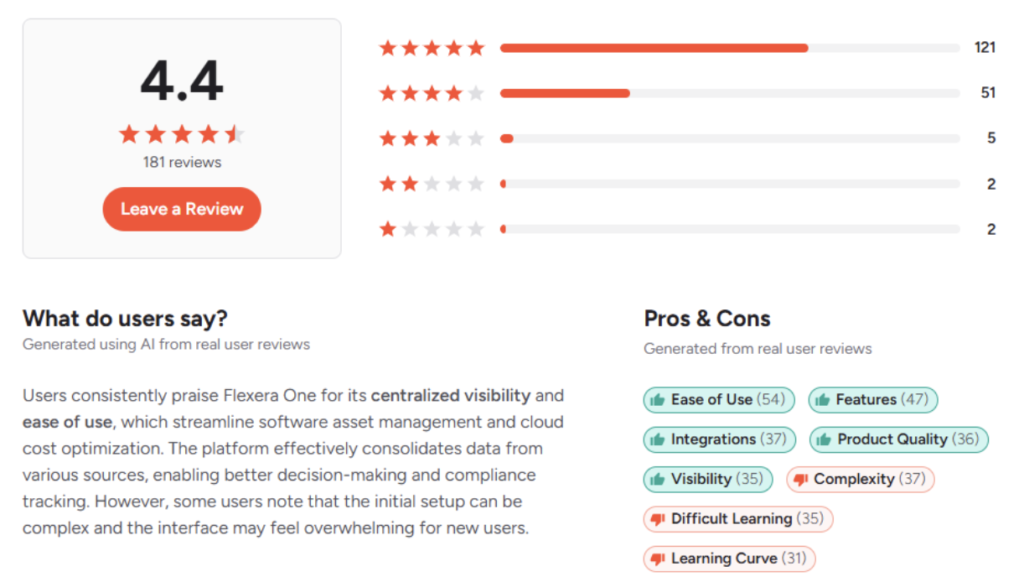
These sources cover different, partly overlapping product scopes, so their ratings do not measure one identical Flexera configuration.
What customers praise
The most consistent positives are:
- consolidated visibility across cloud and hybrid environments;
- cost allocation and reporting across teams or business units;
- governance and optimization insights;
- data normalization and integration with enterprise systems;
- support during implementation and ongoing operation; and
- less dependence on disconnected billing, asset, and licensing systems.
That evidence supports Flexera’s value as an enterprise system of financial and technology insight. It does not prove that every module is equally easy to deploy or that reported savings will transfer to another environment.
Where customers see friction
Broader Flexera One reviews repeatedly mention complex configuration and a substantial learning curve. FinOps-specific Gartner feedback identifies difficult navigation and slow loading or report generation in CloudCheckr.
One Cloud Cost Optimization review points to development effort required for business-specific needs.
The practical conclusion is not that Flexera is unusually difficult in every deployment. It is that buyers should treat data design, implementation capacity, and user adoption as part of the product decision rather than post-purchase details.
What Are You Actually Buying?
Flexera’s FinOps portfolio is broader than a single cloud-cost dashboard. Flexera One FinOps is the broader FinOps solution portfolio within the Flexera One platform. It connects cloud financial management with Flexera’s wider ITAM and SaaS platform.
Within and around that portfolio:
- Cloud Cost Optimization handles billing ingestion, allocation, reporting, recommendations, budgets, and policy-based governance.
- Cloud Commitment Management uses ProsperOps for autonomous rate and commitment optimization.
- Container Optimization uses Ocean for Kubernetes infrastructure optimization.
- Virtual Machine Optimization uses Elastigroup for VM and spot-capacity management.
- Data Cloud Optimization, formerly Chaos Genius, covers Snowflake and Databricks cost and workload analysis.
- ITAM, SaaS management, and cloud license management extend the view beyond infrastructure consumption.
These boundaries matter. Flexera acquired the Spot portfolio in 2025 and ProsperOps and Chaos Genius in 2026. Portfolio breadth does not establish that every capability is included in one package, uses one permission model, or requires the same onboarding.
Ask Flexera to map every required capability to the exact product, interface, integration, entitlement, and commercial line item. Otherwise, a buyer may compare the complete portfolio with a competitor’s single product while receiving a proposal for only part of that portfolio.
Visibility to Executed Savings
Flexera operates at three different levels, and buyers should evaluate them separately.
Visibility and accountability
Cloud Cost Optimization ingests cost data across major cloud providers. The wider Flexera One FinOps platform can incorporate related costs such as labor, support, and taxes and connect cloud spending with software-license information.
Billing Centers, custom dimensions, budgets, anomaly detection, and spend trends help organize costs for reporting, showback, or chargeback.
Its API surface includes billing connections, bill uploads, budgets, cost queries, custom dimensions, and recommendations. That makes Flexera useful when a standard dashboard cannot represent the organization’s allocation model.
Flexera is also rolling out FinOps Assist for natural-language reporting. Its multi-agent evolution remains a roadmap item.
Recommendations and policies
Flexera advertises more than 90 prebuilt optimization policies, with support for custom policies.
These can identify idle resources, rightsizing opportunities, unused storage, commitment opportunities, and governance exceptions. Selected policies can take remediation actions, but “automation” should not be interpreted as autonomous execution for every recommendation.
Autonomous optimization
Deeper execution comes through additional products. ProsperOps manages commitment portfolios across AWS, Azure, and Google Cloud. Ocean automates Kubernetes provisioning, bin-packing, scaling, rightsizing, and capacity selection.
Elastigroup optimizes VM and spot capacity. Data Cloud Optimization targets Snowflake and Databricks.
Flexera made Unified Autonomous Optimization generally available in 2026. It coordinates rate and workload optimization across ProsperOps and Ocean/Elastigroup.
The underlying capabilities remain distinct, so buyers should verify their packaging.
Implementation and Operating Requirements
Flexera’s guided Cloud Cost Optimization onboarding starts with connecting cloud data, configuring Billing Centers, and setting up custom tagging. Those steps determine whether reports reflect the business accurately.
A serious implementation should also establish:
- account and billing-data access;
- allocation rules and exception ownership;
- tag and custom-dimension governance;
- policy thresholds, exclusions, approvals, and rollback procedures;
- APIs, exports, and integrations with finance or IT service systems; and
- separate permissions for any product that executes infrastructure or commitment changes.
Flexera provides regional platform endpoints and APIs, role-based administration, and enterprise integration options. Security teams should still validate data residency, access scope, retention, auditability, and the permissions required by each purchased product.
Customer feedback suggests that support can be strong, including implementation assistance and post-launch support.
The larger concern is internal readiness. FinOps must define allocation logic, engineering must govern automated actions, and finance or procurement must understand how savings and commitments are calculated.
Without clear ownership, a broad platform can become an expensive reporting layer instead of an operating system for FinOps.
Does Flexera Justify Its Cost?
Flexera does not publish a complete list-price table for Flexera One FinOps. Gartner describes Cloud Cost Optimization as subscription-based, with pricing potentially influenced by cloud accounts, spend under management, modules, and advanced features. The final proposal remains the source of truth.
There is also a newer model to understand. In 2026, Flexera announced ProsperOps+ outcome-based pricing, bundling ProsperOps with selected Flexera optimization products.
Flexera says it charges a portion of savings generated through autonomous rate optimization or costs avoided through autonomous usage optimization. It does not publish a universal percentage on that announcement, and this model should not be assumed to apply to every Flexera contract.
The correct economic test is:
Net-value calculation:
Separate savings identified from savings executed. Also separate Flexera-attributable savings from improvements the internal team would have achieved using native tools or existing commitments.
Before signing, procurement should confirm:
- included products and modules;
- the pricing basis and minimum term;
- implementation and professional-services fees;
- support level and renewal treatment;
- the baseline used to attribute savings;
- treatment of existing commitments and negotiated discounts;
- data export and access after termination; and
- who manages commitments or automated workflows when the relationship ends.
Flexera can justify a higher total cost when it replaces several fragmented processes. It is harder to justify when the buyer only needs one narrow capability.
Who Should Choose Flexera?
Flexera is a strong fit if you:
- operate a large multi-cloud or hybrid estate;
- need allocation across many accounts, teams, customers, or business units;
- want to connect FinOps with ITAM, SaaS, or software licensing;
- require policy-driven governance and enterprise reporting;
- run an MSP or multi-tenant billing model; or
- can use several parts of the optimization portfolio.
Look more closely at alternatives if you have a small or primarily single-cloud environment, need only basic visibility, already operate mature native-cloud reporting, or want one specialist optimization outcome with simpler administration.
| If your priority is | Model to investigate |
|---|---|
| Broad FinOps, ITAM, SaaS, and hybrid governance | Flexera |
| Reporting within one cloud | Native cloud tools |
| Specialist commitment automation | A commitment-management platform |
| Kubernetes-only optimization | A container-focused platform |
| Commitment optimization with cashback protection | Usage.ai |
At Usage.ai, we focus more on commitment optimization across AWS, Azure, and Google Cloud through our Flex Insured Commitment Program.
Teams can use Autopilot for automated management or Copilot for recommendation-led control.For eligible Flex Commitments that cost more than equivalent On-Demand usage, we provide cashback protection subject to program terms.
We are not a like-for-like replacement for Flexera’s complete ITAM, SaaS, container, data-cloud, and governance portfolio.
The best comparison method
Give each vendor the same:
- billing history;
- account structure;
- allocation requirements;
- existing commitments;
- growth assumptions; and
- downside scenario.
Then compare net savings, executed actions, governance, implementation effort, fees, and exit treatment. A portfolio demo or headline savings percentage cannot answer those questions.
Verdict: Is Flexera Worth It?
Yes, for the right organization.
Flexera is worth serious consideration when a complex enterprise will use its multi-cloud visibility, allocation, governance, ITAM connections, and broader optimization portfolio. Customer evidence supports its reporting depth, enterprise visibility, and support.
The caveats are material. Buyers must account for implementation effort, UX and performance concerns, pricing opacity, and the boundaries between Flexera’s products. Smaller teams or buyers seeking one narrow outcome may pay for breadth they do not use.
The decision should rest on the exact modules in the proposal, the automation available in that configuration, and the net value demonstrated with your own data.
Review your current cloud spend, commitment coverage, and potential savings across AWS, Azure, and GCP before choosing a platform.
Frequently asked questions
Is Flexera worth it in 2026?
Flexera is worth considering for large, complex organizations that need multi-cloud allocation, governance, reporting, and connections across FinOps, ITAM, SaaS, or software licensing. It may be excessive for smaller or narrowly focused environments.
What do Flexera customers say?
Feedback is generally positive around visibility, reporting, governance, data normalization, and support. Recurring criticisms include configuration complexity, learning curve, navigation, report performance, and customization effort.
How much does Flexera cost?
Flexera does not publish a complete Flexera One FinOps rate card. Pricing depends on the applicable proposal, products, scale, and commercial model. Some ProsperOps+ offerings use outcome-based pricing.
Is Flexera the same as ProsperOps?
No. Flexera acquired ProsperOps in 2026. ProsperOps continues as a Flexera company focused on autonomous commitment and rate optimization, while Flexera One FinOps covers a broader set of financial management and optimization use cases.
Who is Flexera best for?
Flexera is best suited to enterprises and MSPs that can use its breadth across multi-cloud financial management, allocation, governance, workload optimization, ITAM, and SaaS. Buyers needing only one specialist capability should compare narrower alternatives.
If you notice any material information that is incorrect, outdated, or no longer applicable, please contact us at [email protected]. We’ll review the information and update the article where appropriate.