.png)
 AWS
AWS Microsoft Azure
 Google Cloud

The harder question is who carries the financial risk when usage changes.
That distinction matters because two platforms can both promise cloud savings while using materially different models for purchasing, managing, and protecting commitments.
North and Usage.ai both address the financial risk associated with cloud commitments, but they structure that risk differently. North offers Flexbot, which uses North-owned commitments, and Autobot, which builds customer-owned commitment coverage.
Usage.ai offers Flex Commitments, automated commitment management, and a defined Non-Usage Rebate mechanism for eligible underutilization.
The products can look similar at a high level. The underlying risk models are not.
This comparison focuses on the questions that matter to FinOps, engineering, finance, and procurement teams:
- Who owns the commitment?
- Who absorbs underutilization?
- How does protection work?
- What does cancellation actually mean?
- What happens to commitments when a customer leaves?
- How does each platform charge for the service?
North vs. Usage.ai at a glance
| Risk Question | North | Usage.ai |
|---|---|---|
| Commitment model | ! Flexbot + Autobot | ✓ Flex Commitments |
| Underutilization protection | ! Program-dependent | ✓ Non-Usage Rebates |
| Commitment ownership | ! Model-dependent | ! Program-dependent |
| Cancellation | ! Notice required* | ✓ Termination allowed |
| Protection after exit | ! Program-dependent | × Ends at termination |
| Pricing | ! Platform + program fees | ! Savings percentage |
| Cloud coverage | ✓ AWS, Azure, GCP | ✓ AWS, Azure, GCP |
| Primary distinction | ! Multiple ownership models | ✓ Protected commitments |
To learn about the actual risk, you have to follow the commitment from purchase through underutilization and, finally, exit.
North separates commitment ownership into Flexbot and Autobot
North’s current Coverage offering provides two materially different commitment strategies.With Flexbot, customers get access to discounted commitments through North-owned member accounts. North positions Flexbot as giving customers access to discounted commitment economics while North retains ownership of the underlying commitments.
Its Coverage documentation says Flexbot provides coverage that adjusts as usage changes and specifically describes the commitments as North-owned.
With Autobot, the model is different. North describes Autobot as building self-owned coverage over time, with the system making purchasing decisions according to the customer’s objectives.
That distinction is important because commitment ownership determines where the residual financial exposure sits.
A customer-owned commitment remains the customer’s obligation even if the underlying workload changes.
A vendor-owned commitment changes that structure because the vendor assumes ownership of the commitment and provides the customer access to its discounted economics.
North therefore gives customers two fundamentally different models:
- Flexbot: North-owned commitment exposure.
- Autobot: customer-owned commitment exposure with automated purchasing.
Also read: Usage.ai vs ProsperOps: Which Cloud Commitment Platform Fits Your Risk Model?
Usage.ai combines managed commitments with defined protection
Usage.ai takes a different approach through its Flex Commitment Program, combining automated commitment management with a defined Non-Usage Rebate mechanism for qualifying underutilization.Under the Flex Commitment Program, qualifying unused Flex-eligible cloud-resource capacity may receive a Non-Usage Rebate. The program terms define how qualifying underutilization is calculated by reference to the applicable Flex Commitment cost and the equivalent usage cost at the cloud provider’s then-current on-demand rate. Learn how Cashback works.
The program has defined eligibility requirements. For example, the cloud resource must be purchased directly from Usage.ai, designated as Flex-eligible at purchase.
The terms also define circumstances that can affect eligibility, including certain reductions in usage or underutilization resulting from cloud resources that were not purchased directly from Usage.ai.
For buyers comparing commitment-management models, the relevant question is how the program terms define eligibility, exclusions, rebate calculation, and payment.
Customers can evaluate not only how commitments are purchased and managed, but also the eligibility rules and rebate mechanism that apply if an eligible commitment becomes underutilized.
What happens when usage falls
The traditional commitment problem is straightforward.Suppose a company commits to $100 of cloud usage per hour but later only needs $70. The customer has effectively created $30 of economic exposure.
A commitment-management platform can reduce the probability of that outcome through better forecasting, sizing, laddering, and rebalancing.
But forecasting cannot eliminate uncertainty. So, what happens after the forecast is wrong?
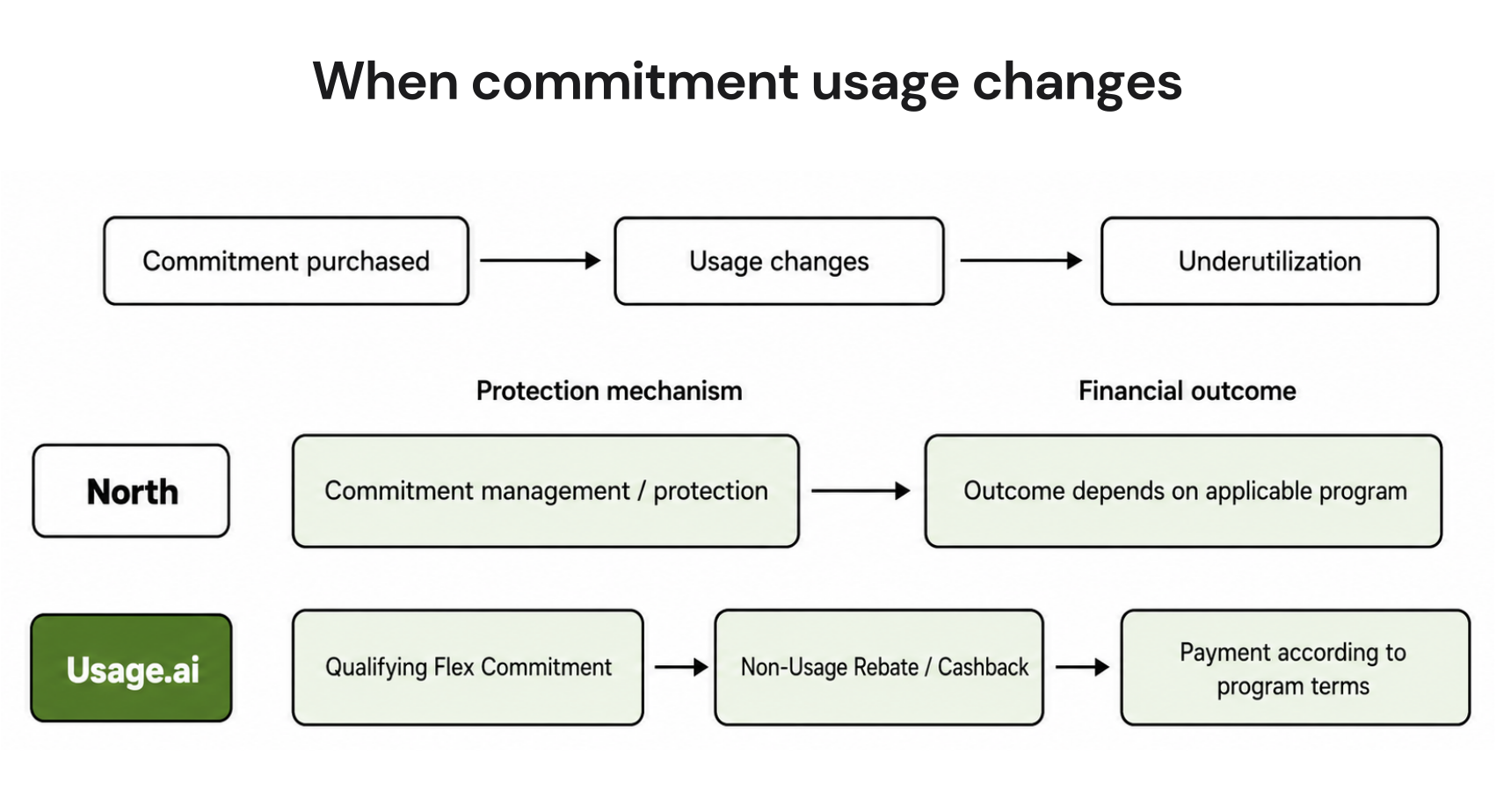
North addresses that through its combination of commitment management and, for eligible commitments, protection mechanisms. North’s documentation describes Flexbot as coverage that adjusts as usage changes and says North owns the commitments used for Flexbot.
Usage.ai addresses the same problem through our Flex Commitment Program. At the end of each month, we calculate qualifying losses associated with eligible Flex Commitments under the program terms.
Qualifying Non-Usage Rebates are accrued and paid according to the program’s stated payment schedule.
The distinction is therefore not whether either platform attempts to reduce commitment risk. Both do.
What happens when the customer cancels?
This is one of the most important differences for a buyer to investigate.North’s Service Cancellation documentation says North’s service can be canceled at any time. It also states that Savings Plans or Reserved Instances can be disconnected from the customer’s billing organization and transitioned to another North customer.
However, North also specifies notice requirements for full-account cancellations.
According to the published policy, North’s MSA requires:
- 30 days’ notice for accounts with up to $10,000 per month in reservations under management.
- Up to 120 days’ notice when reservations under management exceed $10,000 per month.
The second half requires looking at the specific commitment program.
North’s GCP CUD documentation provides an especially clear example. It states that for CUDs managed by North, commitments leave the organization according to the handoff windows in the MSA.
For insured-by-North commitments, the documentation says that during service cancellation, the customer agrees to release North from remaining payback obligations and takes over the full commitment.
That is a material risk-model consideration. It means that the buyer should not evaluate North’s protection solely by asking whether the commitment is “insured.”
The buyer should also ask: What happens to that protection when the North relationship ends?
Also read: Usage.ai vs nOps: Which Cloud Commitment Platform Fits Your Risk?
Usage.ai’s Flex Program also has defined termination rules
Usage.ai defines the Flex Commitment Program’s termination terms directly in our Flex Commitment Program Terms.If a customer terminates their Usage.ai agreement, participation in the Flex Commitment Program ends, along with eligibility for future Non-Usage Rebates. The terms also specify that rebates are not available for underutilization that occurred during the term once the agreement has been terminated.
This gives customers a clear understanding of where Flex Commitment protection begins and ends. Our program terms explicitly define:
- eligible Flex Commitments
- eligibility and disqualifying conditions
- how Non-Usage Rebates are calculated
- when qualifying rebates are provided
- what happens when the agreement ends
Cashback mechanics matter more than protection
The term cashback only matters if buyers understand how the underlying protection works. Usage.ai documents the calculation and payment mechanics in our Cashback guide.At the end of each month, we calculate qualifying losses associated with eligible Flex Commitments under the program terms. Where the applicable conditions are satisfied, the resulting Non-Usage Rebate is accrued and paid 90 days after it accrues, with payment made by bank wire.
Our Flex Commitment Program Terms also specify how the rebate is applied. The applicable rebate is first credited against eligible Fees owed to UsageAI. Any remaining amount is then refunded to the customer.
This level of detail is important when evaluating commitment protection. We believe buyers should be able to understand exactly what their protection covers and how it works before purchasing a commitment.
When comparing providers, look beyond the headline claim and ask:
What constitutes a qualifying loss?
Which commitments are eligible?
What exclusions apply?
How is the qualifying loss calculated?
When is the customer paid?
Is the benefit provided as cash, account credit, or both?
What happens to protection if the customer terminates the agreement?
Pricing models are materially different
North and Usage.ai also use different commercial structures. North’s current pricing page lists a free plan and paid plans.The Startup plan is listed at $199 per month, with a 3.5% Autobot fee and 25% Flexbot fee. The Premier plan is listed at $1,399 per month, with 1.5% Autobot and 20% Flexbot fees. Premier Plus uses custom pricing.
North’s pricing page also says Startup and Premier are month-to-month, while Premier Plus has a one-year term.
Usage.ai’s pricing model is different. We offer a performance-based model in which we charge a percentage of net realized savings generated through the Flex Commitment Program. Billing occurs monthly in arrears after cloud-provider billing data is finalized.
Moreover, there is no platform fee and we charge a percentage of realized cloud savings across AWS, Azure, and GCP.
So the commercial comparison is straightforward:
- North: platform subscription plus applicable Autobot/Flexbot fees.
- Usage.ai: percentage of net realized savings.
Both platforms automate commitments, but the operating model differs
Automation is not the differentiator by itself. Both platforms automate significant parts of commitment management.North’s Coverage product describes Autobot as automatically making commitment purchasing decisions based on business goals, while Flexbot provides North-owned coverage that can adjust as usage changes.
Usage.ai similarly automates commitment purchasing and management. Our platform can purchase and manage commitments across AWS, GCP, and Azure, while customers retain visibility into the resulting savings.
The more important question is what the automation is allowed to do and who carries the financial consequence of the decision.
That creates two different risk models:
Customer-owned commitment automation
The customer owns the commitment. The platform optimizes the purchase. The customer retains the underlying financial exposure.Protected managed automation
The platform manages the commitment and provides a defined protection mechanism for qualifying downside. The customer still needs to understand the protection’s eligibility and termination conditions.This distinction is much more useful than comparing the number of automated features.
Also read: Usage.ai vs Archera: Which Cloud Commitment Platform Delivers Better Value?
The five questions that determine commitment risk
Ask five questions before signing.1. Who owns the commitment?
- North: Flexbot uses North-owned commitments, while Autobot builds coverage using customer-owned commitments.
- Usage.ai: Flex Commitments are purchased through cloud-provider APIs and managed through the Usage.ai program, subject to the applicable program terms.
- Check: Confirm who owns or controls the commitment, who remains financially responsible for it, and what happens to it when the relationship ends.
2. What happens when usage falls?
- North: Provides commitment management and protection mechanisms for eligible commitments.
- Usage.ai: The Flex Commitment Program provides a defined Non-Usage Rebate for qualifying underutilization.
- Check: Review the definition of a loss, eligibility requirements, exclusions, calculation method, and payment process.
3. What happens when you exit?
- North: Its cancellation documentation addresses notice requirements and the treatment or transfer of commitments during cancellation.
- Usage.ai: Flex Commitment Program eligibility and Non-Usage Rebates end when the Usage.ai agreement terminates.
- Check: Determine what happens to active commitments, unused capacity, pending protection claims, and accrued benefits after termination.
4. What do you actually pay?
- North: Costs can include platform and commitment-related fees, depending on the service and commitment model.
- Usage.ai: Fees are based on the applicable pricing arrangement, including savings-based pricing where applicable.
- Check: Compare total net savings, including platform fees, commitment costs, protection economics, and any other applicable charges.
5. What exactly is contractually protected?
Don’t compare headlines such as “insurance” and “cashback.” Compare the documents behind them.Check:
Eligible commitments
Definition of a qualifying loss
Exclusions and disqualifying events
Loss/rebate calculation
Payment timing and method
Treatment of outstanding fees
Termination provisions
Customer obligations
Which platform is the better fit?
Choose Usage.ai when
- You want automated cloud commitment optimization with the option to retain approval over selected commitment decisions.
- Commitment underutilization is a material concern and you want a defined financial protection mechanism alongside optimization.
- You want to evaluate Cashback as part of the economics of an eligible Flex Commitment.
- You want performance-based pricing, with fees tied to net realized savings rather than a traditional platform subscription.
- You want commitment optimization, ongoing management, and downside protection considered within the same economic model.
Choose North when
- You want a broader FinOps platform that combines cloud visibility, rightsizing, commitment optimization, and AI-assisted workflows.
- You want flexibility between North-managed commitments and customer-owned commitments through its Flexbot and Autobot models.
- You prefer a commitment strategy that can vary based on who owns and manages the underlying commitment.
- North’s commercial terms, commitment model, cancellation provisions, and protection mechanisms provide the savings, risk allocation, and exit economics your organization requires.
The meaningful difference is how that uncertainty is allocated: who owns the commitment, who carries the financial exposure when usage falls, and what happens when the customer exits.
See how Usage.ai combines savings with commitment protection.
Frequently asked questions
What is the difference between Usage.ai and North?
North provides a broader FinOps platform with commitment optimization, cloud cost management, rightsizing, and different commitment models through Flexbot and Autobot. Usage.ai focuses more specifically on automated commitment optimization combined with performance-based pricing and a defined Non-Usage Rebate mechanism for eligible Flex Commitments.
Who owns the cloud commitments with North?
It depends on the North product. Flexbot uses North-owned commitments, while Autobot builds customer-owned commitment coverage. Buyers should therefore evaluate ownership and financial responsibility based on the specific North model they select.
Does Usage.ai protect against unused cloud commitments?
Eligible Flex Commitments can qualify for a Non-Usage Rebate under the Usage.ai Flex Commitment Program. The program has specific eligibility requirements, exclusions, calculation rules, and payment terms, so the protection should not be treated as an unconditional guarantee.
What happens to Usage.ai Cashback if the customer terminates the agreement?
Under the Flex Commitment Program terms, participation and eligibility for Non-Usage Rebates end when the Usage.ai agreement terminates. Customers should review the applicable program terms to understand the treatment of commitments and rebates before terminating the agreement.
How does Usage.ai pricing compare with North?
North combines platform plans with applicable commitment-related fees depending on the selected product and plan. Usage.ai's Flex Commitment Program uses a performance-based model tied to net realized savings. The most useful comparison is therefore total effective cost, rather than simply comparing headline percentages.