
 AWS
 Microsoft Azure
 Google Cloud

Gemini model pricing on Vertex AI
The following table compares Global endpoint prices in USD per million input, cached-input, and output tokens.Gemini 4 rates marked with an asterisk are effective promotional prices after qualifying credits, rather than the pre-credit usage rates.
| Gemini model | Input | Cached input | Output |
|---|---|---|---|
| Gemini 3.1 Flash-Lite | $0.25 | $0.025 | $1.50 |
| Gemini 3.5 Flash-Lite | $0.30 | $0.03 | $2.50 |
| Gemini 3.8 Flash* | $0.75 | $0.075 | $3.75 |
| Gemini 3.5 Flash | $1.50 | $0.15 | $9.00 |
| Gemini 3.1 Pro Preview, up to 200K input tokens | $2.00 | $0.20 | $12.00 |
| Gemini 4 Argon* | $1.00 | $0.05 | $5.00 |
| Gemini 4 Carbon* | $1.00 | $0.05 | $5.00 |
Prices are for the specified Global endpoint and Standard usage unless marked as promotional effective rates. Cached-input rates apply where supported; explicit cache storage may incur separate charges.
Legacy Gemini 2.5 pricing
The following models were retired from Gemini Enterprise Agent Platform on October 20, 2026. Their prices are retained only as historical references, not as recommendations for new deployments.| Retired model | Input | Cached input | Output |
|---|---|---|---|
| Gemini 2.5 Flash-Lite | $0.10 | $0.01 | $0.40 |
| Gemini 2.5 Flash | $0.30 | $0.03 | $2.50 |
| Gemini 2.5 Pro, up to 200K input tokens | $1.25 | $0.125 | $10.00 |
Important rate conditions:
Gemini 4 promotions: Through November 30, 2026, Google lists underlying Global Standard rates of $2 input, $0.10 cached input, and $10 output per million tokens for Argon and Carbon, with qualifying promotional credits that produce effective rates of $1, $0.05, and $5. Promotional credits may appear separately from usage charges. From December 1, 2026, the listed non-promotional Standard rates are $4 input, $0.20 cached input, and $20 output.
Gemini 3.8 Flash: Promotional effective rates apply through December 31, 2026. From January 1, 2027, listed Global rates become $1.50 input and $7.50 output per million tokens.
Long context: Gemini 3.1 Pro Preview requests exceeding 200K input tokens use $4 input, $0.40 cached input, and $18 output per million tokens. The higher tier applies to the entire qualifying request.
Regional pricing: Supported non-global Gemini endpoints may cost more than Global.
Multimodal usage: Audio, image, and video inputs can have different rates or token-counting rules.
Embeddings, image, video and partner-model pricing
Vertex AI is not limited to Gemini text generation. Google’s Model Garden includes models for embeddings, multimedia generation, and partner-hosted inference.| Model or service | Example price | Billing unit |
|---|---|---|
| Gemini Embedding 2 (Preview), online text input | $0.20 | Per 1M input tokens |
| Gemini Embedding 2 (Preview), batch text input | $0.10 | Per 1M input tokens |
| Imagen 4 Fast | $0.02 | Per generated image |
| Imagen 4 | $0.04 | Per generated image |
| Imagen 4 Ultra | $0.06 | Per generated image |
| Veo 3.1 Lite, 720p without audio | $0.03 | Per generated video second |
| Veo 3.1 Lite, 720p with audio | $0.05 | Per generated video second |
Embeddings convert content into numerical representations for semantic search and retrieval. Video-generation costs depend on output length, resolution, and audio generation.
Partner models such as Anthropic Claude and open models such as Llama use different billing structures from Gemini. Check the applicable partner-model pricing for managed API token, cache, and batch charges, or estimate CPU, GPU, and serving infrastructure separately for self-deployed models.
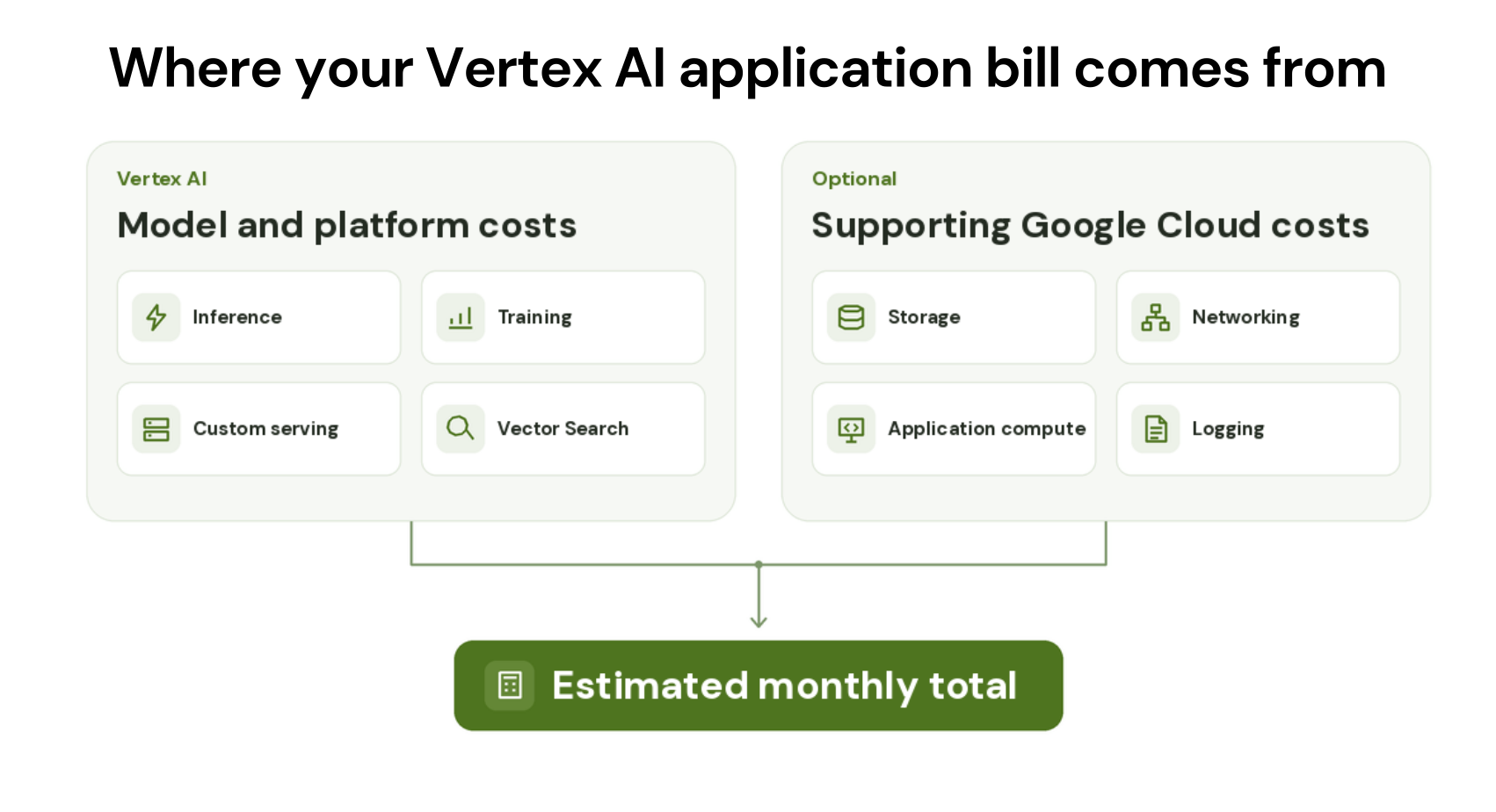
How does Vertex AI pricing work beyond models?
Gemini API inference is primarily usage-based, but other Vertex AI services may be billed by runtime, storage, or requests.| Component | How pricing works | Example |
|---|---|---|
| Model inference | Input/output tokens or generation units | Depends on model |
| Custom training | Compute and accelerator usage | AutoML image classification: $3.465/hour |
| Custom endpoint deployment | Running compute | AutoML image classification: $1.375/hour |
| GPU/CPU serving | Machine resources and runtime | Depends on configuration and region |
| Vector Search | Index building, updating, serving | $3/GiB processed for index building |
| Supporting Cloud Storage | Stored capacity and operations | Iowa Standard: approximately $0.02/GiB-month |
| Supporting networking | Transfer route, tier, destination | Service-specific |
Cloud Storage and networking are separate Google Cloud services, not automatic charges for every Vertex AI request.
Vertex AI pricing examples: Three monthly workloads
Example 1: AI chatbot with 100,000 requests
Assume an application uses Gemini 3.5 Flash-Lite with:100,000 requests monthly
1,500 billable input tokens per request
500 billable output tokens per request
No caching or extra tools
These comparisons do not establish equivalent model performance.
Example 2: Document processing with batch inference
Assume 20,000 documents are processed monthly using Gemini 3.5 Flash-Lite.Each document requires 4,000 input and 500 output tokens.
Monthly totals are 80 million input and 10 million output tokens.
Standard inference:
Batch processing is appropriate for supported asynchronous workloads where immediate responses are unnecessary.
This estimate excludes document preparation, OCR, storage, and orchestration.
Example 3: Production AI chatbot with retrieval
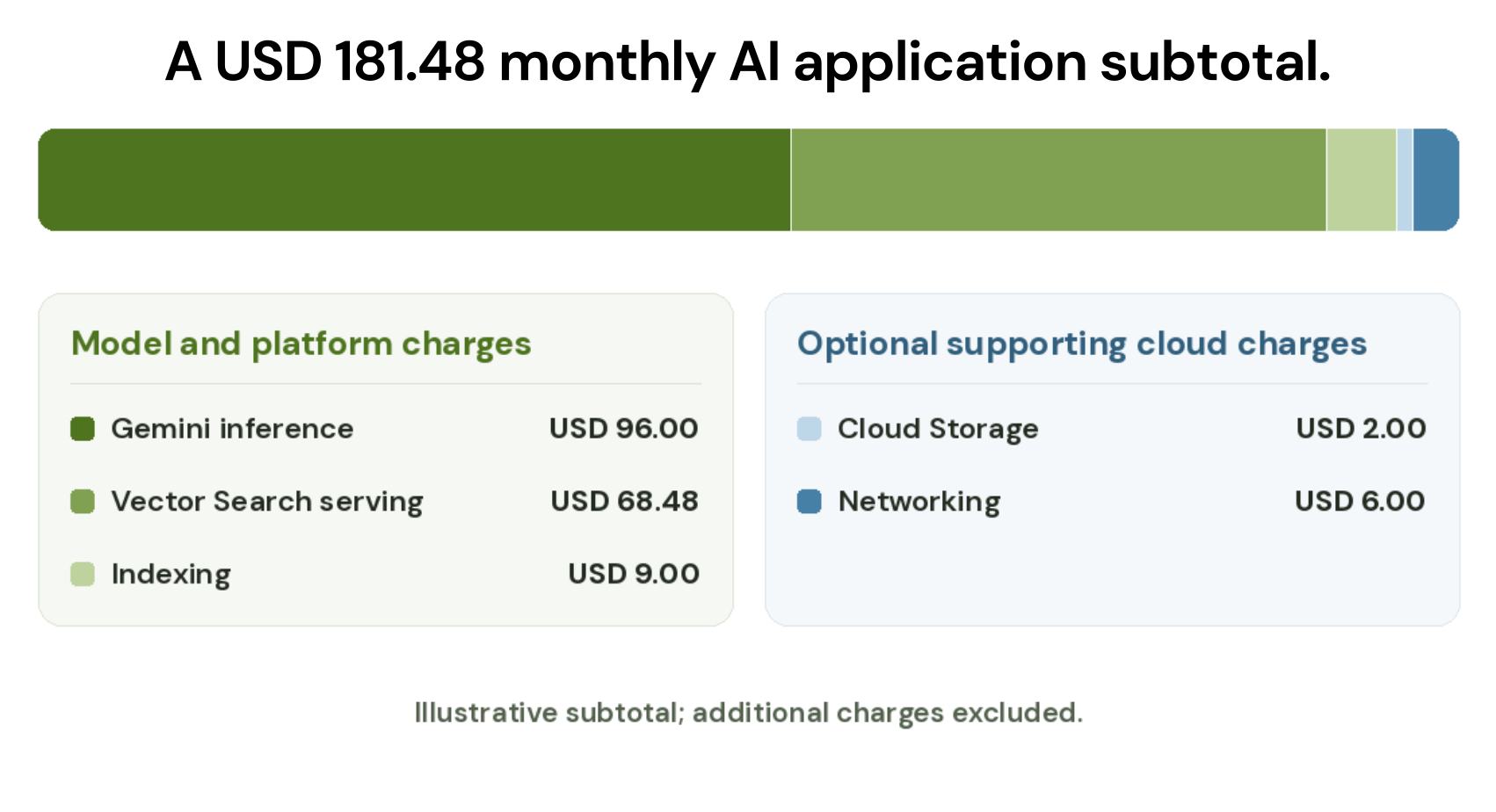
Consider a retrieval-augmented generation (RAG) application using Gemini 3.5 Flash-Lite, an original Vector Search index, and supporting cloud infrastructure in Iowa.Assume 60,000 requests per month, averaging 2,000 input and 400 output tokens each.
| Cost component | Monthly calculation | Estimated cost |
|---|---|---|
| Gemini inference | 120M input + 24M output tokens | $96.00 |
| Vector Search serving | One e2-standard-2 node × 730 hours | $68.48 |
| Vector Search indexing | One 3-GiB index build × $3/GiB | $9.00 |
| Cloud Storage | 100 GiB Standard in Iowa | $2.00 |
| Network transfer | 50 paid GiB × $0.12/GiB after an assumed 1-GiB allowance | $6.00 |
| Illustrative subtotal | $181.48 |
Excluded from this subtotal: Embedding generation, model tool calls, application CPU/GPU hosting, logging, storage operations, extra serving replicas, and taxes.
This is an illustrative subtotal, not a complete production quote.
Standard PayGo vs. Batch, Flex, Priority and Provisioned Throughput
Vertex AI offers different consumption arrangements depending on traffic patterns, capacity requirements, and latency.| Option | Billing approach | When to consider it |
|---|---|---|
| Standard PayGo | Standard model usage rates | Variable interactive workloads |
| Priority PayGo | Higher model-specific rates | Requests needing priority processing |
| Flex PayGo | Discounted eligible usage with latency/availability trade-offs | Latency-tolerant online requests |
| Batch | Discounted asynchronous inference | Offline document or data-processing jobs |
| Provisioned Throughput | Committed capacity measured in GSUs | Predictable traffic needing reserved throughput |
How much does Provisioned Throughput cost?
Google prices Provisioned Throughput using Generative AI Scale Units (GSUs).| Commitment term | Global price per GSU-hour |
|---|---|
| 1 week | $7.14 |
| 1 month | Approximately $3.70 |
| 3 months | Approximately $3.29 |
| 1 year | Approximately $2.74 |
The total commitment depends on how many GSUs the selected model requires.
When does Provisioned Throughput make financial sense?
It deserves evaluation when a production application has sustained demand, predictable peaks, and a business requirement for reserved throughput.However, there is no universal request-volume threshold where Provisioned Throughput becomes cheaper than PayGo.
To evaluate it:
Measure peak requests per second and input/output token volumes.
Convert usage into model-specific throughput using Google's burndown rates.
Estimate required GSUs and commitment costs.
Compare with Standard PayGo expenses, utilization, and expected excess usage.
Is Vertex AI free? Google Cloud credits and free-tier rules
Vertex AI is not universally free. Google offers trial credits and selected free products, but eligibility varies.New eligible Google Cloud customers receive $300 in trial credits valid for 90 days for covered Google Cloud services.
However, Google’s published terms specify that accounts signing up for a trial or upgrading to paid status on or after November 16, 2026, cannot use the $300 credit to pay for Gemini platform services, formerly including Vertex AI.
The credits also do not pay for Gemini Developer API costs or third-party generative AI models offered as managed APIs.
For developers experimenting with supported Gemini models, the Gemini Developer API free tier through Google AI Studio provides limited free input and output usage.
It is not unlimited, and model eligibility and rate limits vary.
Google Cloud Free Trial terms and Gemini Developer API pricing. Checked November 11, 2026. Confirm effective dates and account eligibility before relying on credits.
Vertex AI vs. Gemini Developer API pricing
Both provide access to Gemini models, but billing, limits, and infrastructure capabilities differ.| Factor | Vertex AI / Google Cloud Agent Platform | Gemini Developer API / AI Studio |
|---|---|---|
| Primary use | Enterprise AI applications and cloud integration | Experimentation and API-based development |
| Free usage | Eligible Google Cloud trial and product-specific allowances, with restrictions | Free tier for supported models within limits |
| Model pricing | Google Cloud model and service-specific rates | Separate Developer API pricing |
| Rate limits | Model, region, project, and quota dependent | Model, project, and usage-tier dependent |
| Enterprise controls | Google Cloud IAM, project governance, billing, and supported regional controls | Developer API controls; enterprise offerings available separately |
| Additional costs | Custom training, endpoints, retrieval, and supporting cloud services where used | API usage and separately billed supported features |
Neither option is universally cheaper.
Compare the same model and usage pattern, then check free allowances, request limits, caching, throughput, and infrastructure requirements.
The Developer API may be convenient for initial experimentation, while Vertex AI provides additional Google Cloud integration and enterprise deployment options.
Training, GPU/CPU, storage and networking charges
These costs depend on your application architecture and should not automatically be added to managed Gemini token pricing.Training and endpoints: Google’s AutoML image classification pricing lists $3.465 per training hour and $1.375 per deployment/online prediction hour for the specified configuration. Custom endpoints can incur running charges even without requests.
GPU/CPU: For applicable G2 configurations in Iowa, Google lists standard component rates of $0.02874/vCPU-hour, $0.00337/GiB RAM-hour, and $0.64405/NVIDIA L4 GPU-hour. These are component rates, not a complete machine price.
Storage: Iowa Standard Cloud Storage costs approximately $0.02/GiB-month, excluding operations and transfers.
Networking: Internet egress depends on destination, network tier, and applicable allowances. Cross-region data transfers can have separate charges.
How to estimate and reduce Vertex AI costs
For token-based inference, start with:Before forecasting, measure five inputs from application telemetry and Google Cloud billing data: request volume, billable input tokens, output and reasoning tokens, eligible cached-input volume, and the model and endpoint mix.
Use these observed values, not only prompt estimates, to identify which billing component caused a cost change.
Choose optimization methods based on workload behavior:
Frequent, simple requests: Benchmark lower-cost models against acceptable response quality.
Repeated long prompts: Evaluate context caching and storage fees.
Non-urgent processing: Compare Batch or Flex pricing where supported.
Predictable high traffic: Evaluate Provisioned Throughput and GSU utilization.
Custom serving infrastructure: Monitor idle endpoints, GPU hours, and retrieval replicas.
Unexpected monthly increases: Investigate token usage, grounding, networking, and storage changes.
For broader spending controls, explore our Google Cloud cost management guide
How we help manage eligible Google Cloud commitments
Vertex AI applications can depend on supporting cloud infrastructure beyond model inference. Managing eligible Google Cloud commitments can help optimize those supporting workloads.At Usage.ai, we analyze your usage and existing commitments, then manage eligible CUD purchases directly in your Google Cloud billing account across services including Compute Engine, GKE, Cloud SQL, and BigQuery.Explore our GCP commitment management.
You can approve purchases through CoPilot or use Autopilot within authorized controls. Our Flex Insured Commitments provide conditional Cashback protection when eligible Flex Commitment costs exceed equivalent On-Demand usage, subject to program eligibility and your agreement.
We charge an agreed share of realized savings. These capabilities do not directly reduce Gemini token prices.
Want to understand how we can help manage eligible Google Cloud commitments alongside your Vertex AI workloads? We can review your existing coverage, identify potential savings opportunities, and explain our approach.
Optimize eligible GCP AI commitments with reduced long-term risk and conditional cashback protection, subject to terms.
Frequently asked questions
How much does Vertex AI cost per month?
There is no universal monthly price. Gemini inference depends on model rates and billable tokens. Custom serving, training, embeddings, retrieval, storage, and networking may add separate charges.
Is Vertex AI free for new users?
Google offers eligible new customers $300 in trial credits for 90 days, but service restrictions apply, including the November 16, 2026 Gemini platform credit restriction. The Gemini Developer API has a separate limited free tier for supported models.
Does Vertex AI support Claude and Llama?
Yes. Google Cloud Model Garden includes partner and open models. Managed partner-model API prices and self-deployed infrastructure costs differ from Gemini's pricing.
Is Batch inference always cheaper?
Not always. Eligible models may offer discounted Batch rates, but processing requirements, feature availability, and effective pricing vary. Check the selected model's official pricing page.
Does Vertex AI charge for idle endpoints?
Applicable deployed custom models and retrieval-serving infrastructure can incur charges while running. Managed Gemini API inference follows separate usage-based billing rules.
When should I choose Provisioned Throughput?
Evaluate it when workloads have predictable demand and require reserved capacity. Calculate the model's required GSUs and compare the commitment with projected PayGo spending before purchasing.