.png)


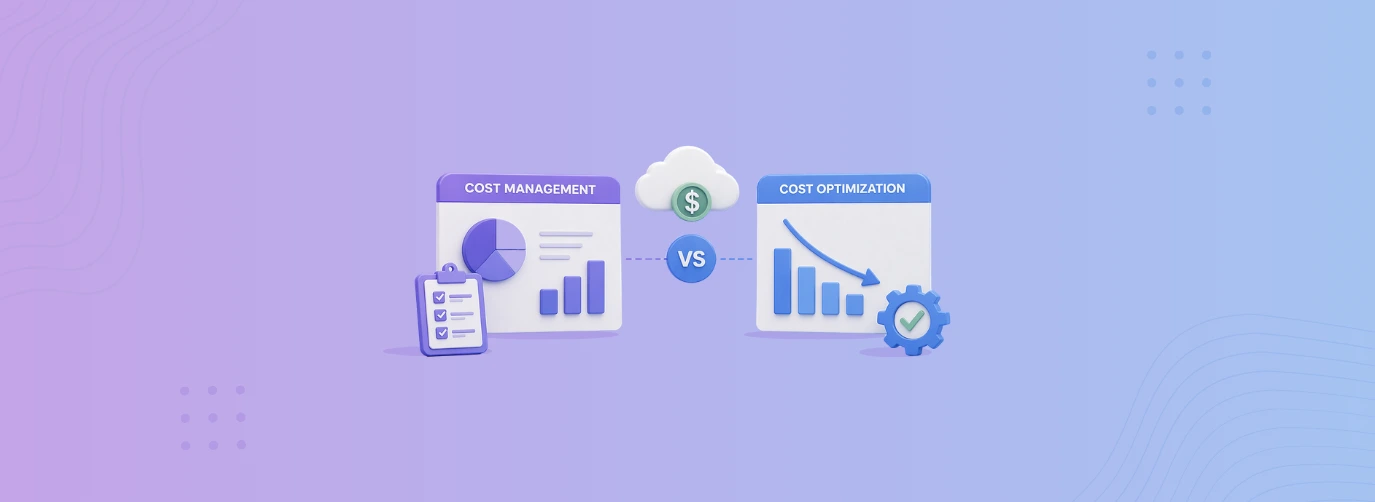
Cloud cost optimization and management are two closely related concepts in FinOps, but they serve different purposes. Cloud cost management focuses on tracking, allocating, and controlling cloud spending across teams and services. Cloud cost optimization, on the other hand, focuses on actively reducing infrastructure costs through strategies such as rightsizing resources, eliminating idle workloads, and purchasing discounted commitments.
Many organizations begin their cloud journey by implementing cost management tools that provide visibility into cloud spending. These tools help teams monitor budgets, allocate costs across departments, and understand where their cloud dollars are going. However, visibility alone does not guarantee savings. To actually reduce cloud bills, companies must move beyond monitoring and implement cloud cost optimization strategies that improve infrastructure efficiency and leverage pricing discounts from cloud providers.
One of the most effective cloud cost optimization strategies involves increasing commitment coverage through mechanisms such as Savings Plans or Reserved Instances. These discounts can significantly lower compute costs but introduce utilization risk if usage drops. Modern FinOps platforms are increasingly designed to automate this process by analyzing usage patterns, recommending commitments, and protecting organizations from underutilization through mechanisms such as cashback protection.
Cloud Cost Optimization and Management: Key Differences
Cloud cost optimization and management address different stages of controlling cloud spending. For FinOps teams, both disciplines are essential. Cost management provides the insights needed to understand where money is being spent, while optimization implements the changes required to reduce that spending.
For example, a cost management dashboard might reveal that a company spends a large portion of its cloud budget on compute resources. Optimization strategies would then determine how to reduce that spend, such as by rightsizing workloads, eliminating idle resources, or purchasing discounted commitments like Savings Plans.
One of the most significant optimization opportunities involves increasing commitment coverage for compute workloads. However, organizations often hesitate to commit because usage can change over time. Some modern platforms address this risk by automating commitment recommendations and providing cashback protection if commitments are underutilized, allowing teams to safely capture savings without taking on excessive financial risk.
What Is Cloud Cost Management?
Cloud cost management is the practice of monitoring, analyzing, and controlling cloud spending across services, teams, and environments. It focuses on giving organizations visibility into how much they spend in the cloud, where that spending occurs, and how costs are allocated across projects or departments.
In a FinOps framework, cloud cost management is the first step toward financial accountability in the cloud. Before companies can reduce cloud costs, they must understand how their infrastructure spending is distributed across workloads, teams, and services.
Core Components of Cloud Cost Management
Most cloud cost management strategies revolve around improving visibility, governance, and financial reporting.
.png)
1. Cost Visibility and Reporting
Cloud providers generate large and complex billing datasets. Cost management tools help transform this data into dashboards and reports that show:
- Total cloud spend
- Spending by service (compute, storage, databases)
- Costs by team, project, or environment
- Trends in cloud spending over time
This visibility allows FinOps teams to quickly identify which workloads or services are responsible for the majority of cloud spending.
2. Cost Allocation and Tagging
Cost allocation assigns cloud spending to specific teams, departments, or applications. Organizations typically use resource tags to track which workloads belong to which teams.
For example:
- team:payments
- environment:production
- service:api
Tagging ensures that each team can see and take responsibility for its own cloud costs, which improves financial accountability across engineering organizations.
3. Budgeting and Forecasting
Cloud cost management also includes budget controls and forecasting models that help organizations predict future cloud spending.
Common techniques include:
- Monthly cloud budgets
- Forecasting future costs based on historical usage
- Alerts when spending exceeds thresholds
These mechanisms help organizations prevent unexpected cost spikes and maintain predictable cloud spending.
4. Governance and Financial Controls
Many organizations implement governance policies to ensure cloud spending stays within acceptable limits. These policies may include:
- Spending alerts for unusual activity
- Approval processes for high-cost resources
- Usage policies for development environments
Governance helps ensure that engineering teams use cloud resources responsibly without creating unnecessary infrastructure costs.
What Cloud Cost Management Does Not Do
While cloud cost management provides essential visibility and control, it does not automatically reduce cloud bills. A cost management dashboard might show that a company spends a large portion of its budget on compute resources, but it does not automatically decide:
- whether workloads should be rightsized
- whether idle resources should be removed
- whether discounted commitments should be purchased
These actions fall under cloud cost optimization, which focuses on actively reducing infrastructure costs through operational and pricing strategies.
Because of this, many organizations eventually move beyond cost visibility tools and adopt optimization platforms that can analyze usage patterns, recommend infrastructure changes, and automate savings opportunities such as commitment purchases.
What Is Cloud Cost Optimization?
Cloud cost optimization is the process of actively reducing cloud infrastructure costs while maintaining application performance, reliability, and scalability. Unlike cloud cost management, which focuses on monitoring and controlling spending, cloud cost optimization focuses on taking actions that improve efficiency and lower the total cloud bill.
In most FinOps organizations, optimization begins after teams gain visibility into their cloud spending. Once companies understand where costs originate, they can implement strategies that reduce unnecessary usage, improve resource efficiency, and take advantage of discounted pricing models offered by cloud providers.
Also read: How Cloud Cost Optimization Actually Works
Common Cloud Cost Optimization Strategies
Organizations typically rely on several optimization techniques to improve cloud efficiency.
.png)
1. Rightsizing Infrastructure
Rightsizing involves adjusting compute resources to match actual workload requirements. Many cloud environments run instances that are larger than necessary because infrastructure is provisioned for peak usage rather than average demand.
Optimization tools analyze CPU, memory, and network usage to recommend smaller instance types or more efficient configurations, helping teams reduce over-provisioning without affecting performance.
2. Eliminating Idle or Unused Resources
Cloud environments often accumulate unused resources such as:
- Idle virtual machines
- Unattached storage volumes
- Unused load balancers
- Development environments left running overnight
Removing or scheduling these resources can significantly reduce infrastructure costs, especially in large environments with multiple teams.
3. Storage Tiering and Lifecycle Policies
Different storage tiers have different price points. For example, frequently accessed storage is more expensive than archival storage. Optimization strategies move older or infrequently accessed data to lower-cost tiers using lifecycle policies.
This approach ensures organizations pay premium storage prices only for data that actually requires high availability.
4. Auto-Scaling and Dynamic Workloads
Auto-scaling automatically adjusts infrastructure capacity based on demand. Instead of running the same number of servers at all times, the cloud platform scales resources up or down depending on traffic levels.
This helps companies avoid paying for unused compute capacity during low-demand periods.
5. Purchasing Cloud Commitments
One of the most powerful cloud cost optimization strategies involves purchasing long-term usage commitments from cloud providers.
These commitments include pricing models such as Savings Plans and Reserved Instances.
By committing to a specific level of cloud usage for a fixed term, organizations can receive significant discounts compared to on-demand pricing.
However, commitments introduce a trade-off. If a company’s infrastructure usage drops below the committed level, part of the discount may go unused. Because of this risk, many organizations hesitate to increase commitment coverage even though it represents one of the largest opportunities for cloud cost optimization.
To address this challenge, some modern optimization platforms automate commitment analysis and purchasing while reducing utilization risk. For example, automated commitment optimization systems can continuously analyze usage patterns, recommend the right commitment coverage, and provide cashback protection when commitments are underutilized, allowing companies to capture discounts without taking on excessive financial exposure.
Why Cloud Cost Management Alone Is Not Enough
While cloud cost management provides essential visibility into spending, it does not automatically reduce cloud infrastructure costs. Many organizations implement dashboards and reporting tools to monitor spending but still struggle to lower their overall cloud bills. This is because visibility alone does not translate into actionable cost reductions.
The Visibility vs Action Gap
A common challenge in FinOps is the gap between cost visibility and cost action. Organizations may have detailed billing reports that highlight expensive workloads, yet the process of fixing those inefficiencies remains manual and slow.
For example, a cost management platform may reveal that compute services represent the largest portion of a company’s cloud bill. However, the platform does not automatically determine:
- whether workloads should be rightsized
- whether idle instances should be removed
- whether discounted commitments should be purchased
Also read: The FinOps Build vs Buy Dilemma: A Practical Guide
The Risk of Underutilized Commitments
One of the biggest opportunities for reducing cloud costs comes from purchasing commitment-based discounts such as Savings Plans or Reserved Instances. These pricing models allow organizations to significantly reduce compute costs by committing to a certain level of usage over time.
However, if usage drops below the committed level, organizations may end up paying for resources they do not fully use.
Moving from Cost Visibility to Cost Optimization
For most organizations, the FinOps journey follows a clear progression:
- Cost visibility – understanding where cloud spending occurs
- Cost governance – implementing budgets and allocation policies
- Cost optimization – improving infrastructure efficiency and pricing
- Automation – continuously optimizing cloud costs at scale
Cloud cost management establishes the foundation for financial accountability, but meaningful savings typically occur only when organizations implement structured cloud cost optimization strategies. This is why modern FinOps practices increasingly combine both disciplines to achieve long-term cloud efficiency.
The Biggest Lever in Cloud Cost Optimization: Commitment Coverage
The largest cost reduction comes from pricing optimization. Cloud providers offer significant discounts when customers commit to a baseline level of compute usage through pricing models such as Savings Plans and Reserved Instances (RIs).
These commitments allow organizations to exchange usage predictability for lower unit pricing. Compared to on-demand rates, commitment-based pricing can reduce compute costs substantially.
What Is Commitment Coverage?
Commitment coverage measures the percentage of cloud usage that is billed under discounted commitments rather than on-demand pricing.
Commitment Coverage = Usage covered by commitments / Total eligible usage
For example, if we assume total compute usage as $100,000/month and the usage covered by commitments as $60,000/month, coverage will be 60%.
Higher coverage means a larger portion of infrastructure is running on discounted rates, directly lowering the effective compute price.
The Utilization Constraint
Commitments introduce a utilization constraint. Discounts apply only when actual usage meets or exceeds the committed spend or capacity. If infrastructure demand drops below the committed level, the unused portion becomes wasted commitment spend. That said, many organizations intentionally maintain low commitment coverage to avoid underutilization risk.
Why Commitment Optimization Is Difficult
Optimizing commitments requires continuously solving three variables:
- Baseline usage — the predictable portion of infrastructure demand
- Workload volatility — how much usage fluctuates over time
- Commitment mix — which combination of Savings Plans or RIs maximizes discount coverage
Traditional recommendation systems update slowly and rely on static historical analysis, which can lead to suboptimal commitment strategies.
Best Practices for Cloud Cost Optimization and Management
Effective cloud cost optimization and management requires combining financial visibility with operational improvements. Organizations that succeed in FinOps typically follow a set of structured practices that ensure cloud resources are used efficiently while spending remains predictable.
.png)
1. Establish Complete Cost Visibility
Before optimization can occur, teams must have a clear understanding of where cloud spending originates. This includes tracking costs across services (compute, storage, networking), teams or departments and environments such as production, staging, and development.
Accurate tagging and cost allocation allow organizations to map infrastructure costs directly to the workloads that generate them. This visibility forms the foundation of any cloud cost optimization strategy.
2. Continuously Monitor Infrastructure Utilization
Cloud environments change constantly as new services are deployed and workloads scale. Regular monitoring of CPU, memory, and network utilization helps identify inefficient resources such as oversized instances or underutilized services.
Continuous monitoring ensures that infrastructure remains aligned with actual workload demand rather than historical provisioning decisions.
3. Optimize Resource Sizing and Scheduling
Many workloads run with more capacity than required, especially in development or testing environments. Rightsizing instances and scheduling non-critical workloads to shut down during off-hours can significantly reduce infrastructure costs.
Automated scaling mechanisms can also dynamically adjust resource capacity based on real-time demand, improving overall efficiency.
4. Increase Commitment Coverage Strategically
For stable workloads, increasing commitment coverage through pricing models such as Savings Plans or Reserved Instances can significantly reduce compute costs. The key is to base commitments on predictable baseline usage rather than peak demand.
Organizations that regularly evaluate commitment coverage are better positioned to capture available discounts while minimizing the risk of underutilization.
Also read: Cloud Cost Analysis: How to Measure, Reduce, and Optimize Spend
5. Automate Optimization Where Possible
Manual cost reviews can quickly become inefficient as cloud environments scale. Many FinOps teams adopt automated optimization platforms that analyze usage patterns, generate recommendations, and continuously monitor infrastructure behavior.
Automation enables organizations to respond to usage changes faster and capture savings opportunities that might otherwise be missed. Some advanced platforms also reduce commitment risk by offering cashback protection when purchased commitments become underutilized, allowing teams to safely implement more aggressive optimization strategies.
6. Integrate FinOps Practices Across Engineering Teams
Successful cloud cost optimization and management requires collaboration between finance, engineering, and platform teams. When developers understand the financial impact of infrastructure decisions, they can design architectures that balance performance with cost efficiency.
Embedding cost awareness into development workflows ensures that optimization becomes a continuous process rather than an occasional cost-cutting exercise.
Cloud Cost Optimization vs Cloud Cost Management: Which Should You Focus On?
If the goal is simply to understand cloud spending, cloud cost management is sufficient. But if the goal is to reduce the cloud bill, the focus must shift to cloud cost optimization.
Most organizations start with cost management to understand their spending patterns. Once that foundation exists, optimization strategies become the primary driver of savings, especially in large environments where pricing strategies and commitment coverage can significantly affect overall infrastructure costs.
The most effective approach is to combine both disciplines. Use cost management to identify where spending occurs, and apply optimization strategies to systematically reduce it. Modern FinOps platforms increasingly automate this process by continuously analyzing usage patterns and enabling safer commitment strategies, including mechanisms that provide cashback protection if commitments become underutilized.
Frequently Asked Questions
1. What is cloud cost optimization?
Cloud cost optimization is the process of reducing cloud infrastructure costs while maintaining performance by improving resource efficiency and leveraging discounted pricing models such as commitments.
2. What is cloud cost management?
Cloud cost management is the discipline of monitoring, allocating, and controlling cloud spending through reporting, budgeting, and governance practices.
3. What is the difference between cloud cost optimization and cloud cost management?
Cloud cost management focuses on visibility and financial governance, while cloud cost optimization focuses on actions that reduce infrastructure costs.
4. What is the most effective cloud cost optimization strategy?
Increasing commitment coverage through discounted pricing models such as Savings Plans or Reserved Instances is typically the most impactful strategy for reducing compute costs.
5. Why do companies struggle with cloud cost optimization?
Organizations often lack automation and hesitate to increase commitment coverage due to the risk of underutilization.
6. How do modern FinOps platforms reduce commitment risk?
Some platforms automate commitment analysis and provide cashback protection if commitments become underutilized, allowing companies to capture discounts with lower financial risk.