.png)


AWS does not publish one universal transfer price for every Region pair, so verify the exact route in current RDS pricing.
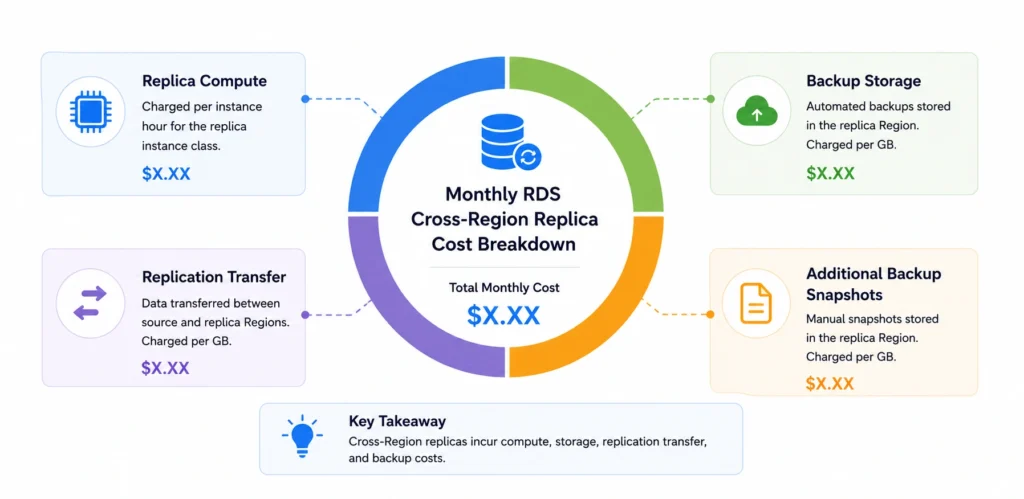
What does an RDS cross-Region read replica cost?
| Cost component | Billing basis | Priority |
|---|---|---|
| Replica compute | Destination-Region DB instance rate | High |
| Replica storage | Provisioned storage plus optional IOPS/throughput | High |
| Cross-Region replication | Data sent from source to destination | Workload dependent |
| Backup storage, where supported and enabled | Backup configuration and retained data | Medium |
| KMS/monitoring | Only when configured | Usually low |
Cost formula
Practical example
Which RDS engines support cross-Region replicas?
| Engine | Cross-Region support | Can serve reads? | Backup support on replica | Edition/version condition | Multi-AZ replica option | Key limitation |
|---|---|---|---|---|---|---|
| Db2 | Yes | No standby replica (DR-oriented) | See AWS docs | Version and licensing requirements apply | See AWS docs | Standby replica does not accept user connections |
| MariaDB | Yes | Yes | See AWS docs | Engine-native asynchronous replication | Yes | None |
| MySQL | Yes | Yes | See AWS docs | Engine-native asynchronous replication | Yes | None |
| Oracle | Yes | Read-only replicas: yes; mounted replicas: no (DR) | See AWS docs | Enterprise Edition; CDB architecture constraints | Yes | Mounted replicas do not accept user connections |
| PostgreSQL | Yes | Yes | Automated backups require version 14.1 or later | Native streaming replication | Yes | Deleting the source terminates replication; promote or delete manually |
| SQL Server | Yes | Yes | Not supported (no automated backups or manual snapshots) | Enterprise Edition only; specified versions | See AWS docs | Read replicas cannot take backups |
| Aurora | Separate model | N/A | N/A | N/A | N/A | Use Aurora-specific cross-Region features or Global Database |
For deeper PostgreSQL planning, see the RDS PostgreSQL read replica strategy.
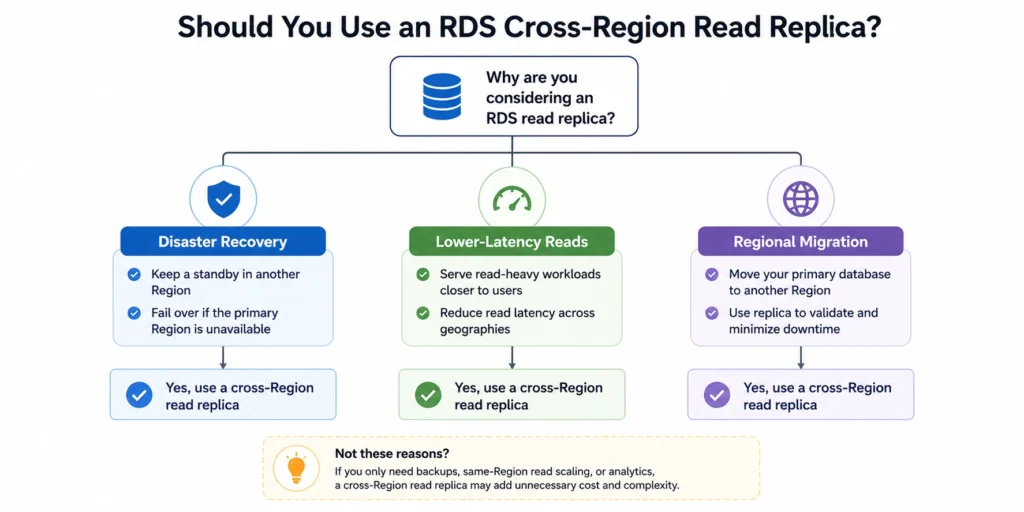
When is a cross-Region replica worth the cost?
Disaster recovery
Replication lag can vary significantly, especially across Regions, so a fixed 1–5 second RPO or guaranteed 5–15 minute RTO should not be assumed. Monitor ReplicaLag and test your actual recovery procedure.
Lower-latency reads
Compare a readable replica’s full compute and storage cost with alternatives such as caching before adding another full database instance.
Regional migration
How do DR alternatives compare?
| Option | Ongoing cost | Recovery profile | Best fit |
|---|---|---|---|
| Cross-Region read replica | Highest | Low RPO potential, promotion required | Critical warm DR target |
| Cross-Region automated backups | Lower | Restore required | Longer recovery acceptable |
| Cross-Region snapshot copies | Lower | Restore from last copy | Periodic recovery points |
| Same-Region Multi-AZ | Different purpose | Automatic AZ-level failover | In-Region high availability |
How do you optimize cross-Region replica cost?
- Confirm the replica is still required for DR, read scaling, or migration.
- Right-size compute using CPU, memory, connections, I/O, and ReplicaLag.
- Review storage type, IOPS, throughput, and allocated capacity.
- Measure actual replicated bytes instead of estimating from total database size.
- Compare On-Demand, Reserved Instances, and Database Savings Plans.
- Recheck commitments after promotions, migrations, or topology changes.
When choosing between them, a stable replica that will keep the same engine, instance family, size, deployment option, and Region for one or three years tends to favor a Reserved Instance. Planned migrations or cross-Region changes tend to favor Database Savings Plans, because that commitment applies across eligible engines, instance families, sizes, deployment options, and Regions for a one-year term.
For commitment planning, see the RDS Reserved Instances guide and Database Savings Plans coverage overview.
Topology callout:
For MySQL and MariaDB, AWS notes you can reduce inter-Region transfer charges by creating one cross-Region replica and then adding same-Region replicas from it, rather than sending changes from the source to several remote Regions. Compare “one source to three remote replicas” against “one remote seed replica plus two local replicas.”
Cross-Region replica cost checklist
What happens when you promote the replica?
AWS recommends enabling backups and completing at least one backup before promotion when backups are part of your recovery plan.
Deletion behavior also differs by engine. For Db2, MariaDB, SQL Server, MySQL, and Oracle cross-Region replicas, deleting the source promotes the replica. For PostgreSQL, replication is terminated and the replica must be manually promoted or deleted.
DR promotion and cutover runbook
- Stop or fence writes to the source when feasible.
- Check ReplicaLag and confirm the replica state.
- Promote the replica.
- Validate data integrity on the promoted instance.
- Change application routing to the promoted instance.
- Build a replacement replica for continued protection.
How Does Usage.ai Optimize Cross-Region Read Replica Costs?
We analyze every primary and replica separately, pin down the Region each one runs in, and buy a matched RI where it actually lives 33% to 69% off On-Demand on covered compute (about 33% on 1-year No Upfront; storage and cross-region transfer stay separate). Recommendations refresh every 24 hours, and we purchase on your approval.
Promote, delete, or resize a replica later? Our cashback protection covers the unused portion in real money, and you pay only a share of the savings we realize.
See how much you can save on RDS read replicas with Usage.ai
Connect in 15 minutes. No contracts, no infrastructure changes. See your savings before committing.
Frequently asked questions
Does a cross-Region replica cost the same as the primary?
Not necessarily. It uses destination-Region pricing and can have a different supported instance class or storage configuration.
Is cross-Region replication always $0.02 per GB?
No. Treat $0.02/GB only as an example where that rate applies. AWS directs customers to current RDS pricing for cross-Region replication charges.
Does SQL Server support cross-Region read replicas?
Yes. Current AWS documentation supports cross-Region read replicas for supported RDS for SQL Server Enterprise Edition versions and Regions.
Are cross-Region read replicas synchronous?
No. RDS read replicas use asynchronous replication. Cross-Region replicas can experience additional lag, and AWS does not specify one universal lag value.
Can a cross-Region replica use Reserved Instance discounts?
Yes, when the running DB instance matches the applicable Reserved Instance requirements, including Region, engine, and other relevant attributes.