.png)



Before committing more, confirm that the usage will persist and that the additional commitment still delivers acceptable net savings in a downside scenario.
The worked example focuses on Compute and EC2 Instance Savings Plans.
Short Answer
Savings Plans utilization shows how much of your purchased commitment was consumed. Coverage shows what share of applicable usage cost received Savings Plans pricing.High utilization and low coverage can indicate room for another commitment, but they are not enough to justify another purchase.
Buy more only when the uncovered usage contains a durable hourly baseline and the incremental commitment still produces acceptable net savings after fees under expected and downside scenarios.
Savings Plan Coverage vs Utilization: What Each Metric Measures
The two percentages describe opposite sides of the same purchase. Utilization looks at the commitment you already bought; coverage looks at the eligible usage that could receive the discount.AWS defines Savings Plans utilization as the percentage of commitment used across On-Demand usage. In practical terms, utilization equals used commitment divided by total commitment.
By contrast, the Savings Plans coverage report measures the percentage of applicable AWS usage costs covered during the selected period.
| Measure | Question answered | Calculation basis | What it cannot prove |
|---|---|---|---|
| Utilization | How much purchased commitment was consumed? | Used commitment ÷ total commitment | That another commitment will be used |
| Coverage | How much eligible usage received the benefit? | On-Demand equivalent of covered usage ÷ total eligible On-Demand-equivalent usage | That uncovered usage is stable |
| Realized discount on covered usage | How much did the covered usage save? | Savings on covered usage ÷ its On-Demand-equivalent cost | Future workload stability |
| Net savings rate | What value remained after relevant fees? | Net savings ÷ total eligible On-Demand-equivalent cost | That the result will continue |
The bases cannot be mixed. Utilization uses commitment dollars at Savings Plans rates; coverage uses the On-Demand equivalent of eligible usage. Realized discount and net savings also require an explicit comparison baseline.
Make sure both metrics use the same dates, accounts, services, sharing settings, and filters. This matters because AWS applies EC2 Reserved Instances first, followed by EC2 Instance Savings Plans and Compute Savings Plans.
Within consolidated billing, plans apply to the owner account before other accounts when sharing is enabled, with eligible usage prioritized by savings percentage. These Savings Plans application rules can shift where coverage appears even when total organizational usage has not changed.
Worked Account View: Reconcile Coverage, Utilization, and Net Savings
Imagine a FinOps team reviewing a month with $100,000 in eligible usage. This example uses public On-Demand pricing as its comparison baseline; “commitment” rows use Savings Plans rates, and the illustrative fee is 20% of realized savings.| Account measure | Value | Calculation | Decision meaning |
|---|---|---|---|
| Eligible usage | $100,000 | Covered plus uncovered usage | Total opportunity in scope |
| Covered usage | $60,000 | On-Demand equivalent | Usage receiving Savings Plans pricing |
| Uncovered usage | $40,000 | Eligible minus covered | Usage still billed On-Demand |
| Coverage | 60% | $60,000 ÷ $100,000 | Discount reach, not purchase readiness |
| Purchased commitment | $42,000 | Monthly aggregate of hourly Savings Plans commitment | Existing obligation |
| Used commitment | $42,000 | Monthly aggregate consumed | No unused commitment this month |
| Utilization | 100% | $42,000 ÷ $42,000 | Existing plan was fully consumed |
| Realized savings | $18,000 | $60,000 − $42,000 | Savings before the illustrative fee |
| Realized discount on covered usage | 30% | $18,000 ÷ $60,000 | Rate benefit on covered usage |
| Illustrative fee | $3,600 | 20% × $18,000 | Use the fee basis that actually applies |
| Net savings | $14,400 | $18,000 − $3,600 | Economic value after the fee |
| Net savings rate | 14.4% | $14,400 ÷ $100,000 | Net benefit across all eligible usage |
Assuming the same rate and an even hourly distribution, suppose the team buys an additional hourly commitment representing $14,000 over the modeled month to cover $20,000 of On-Demand-equivalent usage at the same 30% discount.
If a migration leaves only $15,000 in the entire matching usage pool available after existing commitments, just $10,500 of the new commitment is consumed. The new plan is 75% utilized, and its gross saving falls from an expected $6,000 to $1,000 because the organization still owes the full $14,000.
This is why cloud-savings reviews must use the same comparison baseline and fee basis. Our guide to verifying cloud savings claims explains how list, contracted, existing, incremental, and net savings can produce different percentages.
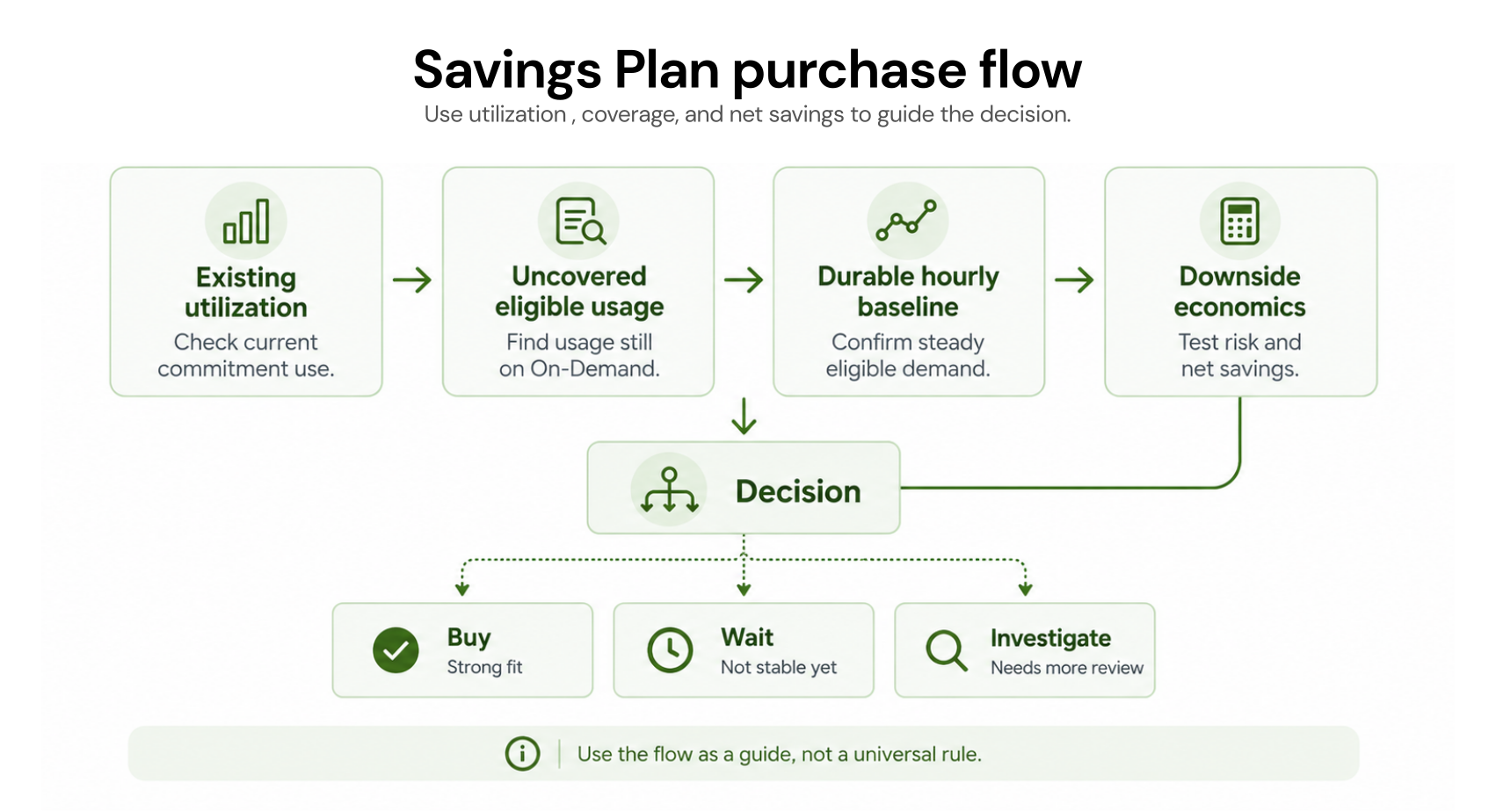
What to Check Before Buying More Savings Plans
Use the current metrics as the start of the review, then validate four areas.1. Make Sure the Numbers Cover the Same Scope
Use the same dates, accounts, services, currencies, cost basis, and sharing configuration.
Compare organization-level results with linked-account results where ownership or showback matters.
Reconcile unexpected figures with detailed billing data. AWS notes that the Savings Plans utilization report can show pro forma data when an account is in a Billing Conductor billing group.
2. Find the Usage That Repeats Every Hour
Monthly averages can hide alternating peaks and troughs. AWS states that each hourly commitment can be used only within that hour and cannot carry forward, so inspect hourly patterns using daily trends only as supporting context before translating uncovered monthly spend into another dollar-per-hour commitment.Separate repeatable production demand from launches, seasonal peaks, one-time processing, and growth that has not yet stabilized. The broader business case for AWS Savings Plans should rest on predictable eligible usage rather than the entire AWS bill.
3. Account for What Is About to Change
Inventory active RIs and Savings Plans, expiration dates, queued purchases, and plan-sharing settings. Then ask engineering about rightsizing, Graviton adoption, migrations, shutdowns, architecture changes, and expected contraction.Existing RIs matter because AWS applies their benefits before Savings Plans. A workload that looks uncovered today may also change when an RI expires or a scheduled plan becomes active.
4. Test Whether the Next Commitment Still Saves
Model the added coverage, expected utilization, marginal discount, commitment term, payment option, and unused-commitment exposure. Deduct the relevant management fee using the fee basis that applies to you, then repeat the calculation under a realistic downside case.Review AWS recommendations, but do not treat them as forecasts. AWS explains that Savings Plans recommendations use historical usage, do not include queued or scheduled purchases, and are generated for immediate rather than future purchases.
Check the 7-, 30-, or 60-day lookback, selected plan type, term, payment option, recommendation scope, and current inventory before buying.
Decision Framework: Buy More, Wait, or Investigate
There is no universal “good” percentage. Interpret each position against usage volatility, forecast confidence, discount depth, and financial risk.| Observed position | Interpretation | Action |
|---|---|---|
| High utilization, low coverage, stable hourly floor, positive downside economics | The evidence supports additional durable demand | Model a measured purchase |
| High utilization, low coverage, volatile uncovered usage | Existing plan performs well, but new demand is uncertain | Wait or commit conservatively |
| Low utilization, high coverage | Current commitment may already exceed durable demand | Do not add; investigate underuse |
| Low utilization, low coverage | Hourly variability, scope, eligibility, sharing, or plan fit may explain the result | Reconcile before purchasing |
| High utilization, high coverage | Current alignment is strong; little incremental opportunity may remain | Review growth and expirations |
| Metrics do not reconcile | Cost basis, scope, or reporting treatment differs | Correct the analysis first |
How We Assess Commitment Performance at Usage.ai
Finding room for another commitment is only the first step. The harder part is keeping that commitment aligned as usage changes. That is where we help.We analyze cloud usage at the billing layer, using billing data and specified metadata without accessing core infrastructure. We recommend commitments based on that data. Once you approve a recommendation, we purchase the commitment through the cloud provider’s API and track it in our dashboard.
With our Flex Insured Commitments, eligible teams can get up to 57% savings from a three-year AWS commitment with none of the commitment risk.
If usage drops and a covered Flex Commitment costs more than the On-Demand rate for the same usage, we provide cashback protection for the difference.
Our pricing is a percentage of realized savings. If we do not generate savings through the program, there is no savings-based fee.
Final Verdict: Utilization Is a Starting Signal, Not a Buying Decision
Treat utilization as evidence about the commitment you already own, not a reason to buy the next one. Increase coverage only when the uncovered spend remains stable by hour and still produces acceptable net savings after fees in a downside scenario.Review coverage, utilization, risk, and savings before increasing AWS commitments.
Frequently asked questions
Does 100% Savings Plans utilization mean I should buy more?
No. It proves that the existing commitment was consumed during the measured period. It does not prove that uncovered usage will remain stable throughout another Savings Plan term.
Why is coverage low when utilization is 100%?
The current commitment may be fully consumed while additional eligible usage continues at On-Demand rates. Account scope, sharing settings, workload growth, existing RIs, and plan eligibility can also affect the result.
Can coverage and utilization both reach 100%?
Yes. That can happen when purchased commitment and eligible usage align across the measured period. It does not guarantee that the same alignment will continue after demand changes.
Should performance be reviewed hourly or monthly?
Use monthly views for reporting, but inspect hourly patterns before purchasing. Savings Plans are hourly commitments, and unused commitment cannot be moved into another hour.
Can a fully utilized Savings Plan still deliver weak savings?
Yes. Utilization does not measure the discount achieved, the share of total eligible usage covered, management fees, or net savings relative to the selected baseline.