.png)



This worked comparison uses a three-year, No Upfront Compute Savings Plan. The same decision logic can inform EC2 Instance Savings Plans and Reserved Instances, although their scope, modification options, payment mechanics, and discount rates differ.
For the product-level differences, see our comparison of Compute Savings Plans and EC2 Instance Savings Plans.
Short Answer
Buy one large AWS commitment when your baseline usage is highly predictable and unlikely to fall. You receive the full discount sooner and avoid the temporary On-Demand costs created by staging purchases.Stagger purchases when forecast uncertainty is meaningful enough to justify that waiting cost. The economic question is whether the additional On-Demand spend during the ramp is smaller than the commitment loss you could avoid if usage changes.
What Changes When You Stagger AWS Commitments?
A Savings Plan is an hourly spend commitment, not a reservation for a fixed quantity of instances. AWS applies Savings Plans automatically to matching usage, while usage beyond the hourly commitment remains On-Demand. Unused commitment in one hour cannot be carried into another.Staggering changes when coverage becomes active and when commitments mature. It does not shorten the native term of each purchase.
| Decision factor | One large purchase | Staggered purchases |
|---|---|---|
| Initial coverage | Reaches the target immediately | Ramps as tranches are purchased |
| Early cash flow | Full recurring commitment charge begins immediately | Commitment charge increases over time |
| Forecast risk | Concentrated in the initial decision | Later tranches can reflect newer information |
| Expirations | One large maturity event | Multiple smaller maturity events |
| Cost of waiting | None in this model | Higher when uncovered usage could otherwise be committed |
| Downside exposure | Larger if the baseline falls | Can be limited by stopping future tranches |
The Worked Model: Same Usage, Different Purchase Timing
Model assumptions
The model compares the strategies under identical usage paths.| Assumption | Value |
|---|---|
| Reference eligible usage | $100/hour at On-Demand rates; scenario changes are defined below |
| Illustrative discount | 30% |
| Full-coverage commitment | $70/hour |
| Product modeled | Three-year, No Upfront Compute Savings Plan |
| Hours per modeled month | 730 |
| Evaluation period | 36 months |
The 30% discount is an illustration, not an AWS quote. Actual Savings Plan rates vary by service, region, term, payment option, and commitment type.
For each modeled month:
Purchase schedules
The one-purchase strategy commits $70 per hour at month zero. It reaches 100% modeled coverage immediately and matures as one block after the three-year term.The staggered strategy purchases four $17.50-per-hour tranches:
Tranche 1: month 0
Tranche 2: month 3
Tranche 3: month 6
Tranche 4: month 9
Metrics used
The comparison measures:Total AWS cost during the 36-month evaluation
Savings relative to remaining entirely On-Demand
Mean monthly coverage of eligible usage
36-month utilization of purchased commitments
Remaining commitment exposure if usage declines
Timing and size of maturity events
The AWS coverage report guidance and utilization report guidance treat these as separate measurements for good reason.
How Each Strategy Performs Under Three Usage Paths
The table covers months 0–36; the “How Staggering Changes Maturities and Exposure” section quantifies commitment charges remaining after that window.| Observed position | Interpretation | Action |
|---|---|---|
| High utilization, low coverage, stable hourly floor, positive downside economics | The evidence supports additional durable demand | Model a measured purchase |
| High utilization, low coverage, volatile uncovered usage | Existing plan performs well, but new demand is uncertain | Wait or commit conservatively |
| Low utilization, high coverage | Current commitment may already exceed durable demand | Do not add; investigate underuse |
| Low utilization, low coverage | Hourly variability, scope, eligibility, sharing, or plan fit may explain the result | Reconcile before purchasing |
| High utilization, high coverage | Current alignment is strong; little incremental opportunity may remain | Review growth and expirations |
| Metrics do not reconcile | Cost basis, scope, or reporting treatment differs | Correct the analysis first |
Mean monthly coverage is the simple average of the 36 monthly coverage percentages. The 36-month commitment utilization is total used commitment divided by total commitment charges during the period. These are illustrative model outputs, not exported AWS report results.
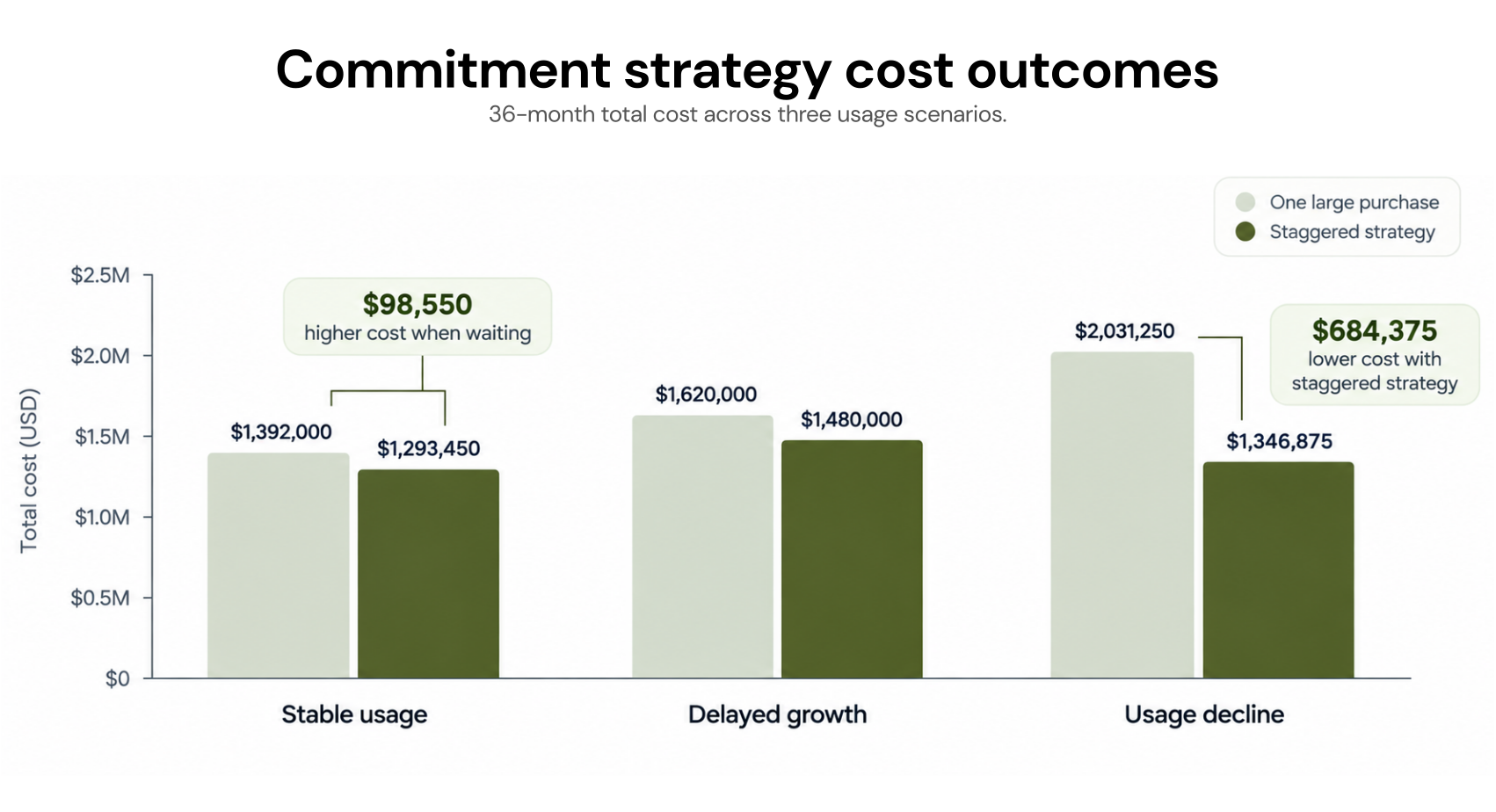
Stable usage
When usage remains at $100 per hour, the large purchase wins. It saves $98,550 more during the 36-month evaluation window because the staggered strategy leaves part of the stable baseline at On-Demand rates during the first nine months.This is the clearest argument against unnecessary staging: if the baseline is genuinely dependable, waiting has a measurable cost.
Delayed growth
In this path, eligible usage is $50 per hour for six months and then rises to $100 per hour. The large purchase is underutilized during those first six months. The staggered schedule follows the growth more closely and finishes $120,450 cheaper, even though it initially leaves some usage uncovered.Usage decline before later purchases
Here, usage begins at $100 per hour. At month six, before the third scheduled purchase, it falls to $50 per hour. The team reviews the change and makes no further purchases, leaving only the first two tranches in place.The large purchase still reports 100% coverage because the remaining usage fits inside the commitment. But utilization falls to 50% after the drop, or 58.3% over the full 36-month period, and the strategy costs $306,600 more than remaining On-Demand.
That distinction is crucial: high coverage does not prove that the commitment amount was correct.
The Cost of Waiting vs the Cost of Being Wrong
The trade-off can be summarized as:Net 36-month cost advantage of staggering=AWS cost with one large purchase−AWS cost with the staggered strategy
The result is negative $98,550 under stable usage, positive $120,450 under delayed growth, and positive $684,375 under the adaptive decline scenario. A positive result means staggering costs less within the comparison window.
The correct schedule therefore depends on the probability and scale of forecast error, not just the highest available discount.
AWS recommendations can inform the decision, but they should not replace a forward-looking forecast. The AWS recommendation methodology uses historical lookback periods and does not predict future changes such as migrations, application retirements, acquisitions, or rightsizing programs.
How Staggering Changes Maturities and Exposure
The following month numbers simplify the 1,095-day AWS term for comparison.| Purchase | Starts | Modeled maturity | Hourly commitment |
|---|---|---|---|
| Large purchase | Month 0 | Month 36 | $70.00 |
| Staggered tranche 1 | Month 0 | Month 36 | $17.50 |
| Staggered tranche 2 | Month 3 | Month 39 | $17.50 |
| Staggered tranche 3 | Month 6 | Month 42 | $17.50 |
| Staggered tranche 4 | Month 9 | Month 45 | $17.50 |
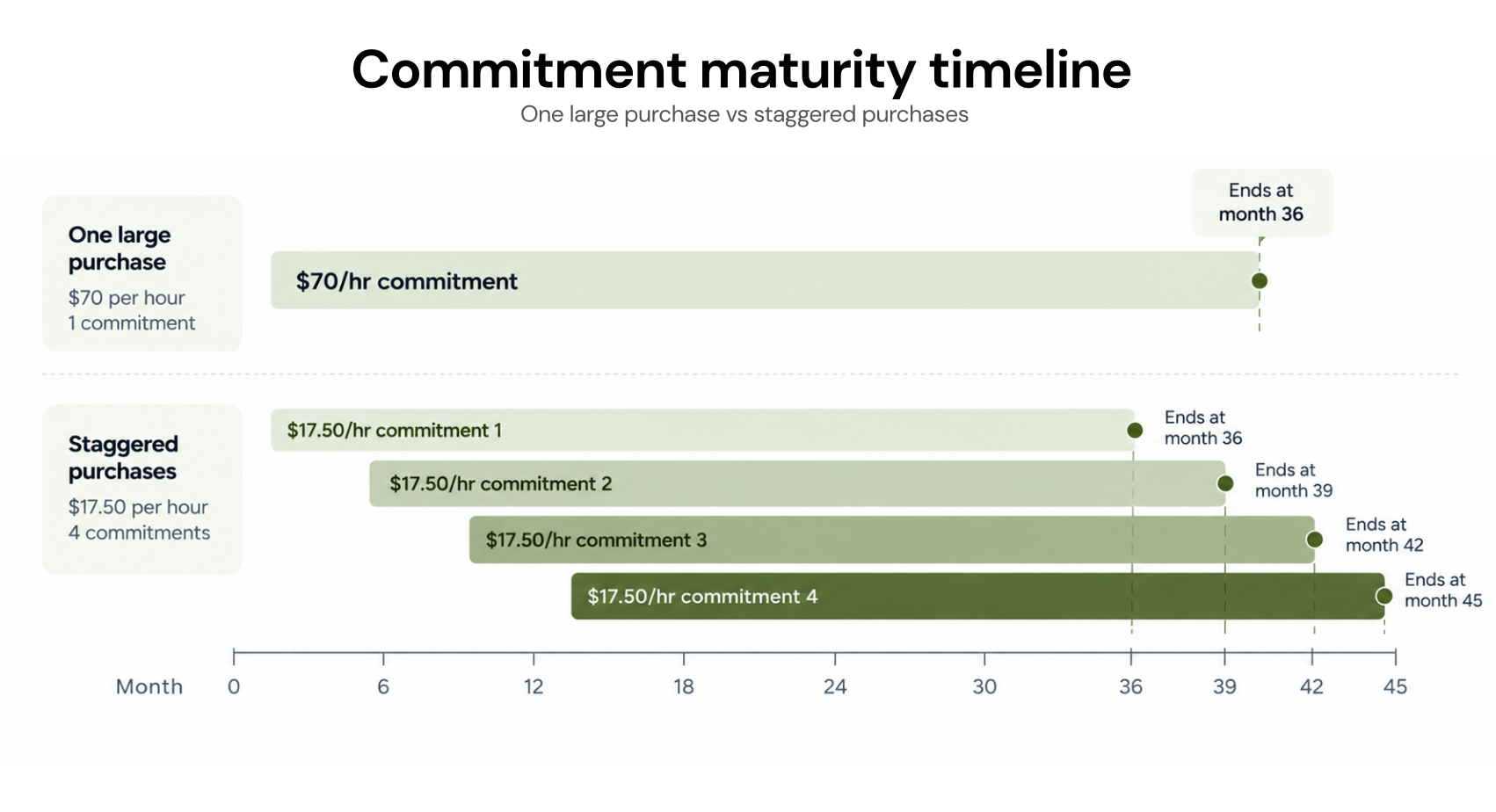
These remaining charges are not automatically losses because the active plans can still cover matching eligible usage.
Staggering therefore reduces the size of each renewal event, but it does not mean all exposure disappears within three months. From the final purchase, the schedule still contains active commitments for another three years.
When to Buy All at Once or Stagger Purchases
Favor one large purchase when:The committed amount is supported by a conservative, durable baseline.
Demand is distributed across flexible eligible services rather than one fragile workload.
No major migration, rearchitecture, or rightsizing event is expected.
Capturing maximum savings immediately matters more than preserving later decisions.
Growth is expected but its timing is uncertain.
A material workload migration or retirement is underway.
Savings Plan recommendations are being influenced by temporary demand.
Multiple teams need time to validate their minimum usage.
Large, synchronized expirations would create renewal risk.
How Usage.ai Helps Manage AWS Commitment Risk
Staggering commitments preserves later purchase decisions, but it also requires ongoing analysis, approvals, and maturity tracking.We analyze usage at the billing layer, recommend commitments based on that data, execute approved purchases through the cloud provider’s API, and keep managed commitments visible in the dashboard.
With our Flex Insured Commitments, teams can get up to 57% savings from a three-year AWS commitment with none of the commitment risk.
If usage drops and a covered Flex Commitment costs more than equivalent On-Demand usage, we provide cashback protection for the difference.
Our pricing is a percentage of realized savings. If we do not generate savings through the program, there is no savings-based fee.
Final Verdict: Commit Now or Preserve Later Decisions?
One large purchase is economically stronger when the entire commitment rests on a stable baseline.Staggering earns its place when later information could materially change the amount you should buy. It sacrifices some early discount value but can prevent a substantially larger utilization loss.
The most defensible strategy is therefore not “always stagger” or “always maximize coverage.” Commit now to usage you can defend, then require each additional tranche to pass the same forecast, utilization, and downside test.
Compare coverage, expirations, and risk before your next AWS commitment.
Frequently asked questions
Is staggering AWS Savings Plans always safer?
It reduces the amount committed before later reviews, but it does not eliminate risk. Outside AWS’s limited return window, every purchased tranche retains its full term, and staging can increase costs when stable usage remains temporarily uncovered.
How frequently should AWS commitments be staggered?
There is no universally correct interval. Choose review points that correspond to meaningful new information, such as migrations, quarterly forecasts, rightsizing milestones, contract changes, or workload launches.
Does a No Upfront Savings Plan eliminate cash-flow risk?
No. “No Upfront” removes the initial lump-sum payment, but the hourly commitment continues throughout the term. Underutilization can still make the total cost greater than the equivalent On-Demand usage.
Should commitment coverage be the primary decision metric?
No. Coverage should be evaluated alongside utilization, total savings, forecast uncertainty, uncovered On-Demand spend, and the amount and duration of remaining commitment exposure.