
 AWS
 Microsoft Azure
 Google Cloud


This guide explains the formula, common metrics, calculation process, cost drivers, improvement practices, and the difference between cloud unit economics and cost optimization.
The Short Answer
Cloud unit economics measures the technology cost associated with delivering one defined unit of value. Its basic unit-cost formula is total attributed infrastructure cost divided by the number of corresponding units delivered.The result might be cost per active user, API request, transaction, job, or inference. Tracking it consistently helps teams distinguish healthy growth from growth that is becoming more expensive to support.
What Is Cloud Unit Economics?
Cloud unit economics connects technology spending with the value created by a product, service, or activity. The FinOps Foundation recognizes Unit Economics as a FinOps capability and distinguishes business unit metrics, such as cost per customer, from resource-efficiency metrics, such as cost per request, workload, or token.At its simplest, a cloud unit-cost metric is:
The formula calculates cost per unit, but full unit economics goes further. Teams can compare that cost with revenue, margin, service quality, or another outcome measure. Public-sector and nonprofit organizations can use mission outcomes instead of revenue.
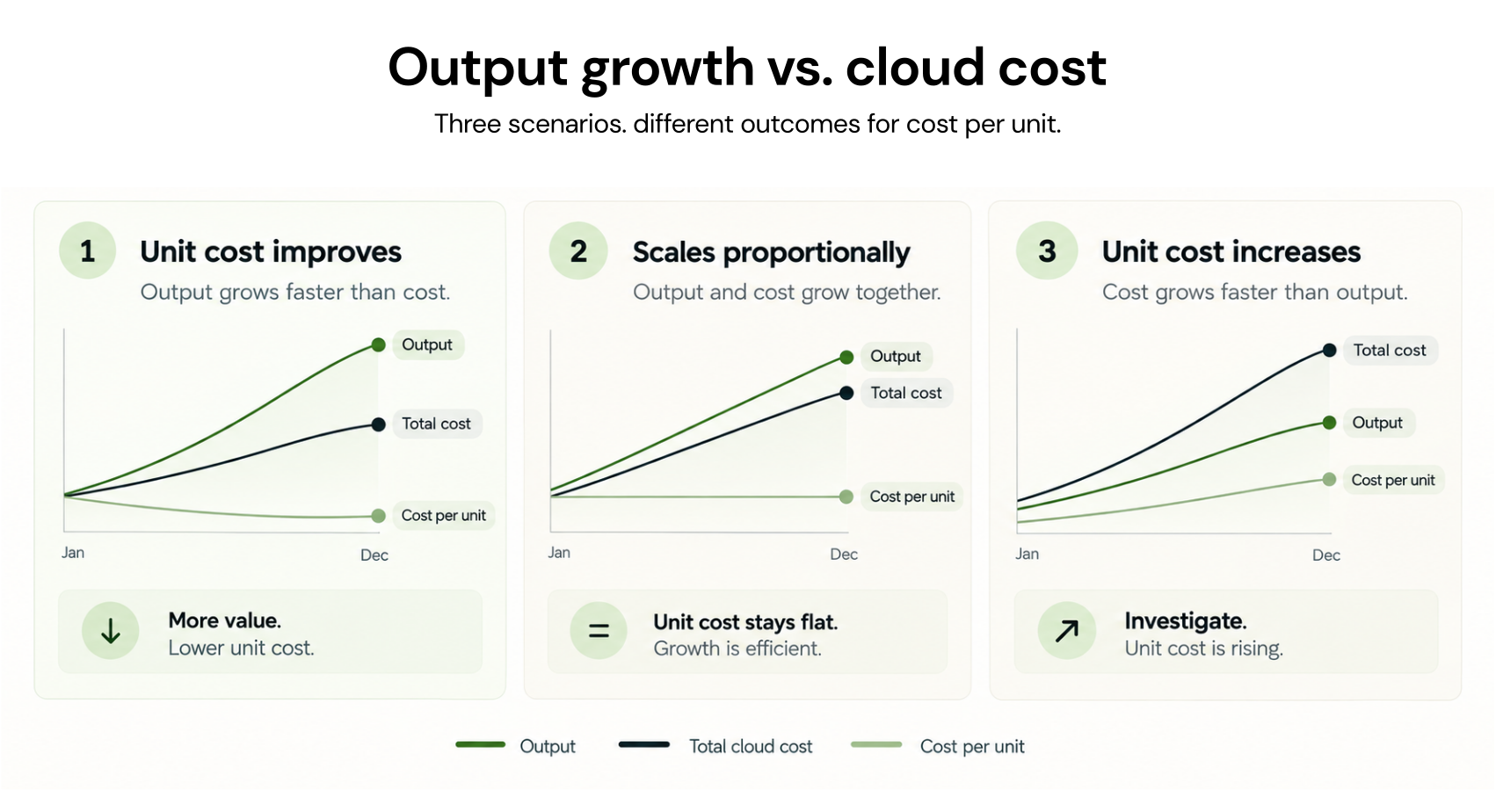
Unit cost falls when costs grow more slowly than comparable units and rises when costs grow faster. A higher result may indicate inefficiency or an intentional improvement in reliability, performance, or product capability.
Common Cloud Unit Economics Metrics
The right denominator depends on how the product delivers value and how demand drives infrastructure consumption. The FinOps Foundation notes that cost per customer is often a useful starting point, but no single metric works for every organization.| Metric | Best suited for | What it helps evaluate |
|---|---|---|
| Cost per active user | SaaS and consumer platforms | Cost of supporting meaningful user activity |
| Cost per API request | APIs and developer platforms | Compute, data, and network cost per call |
| Cost per transaction | Payments, fintech, and e-commerce | Infrastructure cost associated with each completed transaction |
| Cost per workload or job | Data platforms and batch systems | Cost of a discrete processing task |
| Cost per inference or token | AI and ML services | Cost of model execution or consumption at the chosen unit |
One metric can hide a costly subsystem. A SaaS company might track cost per active user while engineering monitors requests and background jobs. For AI and ML workloads, evaluate cost per token or inference alongside relevant outcome and service-quality measures, such as task success, accuracy, latency, or user satisfaction. Add metrics only when they explain distinct cost drivers or decisions.
How to Calculate Cloud Unit Economics
Four steps turn billing and usage data into a defensible metric.Define the unit. Select an output that represents demand or value, such as active users, successful requests, transactions, jobs, tokens, or inferences. Document exclusions so the denominator does not change silently.
Attribute relevant costs. Map compute, storage, networking, databases, observability, and other supporting services to the workload. Follow the metric’s documented cost scope.
Align the measurement period. Use application telemetry, analytics, or operational data for the same period represented by the cost data. Avoid comparing a calendar-month bill with a denominator collected over a different window.
Calculate and track the result. Divide cost by units delivered, compare it with a stable baseline, and annotate material changes in traffic, architecture, pricing, or service quality.
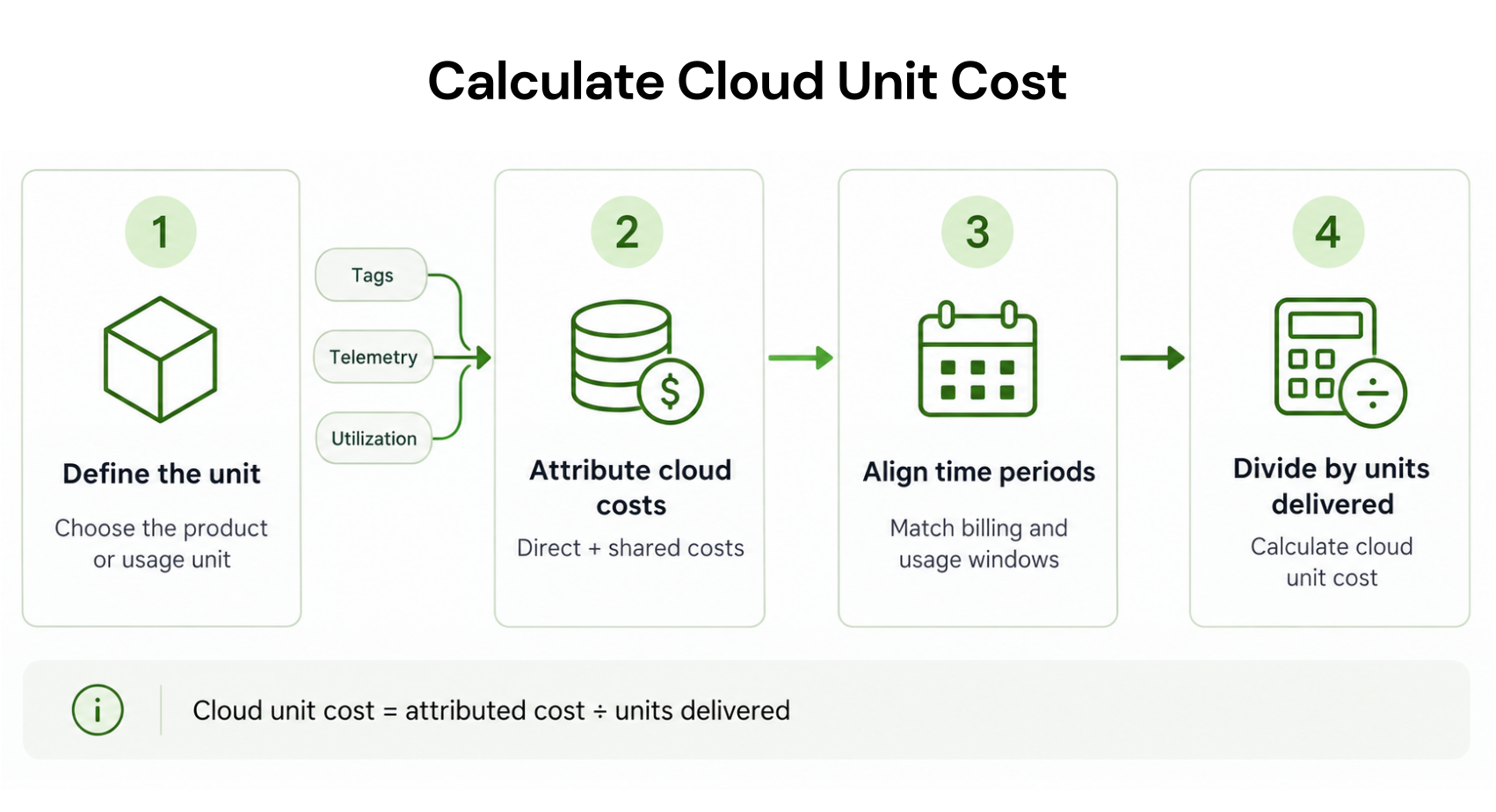
Apply the driver consistently, and document whether unattributed shared cost is distributed by a defined rule or tracked as separate overhead.
Document whether the numerator uses billed or amortized cost and includes negotiated rates, credits, support, and platform overhead. Changing these inclusions between periods breaks the trend.
Worked Example: EC2-Based API Service
Assume an API service has $120,000 in monthly EC2 compute cost and serves 80 million requests:| Scenario | Monthly compute cost | Requests | Cost per request |
|---|---|---|---|
| On-Demand baseline | $120,000 | 80,000,000 | $0.001500 |
| 70% covered at an illustrative 30% discount | $94,800 | 80,000,000 | $0.001185 |
| Change | 21% reduction | No change | 21% improvement |
Review the result alongside traffic mix, latency, error rates, and architecture changes before attributing it to one action.
Factors That Affect Cloud Unit Costs
Unit cost changes when either attributed cost or delivered output changes. Six recurring factors help explain that movement:Architecture design: Service boundaries, database access, caching, serialization, and data movement determine how much infrastructure each unit consumes.
Compute utilization: Oversized or poorly packed resources can raise cost without increasing output; insufficient headroom can harm reliability.
Demand and scaling: Traffic shape, seasonality, minimum capacity, and scaling lag affect how closely provisioned resources follow demand.
Pricing models: On-Demand, Spot, serverless, reservations, Savings Plans, and committed-use discounts trade flexibility, eligibility, interruption tolerance, and term exposure differently.
Commitment coverage and utilization: Properly sized commitments can reduce effective rates, while unused commitments can reduce or eliminate expected savings.
Operational efficiency: Monitoring and periodic review help teams detect cost regressions as workloads, prices, and product requirements change.
Best Practices for Improving Unit Economics
Use the metric to prioritize investigation rather than applying the same optimization to every workload.Improve compute utilization. Compare provisioned capacity with CPU, memory, throughput, latency, and application-specific demand. Rightsize or consolidate only after preserving the headroom required for reliability.
Test workload placement and instance options. Benchmark suitable compute families, sizes, processors, regions, containers, and serverless services against the workload’s performance requirements. Price alone is insufficient because runtime and throughput determine cost per completed unit.
Reduce avoidable service overhead. Examine repeated database queries, unnecessary network hops, excessive serialization, and missed batching or caching opportunities. Validate changes through the unit metric and service-level indicators.
Scale on a representative signal. CPU can be appropriate when it correlates with demand; request rate per target, queue backlog per worker, or concurrency per instance may fit other workloads better. Choose a target-tracking metric that correlates with demand and changes proportionally as capacity changes.
Match pricing to workload behavior. AWS recommends analyzing each workload component before combining On-Demand, Spot, and commitment pricing. Apply commitments to eligible, stable usage and monitor utilization; use flexible or interruptible options only where their operational characteristics fit.
Maintain a consistent measurement cadence. Review unit metrics often enough to support the decisions they inform, and after major launches, migrations, pricing changes, or demand shifts. Record metric definitions and annotate events so teams can explain movement instead of reacting to an unexplained number.
Cloud Unit Economics vs Cost Optimization
Cloud unit economics measures technology cost relative to an output or outcome. Cloud cost optimization changes resource usage, architecture, or purchasing to reduce unnecessary cost and improve value.| Aspect | Cloud Unit Economics | Cloud Cost Optimization |
|---|---|---|
| Primary question | What does it cost to deliver one unit of value? | Where can cost or waste be reduced? |
| Common measures | Cost per user, request, transaction, job, or inference | Idle cost, utilization, effective rates, and total savings |
| Typical work | Define units, allocate costs, track trends, compare value | Rightsize, remove idle resources, tune scaling, change pricing or architecture |
| Participants | Product, engineering, finance, leadership, and FinOps | Engineering, operations, finance, and FinOps |
| Outcome | Evidence for product, pricing, architecture, and investment decisions | Lower waste or better value from cloud resources |
Improve Unit Economics With Usage.ai
Once teams understand the architectural and utilization drivers behind unit cost, pricing strategy can be another controlled lever for improving the cost numerator. We analyze billing and usage across AWS, Azure, and GCP, present commitment recommendations for approval, and purchase and manage approved commitments on customers’ behalf.With Flex Insured Commitments, teams can get the 30–50% savings of a one- or three-year cloud commitment across eligible workloads with none of the commitment risk.
If a covered commitment costs more than equivalent On-Demand usage, we provide cashback protection subject to program eligibility and contract terms.
Our fee is a percentage of realized savings, billed monthly in arrears. If we do not generate verified savings, there is no savings-based fee.
Get a 15-minute, read-only review of coverage, uncovered spend, and commitment risk across AWS, Azure, and GCP.
Frequently asked questions
What is a good cloud unit-cost benchmark?
There is no universal benchmark. Compare a consistently defined metric with internal baselines, targets, and delivered value.
How does cloud unit economics relate to COGS?
Cloud infrastructure can be part of COGS when it supports service delivery. Reducing that cost can improve gross margin when its accounting classification and other inputs remain unchanged.
How should shared infrastructure be allocated?
Use a consistent driver such as requests, CPU, memory, traffic, or active users. Tags can help identify ownership, but telemetry and other metadata may also support allocation.
How often should teams review unit economics?
Use a cadence that matches the decisions and volatility involved. Review again after material product, architecture, demand, or pricing changes.
Which metrics suit AI and ML workloads?
Depending on the deployment, teams may track cost per inference, token, training run, agent action, or business outcome. Include the relevant compute, accelerator, storage, and managed-service costs.