.png)
 AWS
AWS Microsoft Azure
 Google Cloud

Harness combines infrastructure cost visibility, resource optimization, governance, and commitment orchestration. We turn eligible cloud usage into commitment savings through managed purchasing, automation, and qualifying financial protection.
Both approaches can reduce cloud costs, but their operating models, implementation requirements, and financial outcomes differ.
This comparison helps you determine whether Harness, our specialized commitment workflow, or both are right for your environment.
Usage.ai vs Harness: At a glance
| Capability | Usage.ai | Harness |
|---|---|---|
| Primary focus | Commitment optimization | Broad cloud and AI cost management |
| GCP cost visibility | Commitment coverage and savings | Cloud cost reporting and allocation |
| Kubernetes optimization | Not our core workflow | Kubernetes cost visibility; confirm GKE optimization scope in writing |
| GCP AutoStopping | Not our core workflow | GCP VMs and instance groups; documented proxy deployment |
| GCP commitment analysis | Eligible usage and commitment recommendations | Cross-cloud orchestration publicly described |
| GCP CUD purchasing | Supported eligible purchases | Confirm GCP execution scope in writing |
| Automation | Copilot and Autopilot | Resource automation; confirm GCP commitment automation in writing |
| Financial protection | Cashback for qualifying Flex Commitments | Confirm contractual protection terms |
| Pricing basis | Share of realized savings | Tracked cloud spend, subject to module and contract terms |
| Best suited for | Commitment savings and financial exposure | Engineering optimization and cost governance |
The decision should reflect incremental provider savings, vendor fees, execution authority, and qualifying downside protection not feature counts alone.
Two approaches to optimizing the same GCP bill
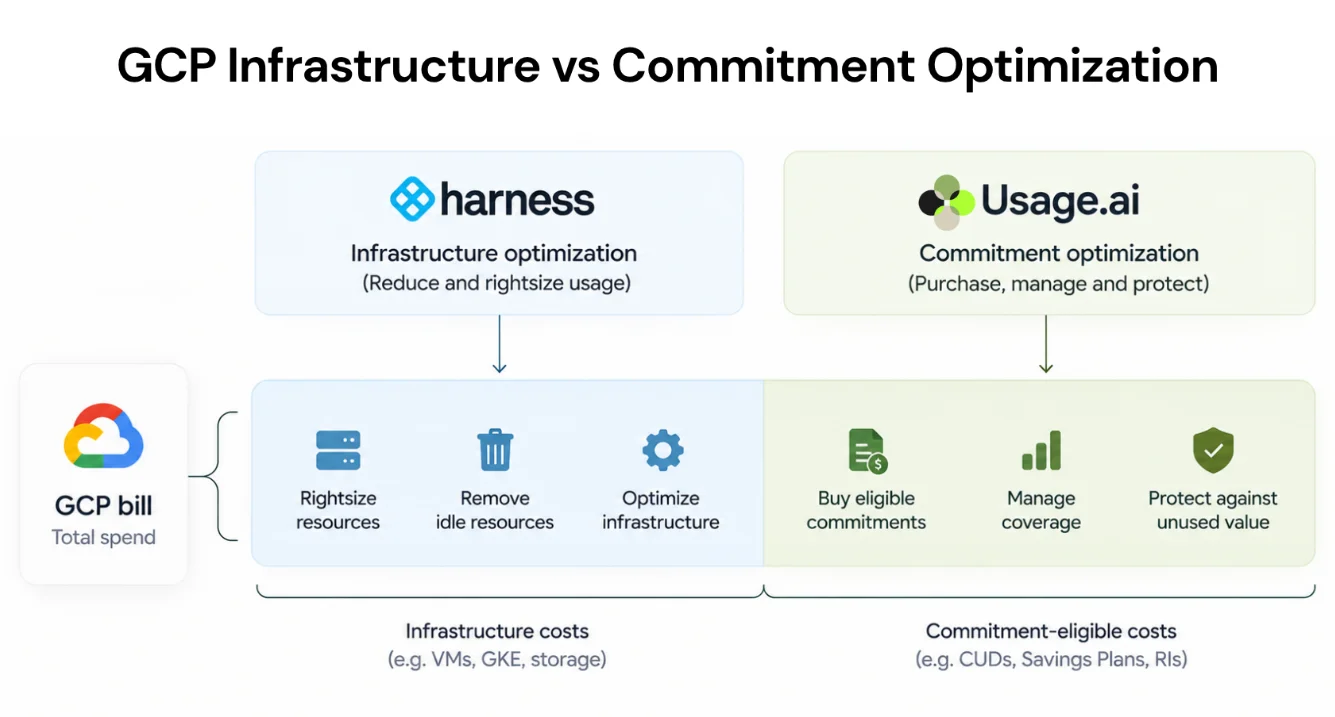
A Google Cloud bill reflects both infrastructure consumption and the rates paid for eligible usage. Harness helps teams manage infrastructure efficiency, cost visibility, and governance, while we focus on commitment purchasing, ongoing management, and qualifying financial protection.Through our GCP cost optimization platform, we analyze usage, recommend suitable commitments, and support purchasing through Copilot or Autopilot. Harness also markets commitment orchestration, so execution scope, pricing, and risk protection are important comparison points.
How Harness works for GCP
Harness supports cloud cost visibility, allocation, governance, and resource automation.For organizations with Kubernetes-heavy spending or idle development infrastructure, these capabilities can address waste that commitment discounts alone cannot eliminate.
Infrastructure optimization and AutoStopping
Harness supports AutoStopping for eligible GCP resources.Its GCP AutoStopping architecture describes support for virtual machines and instance groups, including custom Envoy-based proxy components deployed in the customer’s infrastructure.
Teams should assess eligible resources, required permissions, deployment work, and interactions with existing operations.
Commitment orchestration
Harness’s Cost Management Agent describes commitment recommendations and re-optimization across AWS, Azure, and GCP.This public positioning does not establish every supported GCP CUD purchasing action, approval control, or automated re-optimization mechanism.
For a commitment-focused purchase, request a live demonstration using your actual GCP services and billing structure.
Buyers should establish who executes each purchase, which permissions are required, and how demand changes affect future decisions.
How we manage GCP commitments
Our workflow connects usage analysis, purchasing, and financial management.We review eligible usage, account for existing commitments, and identify opportunities where additional coverage may improve cloud economics.
Supported purchases are managed in the customer’s cloud account.
From recommendations to execution
Our process includes four activities:Analyze usage: Review billing patterns, existing coverage, and eligible uncovered consumption.
Recommend commitments: Identify supported purchases based on commitment rules and expected demand.
Control execution: Approve eligible purchases through Copilot or configure supported automation through Autopilot.
Monitor performance: Track managed commitments and related savings in our dashboard.
Our Flex Commitment eligibility documentation explains managed commitments and program requirements.
This takes the process beyond identifying potential savings to ongoing financial management.
Copilot and Autopilot
Copilot lets customers review recommendations before authorizing eligible purchases.Autopilot supports automated commitment actions within configured account and purchasing controls.
Actual execution scope depends on supported cloud services, permissions, and configuration.
For FinOps and finance teams, this offers a choice between approval-based management and supported automation.
Cashback Protection
Cloud commitments reduce rates but can create financial exposure when usage declines.Our Flex Insured Commitment Program provides Cashback Protection for qualifying commitments.
As explained in our Cashback documentation, a qualifying loss can occur when the cost of a Flex Commitment exceeds what equivalent usage would have cost On-Demand. Eligible Cashback is calculated under the program’s applicable terms.
This benefit is separate from Google Cloud’s native discount.
It does not automatically apply to independently purchased commitments or eliminate the underlying provider obligation.
For another comparison of commitment protection models, our Usage.ai vs Archera guide explains how purchasing controls, pricing, and eligible financial protection differ between two commitment-focused platforms.
Which GCP commitments should be evaluated?
Google Cloud offers CUD models with different eligibility, purchasing scopes, and terms.Its Compute Engine CUD documentation explains the resource-based and spend-based models.
| Commitment type | What to evaluate before purchasing |
|---|---|
| Resource-based CUDs | Specific Compute Engine vCPU, memory, GPU, Local SSD, or sole-tenant node resources; region- and project-associated commitments; 1- or 3-year plans, with terms that can be longer |
| Compute Flexible CUDs | Eligible Compute Engine, GKE Standard or Autopilot, and Cloud Run spend; Cloud Billing-account scope across projects and regions; 1- or 3-year terms |
| Cloud SQL CUDs | Regional spend-based commitments for eligible CPU and memory; purchased through a Cloud Billing account, covering eligible billed projects in the committed region; 1- or 3-year terms |
Planned migrations, project-level changes, and retirements also affect the purchase decision.
Our guide to resource-based versus Flex CUDs explains the financial trade-offs.
Both vendors should identify which instruments they can recommend, purchase, and manage in your environment.
Implementation: What each platform requires
The two approaches carry different operational responsibilities.Harness implementation
Harness’s reporting and governance capabilities require relevant cloud integrations.Infrastructure automation can also require additional permissions, configuration, and deployment components. Its GCP AutoStopping architecture, for example, includes proxy components.
Implementation requirements depend on the selected modules and enabled actions.
Usage.ai implementation
Our workflow starts with billing and usage analysis.A read-only Savings Test lets customers evaluate potential opportunities before enabling purchasing permissions.
When authorized, eligible purchases are made within the customer’s cloud account. Our commitment-management workflow does not require Kubernetes agents or application code changes.
Our security and compliance documentation explains the relevant access and control considerations.
Buyers should compare the permissions and ongoing work required for the functions they intend to enable.
Pricing: Compare net value, not platform percentages
Harness and our platform use different pricing models.Harness pricing
Harness’s product and license definitions describe tracked-cloud-spend pricing for Cloud & AI Cost Management, with module-specific definitions and negotiated terms.The published Commitment Orchestrator license definition references EC2 spending, so it should not be treated as a complete GCP pricing specification.
Buyers should confirm GCP module coverage, fee basis, and contractual obligations.
Usage.ai pricing
We charge an agreed share of realized savings under the applicable terms.Our pricing page explains this savings-based approach.
For commitment optimization, this ties our fee to savings generated through eligible managed activity.
What a fair comparison includes
Separate existing savings from incremental savings attributable to each platform.Compare provider savings, commitment costs, vendor fees, and qualifying protection payments without double-counting amounts already reflected in billing.
Evaluate Harness’s infrastructure savings separately from its commitment benefits.
The goal is to identify the better net outcome for the functions your organization needs.
Can you use Harness with Usage.ai ?
Yes. The platforms can serve complementary functions when responsibilities are clearly defined.Harness may reduce unnecessary infrastructure consumption, improve cost visibility, and manage engineering-level controls.
We can evaluate commitment opportunities that remain after those changes.
Because Harness also offers commitment orchestration, using both platforms does not automatically produce additional commitment savings.
For buyers comparing dedicated commitment-management approaches, our Usage.ai vs ProsperOps comparison examines purchasing automation, pricing, and financial risk in more detail.
Example: The value of the remaining workload
Consider an organization spending $200,000 per month on GCP.Of that amount, $120,000 relates to potentially commitment-eligible workloads. Planned engineering changes are expected to reduce that consumption to $100,000.
A commitment proposal based on the original $120,000 baseline could overstate future demand.
Both vendors should instead evaluate durable eligible usage, existing CUD coverage, and expected workload changes.
We would assess whether our supported execution and protection terms create additional value beyond the customer’s existing tools.
This simplified illustration excludes service-specific eligibility, regional scope, and existing CUD utilization. It is not a customer result or guaranteed savings estimate.
Our guide to automated GCP CUD management explains why commitment decisions must adapt as cloud usage changes.
How to test both platforms against your GCP bill
Start with a consistent Google Cloud baseline.Google Cloud’s CUD Recommender uses historical usage and existing commitments to generate recommendations for supported CUDs.
Review native recommendations, available coverage assumptions, commitment terms, current utilization, and planned infrastructure changes.
Then ask both vendors to evaluate the same environment and assumptions.
A practical proof-of-value scorecard
| Measure | What the buyer should verify |
|---|---|
| Incremental provider discount | Savings beyond existing coverage |
| Realized savings after fees | Financial outcome after commitment costs and vendor fees |
| Commitment utilization | How effectively purchased commitments are consumed |
| Downside exposure | Financial impact if eligible demand declines |
| Operational effort | Time, approvals, engineering work, and ongoing management |
Require written confirmation of supported GCP CUD types, purchase authority, approval controls, IAM permissions, adjustment or exit options, fees, and protection terms.
For our evaluation, establish eligible purchasing scope, Copilot or Autopilot controls, and Cashback eligibility.
For Harness, verify GCP commitment actions, infrastructure automation requirements, and the proposed commercial scope.
The stronger proposal should meet the buyer’s requirements with a measurable financial case.
Which platform is the better fit?
Choose Harness when
Your priorities are broad GCP cost visibility, Kubernetes cost visibility, resource automation, governance, and allocation. Confirm any required GKE optimization actions, deployment requirements, and commercial availability in writing.Harness may also meet commitment-management requirements when its demonstrated GCP execution capabilities, purchasing controls, and contract terms fit your needs.
Choose Usage.ai when
Your central challenge is purchasing and managing eligible GCP commitments, maintaining coverage, and managing qualifying financial exposure.We combine commitment analysis, Copilot or Autopilot controls, savings-based pricing, and Cashback Protection for qualifying Flex Commitments.
This is particularly relevant when finance wants a clearer connection between managed commitment outcomes, vendor fees, and downside protection.
Consider both when
Harness provides the broader infrastructure and governance functions your team needs, while our evaluation identifies additional net commitment value.Purchasing responsibilities and savings attribution should remain distinct.
Final verdict
Harness offers broad cloud cost-management capabilities and publicly describes GCP commitment orchestration. We provide a dedicated commitment-management workflow with purchasing controls, fees tied to realized savings, and Cashback Protection for qualifying Flex Commitments.The reason to evaluate us is whether our approach improves your commitment economics beyond your current tools.
For example, Google Cloud advertises a 52% three-year discount on eligible regional Cloud SQL CPU and memory usage through Cloud SQL CUDs. Storage, backups, IP addresses, outbound data transfer, and licensing are excluded, as explained in Google Cloud’s Cloud SQL CUD documentation.
That is Google’s provider discount, not an additional discount from us. For supported, qualifying commitments, we help manage purchasing and future coverage, while Cashback Protection can address eligible underutilization losses under our Flex Commitment Program.
Google Cloud’s underlying CUD obligation remains in place.
Before adding another platform, measure potential savings and financial exposure against your actual usage, existing commitments, and vendor fees.
Evaluate commitments, eligible opportunities, and net savings before approving purchases.
Frequently asked questions
Does Harness support GCP commitment orchestration?
Harness publicly describes cross-cloud Commitment Orchestrator capabilities, including GCP. Buyers should verify the exact CUD purchasing actions, approval controls, and execution scope for their proposed deployment. Harness publicly describes cross-cloud Commitment Orchestrator capabilities, including GCP. Buyers should verify the exact CUD purchasing actions, approval controls, and execution scope for their proposed deployment.
How does our approach differ from Harness?
We specialize in eligible commitment purchasing and management, savings-based pricing, and qualifying financial protection. Harness combines commitment capabilities with broader infrastructure optimization and governance.
Can our platform work alongside Harness?
Yes, when responsibilities are clear and the additional net financial benefit justifies both services.
Does every GCP commitment receive Cashback Protection?
No. Cashback applies to qualifying Flex Commitments under current eligibility requirements and terms. Existing customer-owned commitments are not automatically protected.
Should we use Google Cloud's native CUD recommendations first?
Yes. Native recommendations provide a useful baseline. Compare their findings with each vendor's proposed actions, pricing, controls, and financial outcomes before purchasing.