 AWS
AWS Microsoft Azure
 Google Cloud


Usage-based pricing is the billing model that made cloud computing accessible to everyone and the same model that makes cloud bills notoriously hard to predict. Every major cloud provider charges based on consumption rather than a flat fee: you pay for what you use, measured against a defined unit, billed at the end of each period. That model scales beautifully when workloads are managed well. It punishes teams that provision without governance.
This guide covers how cloud usage-based pricing works mechanically, where costs escape visibility, and how mature engineering and FinOps teams build predictability on top of a variable billing system.
How Cloud Usage-Based Pricing Actually Works
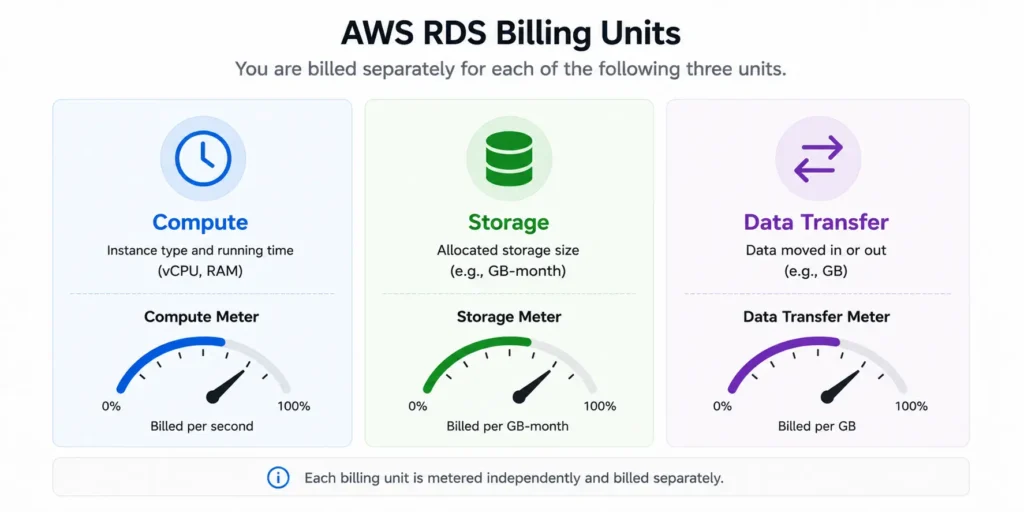
Cloud providers meter consumption at the resource level and aggregate charges into a monthly bill. The billing unit varies by service type.
- Compute is billed by the second or hour. EC2, Azure VMs, and GCP Compute Engine instances accrue charges from the moment they start until they are terminated. A stopped EC2 instance no longer charges for compute, but it continues charging for attached EBS volumes. A terminated instance ends billing entirely.
- Storage is billed by the gigabyte-month. S3, Azure Blob, and GCP Cloud Storage charge based on how much data you store multiplied by how long it sits there. Additional charges apply for requests (PUT, GET, LIST operations) and for data retrieval from lower-cost storage tiers like S3 Glacier.
- Data transfer is billed by the gigabyte transferred. Inbound data into cloud regions is typically free. Outbound data or egress is charged at rates that vary by destination. Traffic leaving AWS to the public internet costs more than traffic to another AWS region, which costs more than traffic within the same availability zone. In architectures with heavy service-to-service communication or large data exports, egress is often the line item that surprises teams the most. See the full breakdown in our cloud cost optimization guide.
- API and managed services are billed per request or per unit of work. Lambda charges per invocation and per GB-second of execution. DynamoDB charges per read and write request unit. SageMaker charges per instance-hour for training and per endpoint-hour for inference. Each service has its own metering logic, which means a single architecture can have dozens of independent billing meters running simultaneously.
Why Usage-Based Pricing Creates Bill Shock
The model’s core benefit, i.e., pay only for what you use breaks down when “what you use” is poorly defined, unmonitored, or structurally inflated by how the architecture is designed.
Idle resources are the most common cause. Cloud billing doesn’t distinguish between a server processing traffic and a server sitting idle. An EC2 instance provisioned for a load test that was never cleaned up bills at full on-demand rates indefinitely. An RDS database running at 3% CPU utilization charges the same as one at 80%. The usage-based model bills for existence, not output, which means provisioned but unused capacity is pure waste.
Egress charges compounds quietly. A microservices architecture where services call each other across availability zones generates inter-AZ data transfer charges on every request. At low traffic volumes, the cost is negligible. At scale, the same pattern can add tens of thousands of dollars per month to a bill that was budgeted based on compute alone.
Commitment miscalibration leaves savings unrealized. AWS, Azure, and GCP all offer 30–60% discounts on compute in exchange for 1- or 3-year usage commitments, Reserved Instances, Savings Plans, and CUDs. These commitment instruments don’t replace usage-based pricing; they apply a discounted rate to a portion of it. Getting the coverage ratio right requires accurate demand forecasting.
- Under-commit and you pay on-demand rates for baseline workloads.
- Over-commit and you pay for reservations that go unused.
Most teams land between the two extremes, partially covered, partially optimized.
Tagging gaps hide cost attribution. When cloud spend isn’t tagged to a team, product, or environment, the usage-based bill becomes a single undifferentiated number that no one can act on. Without allocation visibility, there’s no way to identify which workloads are generating runaway spend.
Usage-Based Pricing vs Subscription Pricing: The Real Tradeoff
Usage-based pricing and subscription pricing represent two fundamentally different cost structures, and the right choice depends on consumption predictability.
| Factor | Usage-Based | Subscription |
| Cost when idle | Near zero | Full price |
| Monthly predictability | Low; varies with consumption | High; fixed fee |
| Scales with growth | Automatically | Requires plan upgrade |
| Barrier to entry | Very low | Moderate |
| Risk of surprise charges | Higher | None |
| Optimization lever | Commitment discounts | Negotiated volume pricing |
Cloud infrastructure is inherently usage-based, which is why commitment discounts exist as the primary cost control mechanism. The Savings Plan model on AWS, for example, is effectively a hybrid: you commit to a minimum spend level per hour (a subscription-like floor), and AWS applies the committed rate to whatever usage-based consumption occurs above it.
How Engineering Teams Build Predictability Into Usage-Based Cloud Billing
Three practices consistently separate teams with controlled cloud costs from teams with escalating ones.
Tagging and cost allocation first. Before any optimization is possible, spend must be attributable. A tagging taxonomy applied across all resources and enforced through policy, maps usage-based billing line items back to the teams and products that generated them. This creates accountability and makes anomalies visible before they compound.
Rightsizing to reduce the baseline. Usage-based pricing charges for provisioned capacity on most instance types, not utilized capacity. An m5.4xlarge provisioned for peak load but running at 15% average CPU is billing for 85% of capacity that goes unused. Rightsizing analysis identifies these gaps and reduces the consumption baseline that billing meters against, often delivering 15–25% savings before any commitment discount is applied.
Commitment management to lock in discounted rates. Once a reliable consumption baseline is established through rightsizing, Reserved Instances and Savings Plans can be applied accurately. The goal is to cover predictable baseline usage with committed rates and let genuinely variable demand float on-demand. The harder problem is keeping coverage calibrated as workloads change, which is where most manual approaches fall short.
How Usage.ai Manages Usage-Based Cloud Costs
Usage.ai is built specifically for the commitment management layer of usage-based cloud environments. The platform continuously analyzes consumption patterns across AWS, GCP, and Azure, then automatically purchases and manages Reserved Instances, Savings Plans, and CUDs on your behalf, keeping coverage calibrated in real time as workloads scale and change.
Customers achieve 30–50% reductions on compute spend without manual analysis or engineering involvement. Usage.ai’s own pricing mirrors the model it optimizes: you pay a percentage of realized savings only, with no upfront cost and no charge if savings are not delivered.

Frequently Asked Questions
1. What is usage-based pricing in cloud computing?
Usage-based pricing in cloud computing is a billing model where customers pay for the resources they actually consume, measured in compute hours, API calls, storage gigabytes, or data transferred rather than a fixed monthly fee. AWS, Azure, and GCP all default to this model across their service catalogs, which means cloud bills fluctuate based on actual consumption each period.
2. Why does my cloud bill spike with usage-based pricing?
Cloud bill spikes under usage-based pricing are most commonly caused by idle resources that remain provisioned and billing, unexpected egress charges from data transfer between services or regions, and miscalibrated commitment coverage that leaves baseline workloads on expensive on-demand rates. Without resource tagging and spend attribution, these spikes are often invisible until they appear on the monthly bill.
3. What is the difference between usage-based pricing and Reserved Instances?
Reserved Instances don’t replace usage-based pricing. They apply a discounted rate to a committed portion of it. You agree to use a specific instance configuration for 1 or 3 years, and AWS applies up to 60% off the on-demand rate for matching usage. The underlying billing is still consumption-based; the commitment locks in a lower per-unit price for the baseline you know you’ll consume.
4. How do cloud providers meter usage-based charges?
Each cloud service uses a different billing unit. Compute is metered by the second or hour from start to termination. Storage is metered by the gigabyte-month. Data transfer is metered by the gigabyte of outbound traffic. API-based services like Lambda or DynamoDB are metered by the request or unit of work. A single cloud architecture typically has dozens of these meters running simultaneously, each contributing to the monthly bill.
5. Does usage-based pricing work for startups?
Usage-based pricing is well-suited to early-stage companies because it eliminates upfront infrastructure cost and scales automatically with growth. The risk increases as spend grows, without tagging, rightsizing, and commitment management practices in place, usage-based billing can become difficult to forecast or control. Most startups benefit from establishing cost governance practices before cloud spend exceeds $20,000 per month.
6. Is usage-based pricing cheaper than subscription pricing for cloud?
For workloads with highly variable demand, usage-based pricing is typically cheaper; you only pay for what you use and avoid paying for idle capacity. For stable, predictable workloads, commitment instruments (Reserved Instances, Savings Plans, CUDs) applied to usage-based billing can achieve effective rates 40–60% below on-demand pricing, making optimized usage-based billing highly competitive with subscription models.