.png)



The FinOps industry has found its next buzzword. Agentic FinOps is showing up in announcements, product launches, and analyst reports with enough frequency that the term is losing precision before most practitioners have had a chance to form an opinion on it. That is worth slowing down on.
The concept itself is legitimate and important. The problem is that almost every usage of the phrase describes something different. Some vendors mean a chatbot that answers cost questions. Others mean a recommendation engine with a chat interface.
A few mean systems that actually take autonomous action on your cloud bill without requiring human approval for each step. Those last ones are the ones worth paying attention to, because the first two have existed for years under different names.
This post tries to define agentic FinOps clearly, explain where it already operates at scale, and be honest about where the category is still early.
%2013%20(5).svg)
What ‘Agentic’ Actually Means in This Context
The word agent in software has a specific meaning: a system that perceives its environment, reasons about a goal, and takes action to achieve it — repeatedly, without constant human instruction. What separates an agent from a tool is that a tool executes a command a human issued. An agent decides what to do next based on the current state.
Applied to FinOps, an agentic system would not just surface that your Reserved Instance coverage dropped to 51% after a workload migration. It would detect the drop, model the current usage pattern, determine the right new commitment configuration, purchase it, and confirm utilization improved — all before a human checked their dashboard.
That is meaningfully different from the current state of most FinOps tooling, which is: visibility layer that shows costs, a recommendation engine that suggests actions, and manual purchasing step where a human goes into the console and buys something. The last step is where most of the delay and most of the missed savings live.
The Two Categories of Agentic FinOps: Commitment Automation and Data Cloud Optimization
The term is being applied to two genuinely different problem spaces right now, and it helps to keep them separate because the maturity, the applicable spend, and the tooling are all different.
Commitment automation: the larger, more established category
This is the management of Savings Plans, Reserved Instances, and Committed Use Discounts across AWS, Azure, and GCP. For most organizations running cloud at scale, this is the single highest-leverage cost category — the delta between on-demand rates and committed rates on the compute that runs continuously. At a $3M annual cloud bill, 45% running on-demand at 30-50% commitment discount opportunity represents $400,000 to $675,000 in recoverable spend per year.
The reason this is difficult to manage well has nothing to do with AI. It is a data freshness and execution speed problem. AWS Cost Explorer refreshes Savings Plan recommendations every 72 hours or more. Your workload changes continuously. By the time a recommendation is generated, acted on, approved, and purchased, the usage pattern it was based on may be a week old. At $10,000 per day in uncovered stable compute, a 7-day lag is $70,000 in avoidable on-demand charges per purchase cycle.
Agentic systems close this gap by running the full cycle autonomously: analyze current usage daily, size the right commitment from the stable floor, purchase it without waiting for a ticket to be approved, monitor utilization, and adjust as usage changes. That loop, run continuously rather than quarterly, is what turns commitment management from a project into a process.
Data cloud optimization: the newer, narrower category
This covers platforms like Snowflake and Databricks, which have their own compute billing models distinct from AWS, Azure, and GCP infrastructure. Snowflake bills by credit consumption per warehouse. Databricks bills by DBU (Databricks Unit) per cluster. Both can scale compute automatically in ways that make manual oversight impractical.
Agentic optimization here looks different than on the infrastructure commitment layer. The levers are workload-level: automatically suspending idle warehouses, right-sizing cluster configurations based on job performance, identifying runaway queries before they generate four-figure compute bills, and attributing cost to the team or pipeline that generated it. These are genuinely harder problems than commitment purchasing because they require deep integration with query execution plans, job scheduling, and data pipeline orchestration.
This category is earlier in maturity than commitment automation. The tools that do it well require rich, warehouse-level telemetry that is distinct from the billing-layer data that commitment platforms typically operate on. It is a real problem worth solving — Snowflake and Databricks spend is among the fastest-growing cost categories in enterprise data infrastructure — but it is a different problem from commitment optimization, and conflating the two misses the fact that most organizations have not yet captured the simpler, larger savings on their core cloud compute.
Also read: AWS Savings Plans: The Complete Guide to Compute Savings Plans for EC2, Fargate, and Lambda
Why the Recommendation-to-Action Gap Is the Real Problem
Every FinOps practitioner has experienced the recommendation-to-action gap. It looks like this: a tool surfaces a Savings Plan opportunity, a ticket gets created, it sits in a backlog for two weeks, someone eventually reviews it, asks three clarifying questions, gets an answer a week later, and purchases a commitment that was sized on usage data from a month ago. Meanwhile the workload has been running on-demand the entire time.
This is not a hypothetical. The FinOps Foundation’s 2025 State of FinOps report found that workload optimization and waste reduction remain the top priority for more than half of FinOps practitioners — which means the problem is not visibility. Organizations have plenty of dashboards. The execution gap is where optimization stalls.
Agentic systems address this by eliminating the human-in-the-loop requirement for the purchasing step on workloads that have already been analyzed and validated as commitment candidates. The human sets the policy: cover at least 70% of stable compute baseline, use 1-year No Upfront terms, refresh daily, maintain utilization above 90%. The agent executes that policy continuously.
This is a governance model, not a bypass of governance. The human still defines the rules. The agent still operates within them. What changes is the cycle time from opportunity identified to commitment purchased — from weeks to hours.
What Agentic FinOps Is Not
It is worth being direct about what the label does not cover, because the term is being used loosely enough that the signal is getting lost in the noise.
A chatbot that answers cost questions
Asking an AI assistant ‘what drove my AWS bill up this month’ and getting a natural-language summary is useful but it is not agentic. It is retrieval and synthesis. No action is taken. The human still needs to review the answer, decide what to do, and do it. This is the Inform phase of FinOps dressed in a chat interface. Better than a static dashboard in some ways, but it does not close the execution gap.
A recommendation engine with better UX
Many tools have added AI-generated recommendations that surface in plain language rather than a table of utilization percentages. That is a UX improvement and it is genuinely helpful. But if clicking the recommendation still lands you in a multi-step approval workflow before anything is purchased, the agentic label is doing a lot of work for what is fundamentally a human-executed process.
Anomaly detection that fires an alert
Real-time anomaly detection is valuable and legitimately AI-powered in many implementations. When a Databricks job triggers an unexpected DBU spike at 2 AM and an alert fires in Slack 10 minutes later, that is faster than a dashboard refresh. But it is still alerting. An agentic system would detect the anomaly and execute a configured response — pause the warehouse, cap the query, throttle the job — without requiring a human to wake up and intervene. The distinction matters in practice, especially when runaway AI agent workloads can generate four-figure bills in under an hour.
The Scope Question: Where Is Your Biggest Autonomous Optimization Opportunity?
Organizations implementing FinOps programs typically sequence their optimization efforts by impact. The hierarchy tends to be: first, eliminate obvious waste (idle resources, unattached volumes, unused reservations); second, right-size overprovisioned compute; third, capture commitment discounts on stable baseline workloads.
The third category — commitment coverage — is typically the largest dollar opportunity and the one where autonomous systems deliver the most value relative to manual processes. The reason is scale and speed. A FinOps team managing 200 AWS accounts, each with EC2, RDS, ElastiCache, Redshift, and Lambda running, cannot practically monitor commitment coverage daily across all services and accounts. An autonomous system can.
For organizations that have not yet reached 70-80% commitment coverage on their AWS, Azure, or GCP compute, that is almost certainly the larger opportunity compared to Snowflake or Databricks optimization. The commitment discount on eligible compute is 30-66% from the first dollar covered. At $1M in annual on-demand EC2 spend, a 1-year No Upfront Compute Savings Plan at 70% coverage delivers approximately $218,000 in annual savings with zero upfront payment. No Databricks optimization or Snowflake warehouse tuning is going to close a gap that large in the same timeframe.
That is not an argument against optimizing data cloud spend. It is an argument for sequencing correctly, and for being clear about which category of agentic FinOps you need most right now.
Also read: Cloud cost optimization best practices: The 20 strategies that actually move the number
What Genuine Commitment Automation Looks Like
For the compute commitment layer, agentic operation has four characteristics that distinguish it from a recommendation platform.
First, it purchases without approval queues for policy-compliant commitments. The policy is set by the FinOps team and approved at the policy level, not at the individual commitment level. Every commitment that falls within the defined parameters — coverage target, term length, payment type, utilization threshold — executes automatically.
Second, it operates on a refresh cycle fast enough to match how quickly cloud environments change. The 24-hour cycle matters because usage patterns shift with deployments, traffic changes, and workload migrations that happen continuously. A weekly recommendation cycle means you are always optimizing for last week’s infrastructure.
Third, it monitors utilization continuously and adjusts coverage when workloads change. Purchasing a commitment is the easy part. Managing it through an architecture migration, a scale-down event, or a product decommission without generating stranded spend is where the real operational complexity lives.
Fourth, it carries downside protection for the cases where autonomous purchasing gets the sizing wrong, or where the workload changes after purchase in ways the system could not predict. At Usage.ai, that protection is the buyback guarantee: if a commitment becomes underutilized because of a usage shift, the unused portion comes back as cashback in real money. That changes the sizing calculus from conservative to accurate — the downside of getting it wrong is covered, which means the system can commit at the right level rather than a hedge.
How Usage.ai Fits in the Agentic FinOps Picture
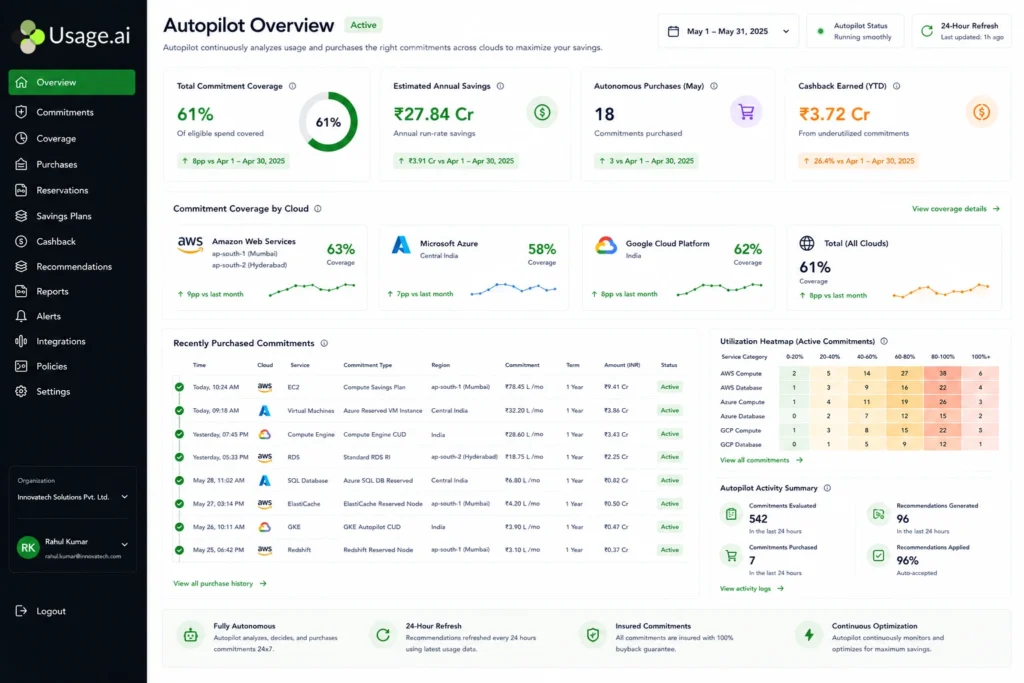
Usage.ai‘s Autopilot is the execution layer for commitment-based discounts across AWS, Azure, and GCP. It purchases Savings Plans, Reserved Instances, and Committed Use Discounts autonomously on a 24-hour refresh cycle, monitors utilization, and backs every commitment with the buyback guarantee described above.
This covers EC2 and Fargate through Compute Savings Plans, RDS through Database Savings Plans and Reserved Instances, ElastiCache, OpenSearch, Redshift, and DynamoDB through Reserved Instances, Azure VMs and workloads through Azure Savings Plans and Reservations, and GCP compute through Committed Use Discounts. The scope is the compute and database commitment layer across all three major clouds.
Where Usage.ai does not currently operate: Snowflake and Databricks optimization, query-level data platform tuning, or workload scheduling within data pipeline orchestration tools. Those are different problems that require different integrations, and teams with significant Snowflake or Databricks spend are right to look for purpose-built tools for that layer. But those tools are optimizing a different slice of the bill than what commitment automation covers, and for most organizations the commitment layer is still the larger opportunity.
The full picture of autonomous cloud cost optimization in 2026 combines both layers: commitment purchasing automation on the infrastructure side, and workload-level optimization on the data cloud side. Neither replaces the other. The sequencing question is which one addresses your largest current gap.
$91M+ in savings delivered to 300+ customers across AWS, Azure, and GCP. Fee is a percentage of realized savings only. No savings, no fee. 30-minute setup, billing-layer access only.
%204.svg)
Frequently Asked Questions
1. What is agentic FinOps?
Agentic FinOps refers to AI systems that take autonomous action on cloud costs rather than just generating recommendations for humans to act on. The distinguishing feature is execution: an agentic system makes decisions and acts on them within defined policy guardrails, without requiring human approval for each individual step. Applied to cloud commitment management, this means automatically purchasing Savings Plans and Reserved Instances when usage patterns support them, monitoring utilization, and adjusting coverage as workloads change — all on a continuous cycle.
2. How is agentic FinOps different from traditional FinOps tooling?
Traditional FinOps tooling is primarily a visibility and recommendation layer. It shows you what you are spending, identifies optimization opportunities, and suggests actions. The human still executes each action. Agentic systems close the recommendation-to-action gap by executing policy-compliant optimizations autonomously. The human defines the policy and reviews outcomes rather than approving each individual purchase. This changes the cycle time from weeks to hours and allows optimization to scale across accounts and services without proportional headcount growth.
3. Does agentic FinOps apply to Snowflake and Databricks costs?
Yes, though it is a different application than infrastructure commitment automation. Snowflake and Databricks use consumption-based billing models at the warehouse and cluster level. Agentic optimization there focuses on workload-level actions: suspending idle warehouses, right-sizing cluster configurations, capping runaway queries, and attributing cost to specific teams and pipelines. This is a newer and technically more complex area than compute commitment purchasing, requiring deep integration with query execution and data pipeline systems.
4. What is the largest autonomous cloud cost optimization opportunity for most organizations?
For most organizations that have not yet reached 70-80% commitment coverage on their AWS, Azure, or GCP compute, the commitment layer is the largest autonomous optimization opportunity. The discount on eligible compute is 30-66% from the first covered dollar, and the scale of eligible spend — all continuously running EC2, RDS, Azure VMs, GCP compute — dwarfs most organizations’ Snowflake or Databricks bills. Both categories benefit from automation, but the sequencing should reflect where the largest gap is.
5. How does Usage.ai’s autonomous commitment purchasing work?
Usage.ai’s Autopilot analyzes your actual cloud usage daily across AWS, Azure, and GCP. For workloads with stable utilization patterns, it sizes Savings Plan and Reserved Instance commitments to the stable spend floor, purchases them without requiring individual approval for each transaction, monitors utilization, and adjusts coverage as usage changes. Every commitment is backed by a buyback guarantee: if a committed workload becomes underutilized because of a usage shift, the unused portion is returned as cashback in real money. Fee is a percentage of realized savings only.