.png)
 AWS
AWS Microsoft Azure
 Google Cloud


In the hypothetical example below, the 30% offer leaves the company with $600 more each month.
Both offers produce the same cloud cost. The difference is which savings dollars each provider uses to calculate its fee.
Before negotiating the percentage, ask the provider to show you the fee in dollars.
Start with what you already pay
To compare two savings-based offers fairly, first agree on what the same workload would cost without the new provider, including discounts and commitments you already have.Suppose:
Reference cost before existing discounts: $100,000 per month
Cost without the new provider, after existing discounts: $88,000
Cloud cost with either new provider, before its fee: $70,000
The $88,000 amount is therefore the relevant no-provider cost for this modeled month.
If either provider reduces that cost to $70,000, the new optimization creates $18,000 of incremental savings before the provider fee.
Use the same workload, month, scope, and currency for both offers.
For more detail on checking baselines and existing commitments before accepting a savings estimate, see Usage.ai’s guide to verifying cloud savings claims before signing a contract.
The fee base can change the result
Now compare two hypothetical offers.Illustrative example only. These figures are not the pricing of Usage.ai or any other named provider. Both offers are assumed to produce the same $70,000 cloud cost. Other costs, protection, and exit terms are excluded so the example isolates the effect of the fee base.
| Monthly measure | Offer A | Offer B |
|---|---|---|
| Reference cost before existing discounts | $100,000 | $100,000 |
| Cost without new provider | $88,000 | $88,000 |
| Cloud cost with provider, before fee | $70,000 | $70,000 |
| Incremental savings before fee | $18,000 | $18,000 |
| Savings used to calculate fee | $30,000 total savings | $18,000 incremental savings |
| Fee percentage | 20% | 30% |
| Provider fee | $6,000 | $5,400 |
| Cloud cost plus provider fee | $76,000 | $75,400 |
| Additional savings the company keeps | $12,000 | $12,600 |
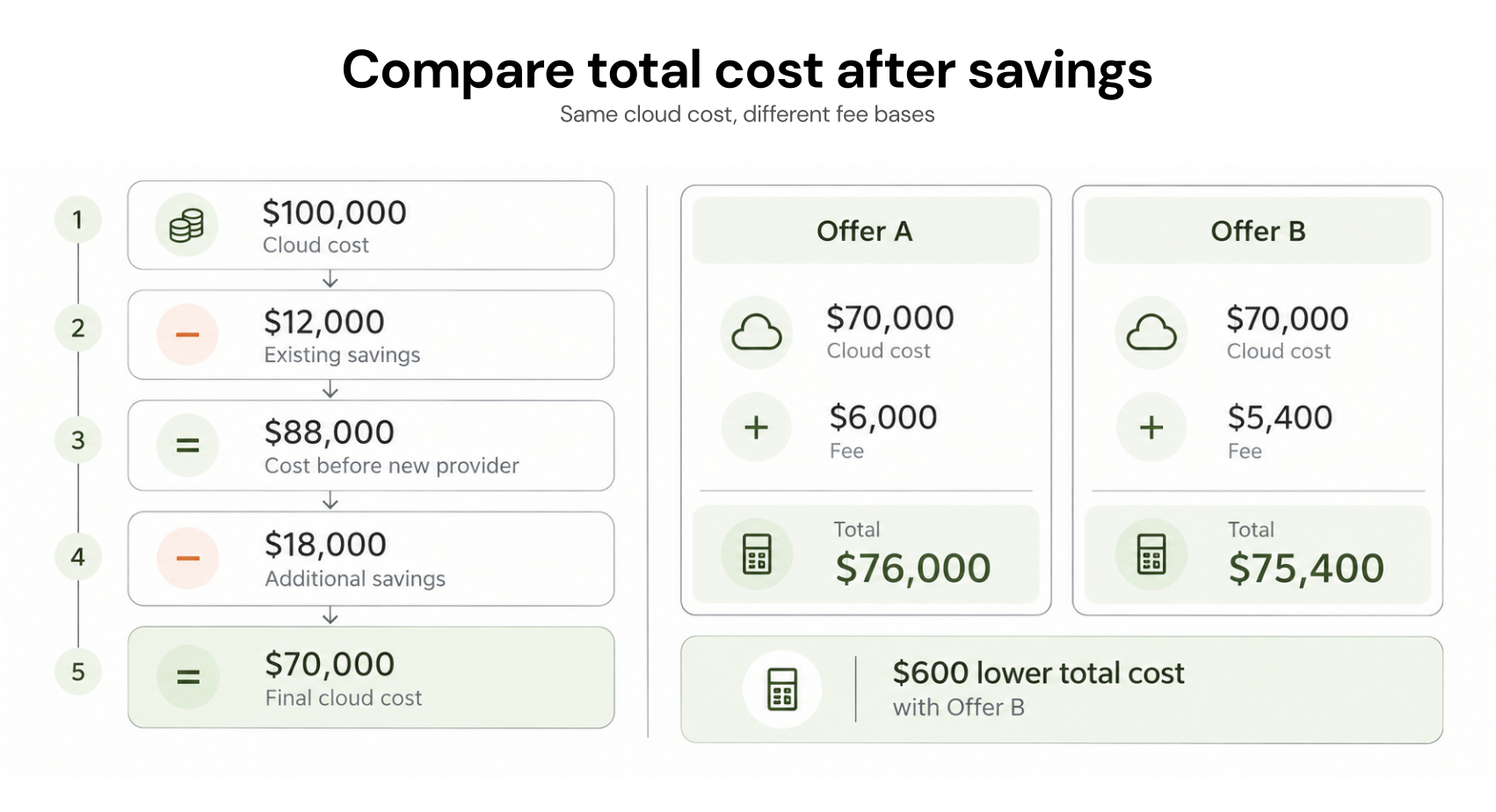
It is because Offer B applies its percentage to $18,000 of incremental savings, while Offer A applies its percentage to $30,000, which includes the $12,000 the company was already saving.
If both providers charged their percentages against the same $18,000 fee base, the 20% offer would be cheaper.
Zesty, meanwhile, currently publishes a 25% entry model for Commitment Manager, while its billing documentation says the applicable fee for an individual business is defined in its contract. Treat a published rate as a starting point, not a complete quote. Review Zesty’s pricing model
These are separate examples. Neither is Offer A or Offer B.
Compare the same scope and a lower-usage month
A savings percentage is also difficult to compare if the providers manage different things.One offer might cover commitment optimization only. Another might include additional services or operating work. Before comparing fees, confirm that both proposals cover the same accounts, workloads, services, and period.
Then ask both providers to price a lower-usage month.
For that new scenario, recalculate:
What would the workload cost without the provider, after existing discounts?
Then compare that with:
What would the workload cost with the provider, including unused commitments and the provider fee?
This matters because commitment utilization affects net savings. The FinOps Foundation’s Commitment Discounts Overview explains that unused commitment capacity can reduce the economic benefit as coverage increases.
Model expected usage, a moderate decline, and a significant decline.
If unused commitment cost is already included in cloud cost, do not subtract it again. Similarly, show any Cashback or refund separately and count it only once.
A cleaner buyer calculation is:
This is a comparison framework, not a replacement for a provider's contractual billing methodology.
Check minimum charges, contract length, and exit costs
A savings-based fee is only one part of commercial economics.Before choosing an offer, confirm:
whether there is a minimum monthly or annual charge
whether the rate changes with contract length
whether implementation or other fees apply
what happens when the relationship ends
whether commitments or other financial obligations continue after exit
How Usage.ai approaches savings-based pricing
At Usage.ai, we charge an agreed share of the realized savings generated through the Flex Commitment Program, rather than charging against a projected savings opportunity. Our current pricing documentation explains that savings-based billing is calculated after cloud-provider usage and billing data is finalized. See how Usage.ai pricing worksWe built Flex Insured Commitments for exactly that lever. With Flex Insured Commitments, teams can get the 30–50% savings of cloud commitments across AWS, Azure, and GCP with none of the commitment risk: there’s no multi-year lock-in, and we purchase and manage commitments on your behalf once you approve a recommendation.
Cashback protection returns the difference in real money, not credits, whenever a commitment costs more than the equivalent on-demand usage.
Our fee is a percentage of realized savings, billed monthly in arrears, if we don’t save you anything, you pay nothing. Setup happens at the billing layer with no infrastructure changes required.
Before comparing the offers
Ask each provider to return the same comparison:Cloud cost without its service
Cloud cost with its service
Provider fee in dollars
Additional savings you keep
The same numbers under lower usage
Review savings, fees, downside scenarios, and eligible cashback to see your net value.
Frequently asked questions
Is a lower savings-share percentage always cheaper?
No. The fee also depends on the savings amount to which the percentage is applied. A lower percentage can produce a higher bill when it uses a broader fee base.
Should existing commitment savings count as new provider savings?
Existing savings and incremental savings should be shown separately. Whether existing savings are included in a provider's billable fee base depends on that provider's pricing methodology and contract.
What baseline should be used to compare savings-based fees?
Use what the same workload would cost without the new service after accounting for existing discounts and commitments. Use the same measurement period and workload assumptions for every offer.
How should underutilization be included?
Rebuild both the no-provider and with-provider costs for the lower-usage scenario. Include unused commitment cost once. Do not subtract the same underutilization loss again if it is already reflected in cloud cost.
What should Finance compare at the end?
Finance should compare the cloud cost with and without the service, the provider fee, other incremental costs, any covered Cashback or refunds counted once, and the additional financial value the company retains.