.png)


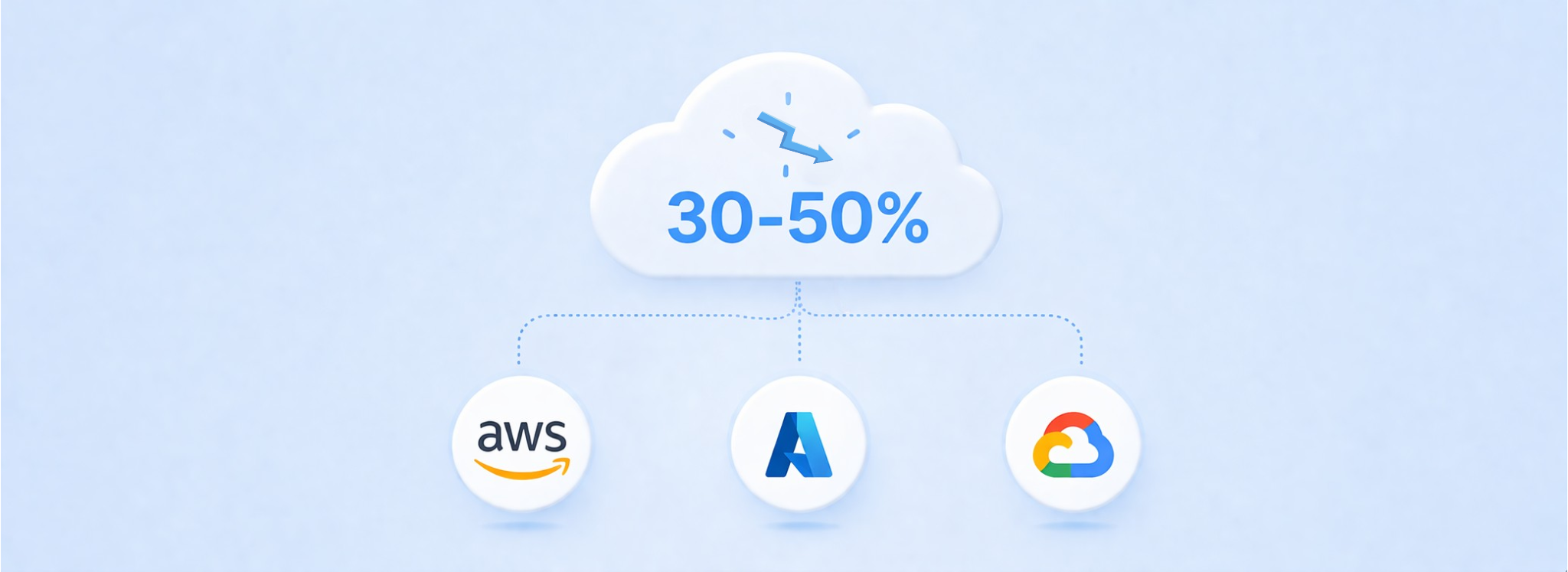
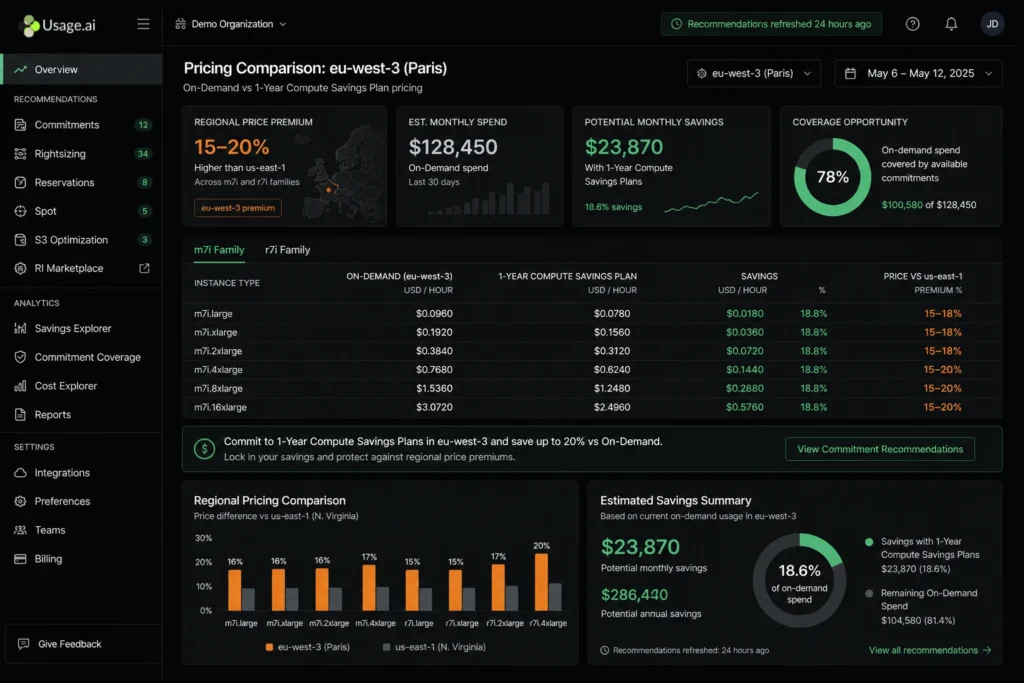
French enterprises running workloads on AWS eu-west-3 (Paris), Azure France Central, or Google Cloud Europe-West often face a hidden cost disadvantage: infrastructure in European regions can carry a 15–20% premium over comparable US regions, causing cloud spend to compound much faster as workloads scale.
It’s a regulatory environment that mandates data residency decisions driving architecture choices that would otherwise be cost-optimized away, and a FinOps skills gap in the French market that leaves commitment purchasing either absent or miscalibrated for 12-18 months after deployments stabilize. The result is a predictable pattern of waste, typically 25-35% of annual cloud spend, that persists long after the initial infrastructure build is complete.
This guide ranks the ten most effective cloud cost optimization tools for France available in 2026, with specific attention to GDPR compliance, regional coverage, and the automation depth that determines whether a tool delivers a dashboard or actual savings.
What is Cloud Cost Optimization?
Cloud cost optimization is the process of systematically reducing cloud infrastructure spend across Amazon Web Services (AWS), Microsoft Azure, and Google Cloud Platform (GCP) while maintaining or improving performance.
For French businesses, this includes managing Reserved Instances, Savings Plans, and Committed Use Discounts alongside General Data Protection Regulation (GDPR) data residency requirements enforced by the CNIL (Commission Nationale de l’Informatique et des Libertés). The highest-impact lever is commitment coverage: moving baseline workloads from on-demand pricing (the default and most expensive option) onto discounted commitment vehicles, which can reduce compute spend by 30-50% without any infrastructure changes.
Why French Businesses Face Unique Cloud Cost Challenges
France is one of the largest AWS, Azure, and GCP markets in continental Europe, but the specific combination of data residency law, regional pricing, and enterprise procurement culture creates cost dynamics that generic cloud cost tools do not address.
- EU-west-3 regional pricing premium: AWS on-demand pricing for eu-west-3 (Paris) runs approximately 15-20% above equivalent US-East-1 pricing for the same instance families. Azure France Central and GCP Europe-West carry similar premiums. For a company spending EUR 1M/year on cloud, this premium represents EUR 150,000-200,000 in additional cost before any commitment optimization is applied.
- GDPR data residency requirements: Articles 5 and 44-49 of the General Data Protection Regulation (GDPR) impose strict requirements on where personal data may be processed and stored. Many French enterprises and their legal teams interpret these requirements to mandate eu-west-3 or France Central workloads, which eliminates the option of migrating to lower-cost US or Asian regions as a cost strategy.
- SecNumCloud and NIS2 compliance overlap: ANSSI (Agence Nationale de la Securite des Systemes d’Information) SecNumCloud certification is required for cloud services handling sensitive government data, while the NIS2 Directive (effective October 2024) mandates cybersecurity risk management for organizations in critical sectors. Both frameworks push architecture decisions that can increase compute costs if commitment strategies are not adjusted.
- FinOps maturity gap: The FinOps Foundation’s 2025 State of FinOps report identifies France as having a lower rate of commitment coverage than UK, Germany, and Nordic markets. French enterprises on average cover only 45-55% of eligible workloads with commitments versus a 65-75% benchmark for leading FinOps organizations, leaving substantial savings uncaptured.
- Cloud waste benchmark: IDC (2025) estimates that European enterprises waste an average of 30% of cloud spend, with France-specific data indicating slightly higher waste rates due to the regional pricing premium and lower commitment penetration.
What to Look for in a Cloud Cost Tool for French Businesses
Not all cloud cost optimization tools are built for the French market. The following five criteria are mandatory, not optional, for any tool deployed in a GDPR-regulated environment with multi-cloud workloads in eu-west-3, France Central, and GCP Europe-West.
- GDPR-compliant data access model (billing-layer-only): Any cloud cost tool that requires access to your infrastructure, application data, or workload configuration creates a GDPR data processing agreement obligation and potential Article 5(1)(f) security risk. The correct access model is billing-layer-only, read-only access to cost and usage metadata (AWS Cost and Usage Report, Azure Cost Management APIs, GCP Billing Export). The tool should never touch running instances, databases, or application data. This is the minimum requirement for deploying any third-party cost tool in a GDPR-regulated environment in France.
- Tri-cloud coverage (AWS, Azure, GCP): Most French enterprises at or above EUR 500K/year cloud spend run workloads across at least two clouds. A tool that optimizes AWS alone leaves Azure Reserved Instances and GCP Committed Use Discounts unmanaged. Require native coverage for all three platforms before evaluating features.
- Automated commitment purchasing (not just recommendations): The market differentiator is automation. Tools that produce Savings Plan and Reserved Instance recommendations require a FinOps analyst to review, approve, and execute purchases manually, typically on a 30-90 day cycle. Platforms that purchase commitments autonomously on a 24-hour refresh cycle deliver 3-5x more coverage in the first 90 days. For a company spending EUR 2M/year on AWS, the difference between a recommendation tool and an autonomous purchasing tool is typically EUR 200K-400K in annual savings.
- Financial guarantee (cashback or credits on underutilization): Commitment purchasing carries risk: if workloads shrink after a commitment is purchased, the unused commitment is a sunk cost. Tools that offer cashback or credits for underutilized commitments remove this risk from the customer. Verify whether the guarantee is in real cash (transferable) or in platform credits (locked to continued spend with the vendor).
- Recommendation refresh speed (24-hour vs 72-hour cycle): AWS Cost Explorer refreshes commitment recommendations every 72+ hours. At a spend rate of EUR 8,000-12,000/day (typical for a EUR 3M/year cloud bill), a 72-hour lag versus a 24-hour refresh cycle represents EUR 24,000-36,000 in uncaptured savings per recommendation cycle. Require 24-hour or sub-24-hour refresh from any tool evaluated for production use.
Also read: AWS Savings Plans vs Reserved Instances: A Practical Guide to Buying Commitments
Best Cloud Cost Optimization Tools in France (2026)
The ten tools below are ranked by how much actual savings they deliver for French enterprises, not by feature count or marketing positioning. The ranking weighting: automation depth (40%), GDPR compliance (25%), savings guarantee (20%), and multi-cloud coverage (15%).
#1 Usage.ai
The only tri-cloud platform with insured commitments, real cashback, and GDPR-safe billing-layer-only access
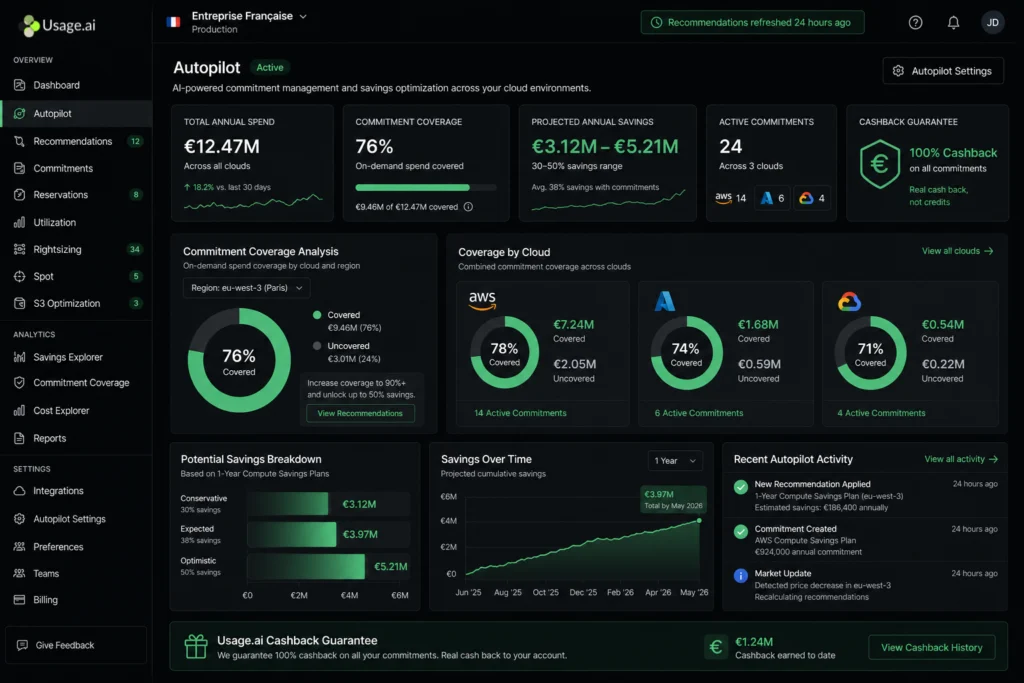
Usage.ai is the strongest cloud cost optimization tool available to French enterprises in 2026, and the gap between it and the next-best option is not marginal. While every other platform on this list either optimizes a single cloud, requires manual execution, or offers only vendor credits as a safety net, Usage.ai delivers autonomous commitment purchasing across AWS, Azure, and GCP simultaneously, with real cashback on any underutilized commitment and full billing-layer-only access that satisfies GDPR Article 5(1)(f) requirements without any Data Processing Agreement complexity.
The platform connects to your cloud environment through read-only billing APIs (AWS Cost and Usage Report, Azure Cost Management APIs, GCP Billing Export) and never accesses running instances, databases, application code, or any resource classified as personal data under GDPR.
For French IT leaders who have had legal teams block third-party cloud tool deployments over infrastructure access concerns, this is the architecture that resolves that objection entirely. There is nothing to debate about GDPR compliance when the tool only sees cost metadata.
On the savings side, the numbers are concrete. Usage.ai has recovered over $91M in cloud savings across its customer base, with customers achieving 30-50% savings within 60 days of onboarding.
Setup takes 30 minutes. Pricing is a percentage of realized savings only: zero upfront cost, zero lock-in, and you pay nothing until savings appear on your bill. Customers include Motive, EVgo (NASDAQ: EVGO), Secureframe, CoinDesk, and Zumba.
Best for: French enterprises spending EUR 500K+ annually on AWS, GCP, or Azure who need GDPR-compliant autonomous optimization with a guaranteed savings outcome and real financial protection on every commitment purchased
See how much you can save on AWS, GCP, or Azure in France with Usage.ai
#2 ProsperOps (now part of Flexera)
Strong autonomous AWS commitment management, but AWS-only and credits instead of cashback
ProsperOps built one of the better autonomous commitment management engines in the market, with a track record of driving high Savings Plan and Reserved Instance coverage for AWS-only environments before being acquired by Flexera in January 2026. The platform purchases AWS commitments in small, incremental tranches rather than large one-time buys, which limits overcommitment risk organically. For teams with stable AWS-only workloads, it is a credible autonomous option.
The limitations are significant for French enterprises. ProsperOps covers AWS only, leaving Azure and GCP workloads entirely unoptimized. Its underutilization protection comes in the form of AWS credits rather than real cashback, meaning any “refund” for a poorly performing commitment is locked to future AWS spending and cannot be redirected elsewhere. Since its acquisition by Flexera, product roadmap visibility has become less clear, and some enterprise buyers have reported longer sales cycles and pricing complexity as the integration progresses.
For French enterprises with multi-cloud environments or those wanting real cashback protection rather than vendor credits, ProsperOps leaves meaningful gaps that Usage.ai fills directly. It ranks second on this list because the autonomous purchasing engine is genuinely good for AWS workloads, but the AWS-only scope and credit-based guarantee keep it behind Usage.ai for any multi-cloud French organization.
Best for: AWS-only organizations that want autonomous commitment purchasing and are comfortable with credit-based (rather than cashback) underutilization protection
#3 Zesty
Real-time resource autoscaling with commitment management, AWS-focused with limited multi-cloud reach
Zesty takes a different approach to cloud cost optimization than pure commitment tools. Rather than forecasting and purchasing commitments ahead of demand, Zesty uses machine learning to dynamically scale resources in real-time, reducing waste as it occurs rather than locking in discounts ahead of time. Its three core products cover EC2 and RDS commitment management (Commitment Manager), automatic EBS volume right-sizing (Zesty Disk), and Kubernetes pod and node optimization (Kompass).
For French enterprises with highly variable workloads, Zesty’s reactive model can be effective because it avoids the overcommitment risk that plagues static commitment strategies. The weakness is scope: Zesty remains primarily AWS-focused, with limited native Azure and GCP commitment management. For French organizations running Azure France Central or GCP Europe-West workloads alongside AWS eu-west-3, Zesty leaves significant spend unoptimized.
Zesty avoids overcommitment by scaling down rather than buying insurance for unused commitments, which is a structurally different risk model than Usage.ai’s cashback guarantee. It ranks third here because the technology is genuinely innovative, but the AWS-centric scope and reactive (rather than proactive commitment-based) approach typically produces lower total savings than autonomous commitment purchasing for mid-to-large cloud estates.
Best for: AWS-heavy organizations with highly variable or unpredictable workloads where dynamic resource scaling is more appropriate than long-term commitment forecasting
#4 Harness Cloud Cost Management
Engineering-workflow integration with cost visibility, but recommendations-only on commitments
Harness Cloud Cost Management (formerly Harness CCM) differentiates itself by connecting cloud spend directly to engineering deployment data. When a deployment causes a cost spike, Harness surfaces that connection in the same workflow engineers use for CI/CD, making cost accountability actionable at the point where architecture decisions are made rather than weeks later in a FinOps report. It supports AWS, Azure, and GCP with cost allocation down to service, team, and deployment level.
The limitation for French enterprises focused on maximizing savings is that Harness does not autonomously purchase commitments. It surfaces Savings Plan and Reserved Instance recommendations, but execution remains manual. For organizations where the primary goal is reducing the bill rather than improving cost attribution, Harness is valuable context but not the cost reduction engine. Pair it with Usage.ai for organizations that want both commitment automation and engineering-level cost visibility.
Best for: Engineering-led organizations that want to attribute cloud spend to specific deployments, teams, or features and build cost accountability into CI/CD workflows
#5 CloudHealth by Broadcom
Governance and policy engine for large enterprises, but manual execution required throughout
CloudHealth (acquired by VMware, now under Broadcom after the 2023 acquisition) is one of the oldest multi-cloud governance platforms and retains a large installed base among enterprise IT organizations that use it for policy enforcement, showback/chargeback reporting, and compliance tagging across AWS, Azure, and GCP. For French enterprises with existing CloudHealth deployments and entrenched FinOps reporting workflows, replacing it mid-cycle is rarely justified.
The core problem for organizations evaluating CloudHealth in 2026 is that the Broadcom acquisition has slowed product investment and raised licensing costs significantly. CloudHealth’s commitment optimization capabilities generate recommendations but do not autonomously execute purchases. Every Savings Plan or Reserved Instance purchase still requires a human to approve and execute, which creates the same 30-90 day optimization lag that autonomous platforms eliminate. For a EUR 2M/year cloud bill, that lag compounds to EUR 200K-400K in uncaptured annual savings versus an autonomous platform.
Best for: Large enterprises with EUR 10M+ cloud spend that use CloudHealth for governance and policy management and have separate commitment purchasing workflows
#6 AWS Cost Explorer
Free native AWS visibility and recommendations, but manual execution only and 72-hour data lag
AWS Cost Explorer is the free starting point for any AWS cost management program and should be configured for every eu-west-3 deployment before any third-party tool is evaluated. It provides Cost and Usage Reports, Savings Plan recommendations, Reserved Instance recommendations, rightsizing suggestions from AWS Compute Optimizer, and anomaly detection through AWS Cost Anomaly Detection. For teams spending under EUR 500K/year on AWS, native tools are often sufficient.
The structural limitations are well-documented. Cost Explorer refreshes Savings Plan recommendations on a 72-hour cycle, creating a three-day lag in optimization that costs EUR 24,000-36,000 per cycle at mid-market spend levels. Commitment purchases require manual review and execution in the AWS console. Coverage is AWS-only, with no native visibility into Azure France Central or GCP Europe-West workloads. And there is no financial guarantee on commitment purchases: overcommitment risk is entirely the customer’s problem.
Best for: AWS-only teams spending under EUR 500K/year who need baseline cost visibility and can manage commitment purchases manually without automation
#7 Azure Cost Management + Billing
Free native Azure visibility, no cross-cloud support, no automated purchasing
Azure Cost Management is the native cost visibility tool for Azure France Central workloads and, like AWS Cost Explorer, should be configured as baseline infrastructure for any Azure deployment. It provides cost allocation by resource group, subscription, and tag, along with Azure Reservation recommendations and budget alerts. For French organizations running Azure France Central as their primary cloud, it is the free first step.
The limitations mirror AWS Cost Explorer: manual execution for every reservation purchase, no AWS or GCP coverage, and no financial protection against overcommitment. Azure Reservations purchased based on Cost Management recommendations carry the full overcommitment risk with no refund mechanism if workloads change. For multi-cloud French enterprises or organizations spending over EUR 500K/year on Azure, a third-party platform with automated Azure Reservation purchasing and a cashback guarantee delivers materially better outcomes.
Best for: Azure-primary organizations spending under EUR 500K/year on Azure who need free native visibility and are comfortable with manual reservation purchasing
#8 Flexera One
Enterprise ITAM and cloud governance combined, high cost and complexity for pure cloud cost optimization
Flexera One is a broad technology spend management platform that covers software asset management (SAM), IT asset management (ITAM), and cloud cost management in a single platform. For large French enterprises that need to manage on-premises software licensing alongside cloud costs and want a single vendor relationship for technology financial management, Flexera One provides capabilities no pure-cloud tool matches.
As a cloud cost optimization tool specifically, Flexera One is expensive (EUR 40K+ annual contracts are typical) and slow to deploy (3-6 month implementation timelines are common). Commitment purchasing requires manual execution. The 2026 integration of ProsperOps into the Flexera portfolio adds autonomous AWS commitment management to the platform, but Azure and GCP commitment automation remain less mature. For teams evaluating Flexera One purely for cloud cost optimization without ITAM requirements, Usage.ai delivers better savings outcomes at a fraction of the cost and complexity.
Best for: Large enterprises (EUR 10M+ technology spend) that need integrated SAM, ITAM, and cloud governance in a single platform and have ITAM requirements that justify the contract cost
#9 CloudZero
Best-in-class unit economics and cost attribution, but no autonomous commitment purchasing
CloudZero is the strongest tool in this list for a specific use case: connecting cloud spend to business outcomes at the product feature, customer, or engineering team level. Its unit economics engine attributes cloud costs to the code and products generating them, giving product managers and engineering leads the ability to answer “how much does it cost to serve this customer segment” or “how much does this feature cost per month” with precision that generic cost allocation tools cannot match.
The limitation is the same as most visibility-focused tools: CloudZero surfaces commitment recommendations but does not execute purchases autonomously. For French enterprises where the primary objective is reducing the total cloud bill rather than improving cost attribution, CloudZero is a complement to Usage.ai rather than a replacement. Pair CloudZero for unit economics visibility with Usage.ai for autonomous commitment purchasing to cover both use cases.
Best for: SaaS companies and engineering-led organizations that need cost-per-customer or cost-per-feature visibility to inform product pricing and architecture decisions
#10 Apptio Cloudability (IBM)
Deep FinOps analytics and executive reporting, but manual execution and enterprise pricing minimize ROI for most
Apptio Cloudability is the incumbent FinOps analytics platform in many large French enterprises, particularly those already using Apptio’s IT financial management products. Its strengths are executive reporting depth, ERP integration (SAP, Oracle, Workday), and chargeback/showback modeling that satisfies the financial governance requirements of large procurement organizations. For a CFO presenting cloud spend to a board, Cloudability’s reporting is well-designed.
For engineering or FinOps teams focused on actual bill reduction rather than reporting, Cloudability’s manual execution model and six-figure annual minimums are difficult to justify in 2026. The platform analyzes and recommends but does not autonomously purchase commitments, meaning every savings opportunity still requires human intervention. IBM’s 2024 acquisition of Kubecost into the Cloudability suite has improved Kubernetes cost tracking, but the core commitment execution gap remains. Organizations comparing Cloudability to Usage.ai on a savings-per-EUR-spent basis will find the autonomous platform delivers better outcomes at lower effective cost.
Best for: Finance-led FinOps programs at large French enterprises (EUR 10M+ cloud spend) where executive reporting, ERP integration, and governance are the primary requirements rather than commitment automation
GDPR and Cloud Costs: The Compliance-Savings Link
The General Data Protection Regulation (GDPR) directly shapes cloud architecture decisions for French enterprises, and those architecture decisions have direct cost implications. Understanding the compliance-cost intersection is essential for any FinOps team operating in France.
How GDPR Shapes Cloud Spending in France
GDPR Article 5(1)(f) requires that personal data be processed in a manner that ensures appropriate security, including protection against unauthorized processing. GDPR Articles 44-49 restrict transfers of personal data to countries outside the European Economic Area (EEA) unless adequate protection is guaranteed. In practice, French enterprises handling personal data of EU residents typically constrain their cloud deployments to eu-west-3 (AWS Paris), France Central (Azure), or GCP Europe-West, which carries a 15-20% on-demand pricing premium over equivalent US-region pricing. This premium is a permanent structural cost driver that cannot be eliminated by architecture changes alone.
The CNIL (Commission Nationale de l’Informatique et des Libertés), France’s data protection authority, has issued specific guidance on cloud service provider assessment and data transfer mechanisms. French enterprises operating under CNIL oversight should ensure any cloud cost tool deployed meets the billing-layer-only access requirement: the tool must not access, process, or store any data classified as personal data under GDPR. Cost and usage metadata (instance types, hours, costs) does not contain personal data and can be accessed under standard Data Processing Agreements without additional GDPR obligations.
Why Billing-Layer-Only Access Is the GDPR-Correct Architecture
Usage.ai’s billing-layer-only access model is GDPR-compliant by design. The platform connects exclusively to:
- AWS Cost and Usage Report (CUR) and billing APIs
- Azure Cost Management REST APIs and billing export
- GCP Billing Export to BigQuery
None of these data sources contain personal data. No infrastructure access, no workload access, no application data access. The billing-layer-only model satisfies Article 5(1)(f) security requirements and eliminates the need for infrastructure-level Data Processing Agreements, simplifying GDPR compliance for French enterprises deploying a cost optimization platform.
Actionable tip: Before deploying any cloud cost tool in France, require the vendor to confirm in writing that their access model is billing-layer-only and that no Data Processing Agreement covering personal data is required. Any tool that requires EC2 SSH access, agent installation, or infrastructure-level API credentials creates a GDPR exposure that billing-layer-only tools eliminate entirely.
Also read: Cloud Cost Optimization Best Practices: 18 Proven Ways to Cut 30-50% of Your Cloud Bill in 2026
How to Reduce Your Cloud Bill in France: Quick Wins
The following five steps are sequenced by impact. Each can be implemented without changing application code or infrastructure configuration.
- Audit idle and unattached resources using AWS Compute Optimizer and Azure Advisor: Idle EC2 instances (running at under 5% CPU utilization), unattached EBS volumes, and oversized RDS instances are the fastest wins. AWS Compute Optimizer identifies these in eu-west-3 without additional cost. Azure Advisor performs the same function for France Central workloads. Eliminating idle resources typically recovers 10-15% of monthly cloud spend within 30 days.
- Purchase Savings Plans and Reserved Instances for stable baseline workloads, or automate with Usage.ai: Manually, this requires identifying stable workloads, sizing commitments conservatively (60-70% of baseline), and executing purchases in AWS. With Usage.ai, this process is automated across all three clouds on a 24-hour cycle. The difference between manual and automated commitment purchasing for a EUR 2M/year cloud bill is typically EUR 200K-400K in additional annual savings captured in the first 90 days.
- Right-size over-provisioned instances: AWS data indicates that 84% of EC2 instances are provisioned at 2x or more the capacity actually consumed under average load. In eu-west-3, right-sizing a fleet of m7i.4xlarge instances to m7i.2xlarge instances reduces on-demand cost by 50% and reserved instance cost proportionally. AWS Compute Optimizer provides right-sizing recommendations at no charge.
- Schedule non-production environments to shut down during off-hours: Development and staging environments running in eu-west-3 accumulate 720 hours of on-demand charges per month. Scheduling automatic shutdown from 20:00-08:00 weekdays and all weekend reduces non-production instance hours by 65-70%, saving EUR 15K-40K/year on a mid-sized engineering organization’s staging environment alone.
- Set up automated budget alerts and anomaly detection in AWS and Azure: AWS Budgets and Azure Cost Alerts can be configured in under 30 minutes to alert on spend anomalies before they compound into significant overruns. Set alerts at 80% and 100% of monthly budget thresholds, and enable AWS Cost Anomaly Detection to identify unexpected service-level cost spikes in eu-west-3 workloads.
Also read: Why Cloud Resource Optimization Alone Does Not Fix Cloud Costs
Frequently Asked Questions
1. What is the best cloud cost optimization tool for French businesses?
Usage.ai is the top-ranked tool for French enterprises because it combines autonomous commitment purchasing across AWS, GCP, and Azure with billing-layer-only access that satisfies GDPR requirements without any Data Processing Agreement complexity. The platform delivers 30-50% savings within 60 days of onboarding with a full cashback guarantee on any underutilized commitments. For AWS-only teams seeking free native visibility, AWS Cost Explorer provides a baseline but lacks automated purchasing and carries a 72-hour recommendation lag that costs EUR 24K-36K per cycle at mid-market spend levels. ProsperOps is the strongest AWS-only autonomous alternative, but its credit-based (not cashback) guarantee and lack of Azure and GCP coverage limit its fit for most French multi-cloud enterprises.
2. How much does cloud cost optimization typically save French enterprises?
IDC (2025) estimates European enterprises waste 30% of cloud spend on average, with French enterprises slightly above that rate due to eu-west-3 regional pricing premiums and below-average commitment coverage. Usage.ai customers achieve 30-50% savings across AWS, GCP, and Azure after full optimization, reached within 60 days. For a company spending EUR 1M/year on cloud, that represents EUR 300K-500K in annual savings. For a EUR 5M/year cloud bill, the savings range is EUR 1.5M-2.5M. The FinOps Foundation (2025) benchmarks 65-75% commitment coverage as the target for leading organizations; French enterprises average 45-55%, indicating significant headroom that automation captures directly.
3. Does cloud cost optimization require access to my infrastructure or data?
No. The GDPR-correct access model is billing-layer-only. Usage.ai connects exclusively to AWS Cost and Usage Report (CUR) APIs, Azure Cost Management APIs, and GCP Billing Export. None of these contain personal data under GDPR. The platform never accesses running instances, databases, application data, or infrastructure configuration, and no agent installation is required. This billing-layer-only model satisfies GDPR Article 5(1)(f) and eliminates the need for infrastructure-level Data Processing Agreements. Any tool requiring infrastructure-level access creates a GDPR obligation that billing-layer-only tools avoid entirely.
4. How long does it take to see savings on AWS, Azure, and GCP in France?
With Usage.ai, the first savings appear on the first billing cycle after onboarding (typically 30 days). Full optimization, meaning 30-50% savings across all eligible workloads, is achieved within 60 days. This is significantly faster than the 6-9 month industry average for manual FinOps optimization programs. The 60-day timeline reflects Usage.ai’s 24-hour recommendation refresh cycle, autonomous purchasing across all three clouds, and insured commitment model that allows more aggressive coverage without the overcommitment risk that slows manual programs.