
 AWS
AWS Microsoft Azure
 Google Cloud

That is harder than it should be. CloudZero describes a tiered model that is steady, predictable and does not vary month to month. Most third-party pages fill the remaining gaps with estimates presented as facts.
This guide takes a different route. It uses:
- CloudZero’s own pricing page
- Its AWS Marketplace listing
- The End User License Agreement published on that listing
- Its technical documentation
- Independent buyer data
The goal is not to tell you whether CloudZero is right for your business. It is to show you how the pricing works, what can change your actual cost, and what to confirm before you sign.
How CloudZero Prices Its Platform
CloudZero sells one subscription. Its pricing page states that all capabilities are included, aligned to the scale and complexity of your AI or cloud environment.For the public Marketplace CloudZero On Demand dimension, the unit of charge is your monitored AWS spend. That is published on the CloudZero AWS Marketplace listing, which does carry rates.
| Component | How it works |
|---|---|
| Unit of charge | Sold in units of $1K/month of AWS spend, with overages and limitations noted |
| Published On Demand rate | $19.00 per unit, per month |
| Effective On Demand rate | 1.9% of monitored AWS spend, before discounts |
| Additional usage | $19.00 monthly for each $1K of AWS spend over contract |
| Contract terms offered | 1-month; 12-month, save up to 8%; 24-month, save up to 13%; 36-month, save up to 11% |
| Published minimum | None stated on CloudZero's public pricing page or current AWS Marketplace listing |
| Free trial | Offered on the Marketplace listing, on the vendor's trial terms |
| What does not affect price | Unlimited cost sources, users, dimensions and dashboards |
- The meter is defined on AWS spend. How Azure, GCP, Snowflake, Datadog or AI-platform spend is metered is not specified on the public pricing page or Marketplace listing reviewed. Multi-cloud buyers should confirm it at quote stage.
- The term ladder is not linear. The published 36-month saving is stated as lower than the 24-month saving.
Is it a percentage of spend or a tier?
Both descriptions circulate, and both are partly right. CloudZero’s pricing page describes a steady, predictable tiered model, while its Marketplace listing bases the On Demand dimension on monitored AWS spend. The reconciliation is straightforward:- Your invoice is a flat subscription that does not float with your monthly bill. So it feels like a tier.
- But the band you land in is set by your spend. So the effective rate is a percentage.
| Monitored AWS spend | Units | Marketplace price/month | Marketplace price/year |
|---|---|---|---|
| $500,000/month | 500 | $9,500 | $114,000 |
| $1,000,000/month | 1,000 | $19,000 | $228,000 |
Only the 1-month dimension values are rendered publicly. The 12, 24 and 36-month rates are not independently verifiable.
The listing carries a second dimension, CloudZero Custom, described only as "CloudZero Platform." AWS documents Marketplace dimension prices as per-unit prices, and CloudZero's description defines no unit. We have therefore excluded its published figure from every estimate here.
What Buyers Pay Versus The Marketplace Rate
The public Marketplace rate is a reference point, not a forecast. Procurement data provides real contract values and spend-based benchmarks.Vendr’s marketplace page reports:
Median contract: $78,400 per year
Range: $37,760 to $374,300
At $1M annualized cloud spend: roughly $10,000 per year
At $10M annualized cloud spend: around $68,800 per year
Effective rates: falling from about 1% to 0.6–0.7% as spend grows
One caveat worth holding onto: Vendr measures annualized cloud spend, while the published Marketplace On Demand rate is defined on AWS spend, so for a multi-cloud estate the two bases diverge.
These are also market observations rather than a rate card the same Vendor page cites two different purchase-sample sizes and refers to a tier called “CloudZero Pro” that doesn’t appear in any CloudZero material, and G2 independently lists no vendor-provided pricing while rating CloudZero’s perceived cost at the top of its five-point scale.
Also read: nOps Pricing & Hidden Costs Explained
Billing Mechanics: The Overage Meter
Your contracted band sets what is covered. Spend above it is billed separately.The listing publishes an additional-usage dimension charging $19.00 monthly for each $1K of AWS spend over contract, applied on top of the contract price. It also notes that entitlements expire if you do not renew or replace the contract before its end date.
This matters because cloud spend rarely stays flat. If your monitored spend grows 30% mid-term, the growth is metered per $1,000 block.
It also qualifies the predictability claim. CloudZero’s month-to-month stability holds while you remain inside your contracted band.
Ask for the overage rate in writing, and ask what buffer above your baseline is included before it triggers. Model your 12-month growth forecast against that threshold, not against today’s spend.
- AWS Marketplace: the charge lands on your AWS bill
- Direct contract: the charge arrives as a separate CloudZero invoice
Costs Outside The CloudZero Invoice
The public sources reviewed do not identify separate CloudZero fees for the items below. These costs may be indirect consequences of the architecture CloudZero requires, and they are documented in CloudZero’s own guides.Costs on your own cloud bill
AWS CUR configuration CloudZero requires a Legacy CUR export with hourly time granularity, resource IDs on, report versioning set to create a new report version, and automatic data refresh.These settings can produce a comparatively detailed CUR, and versioning accumulates objects. You may incur ongoing S3 storage and request charges in your payer account. → CloudZero’s Cost and Usage Report requirements
GCP billing export A Detailed usage cost data export to BigQuery is required, and new exports can take 24–48 hours to produce their first data drop. Detailed exports carry resource-level rows, so they may incur ongoing BigQuery storage cost depending on data volume and applicable free usage. → CloudZero’s GCP connection guide
Kubernetes agent The agent collects pod-level CPU, memory and GPU usage from your clusters. It needs egress on port 443 to CloudZero’s API and to S3. Every cluster you instrument consumes agent compute and memory and sends data externally, which may create incremental compute or data-transfer charges depending on cluster capacity and network routing.
AnyCost connectors For sources without a native connector, adaptors are code that runs in your own environments and translates one vendor’s data into CloudZero’s Common Bill Format. Each unsupported data source may require adaptor development and ongoing maintenance, depending on how the integrations are designed.
For S3 delivery, each data drop contains the complete data set for a billing period, and previous drops stay in your bucket unless you delete them or apply lifecycle rules. → CloudZero’s AnyCost documentation
Costs on your team
G2 reports an average of two months to implement and nine months to return on investment.
One reviewer describes needing several working sessions with DevOps and data engineering to define telemetry and map billing dimensions correctly before the platform is delivered.
CloudZero supports a no-code visual editor for Dimensions as well as optional YAML-based CostFormation. More advanced dimension models may still require technical setup and cross-team input.
A Gartner Peer Insights reviewer notes a two-day lag in cost data availability. Pre-deployment cost estimation therefore still requires separate tooling.
Contract, Renewal And Exit Terms
CloudZero publishes no subscription agreement or SLA on its website. Its Marketplace listing does publish an EULA.That document is a copy of the Standard Contract for AWS Marketplace, version 2, dated 2019-04-24. The listing’s own comparison panel flags standard contracts as “No.” That is consistent with a static copy uploaded as a custom EULA, rather than enrolment in the AWS programme.
For a Marketplace purchase, these are the operative published terms.
| Term | As published |
|---|---|
| Termination for convenience | Available at any time without cause. On entitlement pricing: no refund, and no relief from remaining payment obligations for the unused portion. On metered pricing: you pay usage to the point of termination |
| Warranty remedy | Defects corrected or services re-performed within a reasonable time not exceeding 30 days. Failing that, you may terminate and receive a prorated refund of prepaid fees |
| Data on exit | On the buyer's written request made before termination or expiration, data is extracted and returned within 30 days, or the buyer may retrieve or delete it with vendor support during the 30 days following termination, in a current standard non-proprietary format. Following confirmed delivery or validated retrieval or deletion, the vendor permanently deletes it, and will certify deletion in writing on request |
| Liability cap | Greater of $500,000 or fees paid and required to be paid, for the subscription on entitlement pricing, or in the 12 months preceding the event on metered pricing. Five times those fees and amounts or $2 million, whichever is greater, for unauthorised access to your data |
| Governing law | New York, exclusive forum New York County versus Massachusetts and Suffolk County in CloudZero's website Terms of Use |
| Refunds | Listing states no refunds are offered |
| Support and credits | Email and chat, Monday to Friday, business hours. No SLA or service-credit policy is published |
Product-side exit mechanics differ from the contract
CloudZero’s documentation states that deleting a connection stops its billing data appearing in the platform. But the data still exists in CloudZero’s data stores, and permanent deletion requires contacting your account manager.AWS and Snowflake connections cannot be deleted without account manager involvement at all.
The contract also contains an additional remedy for certain new entitlement-priced subscriptions of at least $100,000, subject to several defined carve-outs. It excludes software for which the licensor also offers free trial use. Because the current Marketplace listing offers a free trial, buyers should not assume that remedy applies. That is worth putting to your own counsel.
What Buyers Report About Value
Sentiment on price is broadly positive, with one consistent qualifier.CloudZero holds 4.6 out of 5 from 70 ratings on its Marketplace listing, and 4.6 out of 5 across 32 Gartner Peer Insights ratings as of September 2026. Buyers there consistently praise cost visibility and FinOps account management.
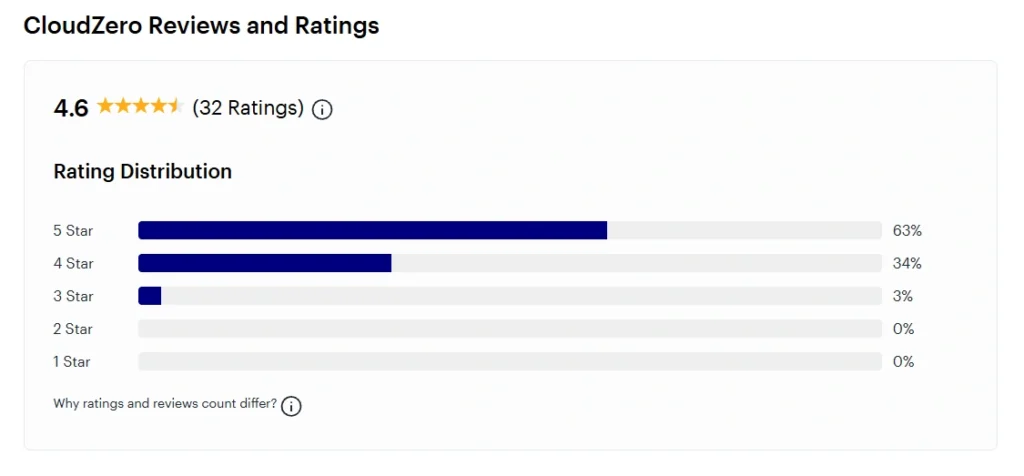
The recurring criticism is scale-dependent: reviewers note it can be pricey for smaller teams. Also read: CloudZero Reviews: Is It Worth It in 2026?
Comparing CloudZero’s Cost Fairly
Comparing headline rates across FinOps tools produces the wrong answer. The tools charge for different things, and shift different costs onto you. The unit of charge, what happens when spend grows mid-term, the provider-side data costs the architecture requires, and what you can take with you on exit all matter more than the sticker price.Where Usage.ai fits differently
CloudZero provides cost visibility, allocation and recommendation-led optimization. Usage.ai focuses on automated commitment optimization. We reduce the underlying cloud bill through Flex Insured Commitments, and charge on realized savings, with cashback when an eligible commitment is underutilized.That answers a different question from CloudZero’s, and many teams run both. It is an adjacency, not a swap.
5 Questions To Ask Before Signing
What spend band are we quoted into, and what effective percentage of our monitored spend does that represent?
At what point does additional usage trigger, at what rate, and what growth buffer is included?
Are we on AWS Marketplace terms or CloudZero's own paper, and which governs refunds, exit and data return?
On non-renewal, how is our data returned, in what format, and what does permanent deletion require?
Which capabilities in this quote are generally available today, and which are in preview?
Verdict: Who This Pricing Fits
CloudZero’s pricing can work if you:have enough monitored spend that a sub-1% effective rate is defensible against the allocation value you get
can forecast spend growth well enough to size a band and negotiate a buffer
have technical capacity for advanced dimension setup, agent deployment and any AnyCost adaptors you need
accept provider-side data costs and a two-month implementation as part of the business case
run a smaller estate where the subscription is large relative to the waste it will surface
expect volatile spend and want no metered element at all
need a self-service price before entering a sales cycle
want automated commitment purchasing and downside protection rather than recommendation-led cost optimization
Review your AWS spend baseline, contract band, and overage exposure. Connect in 15 minutes, no contracts, no infrastructure changes.
Frequently asked questions
How much does CloudZero cost?
CloudZero's own pricing page publishes no figures. The CloudZero On Demand dimension on its AWS Marketplace listing is priced in units of $1K of monthly AWS spend at $19.00 per unit, which is 1.9% of monitored AWS spend when applied linearly.
Procurement data from Vendr shows negotiated contracts commonly landing between roughly $37,000 and $374,000 a year, at effective rates below the public Marketplace On Demand rate.
Does CloudZero charge per user?
No. The subscription includes unlimited users, cost sources, dimensions and dashboards. The Marketplace On Demand price scales with the AWS spend CloudZero monitors, not with headcount or dashboard count.
Does CloudZero charge overages if my cloud spend grows?
The Marketplace listing publishes an additional-usage dimension charging $19.00 monthly for each $1K of AWS spend above your contracted level, applied on top of the contract price. Confirm the trigger point and any included buffer in your own agreement.
Can I cancel CloudZero, and get a refund?
Under the EULA published on its Marketplace listing, you may terminate for convenience at any time. But on the contracted portion there is no refund, and no relief from remaining payment obligations.
The listing separately states that no refunds are offered. On a written request made before termination or expiration, your data must be returned within 30 days in a standard non-proprietary format. Where self-service retrieval is available, you may retrieve or delete it during the 30 days following termination.
If you notice any material information that is incorrect, outdated, or no longer applicable, please contact us at [email protected]. We’ll review the information and update the article where appropriate..