 AWS
AWS Microsoft Azure
 Google Cloud


But if you’re evaluating nOps, you probably want to know more than how its pricing model works. You’d also want to understand what you could actually pay, how its savings and credit-back mechanisms affect the economics, and which contract terms matter before you sign.
We put this guide together to make that evaluation easier. It looks at nOps pricing, Savings Share, Credit Back protection, additional costs, and commitment-related contract terms.
It also uses nOps’s published documentation alongside independent customer feedback to separate documented pricing terms from issues buyers may want to investigate further.
The goal isn’t to tell you whether nOps is right or wrong for your business. It’s to give you a clear, balanced view of the pricing model and the costs that can affect your total economics, so you can decide whether nOps makes sense for your cloud environment.
nOps Pricing at a Glance
nOps currently has two distinct pricing models on its public pricing page.- Autonomous Rate Optimization product uses a share-of-savings model
- Cost Visibility and Allocation uses a fixed fee based on cloud spend.
| nOps pricing component | Public pricing model |
|---|---|
| Autonomous Rate Optimization | Share of Savings |
| Cost Visibility & Allocation | Fixed fee based on cloud spend |
| Commitment Management | Percentage of savings |
| Universal Savings Share rate | Not publicly published |
The current AWS Commitment Management MSA is more specific about the contractual mechanics. It states that nOps charges a monthly fee based on Realized Savings on the Commitments and that the fee can be invoiced through AWS Marketplace or separately, depending on the agreement. See nOps Commitment Management MSA
So if you’re looking for a single answer to “How much does nOps cost?”, there isn’t one public number. You need the applicable rate and terms in your commercial agreement.
How Does nOps’s Savings-Share Pricing Work?
Teams that already have strong Effective Savings Rates can use its platform to identify incremental savings opportunities, with the share-of-savings model applying when nOps finds additional savings. See nOps FAQ.
Your commercial rate matters more than the headline model
The public pricing page explains how nOps charges, but it does not publish one universal Savings Share percentage for every customer.That means buyers should not assume a particular percentage when building their business case.
Instead, ask nOps for a worked calculation using your own:
savings baseline;
expected savings;
applicable Savings Share;
existing commitments;
fee adjustments or credits.
Any applicable protection or cashback
What Are the Hidden Costs of nOps?
“Hidden costs” can be misleading if it suggests nOps routinely adds undisclosed fees. The available evidence doesn’t establish that.A more useful question you need to ask is: what costs or commercial considerations aren’t obvious from the headline Share of Savings model?
1. Your actual Savings Share is customer-specific
Before signing, get these terms in writing:- exact Savings Share percentage;
- definition of savings;
- spend included in the calculation;
- treatment of existing commitments;
- treatment of credits and adjustments.
2. Confirm what functionality is included
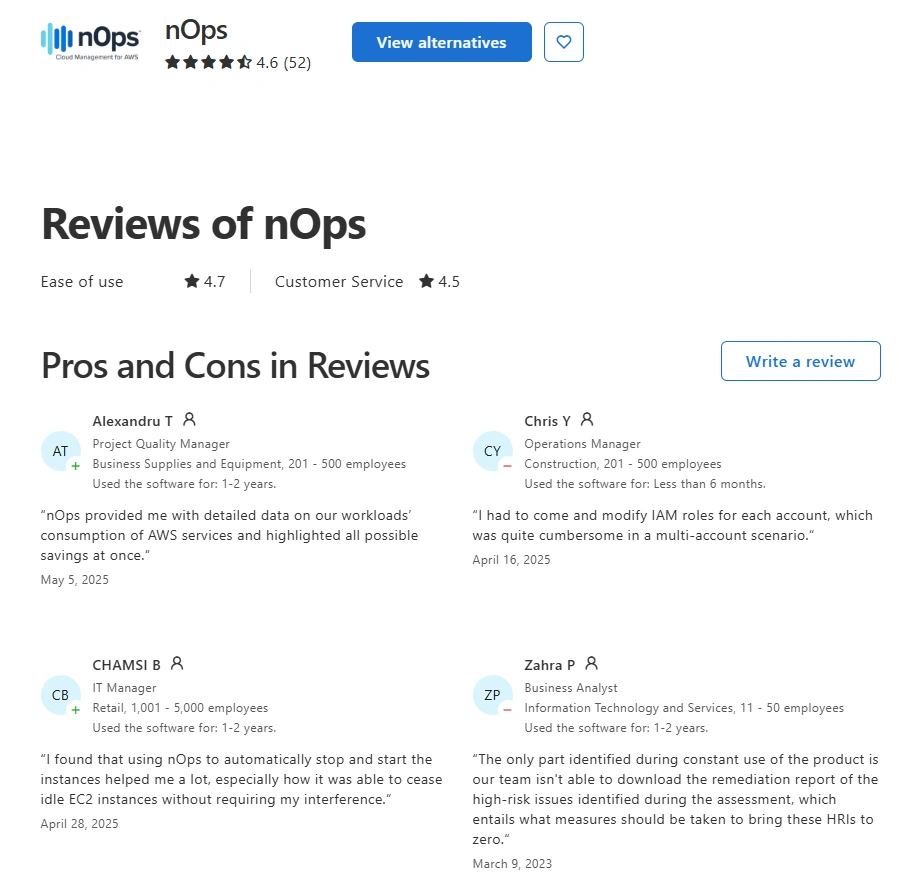
Customer reviews provide useful context, but they shouldn’t be treated as universal pricing evidence.For example, recent Capterra reviews praise nOps for cost savings, automation, and visibility, while individual reviewers also mention limitations around dashboards, integrations, and multi-account setup. One reviewer specifically described modifying IAM roles across accounts as cumbersome in a multi-account environment.
3. Implementation has an internal cost
nOps says onboarding typically takes under five minutes and that no infrastructure changes are required. That doesn’t mean enterprise adoption has zero internal cost.Your team may still need to handle:
- account and IAM configuration;
- security review;
- procurement approval;
- validation of commitment recommendations;
- internal FinOps and engineering processes.
4. Percentage-based pricing can become material at scale
Consider a hypothetical 20% fee:- $1 million of savings → $200,000 fee
- $10 million of savings → $2 million fee
How much incremental savings does nOps create, and how much of that value remains with us after the fee?
Does nOps Protect You From Underutilized Commitments?
Yes. This is an important part of nOps’s ShareSave proposition.nOps’s current FAQ says its 100% utilization guarantee means unused hours from ShareSave commitments are credited against monthly fees. See nOps FAQ.
That changes how you should think about commitment risk.
If a managed commitment is underutilized, the unused commitment value isn’t simply an additional nOps charge. Instead, that unused hours are credited against the monthly fee.
However, buyers should still understand exactly how the guarantee works under their agreement.
Show us the fee and credit calculation under our expected baseline and under a realistic usage-downside scenario.
nOps Contract Terms
The current AWS Commitment Management MSA deserves particular attention because the commercial relationship involves more than a software subscription.Contract term and renewal
The current MSA specifies an initial one-year term, followed by automatic one-year renewal periods unless the required notice is provided.This is worth reviewing separately from AWS commitment flexibility.
There are two different forms of commitment:
- cloud commitment risk: the AWS commitments purchased;
- vendor contract term: your agreement with nOps.
What happens to AWS commitments if you leave?
This is particularly important.The MSA states that if termination occurs before the end of the agreement term, the subscriber remains responsible for commitments purchased to provide the services.
That should not be described as an “nOps exit fee.” It is contractual responsibility for AWS commitments that have already been purchased.
AWS commitment liability and a vendor cancellation charge are different things.
Who controls commitment purchases?
The MSA gives nOps sole discretion over the quantity and length of commitments it procures on the subscriber’s behalf and authority to purchase those commitments through AWS.For enterprise buyers, that’s an important commercial-control consideration to understand before signing.
Is nOps Worth the Cost?
There isn’t a universal answer.nOps may be attractive if you want automated commitment management without having your FinOps or engineering team manually manage the portfolio.
Its current Commitment Management product emphasizes continuous optimization, incremental commitment purchases, and risk reduction.
Customer feedback is broadly positive, although individual experiences vary. Capterra currently lists nOps at 4.6/5 from 52 reviews, with reviewers commonly discussing cost savings, automation, ease of use, and support.
But the value depends on your starting point.
How does nOps pricing compare with alternatives?
If you’re comparing nOps with alternatives, look at the net economics under the same usage scenario, rather than comparing Savings Share percentages alone:| What to compare | Why it matters |
|---|---|
| Savings generated | Shows the gross benefit before vendor fees |
| Vendor fees | Shows what you pay for the optimization service |
| Commitment exposure | Shows how much usage you need to maintain |
| Downside protection | Shows what happens if usage falls |
| Exit economics | Shows what happens to managed commitments if you leave |
| Customer control | Shows who controls commitment purchases and related decisions |
A platform with a lower headline fee isn’t necessarily cheaper if its pricing model, protection mechanism, or contractual terms produce a less favorable risk-adjusted outcome.
Also read: 6 Best nOps Alternatives in 2026
Where Usage.ai takes a different approach
Usage.ai uses a different model for Flex Insured Commitments. Rather than treating underutilization only as a commitment-management problem, we provide cashback protection when an eligible Flex Commitment costs more than the equivalent on-demand usage.The underlying commitment still exists in the customer’s AWS account. The difference is how the downside is handled.
When the eligible protection conditions are met, the excess cost is returned as cashback rather than leaving the customer to absorb the full gap. Learn how cashback works.
Also read: Usage.ai vs nOps: Which Cloud Commitment Platform Fits Your Risk?
7 Questions to Ask Before Buying nOps
What exact Savings Share percentage applies to us?
How does nOps define and calculate Realized Savings?
Which AWS spend is included in the fee calculation?
How does the 100% utilization guarantee affect our monthly fee?
Which reporting, analytics, and integrations are included?
What happens to managed AWS commitments if we terminate?
What will our net savings look like under a realistic usage-downside scenario?
Who is nOps pricing a good fit for?
nOps pricing can fit if you:- want automated commitment management and are comfortable with a performance-based Savings Share model;
- want nOps to manage commitment purchasing and optimization on your behalf;
- have enough recurring cloud usage for automated commitment optimization to generate meaningful savings;
- are comfortable reviewing the commercial terms around Savings Share, commitment purchases, and renewal before signing.
- have highly variable or uncertain cloud usage;
- want a different approach to underutilization protection, such as direct cashback;
- need greater predictability around vendor fees;
- want more control over commitment purchasing decisions;
- want to compare the financial impact of different commitment-risk models before committing.
Your usage stability, commitment horizon, internal FinOps capabilities, desired level of vendor control, and tolerance for downside risk should determine whether its pricing model makes sense for your environment.
Bring your current commitment inventory, 12 months of normalized cloud usage, expected growth, and one realistic downside scenario.
We can model the economics, including fees, commitment exposure, and cashback protection, so you can see the net savings you would actually retain.
Talk to an Expert
Connect in 15 minutes. No contracts, no infrastructure changes. See your savings before committing.
Frequently asked questions
Does nOps publish its pricing?
Yes, but not as one universal price. nOps's public pricing page describes Autonomous Rate Optimization as a Share of Savings model and Cost Visibility & Allocation as a fixed fee based on cloud spend. The applicable Savings Share rate needs to be confirmed in your commercial agreement.
Does nOps charge if commitments are underutilized?
nOps says its ShareSave offering includes a 100% utilization guarantee, under which unused hours from ShareSave commitments are credited against monthly fees. Buyers should review the applicable agreement to understand exactly how the protection applies.
Are there additional costs beyond nOps's Savings Share?
The public pricing information does not establish a universal list of additional fees. However, buyers should confirm which features and services are included in their package and account for internal implementation, security, and operational costs when calculating total cost.
What happens to AWS commitments if I cancel nOps?
The current AWS Commitment Management agreement states that if the agreement is terminated before the end of its term, the subscriber remains responsible for commitments purchased to provide the services. This is different from an nOps cancellation or exit fee.
Is nOps's pricing better than Usage.ai?
There is no universal answer. Both use performance-based economics, but their approaches to commitment-risk protection differ. The better comparison is net savings after fees, protection, commitment exposure, and contractual terms under the same usage and downside scenarios.
If you notice any material information that is incorrect, outdated, or no longer applicable, please contact us at [email protected]. We’ll review the information and update the article where appropriate.