 AWS
AWS Microsoft Azure
 Google Cloud

The more useful questions are: What do customers actually like? Where does the platform fall short? How much control do you give nOps over commitment purchases? How does its pricing work? And what happens when cloud usage changes?
This review looks at those questions using current customer reviews, nOps documentation, pricing information, and its commitment-management terms.
What do nOps customers actually say?
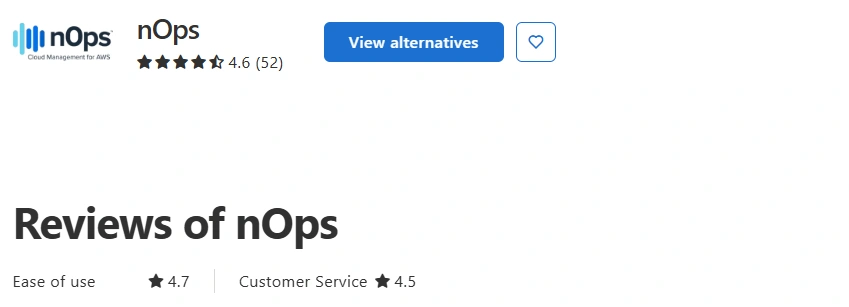
The public review signal is strong.G2 currently shows nOps at 4.8/5 from 141 reviews. The AWS Marketplace listing for nOps also displays a 4.8/5 rating across 157 ratings, but 141 of those are external G2 reviews and only 16 are native AWS Marketplace reviews. These should therefore not be treated as two independent review pools.
What customers like
The most useful positive feedback is concentrated around several themes.- AWS commitment management. Recent reviews describe nOps as useful for managing AWS Savings Plans and Reserved Instances as usage changes, reducing the need to manually monitor and adjust commitments.
- Reduced operational effort. Customers repeatedly mention automation around cost optimization, commitments, and infrastructure management. An AWS customer review, for example, described automated AWS cost optimization across EC2, containers, clusters, and commitment features.
- AWS and Kubernetes visibility. A reviewer highlighted EKS cost visibility down to namespaces and applications and said nOps data reconciled with AWS Cost Explorer. That is useful evidence of the platform’s capabilities.
- Support. Support is another recurring positive theme across G2 and Capterra feedback, although the experience is not uniformly positive.
Where customers see friction
The negative evidence is smaller, but it is worth paying attention to.- API and reporting usability. A reviewer praised nOps’s API and data but specifically identified API discoverability and documentation as areas that could improve.
- Multi-account setup. A Capterra reviewer said modifying IAM roles for each account was cumbersome in a multi-account environment. Another review mentioned that some integrations can take longer to configure in multi-account environments.
- Automation still needs governance. Earlier customer feedback includes concerns around aggressive automation and resource-sizing decisions. Even where the vendor addressed those issues, the broader lesson is important: automated production changes should operate within defined policies, exclusions, monitoring, and rollback procedures.
How autonomous is nOps?
nOps’ current AWS Rate Optimization offering describes continuous commitment optimization, incremental purchases, and rebalancing as usage changes. nOps says it can adjust commitment exposure as frequently as hourly and manage Savings Plans and Reserved Instances across supported services.The important question for buyers is therefore not whether nOps automates commitment management. It does.
The question is how much purchasing authority you’re comfortable delegating.
The January 2026 nOps Commitment Management agreement gives nOps discretion over the quantity and length of commitments purchased on the customer’s behalf for allocated spend. It also establishes an AWS account within the customer’s organization for commitment purchasing and management.
You give up some transaction-level control in exchange for less manual commitment management.
Is nOps equally proven across AWS, GCP, and Azure?
Not based on the public evidence available today.nOps now markets autonomous rate optimization across AWS, Google Cloud, and Azure, including incremental commitment strategies for variable workloads. Its Google Cloud rate optimization offering describes automated commitment management for GCP.
However, the independent customer evidence remains substantially more AWS-centered. The AWS Marketplace profile contains a large body of AWS-related customer feedback, while the strongest publicly visible use cases and reviews also focus on AWS.
That doesn’t establish that nOps’s GCP or Azure capabilities are weak. It establishes a more limited conclusion: buyers should not assume that the same level of independent validation exists across all three clouds.
GCP and Azure buyers should ask for cloud-specific references, supported-service details, permissions requirements, and a savings analysis based on their own usage.
How does nOps approach commitment risk?
nOps’s strategy is built around smaller, more frequent commitment adjustments rather than relying exclusively on large, infrequent purchases.Its current commitment management documentation describes incremental commitments, dynamic seeding and rebalancing, and staggered maturity to make coverage more responsive to changing usage.
This is an important distinction from traditional commitment management.
The objective isn’t to eliminate commitments. It is to reduce the amount of future usage that is locked into a single commitment decision.
nOps also documents a credit-back mechanism for eligible unused commitments it purchases and manages. Its pricing describes unused commitment value being offset against nOps fees, with excess value carried forward as credit.
That should not be interpreted as “commitment risk doesn’t exist.”
There are still contractual conditions, eligibility requirements, and the underlying cloud-provider commitment obligations. Buyers should review the specific program and agreement before treating credit-back as financial protection.
What does nOps cost?
nOps currently publishes two broad pricing models:- Autonomous Rate Optimization: share of realized savings.
- Cost Visibility and Allocation: fixed fee based on cloud spend.
The share-of-savings model can align vendor incentives with customer savings, but the relevant metric is net value, not gross savings.
Before signing, ask nOps to provide the savings baseline and show exactly how the fee is calculated.
What happens if you leave nOps?
The commitment-management agreement is just as important as the savings model.The January 2026 nOps Commitment Management MSA establishes an initial one-year term with automatic one-year renewals unless the required notice is provided. It also states that the customer remains responsible for commitments already purchased on its behalf.
That last point is important but not unusual. Cloud commitments do not disappear when an optimization relationship ends.
The practical diligence questions are:
- Who manages the remaining commitment portfolio?
- What happens to the AWS account used for commitment management?
- What reporting and historical data remain available?
- What obligations survive termination?
How does nOps compare with alternatives?
The useful comparison is not simply whether another platform automates commitments. Several do.The more important question is how each platform handles commitment risk, automation, financial protection, and customer control.
| If your priority is... | Model to investigate |
|---|---|
| Autonomous commitment optimization | ProsperOps |
| Incremental commitment management | nOps |
| Explicit commitment guarantees | Archera |
| Commitment optimization with cashback protection | Usage.ai |
nOps: incremental commitment management
nOps emphasizes continuous optimization and incremental commitment layering. Its model is designed to adapt coverage as usage changes rather than relying on large, infrequent commitment purchases. See the nOps commitment management approach for its current model.ProsperOps: autonomous optimization
ProsperOps is a relevant option for teams primarily looking for autonomous commitment optimization. The comparison should focus on how each platform handles control, commitment exposure, fees, and exit terms rather than automation alone.Also read: ProsperOps Reviews: Is It Worth It in 2026?
Archera: financial guarantees
Archera is worth investigating when explicit commitment protection is a major buying criterion. Buyers should evaluate the actual Archera guarantee terms and exclusions rather than treating “insured” or “guaranteed” as standardized industry terms.Also read: Archera Reviews: Is It Worth It in 2026?
Usage.ai: optimization plus cashback protection
At Usage.ai, we combine commitment optimization, flexible automation, and cashback protection. Teams can choose Autopilot for automated commitment management or Copilot when they want recommendations and greater control over individual decisions.Eligible Flex Commitments can also receive cashback when defined downside occurs, subject to the program’s terms. See how cashback works for the applicable mechanics.
The distinction isn’t simply automated vs. manual. The more useful comparison is:
- ProsperOps: emphasizes autonomous optimization.
- nOps: emphasizes incremental commitment management and continuous rebalancing.
- Archera: emphasizes explicit commitment guarantees.
- Usage.ai: combines Autopilot or Copilot control with cashback protection for eligible Flex Commitments.
When might AWS-native tools be enough?
nOps isn’t automatically necessary for every AWS environment.AWS Cost Optimization Hub provides native recommendations for areas including rightsizing, idle resources, Graviton, Reserved Instances, and Savings Plans. AWS also provides Cost Optimization Hub as a centralized source for optimization recommendations.
Native tooling may be enough when:
- AWS spend is relatively small or stable;
- your internal FinOps team has sufficient capacity;
- Cost Explorer, CUR, and AWS optimization workflows are already mature; or
- your organization requires approval before every commitment purchase.
Who should consider nOps?
nOps is worth evaluating if you:
- manage a material AWS environment;
- have changing compute usage or multiple accounts;
- struggle to maintain commitment coverage manually;
- want automated Savings Plan and RI management;
- value continuous optimization over transaction-level control; and
- can validate incremental net savings.
Look more closely at alternatives if you:
- need independently proven GCP or Azure maturity;
- require approval for every commitment purchase;
- have a small, stable AWS environment;
- already have highly effective AWS-native FinOps processes; or
- require a specific financial-protection or control model.
Verdict: Is nOps worth it in 2026?
Yes, for the right organization.The strongest public evidence supports nOps for AWS commitment management, cost visibility and allocation, and compute/Kubernetes optimization. Current customer feedback is particularly positive around automation, AWS savings workflows, visibility, and reduced manual effort.
The caveats are equally important.
The public evidence is more limited for GCP and Azure than for AWS. Some customers report friction around APIs, IAM, integrations, and aspects of the user experience. And although nOps’s incremental commitment model and credit-back mechanism can reduce downside exposure, buyers should still understand the actual contractual obligations.
The best way to compare platforms
Don’t ask vendors to show you their best-case savings percentage.Give each vendor the same:
current commitment inventory;
recent usage history;
expected growth;
realistic downside scenario;
cancellation scenario.
That is a much better basis for a 2026 cloud commitment decision than a review score alone.
Connect in 15 minutes. No contracts, no infrastructure changes. See your savings before committing.
Frequently asked questions
Is nOps worth it in 2026?
nOps is worth considering for AWS-heavy organizations that want to automate commitment management, reduce manual FinOps work, and improve cloud cost visibility. The strongest public customer evidence is currently concentrated on AWS environments. Whether nOps is worth it depends on the incremental net savings it can generate after fees.
What do nOps customers say?
Public customer feedback is generally positive. Reviewers frequently mention AWS Savings Plans and Reserved Instance management, Kubernetes cost visibility, reduced operational effort, and responsive support. Reported drawbacks include reporting and API usability, IAM setup complexity in some multi-account environments, and concerns about automation guardrails.
Does nOps support AWS, Azure, and Google Cloud?
Yes. nOps publicly offers rate optimization for AWS, Microsoft Azure, and Google Cloud. However, the independent customer evidence available for this review is substantially stronger for AWS than for Azure or Google Cloud, so buyers should request cloud-specific references and validation.
How does nOps pricing work?
nOps publicly states that its Autonomous Rate Optimization offering is priced as a percentage of realized savings, while its Cost Visibility and Allocation platform uses a fixed fee based on cloud spend. Buyers should evaluate expected net savings after fees rather than relying solely on projected gross savings.
Who is nOps best suited for?
nOps is generally best suited for organizations with meaningful AWS spend, changing usage patterns, multiple accounts, or limited internal capacity to continuously manage Savings Plans and Reserved Instances. The strongest public customer evidence is currently concentrated in AWS environments
If you notice any material information that is incorrect, outdated, or no longer applicable, please contact us at [email protected]. We’ll review the information and update the article where appropriate.