 AWS
AWS Microsoft Azure
 Google Cloud

The real question is whether your organization can turn its allocation model, unit-cost metrics, anomalies, and recommendations into better engineering and financial decisions. That determines whether CloudZero becomes a financial control plane or simply another dashboard.
Our assessment: CloudZero is a credible option for organizations that need business-level cost intelligence across complex infrastructure.
CloudZero at a Glance
| Our assessment | |
|---|---|
| Best for | Mature FinOps and engineering teams needing business-level cost allocation |
| Coverage | AWS, Azure, GCP, OCI, Kubernetes, SaaS, data, and AI sources |
| Core strength | Dimensions, shared-cost allocation, and unit economics |
| Optimization | Recommendations and savings tracking, not universal autonomous execution |
| Pricing | Custom subscription based on scale and complexity |
| Customer sentiment | Generally positive, with a moderate public review sample |
| Main strengths | Allocation, dashboards, anomaly detection, unit economics, support |
| Main questions | Setup effort, forecasting depth, actionability, pricing, ongoing ownership |
| 2026 verdict | Worth considering when granular cost intelligence will change decisions |
What Changed in 2026?
Older comparisons can give buyers an incomplete picture of CloudZero. The current platform connects to AWS, Azure, GCP, and OCI, plus sources including Kubernetes, Snowflake, Databricks, Datadog, OpenAI, Anthropic, and Cursor. Its connection documentation provides the current native-source list.Several developments are genuinely new in 2026:
January: Dimension Studio entered public preview, adding visual Dimension creation alongside CostFormation.
March: CloudZero launched its Claude Code Plugin, which connects an MCP server and prepackaged skills to CloudZero cost data through AI Hub.
May: It announced real-time AI spend collection through an endpoint agent or supported LLM gateway, alongside a rebuilt platform UI.
These additions do not eliminate every implementation or automation concern. They do mean older claims about absent AI costs, YAML-only allocation, or anomaly detection as the only optimization capability should not be repeated as current facts.
What CloudZero Customers Say
As of August 27, 2026, public customer feedback is favorable overall. Gartner Peer Insights shows 4.6/5 from 32 ratings. The AWS Marketplace review page shows 4.6/5 across 70 ratings, but most are imported from external sources.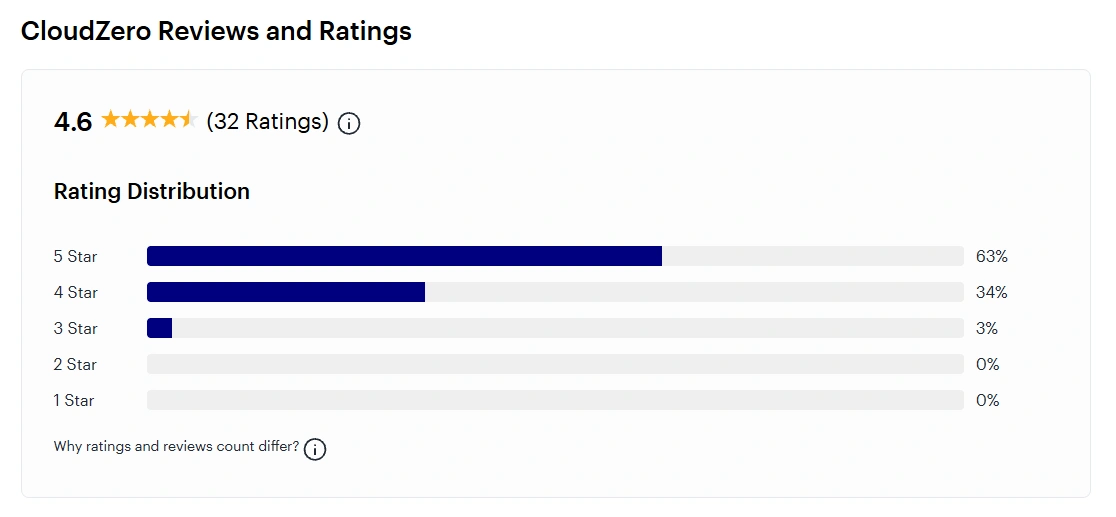
What customers consistently praise
- Business context: Reviewers value seeing which product, application, customer, or team is driving spend rather than stopping at service-level totals.
- Investigation and reporting: Dashboards, resource-level drill-down, anomaly detection, and executive reporting reduce manual analysis.
- Unit economics: Customers highlight the ability to connect infrastructure costs to workload efficiency and profitability.
- Support: Responsive onboarding and ongoing FinOps guidance appear repeatedly in favorable feedback.
Where customers see friction
PeerSpot’s CloudZero reviews surface concerns around budget usability, business-mapping maintenance, reporting depth, forecasting, integrations, and price relative to the capabilities used.One reviewer described maintaining a very large YAML configuration as difficult and error-prone.
Dimension Studio may reduce that specific burden for newer deployments. It does not remove the need to define allocation logic, resolve disputed ownership, or keep mappings current as the organization changes.
A recent Gartner Peer Insights reviewer also reported delayed cost availability and reduced billing-line detail, which they said limited diagnosis at the resource level. Because ingestion timing and detail can vary by provider and connection, buyers should test both data latency and line-item fidelity during a proof of value.
CloudZero in Real FinOps Operations
Dimensions and unit economics
Dimensions are CloudZero’s central operating concept. They assign costs to categories the business cares about: customer, product, feature, team, environment, or another defined unit.Dimension rules can use billing metadata, accounts, services, tags, and existing Dimensions. Allocation Dimensions can additionally use customer-supplied telemetry to divide shared costs.
CloudZero can also split shared costs evenly, proportionally to existing spend, or through usage data supplied by the customer. This is more flexible than waiting for perfect resource tags, but it is not context-free automation. Someone still has to decide which allocation method is economically defensible.
Unit economics then combines allocated spend with a business activity measure:
Detection and recommendations
CloudZero’s Anomaly Detection monitors unexpected spending changes down to hourly granularity. Teams can configure anomaly monitoring for specific Views and route notifications through Slack or email.Optimize analyzes billing, utilization, and configuration data. It produces resource-specific recommendations, estimated savings, guidance, workflow status, and realized-savings tracking. CloudZero checks for new recommendations daily.
That is actionable optimization, but a recommendation is not the same as an automatically executed change. Some AWS recommendations also depend on AWS Compute Optimizer or Cost Optimization Hub.
Buyers should confirm:
- Which actions are native
- Which require approval
- Which depend on another service
Coverage and reconciliation
Explorer consolidates supported costs and lets teams group, filter, compare, and drill down to resources. Unsupported providers can be added through AnyCost, but custom sources require an adaptor that converts source data into CloudZero’s Common Bill Format.Hourly granularity should not be confused with guaranteed hourly arrival. Provider billing exports determine when underlying data becomes available.
For access and security, CloudZero documents all native cost connections as read-only. It supports granular role-based access control, including Dimension- and cost-type restrictions.
Its security materials list SOC 1 Type 2 and SOC 2 Type 2 attestations.
Finance should also choose the correct cost treatment:
Real Cost: CloudZero’s default Real Cost starts with Discounted Amortized Cost and filters out non-consumption charges such as taxes and support fees. It also excludes unused RI and Savings Plan portions.
Billed Cost: Billed Cost is more appropriate for invoice reconciliation.
Discounted and amortized views: These answer different allocation questions.
What Buyers Should Scrutinize
Connection is not a complete implementation. Connecting a billing source can be straightforward. Creating defensible product, customer, and feature economics may still require FinOps, engineering, finance, and product input.Dimensions need an owner. Products, teams, shared platforms, and customer relationships change. Buyers should decide who approves allocation logic, monitors unallocated spend, handles disputes, and maintains Dimensions after onboarding.
Forecasts may not replace FP&A. CloudZero supports budgets, threshold alerts, customer-entered forecast targets, and current-month spend pacing. However, its budget documentation describes a Forecast as a separate target imported from the customer’s planning process.
Buyers expecting advanced predictive forecasting should validate that use case directly. Optimization is not universal execution. CloudZero assesses reservations and Savings Plans in the broader cost model. CloudZero promotes an integration with ProsperOps for automated commitment management.
Buyers should confirm whether ProsperOps is contracted and priced separately and which platform performs each action.
CloudZero Pricing and Value
CloudZero does not publish standard dollar prices. Its current pricing page describes one subscription with all capabilities included, priced according to the scale and complexity of the environment.The subscription lists unlimited cost sources, users, dimensions, and dashboards. It also includes hourly granularity, anomaly detection, optimization recommendations, budgets, forecasts, multi-year retention, RBAC, streaming telemetry, and MCP integration.
That makes unsupported third-party starting prices unsuitable as confirmed 2026 list prices. Buyers need a quote and a total-value calculation:
- The pricing metric, minimum commitment, contract term, and renewal increase
- Whether onboarding, allocation design, and advisory support are included
- Costs for custom AnyCost adaptors or partner products
- How price changes as sources, complexity, or spend grows
- Data export, historical access, and surviving obligations after termination
When Other Tools Are Enough
| Primary requirement | Model to investigate |
|---|---|
| Basic single-cloud reporting | Native cloud cost tools |
| Business allocation and unit economics | CloudZero |
| Autonomous commitment execution | Specialized commitment platform |
| Commitment optimization with cashback protection | Usage.ai |
| Advanced financial planning | FinOps platform with deeper FP&A |
| Automatic Kubernetes resource changes | Specialized Kubernetes optimizer |
An organization may use both when it needs broad cost intelligence and specialized commitment execution. If commitment savings are the only major requirement, CloudZero’s broader platform may be unnecessary.
Who Should Consider CloudZero?
CloudZero is worth evaluating if you:
Need cost per customer, product, feature, transaction, or team
Manage material shared, Kubernetes, multi-cloud, SaaS, data, or AI costs
Want engineering and finance to work from the same allocation model
Have people available to own allocation logic and act on recommendations
Can demonstrate that better cost intelligence will change pricing, architecture, accountability, or margin decisions
Consider alternatives if you:
Operate a small or straightforward single-cloud environment
Mainly need automatic commitment purchasing or infrastructure remediation
Expect a completely hands-off allocation implementation
Require advanced predictive planning as the primary capability
Already have effective native reporting and internal allocation workflows
Verdict: Is CloudZero Worth It?
Yes, for the right organization.CloudZero is worth considering when granular allocation and unit economics materially improve how teams price products, manage margins, investigate changes, or assign cost ownership.
Customer feedback supports its strengths in visibility, dashboards, anomaly detection, and support, while its expanded 2026 coverage addresses several older limitations.
The business case weakens when a team only needs another cost dashboard or lacks owners for its allocation model.
The decisive question is not how much data CloudZero can display. It is whether your organization can operationalize that intelligence well enough to justify the subscription and ongoing effort.
Use your actual cloud bill to review commitment coverage, risk, and likely savings before making a platform decision.
Frequently asked questions
Is CloudZero worth it in 2026?
CloudZero is worth evaluating for mature FinOps organizations that need business-level allocation, unit economics, and consolidated cost intelligence. It may be excessive for small environments or teams seeking only automatic commitment execution.
What do customers like most?
Recurring positives include granular visibility, Dimensions, dashboards, anomaly detection, unit economics, executive reporting, and responsive support.
How much does CloudZero cost?
CloudZero requires a custom quote. It offers one subscription with its listed capabilities included, with pricing aligned to environment scale and complexity.
Does CloudZero reduce costs automatically?
CloudZero automatically detects anomalies and generates optimization recommendations. Buyers should not assume every recommendation is executed automatically; some actions remain manual or depend on provider services and partner integrations.
Is CloudZero better than native tools?
CloudZero adds cross-provider cost consolidation, customizable business dimensions, shared-cost allocation, and unit economics. Native tools may still be sufficient for smaller, single-cloud environments with mature internal reporting.
If you notice any material information that is incorrect, outdated, or no longer applicable, please contact us at [email protected]. We’ll review the information and update the article where appropriate.