.png)
 AWS
AWS Microsoft Azure
 Google Cloud


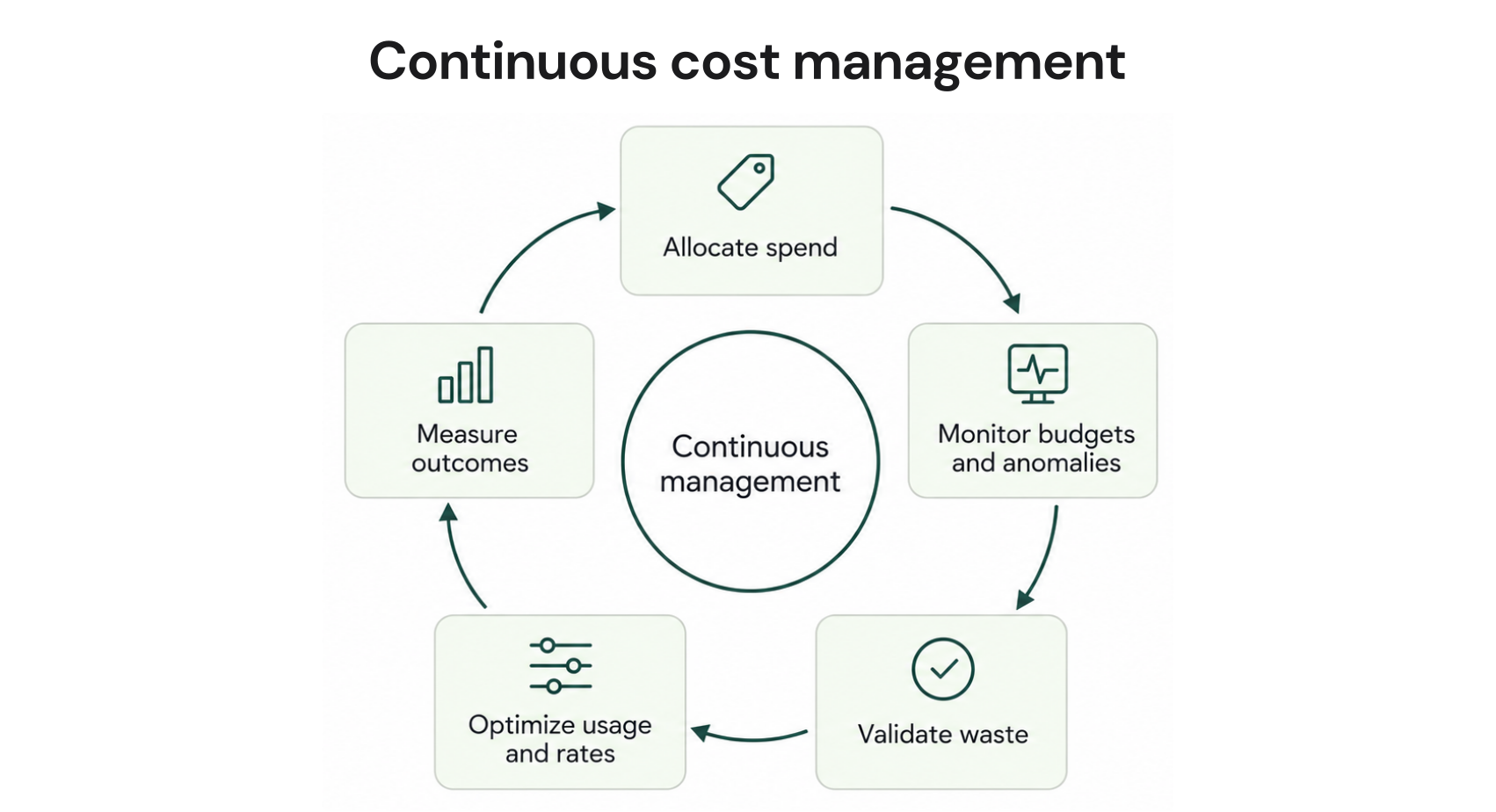
Cloud cost management gives organizations a continuous way to understand spending, assign responsibility, control financial risk, and improve the value received from cloud services.
This guide explains its core components, its relationship to FinOps and cost optimization, the tools involved, and a practical way to build a program.
The Short Answer
Cloud cost management is the ongoing practice of monitoring, allocating, governing, and optimizing cloud spending. It helps teams understand what they spend, who owns it, whether it is within expectations, and where action is needed.It combines financial controls with technical decisions across AWS, Azure, and Google Cloud. The goal is not simply to cut the bill, but to keep cost, performance, flexibility, and business value aligned as cloud usage changes.
What Is Cloud Cost Management?
Cloud cost management is an operational discipline for planning, monitoring, allocating, controlling, and improving cloud expenditure. It connects billing data with resource usage, business context, ownership, budgets, and technical decisions.That scope matters because a cloud bill alone cannot explain whether spending is justified. Teams need to know which product or environment created a cost, whether the resource is required, whether its configuration is efficient, and whether the pricing model still suits the workload.
Effective management creates three outcomes:
Visibility: teams can explain where spending comes from.
Accountability: material costs map to an owner, workload, or business purpose.
Control: teams can detect changes, evaluate options, act, and verify the result.
Core Components and Strategies
Visibility and allocation
Visibility starts with provider billing data, cost reports, and dashboards. Allocation adds business meaning by mapping costs to products, teams, environments, or customers through accounts, labels, tags, and allocation rules.Useful dimensions commonly include team, service, environment, project, and cost center. The goal is not perfect tagging for its own sake; it is enough reliable context to explain material spend and identify the person responsible for the next decision.
Budgets, forecasts, and anomalies
Budgets compare actual or forecast spending with an expected amount. Anomaly detection looks for unusual changes that a fixed monthly threshold may miss, such as a sudden increase early in the billing period.Standard budgets and anomaly alerts generally notify teams rather than guaranteeing a hard spending limit.
Google Cloud offers Preview spend-cap budgets for a limited set of services and scopes; they can pause new usage but do not stop ongoing persistent resources. AWS and Azure budget thresholds can trigger configured actions rather than acting as universal hard caps.
Billing data can arrive after usage occurs, so every alert needs an owner, an escalation path, and a defined response. AWS, Azure, and Google Cloud each provide native cost reporting, budgets, and alerting, but their data and notification cadences differ.
Usage and architecture efficiency
Usage optimization addresses resources that are idle, oversized, poorly scheduled, or stored in an unnecessarily expensive tier. Rightsizing should consider memory, network, storage, latency, peaks, and service objective, not average CPU alone.Architectural choices also affect cost. Regions, data-transfer paths, managed-service designs, redundancy, and scaling policies can change the cost required to deliver the same business outcome. For a deeper treatment of these levers, see the complete cloud cost optimization guide.
Pricing and commitments
Stable, eligible usage may qualify for lower rates through AWS Savings Plans or Reserved Instances, Azure reservations, Savings Plan for compute, Savings Plan for databases, and Google Cloud Committed Use Discounts.These products exchange a usage or spending commitment for discounted pricing, with eligibility and terms varying by provider and service.
Commitments should be evaluated after obvious waste and overprovisioning have been addressed. Otherwise, a team can commit to an inflated baseline and continue paying for capacity it does not need.
Underutilization is the main financial risk. Some native commitments have narrow return, modification, exchange, or resale options, while others cannot be canceled after purchase. Always verify the current provider terms, eligible usage, scope, payment model, and downside scenario before buying.
Management vs FinOps vs Optimization
Terminology varies across organizations. In this guide, we use the following distinctions. These disciplines work together, but they answer different questions.| Concept | Main question | Typical work | Primary outcome |
|---|---|---|---|
| Cloud cost management | How do we understand and control cloud spend over time? | Reporting, allocation, budgets, forecasting, governance, and optimization oversight | Predictability and accountability |
| Cloud cost optimization | What should we change to improve cost efficiency? | Rightsizing, removing waste, architectural changes, and rate optimization | Lower cost or better unit economics |
| FinOps | How do teams maximize technology value together? | Shared decisions, measurement, ownership, governance, and iterative improvement | Business value and financial accountability |
In practice, management supplies the visibility and controls required for reliable optimization. For a fuller comparison, see cloud cost management vs. cloud cost optimization
Cloud Cost Management Tools
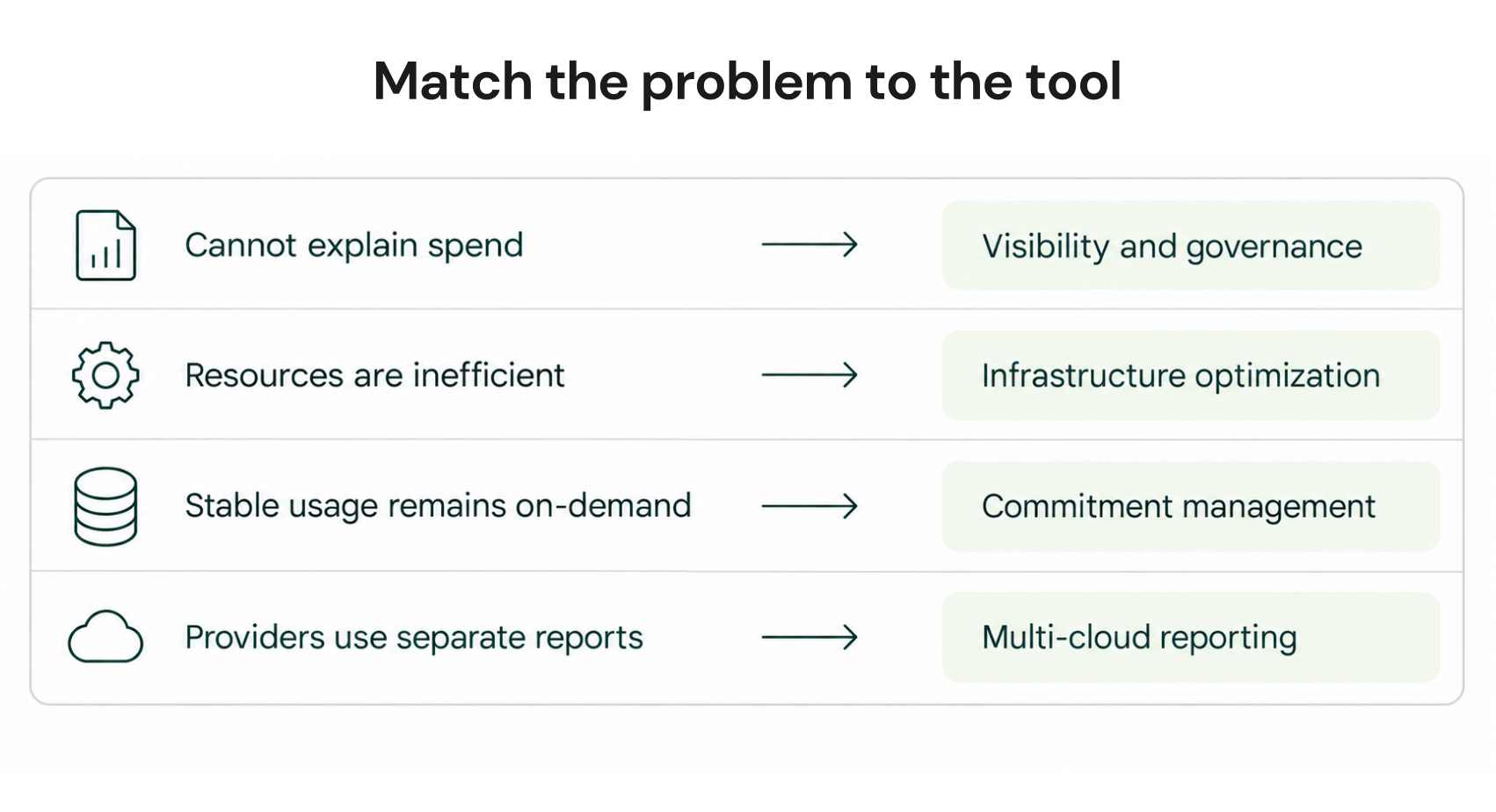
Cloud cost management tools fall into several overlapping categories. The right category depends on the problem that remains unresolved after the billing data is available.| Tool category | Best suited to | Typical capabilities | Common limitation |
|---|---|---|---|
| Native provider tools | Starting with one primary cloud | Billing reports, budgets, forecasts, anomaly alerts, and provider-specific recommendations | Separate interfaces and data models across clouds |
| Cost visibility and governance platforms | Allocation and reporting across teams or clouds | Normalized reporting, showback, chargeback, budgets, and governance | Recommendations may still require an execution process |
| Infrastructure optimization platforms | Inefficient compute, storage, or Kubernetes usage | Rightsizing, scheduling, scaling, cleanup, and automation | Scope varies by resource type and platform |
| Commitment management platforms | Stable usage left on variable rates | Commitment analysis, purchasing workflows, utilization monitoring, and rebalancing | Does not replace resource ownership or architecture work |
Evaluate tools by asking:
Can we allocate material spend to the right owner?
Do we need recommendations, execution, or both?
Are our largest opportunities in infrastructure usage or pricing?
Do we need consistent reporting across multiple providers?
Who carries the financial risk when a commitment is underused?
Why Cost Management Programs Struggle
Many programs struggle even when cost data is available. Common failure patterns include shared costs that remain unallocated, recommendations with no accountable owner, and commitments that become underused after workloads change.The practical fix is a shorter feedback loop: connect each material issue to an owner, expected outcome, action date, and review point. The detailed failure patterns and remedies are covered in why cloud cost management fails.
Build a Cloud Cost Management Program
1. Establish reliable visibility
Enable cost reporting across all relevant accounts and subscriptions. Define a minimum allocation model and identify material spend that still lacks an owner or business context.2. Add financial guardrails
Create budgets, forecasts, and anomaly alerts at scopes where someone can act. Document who receives each alert, what they investigate, and when the issue is escalated.3. Remove validated waste
Review idle resources, outdated storage, non-production schedules, and rightsizing candidates. Confirm dependencies, retention requirements, performance needs, backups, and rollback options before changing or deleting anything.4. Evaluate pricing options
Separate stable eligible demand from variable usage. Compare on-demand pricing with available commitments using current provider terms, then model what happens if usage falls or moves.5. Measure and repeat
Track allocation coverage, forecast variance, completed optimization actions, commitment utilization, and realized savings. Revisit decisions after migrations, product changes, or meaningful demand shifts rather than treating optimization as a one-time project.For deeper ownership models and KPIs, use the cloud cost governance framework. When manual handoffs become the bottleneck, the FinOps automation guide explains where automation can strengthen the operating loop.
Where Usage.ai Fits
Commitment management does not replace allocation, governance, rightsizing, or architecture work. We built Usage.ai for teams with stable, eligible usage across AWS, Azure, and Google Cloud that want help managing commitments without directly carrying the same long-term downside.We built Flex Insured Commitments for that commitment-management layer: teams can get the 30–50% savings of cloud commitments across AWS, Azure, and GCP with none of the commitment risk.
If an eligible Flex Commitment costs more than the equivalent on-demand usage, we calculate that loss at the end of the month and provide cashback protection for it,, subject to program terms.
We charge a percentage of realized savings; if no savings are realized, there is no savings-based fee.
Review usage, coverage, commitment risk, and potential savings.
Frequently asked questions
What is cloud cost management?
Cloud cost management is the continuous practice of understanding, allocating, controlling, and improving cloud spending. It combines financial processes such as budgeting and forecasting with technical practices such as rightsizing, waste removal, and commitment management.
What do cloud cost management tools do?
They collect and organize billing data, allocate costs, track budgets, detect anomalies, and recommend or automate improvements. Capabilities differ, so teams should select tools based on whether they need visibility, governance, infrastructure optimization, or commitment management.
How does cloud cost management differ from FinOps?
Cloud cost management focuses specifically on operating and controlling cloud spend. FinOps is the broader framework and cultural practice that creates financial accountability and maximizes technology value through collaboration among engineering, finance, business, and other stakeholders.
How does it differ from cost optimization?
Cloud cost management provides the visibility, ownership, controls, and review process for cloud spending. Cloud cost optimization is the action layer that changes resource usage, architecture, or pricing to improve efficiency.
When should teams consider commitments?
Evaluate commitments after removing validated waste and establishing a stable eligible baseline. Compare current provider terms and model declining or migrating usage before purchasing, because expected discounts depend on sustained utilization.