 AWS
 Microsoft Azure
 Google Cloud

The Short Answer
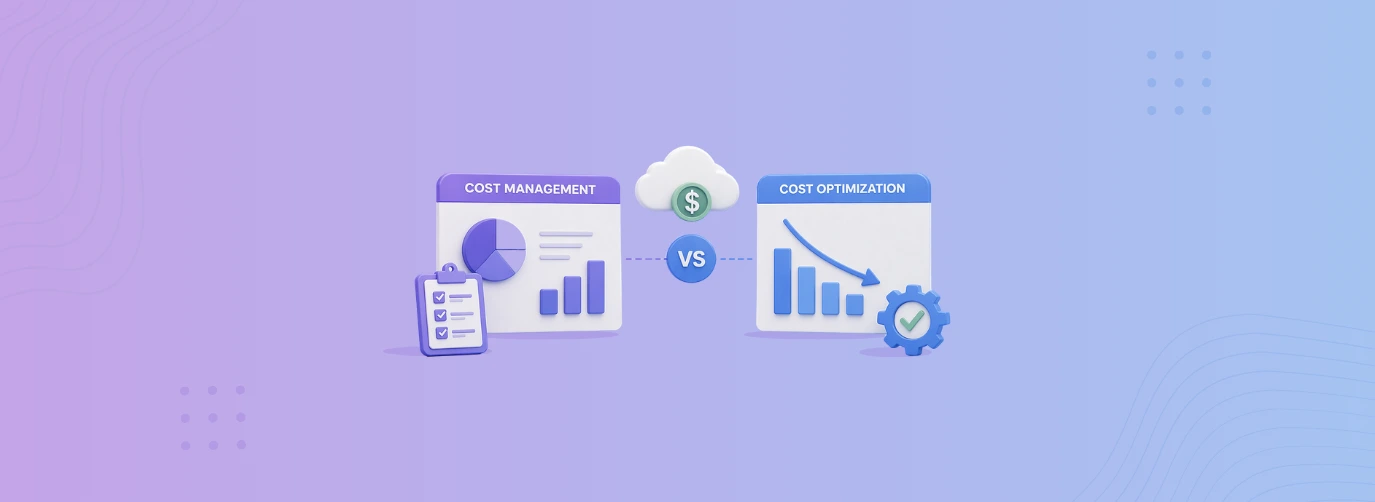
Cloud cost management organizes, allocates, forecasts, and governs cloud spending. Cloud cost optimization uses cost and utilization signals to improve usage efficiency, architecture, and the rates paid for eligible services.Neither discipline replaces the other, and modern cost-management platforms may also surface optimization recommendations. The strongest FinOps programs continuously use management data to identify actions, implement them, measure the result, and adjust their controls.
Cloud Cost Optimization vs Management
Cloud cost management and optimization are connected parts of cloud financial operations. Management creates the visibility, ownership, forecasts, and controls needed for informed decisions. Optimization uses that information to improve value.At a Glance
| Dimension | Cloud Cost Management | Cloud Cost Optimization |
|---|---|---|
| Definition | Organizing, allocating, monitoring, forecasting, and governing cloud spend | Improving cost efficiency through usage, architecture, and pricing actions |
| Primary question | Where is the money going, who owns it, and how is it tracking against plan? | What should change to improve cost efficiency without weakening required outcomes? |
| Typical activities | Allocation, tagging, reporting, budgeting, forecasting, and anomaly monitoring | Idle-resource removal, rightsizing, scheduling, architecture changes, and rate optimization |
| Primary outputs | Reliable cost data, ownership, forecasts, budgets, and guardrails | Implemented changes, measured savings, and improved unit economics |
| Common stakeholders | Finance, FinOps, engineering, product, and business leaders | Engineering, platform, FinOps, procurement, and service owners |
| Success measures | Allocation accuracy, forecast accuracy, budget variance, and accountability | Realized savings, efficiency, commitment utilization, and business value |
Microsoft Cost Management works with Azure Advisor to surface cost-saving actions, while Google Cloud Cost Management includes recommendations that users can apply.
The practical difference is therefore one of emphasis: management builds understanding and control, while optimization turns opportunities into measurable changes.
What Is Cloud Cost Management?
Cloud cost management is the practice of understanding, allocating, planning, and controlling cloud spending across services, accounts, teams, products, and environments. It gives decision-makers a reliable view of current costs, expected costs, ownership, and deviations from plan.Core Cost Management Functions
Visibility and reporting: Convert billing data into usable views of spend by provider, service, account, environment, product, or team.
Allocation and ownership: Use account structures, labels, tags, and cost categories to associate spending with the teams or business outcomes that generate it.
Budgeting and forecasting: Establish financial expectations, forecast future spending, and alert stakeholders when actual or projected costs cross defined thresholds.
Anomaly monitoring: Detect unexpected changes early enough for teams to investigate their technical and business causes.
Governance: Define policies, permissions, approval paths, and accountability for cloud-spending decisions.
What Is Cloud Cost Optimization?
Cloud cost optimization improves the value of cloud spending while maintaining required performance, reliability, security, and scalability. It is broader than lowering the bill: the financial benefit must justify its operational and business tradeoffs.Common Optimization Strategies
Eliminate idle resources. Stop or remove infrastructure that delivers no current value, such as abandoned development resources, unneeded unattached volumes, or unused load balancers.
Rightsize active workloads. Match compute, storage, and database capacity to observed demand. Provider recommendations are useful inputs, but production changes still require workload-aware validation rather than relying on a single average-utilization value.
Schedule and scale capacity. Shut down noncritical environments when they are not needed and use autoscaling where demand changes predictably enough for capacity to follow it.
Choose suitable storage and architecture. Select storage classes using access frequency, retrieval time, retention, availability, durability, and access-cost requirements. Review architecture and service choices when they create recurring spend that simpler resource changes cannot address.
Optimize purchasing rates. Apply commitments or other discounted pricing to eligible, predictable usage after obvious waste and sizing issues have been addressed. Commitments can be a material lever, but the result depends on workload stability, eligibility, discount structure, and utilization.
Management vs Optimization vs Governance
Governance is the system of policies, decision rights, permissions, and accountability that guides cloud use. It is not simply another name for cost management, nor is it a substitute for optimization.| Discipline | Role | Example |
|---|---|---|
| Cost management | Creates financial visibility and control | Allocating Kubernetes costs to the products and teams that generated them |
| Cost optimization | Improves usage efficiency or purchasing rates | Rightsizing a service after validating its performance requirements |
| Governance | Defines how decisions are made and enforced | Requiring owners and expiration dates for temporary environments |
How They Work Together in FinOps
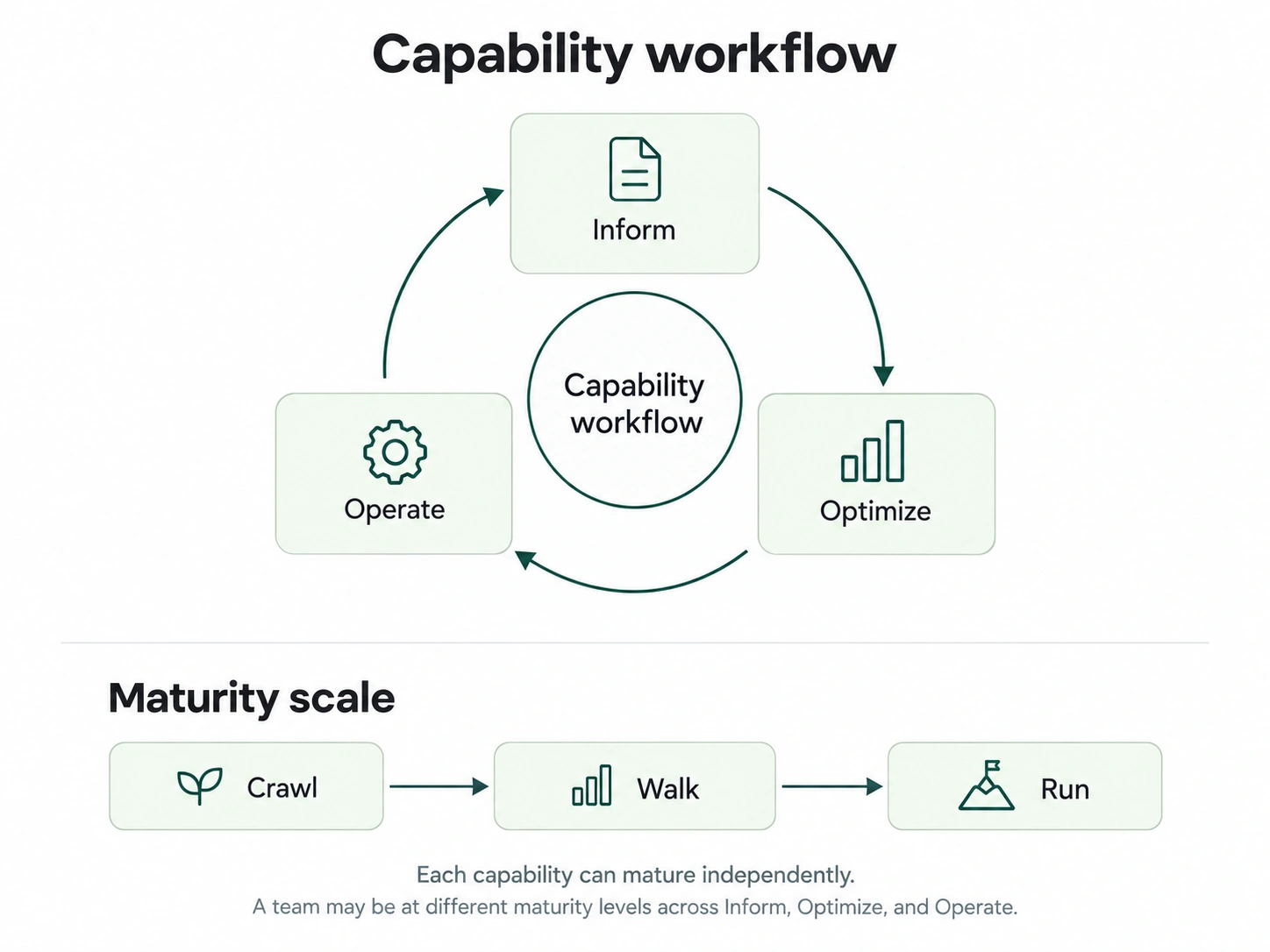
Cost management and optimization operate as a loop rather than a one-way handoff. A team establishes visibility, identifies an opportunity, assesses technical and financial tradeoffs, implements an approved change, and measures the result. The new data then informs the next decision.FinOps Phases and Maturity
The FinOps Framework phases are Inform, Optimize, and Operate. Practitioners cycle through them repeatedly: Inform provides cost, usage, and efficiency data; Optimize identifies opportunities to improve value; and Operate enables teams to act, measure results, and refine their processes.FinOps maturity describes something different. The Crawl, Walk, Run maturity model indicates how developed a particular FinOps capability is. One organization might be at Run for cost allocation but Crawl for commitment management, and reaching Run everywhere is not the objective; maturity should follow business value.
A Practical Operating Cycle
Establish ownership and visibility. Allocate material spend to services, products, or teams and identify the owners who can act on it.
Remove avoidable consumption. Address idle resources, unnecessary schedules, and clear sizing problems before treating current spend as the baseline.
Evaluate structural changes. Compare architecture or service choices where they could improve unit economics without creating unacceptable risk.
Optimize rates on stable usage. Size commitments or other discounts against the eligible baseline that is expected to remain.
Measure and govern. Track realized results, utilization, performance, and recurring regressions, then update policies and forecasts.
Commitment Coverage Explained
Commitment coverage measures how much eligible usage receives a commitment discount instead of being billed at an On-Demand or pay-as-you-go rate. Exact reporting terminology varies by provider and platform, so teams should use a consistent eligible-spend basis when comparing results.Commitment Coverage Formula
For AWS Savings Plans, coverage uses the On-Demand-equivalent value of covered usage: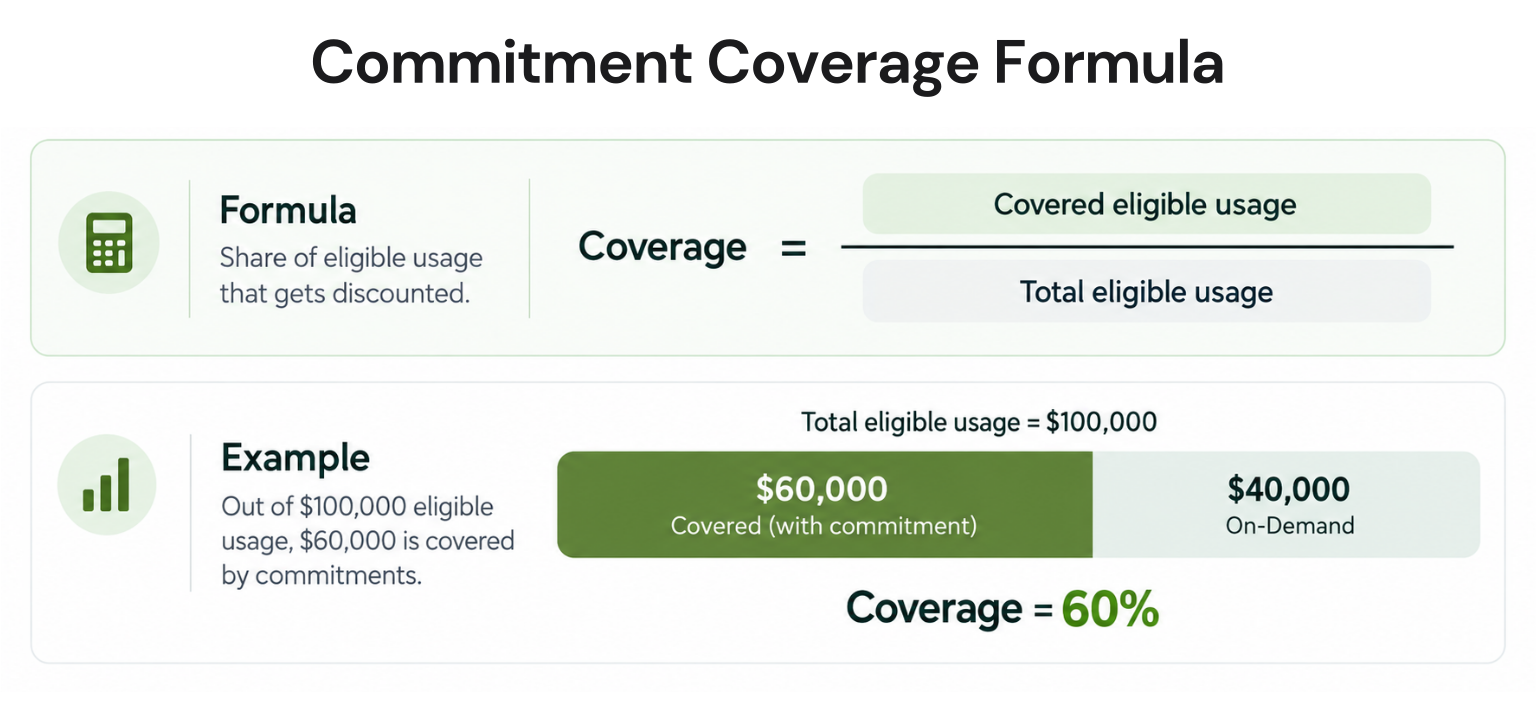
Coverage vs Utilization
Coverage asks how much eligible usage received a discount. Utilization asks how much of the purchased commitment was consumed by matching usage.Higher coverage can reduce eligible On-Demand spend, but purchasing too much can lower utilization. Eligible usage receives the applicable discounted rate up to the commitment, while unused commitment remains payable. Teams therefore need to balance coverage with utilization and the possibility that workloads may shrink, migrate, or change configuration.
There is no target that suits every environment. A defensible target begins with the stable eligible baseline, accounts for existing commitments and workload changes, and leaves an intentional amount of variable usage where flexibility has greater value than the additional discount.
Which Should You Focus On?
Focus first on cost management when teams cannot reliably explain where spend originates, who owns it, or how it compares with forecast. Improve allocation, reporting, anomaly detection, and accountability until decisions can be made from dependable data.Shift more attention to optimization when the largest cost drivers and owners are already clear but identified opportunities remain unimplemented. Begin with reversible usage changes, evaluate structural improvements, and size rate commitments only against stable usage that remains afterward.
Most organizations need both capabilities operating continuously. The useful question is not which discipline should exist, but which gap is currently preventing the organization from improving the business value of its cloud spend.
Where Usage.ai Fits
Rate optimization becomes difficult when teams want commitment discounts but cannot confidently predict how long the underlying usage will remain. We built Flex Insured Commitments to manage that tradeoff across AWS, Azure, and GCP.With Flex Insured Commitments, teams can access 30–50% savings through eligible one- or three-year cloud commitments with none of the commitment risk.
We provide cashback protection for qualifying losses when an eligible Flex Commitment costs more than equivalent On-Demand usage, subject to program terms; our fee is a percentage of realized savings, so if we do not save you money, you do not pay.
Review commitment coverage, risk, and savings across AWS, Azure, and GCP.
Frequently asked questions
What is the main difference between cloud cost management and optimization?
Cost management emphasizes visibility, allocation, planning, and control. Optimization uses financial and utilization data to implement changes that improve usage efficiency, architecture, purchasing rates, or business value.
Is cloud cost governance different from cost management?
Yes, although they overlap. Governance defines policies, permissions, ownership, and decision rights, while cost management supplies the data and financial processes those controls rely on.
What are the FinOps maturity stages?
Crawl, Walk, and Run describe the maturity of individual FinOps capabilities. Inform, Optimize, and Operate are iterative FinOps phases, not maturity levels.
Should rightsizing happen before purchasing commitments?
Generally, yes. Removing idle usage and rightsizing first helps prevent teams from sizing a long-term commitment against an inflated baseline.
What commitment coverage should a team target?
There is no universal percentage. The target should reflect stable eligible usage, existing commitments, expected workload changes, utilization risk, and the value of retaining On-Demand flexibility.