.png)



Cloud commitment models have been evolving steadily over the last few years. For compute workloads, flexible, spend-based commitments made it easier for teams to reduce costs without locking themselves into rigid infrastructure decisions.
Database workloads, by contrast, remained tied to far more rigid commitment models.
Until recently, most managed database services required Reserved Instances, commitments tied to specific instance types, engines, and Regions. For teams running modern database environments that scale frequently, resize often, or change deployment models, this made long-term cost optimization difficult and, at times, risky.
That’s beginning to change now.
With the introduction of AWS Database Savings Plans in December last year, AWS introduced a spend-based commitment option for databases, offering teams more flexibility than traditional configuration-locked commitments.
Today, we’re sharing our announcement on how Usage.ai now supports this new commitment model and what that means for teams optimizing managed database workloads.
What’s Live on Usage.ai
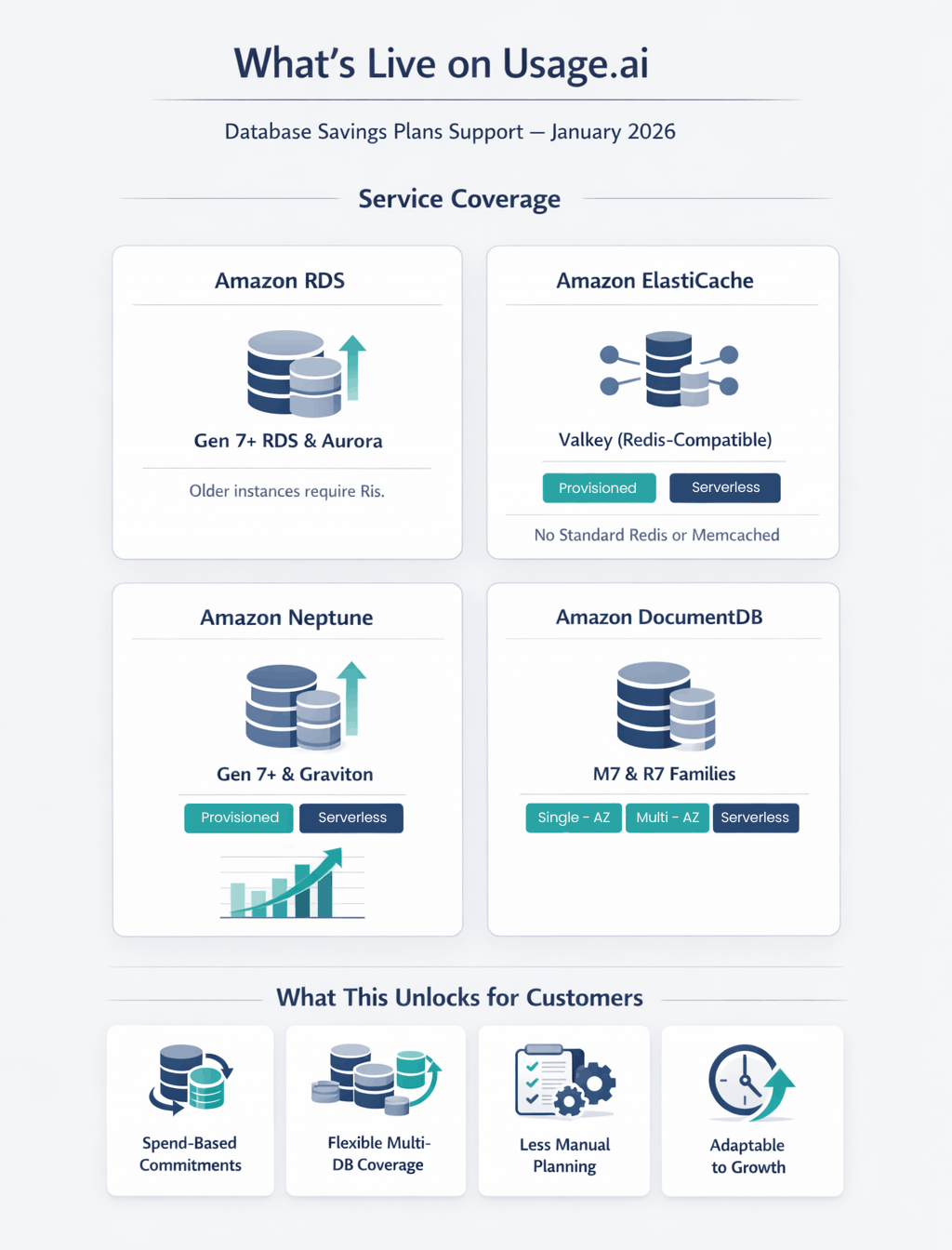
As of January 20th, 2026, Database Savings Plans coverage will be available in Usage.ai for the following AWS managed database services:
- Amazon ElastiCache: Supported only for ElastiCache for Valkey (Redis-compatible), including both provisioned clusters and serverless deployments. Standard Redis and Memcached engines are excluded and continue to require Reserved Nodes for commitment-based savings.
- Amazon RDS: Supported for newer-generation RDS and Aurora instance families (Gen 7 and newer, such as db.m7, db.r7, and equivalent Graviton-based families). Older RDS families (including M5, R5, T3, and T4g) are not eligible for Database Savings Plans and require Reserved Instances or migration to newer families to benefit from spend-based discounts.
With this release, our customers can:
- Model spend-based database commitments instead of instance-specific Reserved Instances
- Evaluate commitment coverage for databases that resize dynamically or run across multiple engines.
- Further reduce manual effort across database commitments, including Reserved Instances and Savings Plans.
- Confidently align long-term commitments with workloads that change over time
Why This Matters for Database Optimization
Reserved Instances required teams to predict, often months in advance:
- Instance class
- Engine
- Deployment model
- Region
For workloads running on RDS or ElastiCache, even routine changes like resizing, scaling, or upgrading instance generations could break Reserved Instance coverage and lead to wasted spend.
Database Savings Plans change that equation by introducing a spend-based commitment option for databases. This allows Usage.ai to extend automated coverage modeling to managed database workloads, alongside existing Reserved Instance strategies.
This is especially valuable for teams operating:
- Multi-engine database environments
- Frequently scaling or resizing workloads
- Modern architectures that evolve faster than traditional RI planning cycles
From a product perspective, this release adds Database Savings Plans to how Usage.ai evaluates cloud commitments. Customers can now assess Database Savings Plans alongside Reserved Instances, see how each option covers their database usage over time, and choose the approach that best fits their workloads.
What’s Coming Next
In the next rollout cycle, Usage.ai will extend Database Savings Plans support to additional AWS services, including:
- Amazon DynamoDB Keyspaces
- Amazon Timestream
- Amazon Neptune
- Amazon DocumentDB
While there is no specific timeline to share yet, support for these services is planned for this quarter as AWS continues to expand Database Savings Plans coverage.
Closing Thoughts
AWS’s move toward spend-based commitments for databases reflects a broader shift in how cloud infrastructure is built and operated. Databases are no longer static, single-configuration systems and commitment models are finally catching up to that reality.
With today’s update, Usage.ai customers can begin applying Database Savings Plans to more of their managed database footprint, with the same confidence and automation they expect from compute optimization.
We’ll continue to roll out support as AWS expands the scope of Database Savings Plans and we’ll share updates as new services become available.
To explore database commitment optimization in Usage.ai, visit usage.ai.