.png)


Most cloud cost tools promise to reduce your bill. Very few explain the difference between showing you the problem and actually fixing it. That distinction matters more than any feature checklist.
Finout is one of the most capable visibility and allocation platforms in the FinOps market. Usage.ai is one of the most automated commitment purchasing and cashback-insured savings platforms available. They are not the same category of tool. Evaluating them as direct substitutes leads to a gap that costs real money every month.
This comparison explains what each platform does, where each one wins, and the specific scenarios where you need one, the other, or both.
What Is the Difference Between Cloud Cost Visibility and Cloud Cost Execution?
Cloud cost visibility means understanding where your cloud money goes. It means tagging, allocating, reporting, and forecasting. A visibility tool answers: “Which team, product, or feature is driving this spend?”
Cloud cost execution means automating the purchases and adjustments that reduce the rate you pay. It means buying Savings Plans, Reserved Instances, and Committed Use Discounts at the right time, in the right volume, and switching or unwinding them when usage patterns shift. An execution tool answers: “How do I pay less per unit of cloud compute, automatically?”
Both functions matter. They sit at different stages of the FinOps cycle. Visibility without execution leaves savings on the table. Execution without visibility makes it hard to allocate credit or identify new optimization opportunities.
This is the core reason Finout and Usage.ai get compared; they both appear in FinOps evaluation lists. But they operate at different layers of the same problem.
What Does Finout Do?
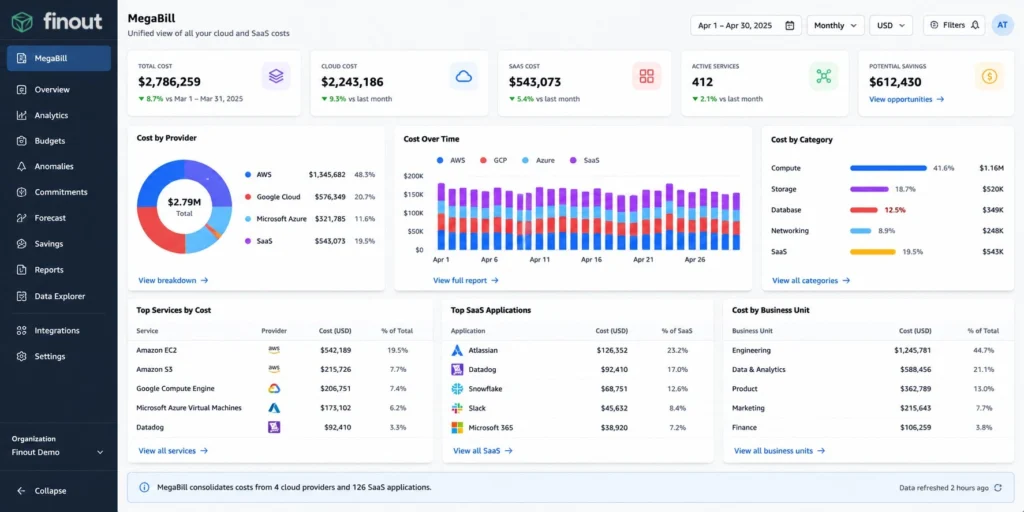
Finout is a FinOps visibility and governance platform. Its core capabilities are:
- MegaBill: A unified billing view that consolidates costs from AWS, GCP, Azure, OCI, Kubernetes, Snowflake, Databricks, OpenAI, Anthropic, and other SaaS services into a single interface. This is its strongest differentiator — no other platform in the mid-market has comparable breadth of cost source integrations.
- Virtual Tagging: Finout applies cost allocation labels retroactively at the analysis layer, without touching your actual infrastructure tags. This means you can allocate spend to teams, features, products, or customers even when your tagging hygiene is imperfect. This is a genuine engineering advantage for organizations with messy or incomplete tagging.
- Anomaly Detection: Real-time alerts when spending spikes beyond expected patterns. Integrates with Slack, Microsoft Teams, and ServiceNow.
- Budgeting and Forecasting: Forward-looking spend projections and budget guardrails, useful for finance and engineering alignment.
- Showback and Chargeback: Cost reporting delivered to individual teams or business units, supporting FinOps culture adoption across an organization.
What Finout does not do: Finout does not autonomously purchase cloud commitments. It does not buy Reserved Instances or Savings Plans on your behalf. It surfaces recommendations but the action belongs to you or your cloud team. Finout is an observability and governance layer, it does not execute changes to your cloud bill at the rate level.
Finout pricing starts at approximately $1,000/month on a subscription model (verify current pricing at finout.io/pricing — rates change).
What Does Usage.ai Do?
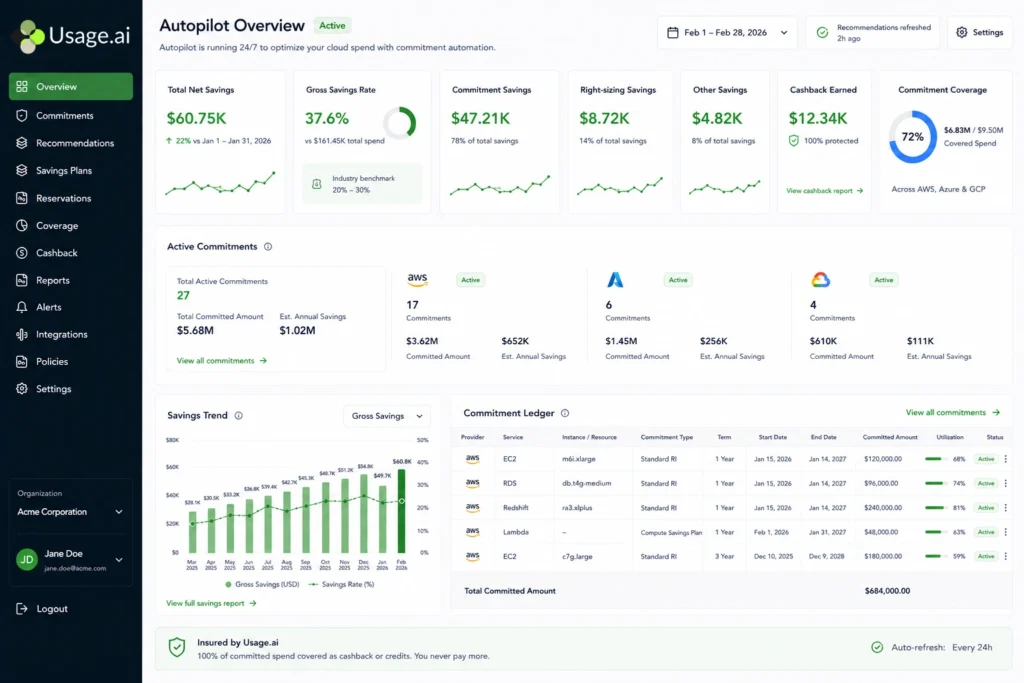
Usage.ai is a commitment automation and savings execution platform. Its core capabilities are:
- Insured Flex Commitments: Usage.ai’s proprietary product that delivers SP/RI-equivalent discounts of 30-60% without requiring multi-year lock-in or upfront payment. Every commitment purchased through the platform is fully insured — if a commitment goes underutilized, Usage.ai buys it back and returns the value as cashback (real money, not credits).
- Autopilot: Fully autonomous commitment purchasing across AWS, GCP, and Azure. The platform analyzes usage patterns, purchases the right commitments at the right volume, and rebalances continuously. No manual review required.
- 24-Hour Recommendation Refresh: Usage.ai refreshes commitment recommendations every 24 hours. AWS Cost Explorer refreshes every 72+ hours — a 3-day lag. At $6-12K/day in uncovered spend, that gap compounds to $18K or more per refresh cycle.
- Zero Lock-In Guarantee: Usage.ai Insured Flex Commitments carry no multi-year obligation. Commitments adjust quarterly. Scale down? No penalty. Underutilized? Cashback paid in real money, not credits.
- Multi-Cloud Coverage: Supports AWS (EC2, Fargate, Lambda, RDS, ElastiCache, Redshift, DynamoDB, OpenSearch), Azure (VMs, Dedicated Hosts, App Service), and GCP (Compute Engine, GKE, Cloud SQL).
- 30-Minute Setup: Billing-layer access only. No infrastructure changes, no code modifications, no deployment risk.
What Usage.ai does not do: Usage.ai is not a visibility or allocation platform. It does not provide MegaBill-style SaaS cost consolidation, virtual tagging for cost allocation, or showback/chargeback reporting. Its focus is rate reduction through commitment automation, not spend attribution.
Usage.ai fees are a percentage of realized savings only. Zero fee if Usage.ai saves nothing.
Finout vs Usage.ai: Side-by-Side Comparison
| Dimension | Finout | Usage.ai |
| Primary Function | Cost visibility and allocation | Commitment automation and savings execution |
| Core Output | Dashboards, reports, allocation data | Autonomous commitment purchases, cashback |
| Savings Mechanism | Visibility-driven (you act on insights) | Autonomous execution (platform acts for you) |
| Commitment Automation | Recommendations only, manual execution | Full Autopilot — purchases and rebalances automatically |
| Cashback on Underuse | No | Yes — real money, not credits |
| Lock-In Terms | N/A (visibility tool, no commitments purchased) | Zero lock-in, quarterly adjustments, cancel anytime |
| Upfront Cost | Subscription from ~$1,000/month | $0 upfront, % of realized savings only |
| Cloud Coverage | AWS, GCP, Azure, OCI, Kubernetes, SaaS | AWS, GCP, Azure |
| SaaS Cost Consolidation | Yes (Snowflake, Databricks, OpenAI, etc.) | No |
| Virtual Tagging | Yes — retroactive, no-code | No |
| Anomaly Detection | Yes | No |
| Budgeting/Forecasting | Yes | No |
| Recommendation Refresh | Not applicable | 24 hours (vs. 72+ hours for AWS native tools) |
| Setup Time | Standard enterprise onboarding | 30 minutes, billing-layer access only |
| Pricing Model | Flat subscription | % of realized savings |
| Best For | Teams needing cost attribution, allocation, governance | Teams needing automated rate reduction on compute spend |
Finout Alternatives: The Full Landscape
If you are evaluating Finout alternatives, your actual need determines which tool belongs on your shortlist. Here is the honest breakdown by use case:
1. CloudZero — Best for Unit Economics and Engineering Attribution
CloudZero uses CostFormation, a code-defined allocation model that maps cloud spend to individual features, customers, or services — even without perfect tags. It goes deeper than Finout on unit economics (cost-per-customer, cost-per-feature) and is the stronger choice for engineering-led organizations where cost accountability needs to live at the service level.
Best fit: Engineering teams that need to answer “how much does the Login Service cost this month” rather than just “how much did we spend on EC2.”
Limitation: CloudZero is a visibility and attribution tool. Like Finout, it surfaces recommendations but does not autonomously purchase commitments.
Also see: CloudZero Alternatives: Best Cloud Cost Tools That Actually Cut Spend in 2026
2. Vantage — Best for Early-Stage Visibility and Engineering Simplicity
Vantage is the most developer-friendly visibility platform in this comparison. Clean dashboards, fast setup, multi-cloud support, and a free tier up to $2,500/month of tracked spend. It includes an Autopilot feature for EC2 Reserved Instance purchasing, but its core strength is read-only cost intelligence.
Best fit: Teams early in their FinOps journey who need clean dashboards and basic allocation before investing in deeper governance or commitment automation.
Limitation: Vantage is primarily a read-and-report tool. It informs where to save; it requires engineering action to execute most changes. Its commitment automation covers EC2 Reserved Instances only and does not include the cashback insurance or quarterly adjustment flexibility of Insured Flex Commitments.
3. nOps — Best for AWS Automation with Commitment Management
nOps is the closest tool in this list to Usage.ai in terms of autonomous commitment purchasing. It manages commitments for AWS (EC2, Fargate, Lambda) and includes cost visibility, rightsizing, and spot automation. It is an AWS Advanced Technology Partner and manages $4B+ in annual cloud spend. Pricing follows a savings-share model (percentage of delivered savings).
Best fit: AWS-heavy teams that want both visibility and commitment automation in one platform, with a preference for outcome-based pricing.
Limitation: nOps is AWS-first. Multi-cloud organizations running material Azure or GCP spend will need supplementary tooling. It also includes infrastructure-layer access (rightsizing, spot management) — teams wanting billing-layer-only access will find Usage.ai’s model cleaner.
Also read: nOps Alternatives: Compare 7 Best Cloud Cost Tools (2026)
4. Apptio Cloudability — Best for Enterprise Governance and Chargeback
Cloudability (IBM/Apptio) is the incumbent enterprise FinOps governance platform. Deep showback/chargeback, TBM-style business mapping, and compliance-grade reporting. Pricing is percentage-of-spend (approximately 2-3% of annual cloud bill) with annual contracts.
Best fit: Fortune 500 organizations with complex chargeback requirements, multi-business-unit reporting, and governance mandates.
Limitation: Cloudability is primarily a governance and reporting platform. Commitment automation is available as an add-on, not the core product. At 2-3% of spend on large cloud bills, the platform cost is significant.
Also read: Apptio Cloudability Alternatives: 7 Tools Compared for FinOps Teams in 2026
5. Usage.ai — Best for Automated Commitment Execution with Zero Lock-In
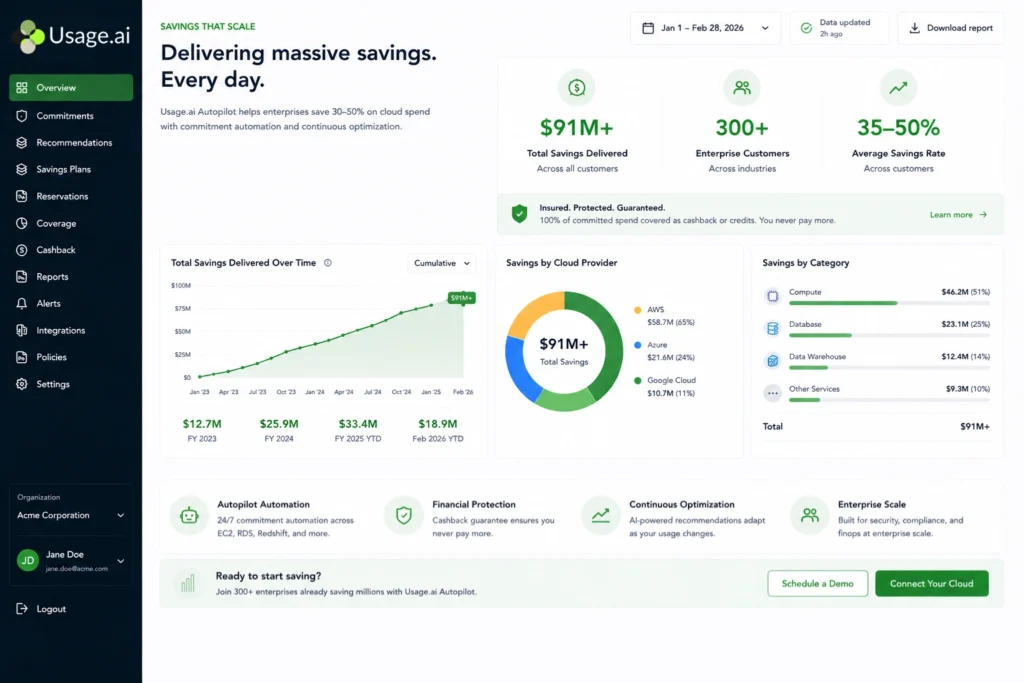
Usage.ai is the appropriate choice when the primary goal is paying less per unit of cloud compute — automatically, across AWS, GCP, and Azure — without infrastructure access, multi-year lock-in risk, or upfront fees.
Usage.ai Insured Flex Commitments carry no multi-year lock-in. Commitments adjust quarterly. Scale down? No penalty. Underutilized? Cashback paid in real money — not credits. That is a meaningful structural difference from both AWS native commitments (1-3 year lock-in, no buyback) and most competitors (credits only, rigid terms).
Best fit: Organizations with material steady-state compute spend on AWS, Azure, or GCP that want autonomous commitment management without multi-year lock-in risk. Works as a standalone tool or as a complementary execution layer alongside a visibility platform like Finout.
Learn more about how Usage.ai handles commitment automation at usage.ai. Book a demo.
The FinOps Stack: How Finout and Usage.ai Work Together
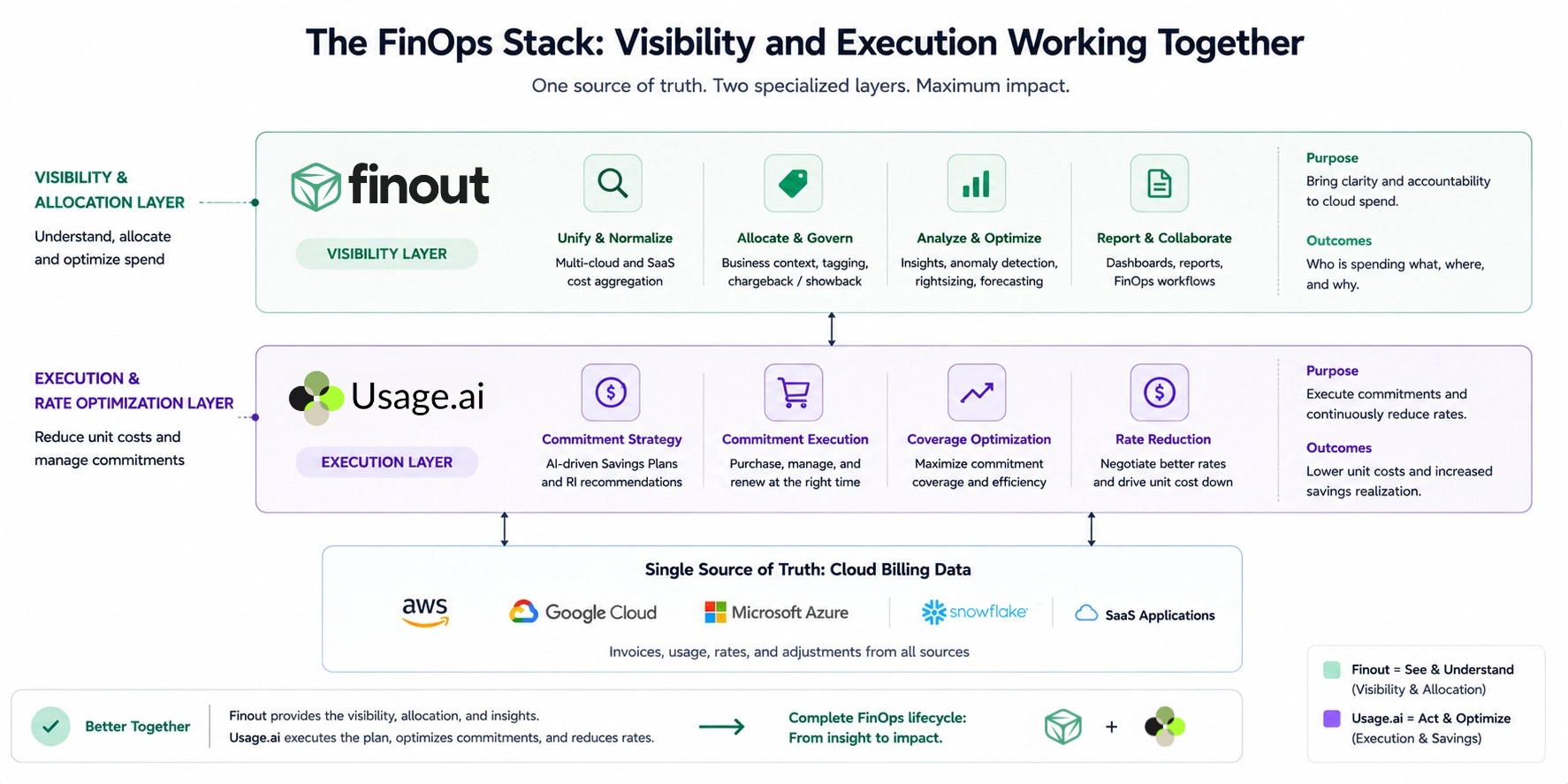
The most cost-efficient FinOps teams do not pick one or the other. They use a visibility platform to understand spend attribution and a commitment execution platform to reduce the rate at which that spend accrues.
- Finout answers: “Where is our cloud money going, and which team, product, or customer is driving it?”
- Usage.ai answers: “How do we pay 30-50% less for that compute, automatically, with no lock-in risk?”
These are sequential questions, not competing ones. Finout can show you that your EC2 spend is $400K/month and attribute it cleanly to three product lines. Usage.ai can then reduce the rate on that $400K by purchasing the right Savings Plans and Reserved Instances automatically — while protecting against underutilization with its buyback guarantee.
Running both tools is not redundancy. It is complete FinOps stack coverage: observability plus execution.
Choose Finout When
- Your primary need is understanding where cloud money goes, not automating how you pay less for it
- You run a complex multi-cloud and SaaS environment (AWS + GCP + Azure + Snowflake + Databricks + AI APIs) and need a single billing view
- Your tagging hygiene is poor and you need retroactive cost allocation without infrastructure changes
- Finance and engineering teams are misaligned on cost ownership and you need showback/chargeback reporting
- You need anomaly detection, budgeting, and forecasting as core capabilities
- You are in the early-to-mid stages of FinOps maturity and need governance infrastructure before commitment automation
Choose Usage.ai When
- Your primary need is paying less per unit of cloud compute, automatically, with no manual effort
- You have steady-state compute spend on EC2, RDS, Fargate, Lambda, Azure VMs, or GCP Compute Engine
- You want commitment discounts of 30-60% without 1-3 year lock-in or upfront payment
- You have been burned by unused Reserved Instances and want a buyback guarantee on every commitment purchased
- You want a fee model that charges only on realized savings — zero fee if nothing is saved
- You need full coverage in 60 days rather than the 6-9 month industry standard for manual optimization
- You want billing-layer-only access — no infrastructure changes, no deployment risk, 30-minute setup
Run a savings estimate at usage.ai.
Choose Both When…
- You need full-stack FinOps: cost attribution (Finout) and rate reduction (Usage.ai)
- You are running $500K+/month in cloud spend and both visibility gaps and commitment gaps are costing you money
- Finance needs allocation and chargeback reporting (Finout) while engineering wants autonomous savings without lock-in risk (Usage.ai)
- You already have Finout and your cloud bill is still not declining — the execution layer is what is missing
How Does Usage.ai’s Cashback Model Differ from Competitors?
This is the dimension no other comparison post addresses directly.
When a commitment goes underutilized with most tools or with AWS native commitments, you absorb the loss. AWS does not refund unused Reserved Instances. Most third-party commitment tools offer credits — vendor-specific, restricted to future purchases on their platform.
Usage.ai returns underutilized commitment value as cashback — real money, paid directly, not locked to the platform. This is a structural risk transfer: the downside of commitment purchasing moves from the customer to Usage.ai.
| Buyback Guarantee: If a commitment purchased through Usage.ai goes underutilized, Usage.ai buys it back — returning the value as cashback (real money, not credits). This covers the primary risk of commitment purchasing: usage pattern changes that leave committed capacity unused. |
Frequently Asked Questions
1. Is Finout the same as a cloud cost optimization tool?
Finout is a cloud cost visibility and allocation platform, not a cost optimization tool in the execution sense. It provides dashboards, tagging, anomaly detection, budgeting, and showback/chargeback reporting. It surfaces optimization recommendations but does not autonomously execute changes like purchasing Reserved Instances or Savings Plans. Organizations using Finout for visibility still need a separate commitment automation tool to realize rate-level savings of 30-50% on compute spend.
2. What is the difference between Finout and Usage.ai?
Finout and Usage.ai operate at different layers of cloud cost management. Finout is a visibility and governance platform that tells you where cloud money is going. Usage.ai is a commitment execution platform that autonomously reduces the rate you pay through Savings Plans, Reserved Instances, and Committed Use Discounts — with a cashback buyback guarantee on any underutilized commitments. The two tools are complementary: Finout for attribution, Usage.ai for rate reduction.
3. Does Finout automate commitment purchasing?
No. Finout surfaces commitment recommendations but does not autonomously purchase Savings Plans or Reserved Instances. Executing on those recommendations requires manual action by your cloud or FinOps team, or a separate commitment automation platform. This is the core gap Usage.ai fills for Finout customers whose bills are not declining despite having visibility.
4. What happens if my usage drops after Usage.ai purchases commitments?
Usage.ai Insured Flex Commitments include a buyback guarantee. If a commitment goes underutilized due to usage pattern changes, Usage.ai buys it back and returns the value as cashback — real money, not credits. Commitments also adjust quarterly, so scaling down carries no penalty. This is structurally different from AWS native commitments (1-3 year lock-in, no refund) and competitors that offer credits only.
5. How long does it take Usage.ai to reach full coverage?
Usage.ai reaches full commitment coverage in 60 days. The industry standard for manual RI and Savings Plan optimization is 6-9 months. That 4x speed difference translates directly to months of savings left unrealized when teams optimize manually or rely on native cloud tools.
6. What is the pricing difference between Finout and Usage.ai?
Finout uses a flat subscription model starting at approximately $1,000/month (verify current pricing at finout.io/pricing — rates change). Usage.ai charges a percentage of realized savings only. If Usage.ai saves you nothing, you pay nothing. There is no upfront fee and no minimum commitment on the savings share. The two pricing models reflect their different functions: Finout charges for visibility access; Usage.ai charges for savings delivered.
7. Which cloud providers do Finout and Usage.ai support?
Finout supports AWS, GCP, Azure, OCI, Kubernetes, and a broad range of SaaS providers including Snowflake, Databricks, OpenAI, and Anthropic. Usage.ai supports AWS, GCP, and Azure for commitment automation. Usage.ai does not currently support OCI or SaaS cost consolidation — its scope is cloud compute rate optimization across the three major hyperscalers.
8. Can I use Finout and Usage.ai together?
Yes, and this is the recommended architecture for organizations that need both cost attribution and rate reduction. Finout handles the visibility and governance layer: tagging, allocation, anomaly detection, and forecasting. Usage.ai handles the execution layer: autonomous commitment purchasing, rebalancing, and cashback insurance on underutilization. The two tools do not overlap in function and share only the billing data layer.