 AWS
AWS Microsoft Azure
 Google Cloud

The catch is sizing it right: commit too much and you pay for capacity you don’t use, commit too little and you leave savings on the table. For a broader view across AWS, Azure, and GCP together, see our [Multi-Cloud Cost Optimization Guide].
The Short Answer
Resource-based CUDs fit workloads that hold steady on the same machine series and region, at the deepest rates. Flex CUDs fit workloads that shift across families, regions, GKE, or Cloud Run at a lower but still solid rate and both can run together on the same billing account.That split is a starting point, not a fixed rule. How stable your fleet actually is, and whether your spend touches services like Cloud SQL or BigQuery that need their own commitments, will shift the right mix, so confirm current rates against Google’s pricing pages before committing.
What Are GCP CUDs?
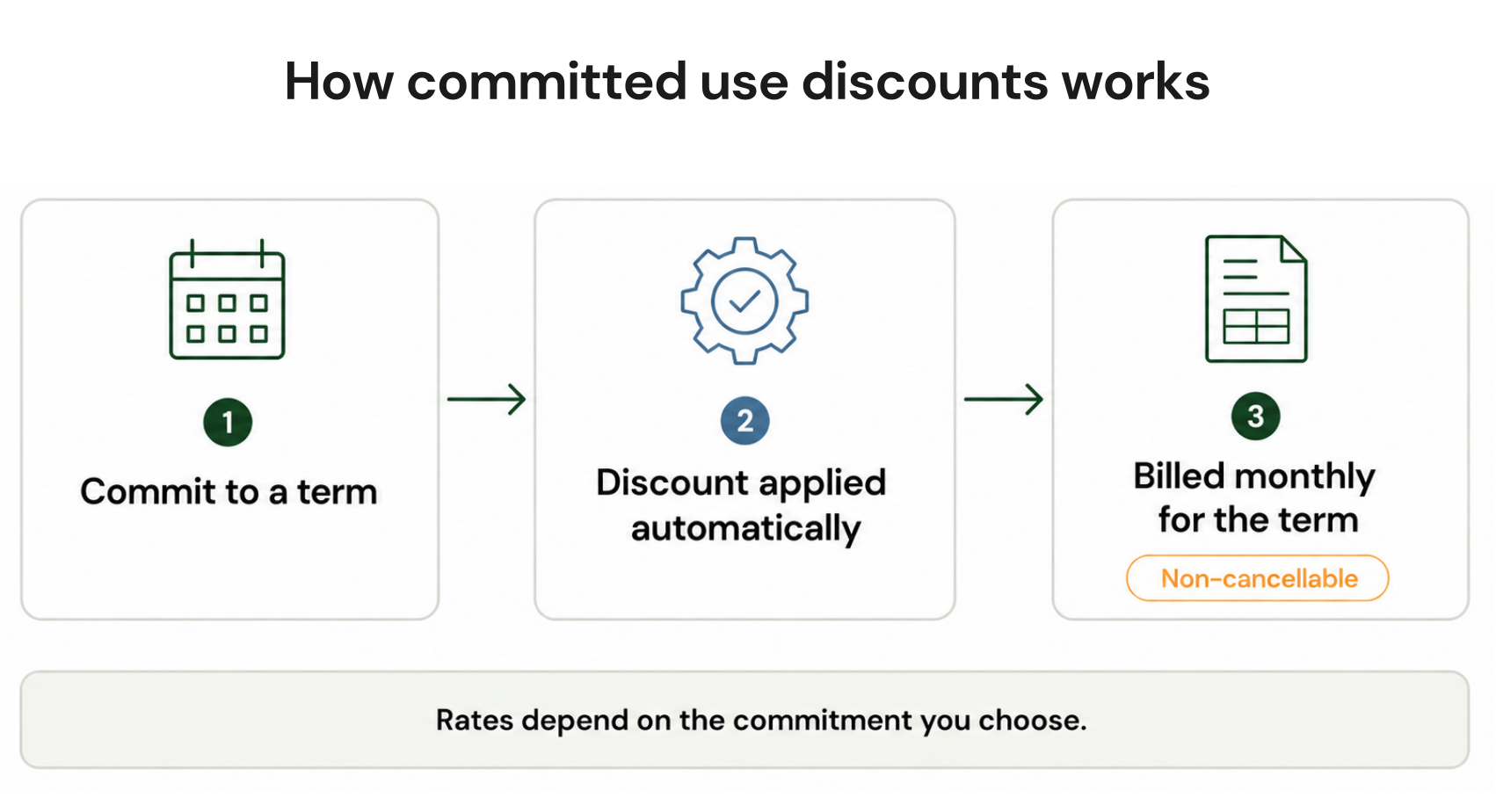
GCP Committed Use Discounts are pricing agreements where you commit to a minimum level of cloud resource usage or spend over 1 or 3 years. In exchange, Google applies discounted rates. These discounts aren’t available on on-demand pricing regardless of how much you spend.Discounts apply automatically to eligible usage once purchased, no tagging or pre-provisioning required.
Spend-based Flex CUDs apply across all projects in your billing account. Resource-based commitments are purchased in a project and region; whether the discount applies project-wide or account-wide depends on your CUD sharing configuration:
- Billing accounts created on or after June 16, 2026: sharing enabled by default.
- Accounts created earlier with no active commitments on that date: switched automatically.
- Accounts created earlier with active commitments on that date: previous scope retained until changed manually.
GCP CUD Types & Discount Rates
1. Resource-Based CUDs
A resource-based CUD commits you to a set amount of Compute Engine resources typically vCPUs and memory in one region and machine series for 1 or 3 years. An N2 commitment covers N2 usage, but not N2D or C3.Per Google Cloud documentation, hardware commitments deliver up to 55% for most machine series and up to 70% for memory-optimized series. General-purpose and compute-optimized machines typically run ~37% (1-year) and ~55% (3-year). Commitments can also be auto-renewed or extended.
Best for:
- Stable fleets with known machine types
- VMs that haven’t changed series or region in 12+ months
- Workloads where the instance family isn’t going to shift
- Scoped to a machine series migrate from N2 to N4 and the discount stops applying to migrated VMs
- Scoped to a region; CUDs don’t transfer across regions
- Non-cancellable, so the wrong size or series is billing exposure for the full term
- On-demand: n2d-standard-8 costs ~$0.3378/hour
- 1-year CUD: ~$0.2129/hour (37% discount)
- 3-year CUD: ~$0.1521/hour (55% discount)
- Annual savings on a 3-year commitment: ~$1,627 vs on-demand
2. Compute Flexible CUDs (Flex CUDs)
A Compute Flexible CUD is a spend-based commitment to a minimum hourly amount of eligible spend at the Cloud Billing-account level. It can cover eligible Compute Engine resources, GKE Standard and Autopilot, and Cloud Run resources, but eligible SKUs and discount rates vary.For example, C2/C2D and listed general-purpose Compute Engine series, GKE Standard and Autopilot, and Cloud Run services with instance-based billing, jobs, and worker pools receive 28% for one year or 46% for three years.
H3/H4D receive 17% or 38%; C4N receives 28% or 54%; memory-optimized M1–M4 receive no one-year discount and 63% for three years; and Cloud Run request-based billing and Cloud Run functions receive 17% for either term.
Check the current eligible-SKU list and rate table before purchasing. Flex suits workloads migrating between eligible machine families, mixed VM and container environments, and growing infrastructure where precise forecasting is difficult. For GKE-specific strategy, see our [GKE cost optimization guide].
3. Service-Specific Spend-Based CUDs
Service-specific spend-based CUDs commit you to eligible spend for one Google Cloud service. Their regional scope, eligible resources, exclusions, and rates vary by product; for example, Cloud SQL CUDs cover eligible instance vCPU and memory in the committed region.| Service | 1-Year | 3-Year |
|---|---|---|
| Cloud SQL | 25% | 52% |
| BigQuery (PAYG compute) | Available | Available |
| Bigtable, Memorystore, AlloyDB, Spanner, Dataflow, Firestore | Varies | Varies |
Not eligible for CUDs: Cloud Storage and persistent disk storage, network egress, Spot VMs (already discounted), and App Engine standard environment.
On-Demand vs SUD vs CUD
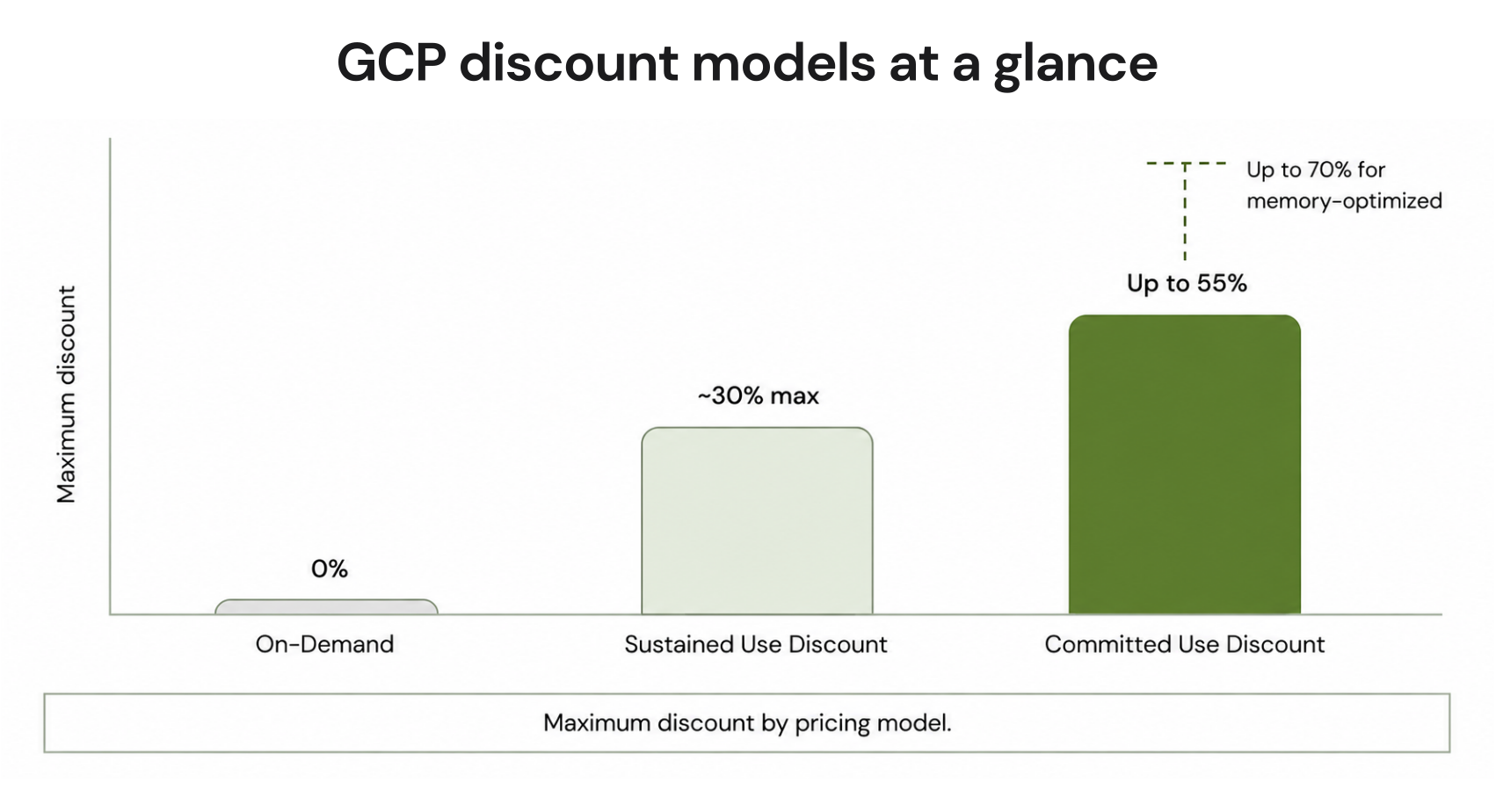
On-Demand Pricing is the default no commitment, no discount. Right for unpredictable workloads, most expensive for stable production.Sustained Use Discounts (SUDs) apply automatically when a VM runs more than 25% of a billing month. Maximum is ~30% for N1 and memory-optimized M1/M2, 20% for N2/N2D/C2, and newer series like E2, N4, C3, and C4 are ineligible. Self-serve billing accounts only.
Committed Use Discounts (CUDs) require an explicit purchase. SUDs don’t apply to usage already covered by a CUD CUDs take precedence.
| Feature | On-Demand | SUD | CUD |
|---|---|---|---|
| Commitment required | None | None | 1 or 3 years |
| Max discount | 0% | ~30% | Up to 55% (70% memory-optimized) |
| Cancelable | N/A | N/A | No |
| Best for | Variable workloads | Workloads running most of the month | Stable, predictable baseline |
| Financial risk | None | None | Medium–High if overcommitted |
Resource-Based vs Flex CUDs
| Resource-Based | Flex | |
|---|---|---|
| You commit to | vCPU + memory in a region and series | Hourly spend |
| Portability | Fixed to one series and region | Across families, regions, GKE, Cloud Run |
| Max discount | Up to 55% (70% memory-optimized) | Up to 63%; varies by eligible resource and term |
| Best for | Stable, unchanging infrastructure | Workloads that evolve or mix services |
For the full decision framework, dollar comparisons, and layering strategy, see [Resource-Based vs. Flex CUDs: Which Saves More on GCP?]
Real-World GCP CUD Cost Example
A company has a stable $10,000 monthly on-demand-equivalent baseline for Compute Engine, GKE, or Cloud Run usage that qualifies for the 28% one-year and 46% three-year Compute Flexible CUD rates. Here is how those commitments affect that bill.| 1-Year Flex CUD | 3-Year Flex CUD | |
|---|---|---|
| Discount | 28% | 46% |
| Monthly commitment fee | $7,200 | $5,400 |
| Covers on-demand-equivalent | $10,000 | $10,000 |
| Monthly savings | $2,800 | $4,600 |
| Annual savings | $33,600 | $55,200 |
The risk: if this company’s spend drops to $5,000/month in year 2, they’re committed to $5,400/month while using $5,000 of resources. The commitment becomes a cost, not a saving.
Sizing Your CUD Commitment
| Strategy | Coverage | Risk | Best For |
|---|---|---|---|
| Conservative | 40–60% | Low | Rapidly growing infrastructure |
| Balanced | 60–80% | Medium | Most production environments |
| Aggressive | 80–95% | High | Very stable, multi-year plans |
How to Purchase GCP CUDs
Purchasing takes minutes in the Cloud Billing console you’ll need the Billing Account Administrator role and at least 60 days of usage data. Resource-based commitments activate the next day at 12 AM Pacific; Flex commitments activate within 1–2 hours. The harder work is sizing.Recent GCP CUD Program Changes
- Mid-2024: Flex CUDs expanded to cover GKE Autopilot and Cloud Run alongside Compute Engine VMs.
- January 21, 2026: Google Cloud automatically transitioned remaining customers to the new spend-based CUD model, which applies discounts directly to eligible SKU prices rather than using credit offsets. Accounts without active spend-based commitments had already moved to the new model on July 15, 2025, when early opt-in also opened.
- Late 2025: Flex coverage broadened to more machine families, including memory-optimized and HPC series.
- June 16, 2026: CUD sharing became the default scope for most accounts see our [June 2026 GCP FinOps update].
Removing the Commitment Risk
We help GCP teams identify and size commitment opportunities from actual billing usage, so a commitment matches what the workload needs.With Flex Insured Commitments, teams capture commitment-based savings while reducing the risk of unused capacity. With Flex Insured Commitments, teams can get the 46% savings of a 3-year commitment with none of the commitment risk.
If usage drops and a covered commitment costs more than the on-demand equivalent would have, we cover the difference through cashback, so a shrinking workload doesn’t turn into a loss. And we bill only a percentage of realized savings, so our result depends on yours.
Review your Compute Engine baseline, coverage level, and commitment risk before you sign a 1- or 3-year term.
Frequently asked questions
How do GCP Committed Use Discounts work?
You commit to a minimum level of usage or spend for 1 or 3 years, and Google automatically applies the discount to eligible usage each hour. If usage falls below the committed level, you still pay the full commitment fee. CUDs are non-cancellable.
What is the difference between a committed use discount and a sustained use discount?
SUDs are automatic discounts of up to ~30% for VMs running more than 25% of a billing month, with no commitment. CUDs require a 1- or 3-year commitment but deliver up to 55% for most compute and 70% for memory-optimized machines.
What is a Compute Flexible Committed Use Discount?
A spend-based commitment to a minimum hourly amount of eligible GCP compute spend, discounted 28% (1-year) or 46% (3-year) for general-purpose series, applying across VM families, regions, GKE, and Cloud Run.
What happens if I don't use all of my GCP committed use discount?
You pay the commitment fee without receiving the full benefit, and unused commitment doesn't carry forward to future hours.
Can GCP committed use discounts be cancelled?
No. Once purchased, CUDs can't be self-service cancelled for the full term. If you purchased one by mistake, contact Cloud Billing Support immediately Google may reverse it within a very narrow window.