.png)


We started working on Database Savings Plans support the day AWS announced it at re:Invent 2025.
In January 2026, we shipped the first version, covering RDS, Aurora, and ElastiCache for Valkey. We said more services were coming. Today, that coverage is complete.
Usage.ai now automates AWS Database Savings Plans across all 10 services AWS currently covers under the program. Every part of the lifecycle is handled: analysis, commitment sizing, purchase, monitoring, and cashback if a commitment goes underutilized.
What AWS Database Savings Plans Are and Why They’re a Big Deal
Before DSP, getting discounts on managed AWS databases meant Reserved Instances. RIs lock you to a specific instance class, engine, and Region. Change any of those, be it a resize, an engine migration, or a Region shift, and the discount disappears. For teams running modern, evolving database environments, that rigidity made long-term cost optimization genuinely difficult.
And for some services, like Amazon Keyspaces, DocumentDB Serverless, Neptune Serverless, and Aurora Serverless v2, there was no discount path at all. You were paying on-demand rates regardless of how predictable your usage was.
AWS Database Savings Plans change the model entirely. You commit to a consistent hourly spend amount for a one-year term. AWS applies discounts automatically across all eligible database usage up to that amount, every hour, without any manual configuration. The discount follows your spend, not your instance configuration.
- Up to 35% off for serverless workloads.
- Up to 20% for most provisioned workloads.
- No upfront payment required.
AWS expanded the program on March 5, 2026 to add Amazon OpenSearch Service and Neptune Analytics. We added support for both immediately after.
For the full technical breakdown, service eligibility, discount rates by deployment model, the DSP vs. Reserved Instance decision framework, see the AWS Database Savings Plans: Complete Guide for 2026.
What’s Live on Usage.ai Today
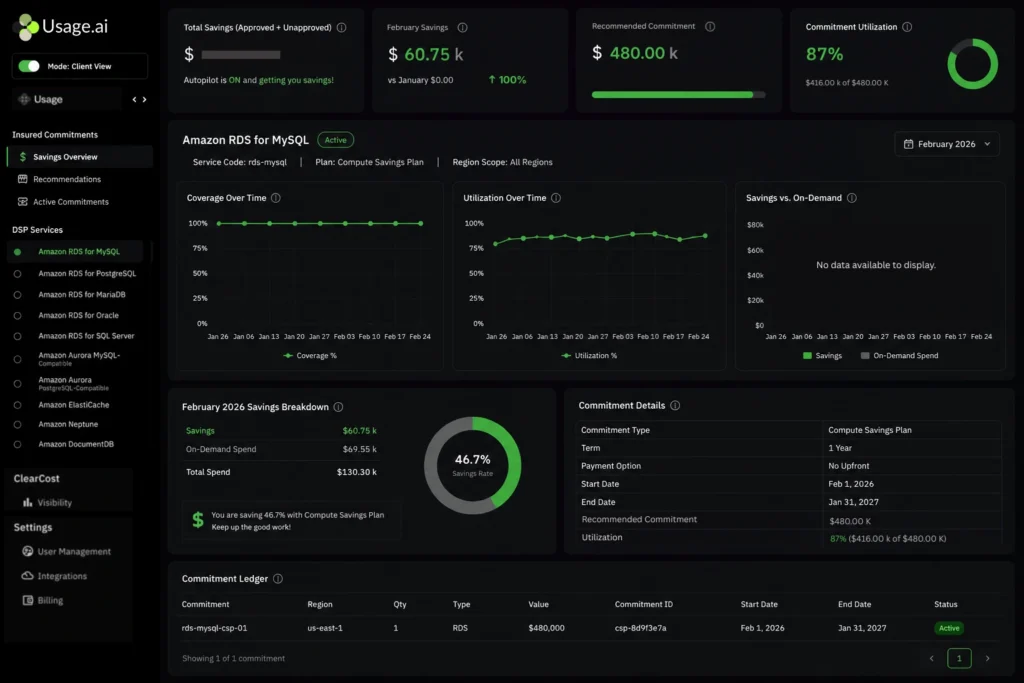
Full DSP lifecycle automation is now live across all 10 eligible services:
- Amazon RDS: Gen 7+ provisioned instances (db.r7, db.r8g, db.m7, db.m7g families). If you’re still on db.r5, db.r6g, or db.m5, those remain RI-only, DSP eligibility kicks in once you migrate to Gen 7+. Usage.ai identifies that gap and flags it before making a DSP recommendation.
- Amazon Aurora: Gen 7+ provisioned instances, Aurora Serverless v2 (ACU-based billing), and Aurora DSQL (DPU-based billing). Serverless v2 is where the 35% discount applies and where teams previously had zero commitment discount options. If your Aurora spend is split across provisioned and serverless, Usage.ai models both correctly under a single commitment.
- Amazon DynamoDB: on-demand throughput (up to 18% savings) and provisioned capacity (up to 12% savings). One important constraint: DSP cannot be combined with DynamoDB reserved capacity on the same table; reserved capacity applies first, and DSP covers the remaining eligible spend. Usage.ai accounts for this in the floor calculation so the commitment isn’t over-sized against already-covered usage.
- Amazon ElastiCache: Valkey engine only, covering Gen 7+ provisioned clusters and ElastiCache Serverless for Valkey. Standard Redis OSS and Memcached are not eligible and continue to require Reserved Nodes. If your team is still on Redis OSS, Valkey is API-compatible and priced lower, the migration unlocks DSP eligibility as a secondary benefit.
- Amazon DocumentDB: Gen 7+ provisioned instances and DocumentDB Serverless (DCU-based billing). DocumentDB Serverless is one of the services that had no commitment discount at all before DSP, any savings here are net new.
- Amazon Neptune: Gen 7+ provisioned instances, Neptune Serverless (NCU-based billing), and Neptune Analytics, which AWS added to the DSP program on March 5, 2026. A single DSP commitment now covers all three Neptune deployment types simultaneously. Usage.ai added Neptune Analytics support immediately after the AWS expansion.
- Amazon Keyspaces: on-demand throughput (up to 18% savings) and provisioned throughput (up to 12% savings). There are no Reserved Instances for Keyspaces; DSP is the only commitment discount path that exists for this service. Teams with stable Keyspaces spend who haven’t been able to discount it have a path now.
- Amazon Timestream: Timestream for InfluxDB instances. Timestream for InfluxDB is the current active product line from AWS. DSP covers InfluxDB instance spend; Usage.ai scopes the commitment accordingly.
- Amazon OpenSearch Service: Serverless usage and Gen 7+ provisioned instances, added by AWS to the DSP program on March 5, 2026. Older provisioned OpenSearch instance families are not eligible and continue to require Reserved Instances. Usage.ai added OpenSearch support following the March expansion.
- AWS Database Migration Service (DMS): Gen 7+ replication instances and DMS Serverless. DSP covers ongoing replication workloads on eligible instance families; it does not apply to one-time migration tasks billed differently.
Read the full announcement in our official press release.
How Usage.ai Handles It
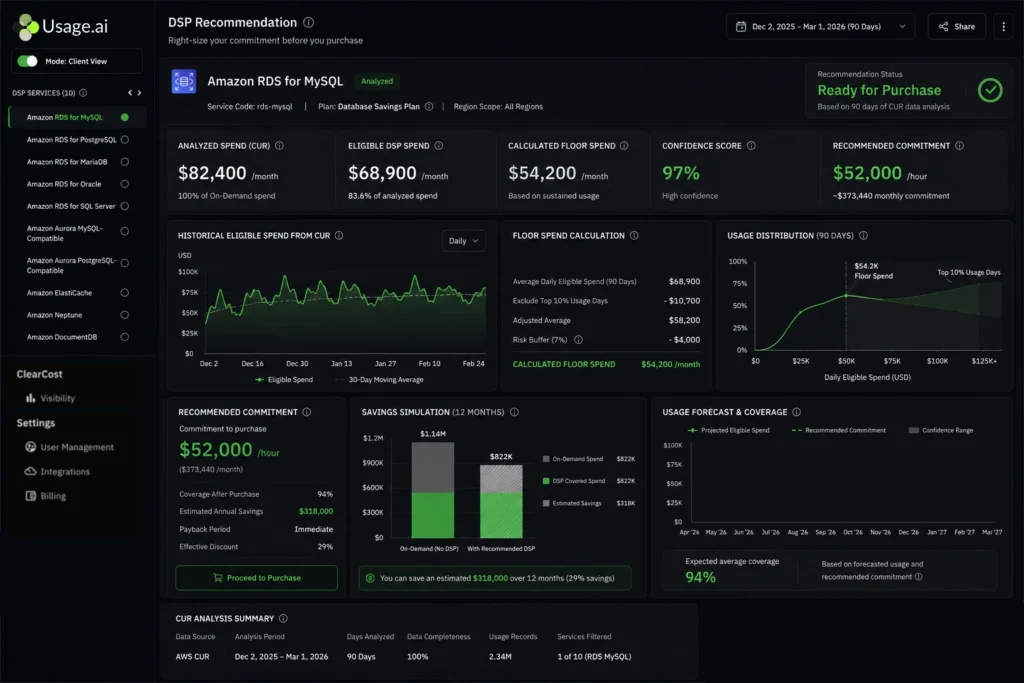
The right commitment level is your consistent floor of eligible hourly spend; the amount your DSP-eligible database costs never drop below, across all hours of the day and night.
- Commit above that floor and you’re paying for capacity you’re not using during quiet periods.
- Commit below it and you’re leaving savings on the table during peak hours.
Getting this right manually across 10 services with different eligibility rules, separated from your RI-covered spend so you don’t double-count takes real work. And it needs to be maintained continuously, not just on day one.
Here’s what Usage.ai does:
Analysis. We pull your Cost and Usage Report data and identify DSP-eligible spend across all 10 services. We separate it from RI-eligible spend, i.e., older-gen instances like db.r5 and db.r6g, standard Redis and Memcached so the recommendation is scoped correctly.
Commitment sizing. We calculate your consistent hourly floor spend on DSP-eligible usage across the past 60 days. That’s the right commitment level: enough to capture savings on your predictable baseline, without over-committing on variable peak spend.
Purchase. We purchase the DSP commitment through billing-layer access. The plan activates immediately.
Monitoring. We monitor DSP utilization on a 24-hour refresh cycle. AWS Cost Explorer refreshes every 72+ hours. That lag matters, our 24-hour cycle means utilization changes get caught and acted on before they compound.
Cashback on underutilization. If a commitment goes underutilized, a database gets decommissioned, migrated, or downsized, we provide cashback on the unused committed amount in real money. No stranded commitments. The same guarantee that covers your Savings Plans and Reserved Instances now covers DSP too.
Fee: a percentage of realized savings only.
What to Get Right Before You Commit
A DSP discount applies to your committed spend level. If that spend level reflects oversized instances or infrastructure you’re planning to migrate, you’re locking in savings on a higher baseline than necessary; the discount is real, but it’s discounting a number that’s larger than it needs to be.
The right sequence is: right-size first, migrate to Gen 7+ where it makes sense, confirm your storage configuration, then purchase DSP on the spend floor that reflects your actual, optimized infrastructure.
Skipping that sequence doesn’t void the discount. It just means you’ve committed to paying for more than you need to for the next 12 months.
Usage.ai surfaces this before making a recommendation. Where a right-sizing opportunity or generation upgrade is identified, we flag it as a prior action, so the commitment is sized against the right baseline from the start.
Get Started
If you want to see your DSP-eligible spend across all 10 services, the free savings calculator shows you in under 60 seconds.
To see how Usage.ai automates DSP alongside your Reserved Instances and Compute Savings Plans, book a demo.