.png)



ElastiCache Serverless pricing has two dimensions: ECPUs (ElastiCache Processing Units, covering both vCPU time and data transfer per request) and data stored (GB-hours). The rate on both dimensions depends on which engine you choose. Valkey is 33% cheaper than Redis OSS and Memcached on both ECPU and storage.
This guide covers the exact rates per engine, the ECPU mechanics, the minimum storage floor and why it matters for dev environments, three worked examples including the AWS Database Blog official example, the break-even against node-based clusters, and the Database Savings Plans discount path.
See exactly what you’re overpaying in under 60 seconds. Try the Calculator for free →
Exact Rates: Valkey vs Redis OSS vs Memcached Serverless
All rates: US East (N. Virginia), June 2026. Source: AWS Database Blog official worked examples, pump.co (March 2025), Usage.ai live ElastiCache blog. Verify at aws.amazon.com/elasticache/pricing/ — rates change.
| Engine | ECPU Rate | Storage Rate |
| Valkey Serverless | $0.0023/million ECPUs | $0.084/GB-hour |
| Redis OSS Serverless | $0.0034/million ECPUs | $0.125/GB-hour |
| Memcached Serverless | $0.0034/million ECPUs | $0.125/GB-hour |
| Valkey vs Redis OSS saving | 32% cheaper ($0.0023 vs $0.0034) | 33% cheaper ($0.084 vs $0.125) |
Sources: Redis OSS rates ($0.0034/million ECPUs, $0.125/GB-hr) from AWS Database Blog official worked example (aws.amazon.com/blogs/database/unlock-on-demand-cost-optimized-performance-with-amazon-elasticache-serverless/). Valkey rates ($0.0023/million ECPUs, $0.084/GB-hr) from pump.co (March 2025) citing AWS official. Verify at aws.amazon.com/elasticache/pricing/ — rates change.
Complete Serverless Pricing Table
All rates: US East (N. Virginia), June 2026.
| Component | Rate | Notes |
| ECPU — Valkey Serverless | $0.0023/million | 33% cheaper than Redis OSS. 1 ECPU = 1 KB data transferred. Complex commands consume more. |
| ECPU — Redis OSS / Memcached | $0.0034/million | Official AWS worked example rate. 50K RPS at 1 KB/request = 180M ECPUs/hr = $0.61/hr. |
| Storage — Valkey | $0.084/GB-hr | Minimum 100 MB metered. At 100 MB continuous: ~$6/month floor. |
| Storage — Redis OSS / Memcached | $0.125/GB-hr | Minimum 1 GB metered. At 1 GB continuous: ~$91/month floor. |
| Minimum — Valkey | 100 MB (~$6/month) | 90% lower minimum than Redis OSS. 10 dev caches = $60/month vs $910/month. |
| Minimum — Redis OSS / Memcached | 1 GB (~$91/month) | Even a near-empty cache costs ~$91/month in storage alone. |
| Backup storage | $0.085/GiB-month | All regions. No data transfer fees for backup creation or restore. Source: AWS official pricing page. |
| Data transfer — same AZ | $0.00 | No charge for EC2 to ElastiCache within same Availability Zone. |
| Data transfer — cross-AZ | $0.01/GiB | Standard EC2 regional rate applies when EC2 and Serverless cache are in different AZs. |
| Reserved Nodes | Not available | Reserved Nodes apply to node-based clusters only. |
| Database Savings Plans | Up to 30% | 1-year commitment. Covers ElastiCache Serverless. Source: AWS official pricing page. |
| Scale-to-zero / pause | Not available | Billing starts when cache enters Available state. Delete the cache to stop all charges. |
| Global Datastore | Not available | Cross-region replication is node-based only. |
Backup $0.085/GiB-month from AWS official pricing page. Data transfer rates from AWS official. All other rates from AWS Database Blog official worked examples and pump.co (March 2025). Verify all at aws.amazon.com/elasticache/pricing/.
How ECPU Pricing Works
An ElastiCache Processing Unit (ECPU) is one kilobyte of data transferred per cache operation. Reads and writes each consume ECPUs equal to the KB transferred. A GET returning 500 bytes (0.5 KB) consumes 0.5 ECPUs. A GET returning 3.2 KB consumes 3.2 ECPUs. Source: AWS official pricing page: ‘Reads and writes require 1 ECPU for each kilobyte (KB) of data transferred.’
Commands that require additional vCPU time beyond basic data transfer — HSET with many fields, ZADD to large sorted sets, LRANGE over large lists, Lua scripts — consume proportionally more ECPUs than the 1-per-KB baseline. For most standard caching patterns (GET/SET of small JSON objects, session tokens, feature flags), ECPU consumption scales linearly and predictably with request rate and payload size.
Calculating your ECPU consumption: requests per second x average KB per request = ECPUs per second. At 10,000 RPS with 1 KB average payload: 10,000 ECPUs/second = 36 billion ECPUs/hour. At $0.0034/million (Redis OSS): $0.12/hr = $87.60/month. At $0.0023/million (Valkey): $0.08/hr = $58.40/month.
The Minimum Storage Floor: Why Engine Choice Changes Everything for Dev Environments
The minimum metered data storage is billed regardless of how much data your cache actually holds. AWS samples storage multiple times per minute and calculates an hourly average — if you store 50 MB in a Redis OSS Serverless cache, you are billed for 1 GB (the minimum). If you store 50 MB in a Valkey Serverless cache, you are billed for 100 MB (the Valkey minimum).
Monthly floor cost comparison:
Redis OSS Serverless minimum: 1 GB x $0.125/GB-hr x 730 hrs = $91.25/month.
Valkey Serverless minimum: 0.1 GB x $0.084/GB-hr x 730 hrs = $6.13/month.
For a team running 10 development and staging caches, all near-empty: Redis OSS = $912.50/month in storage minimums. Valkey = $61.30/month. The $851.20/month difference requires zero application changes — Valkey is a drop-in replacement for Redis OSS with the same commands, data types, and client protocols. Source: AWS Database Blog (October 2024), pump.co (March 2025).
The fastest cost reduction available to any team running Redis OSS Serverless caches that are not full: switch to Valkey Serverless. No code changes. No migration scripts for empty or near-empty caches. Just create a new Valkey Serverless cache and point your application at the new endpoint. Cost drops immediately by 33% on ECPU and storage, plus the minimum floor drops 15x.
Also read: ElastiCache Reserved Nodes: Complete Pricing Guide
Worked Example 1: Variable Traffic Application Cache (AWS Official)
Source: AWS Database Blog official ElastiCache Serverless worked example (aws.amazon.com/blogs/database/unlock-on-demand-cost-optimized-performance-with-amazon-elasticache-serverless/). Engine: Redis OSS Serverless, US East (N. Virginia).
Scenario: application cache with variable traffic. During peak hours (22 hours/day), data stored = 10 GB. During 2 hours of off-peak, data stored = 50 GB (batch processing loads additional data). Request rate: 10,000 ECPUs/second for 22 hours, 100,000 ECPUs/second for 2 peak hours. Each request transfers 500 bytes = 1 ECPU per request (rounds up from 0.5 KB).
| Usage component | Calculation | Cost |
| Average hourly data storage | (10 GB x 22 hrs + 50 GB x 2 hrs) / 24 = 13.3 GB-hrs/hr | |
| Hourly storage charge | 13.3 GB-hrs x $0.125/GB-hr | $1.67/hr |
| Average hourly ECPUs | (10K ECPUs/sec x 3,600 x 22 hrs + 100K ECPUs/sec x 3,600 x 2 hrs) / 24 = 63M ECPUs/hr | |
| Hourly ECPU charge | (63M / 1M) x $0.0034 | $0.21/hr |
| Total hourly | $1.67 + $0.21 | $1.88/hr |
| Total monthly | $1.88 x 730 hrs | $1,372.40/month |
Source: AWS Database Blog official worked example (aws.amazon.com/blogs/database/unlock-on-demand-cost-optimized-performance-with-amazon-elasticache-serverless/), Redis OSS rates verified June 2026. Same workload on Valkey Serverless: storage $1.12/hr (13.3 x $0.084) + ECPU $0.14/hr (63M x $0.0023) = $1.26/hr = $919.80/month. Valkey saves $452.60/month — 33% lower.
Worked Example 2: Simple GET/SET Cache at 50K RPS (AWS Official)
Source: AWS Database Blog official example. Engine: Redis OSS Serverless. Scenario: application cache storing 10 GB, receiving 50,000 requests per second, each request a GET or SET transferring less than 1 KB (= 1 ECPU per request).
| Usage component | Calculation | Cost |
| Storage | 10 GB-hrs x $0.125/GB-hr | $1.25/hr |
| ECPUs | 50,000 RPS x 3,600 sec/hr = 180M ECPUs/hr. (180M / 1M) x $0.0034 | $0.61/hr |
| Total | $1.25 + $0.61 | $1.86/hr (~$1,358/month) |
Source: economize.cloud citing AWS official worked example. Same workload on Valkey: storage $0.84/hr (10 x $0.084) + ECPU $0.41/hr (180M x $0.0023/1M) = $1.25/hr = $912.50/month. Valkey saves $445.50/month.
Worked Example 3: Dev Cache Floor Cost Comparison
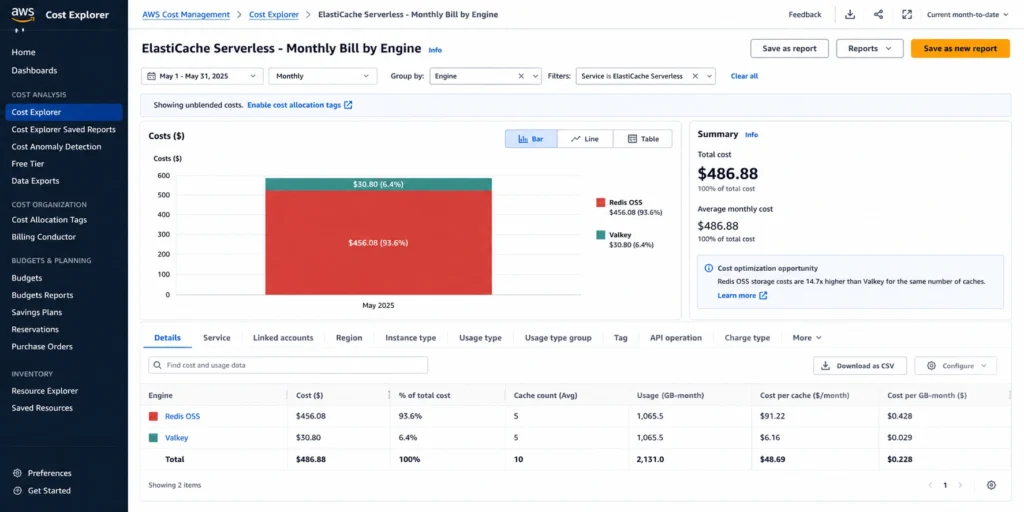
Scenario: 5 development caches, each storing 50 MB, receiving 100 requests per hour (essentially idle). This is the scenario where engine choice has the most dramatic impact.
Redis OSS Serverless — 5 caches at minimum 1 GB each: 5 x 1 GB x $0.125/GB-hr x 730 hrs = $456.25/month in storage alone. ECPU: negligible (100 requests/hr x 1 KB = 100 ECPUs/hr per cache = essentially $0). Total: $456.25/month for 5 empty dev caches.
Valkey Serverless — 5 caches at minimum 100 MB each: 5 x 0.1 GB x $0.084/GB-hr x 730 hrs = $30.66/month in storage alone. Total: $30.66/month for the same 5 empty dev caches.
Monthly saving by switching dev caches to Valkey: $425.59/month. Annual saving: $5,107. Zero application changes required. Source: math from verified rates.
Rule of thumb for dev caches: always use Valkey Serverless. The 15x lower minimum storage floor makes it the default correct choice for any cache where the stored data is small relative to the Redis OSS 1 GB minimum. Reserve Redis OSS Serverless for the rare case where Redis-specific features absent from Valkey are required.
Serverless vs Node-Based: The Break-Even Point
Node-based clusters bill per node-hour at a fixed rate regardless of request volume. Serverless bills per ECPU consumed. At low request rates, Serverless is cheaper because you pay less when the cache is underutilized. At high sustained request rates, node-based clusters become cheaper because the per-node-hour rate is lower than the equivalent ECPU cost.
The cross-over for Redis OSS: at 50K RPS with 1 KB payloads, Serverless costs $1.86/hr. A comparable node-based cluster (cache.r7g.xlarge Redis OSS, $0.437/hr on-demand) serves this workload for $0.437/hr — 4.3x cheaper per hour. Source: node rate from Usage.ai live ElastiCache blog (verified April 2026), Serverless rate from official worked example.
At 10K-20K RPS with a 20 GB dataset (AWS official example), Serverless total is $1.48/hr versus a node-based cluster at $0.874/hr (two cache.r7g.large nodes, two replicas for HA). Even at this lower throughput, node-based is cheaper. Serverless wins for the genuinely variable, bursty workload — not the steady one. Source: AWS Database Blog official worked example.
The Valkey cross-over is more favorable: at $1.25/hr for the 50K RPS Valkey example versus $0.350/hr for a cache.r7g.xlarge Valkey node, node-based is still cheaper at sustained load but the Serverless cost is lower. For workloads that dip to near-zero for 40% of hours, the Valkey Serverless cost averaging across the full month can be competitive. Source: math from verified rates.
Database Savings Plans for ElastiCache Serverless
Database Savings Plans are listed on the AWS ElastiCache pricing page as one of three pricing options alongside on-demand nodes and serverless. For ElastiCache Serverless, DSP provides up to 30% savings on a 1-year commitment. Source: AWS official ElastiCache pricing page.
The DSP commitment is a dollar-per-hour spend level. For a Serverless cache running at a consistent minimum spend floor — even at the $6/month Valkey minimum — the DSP commitment captures 30% savings on that stable component. For a team spending $1,000/month on Serverless caches with a predictable $600/month floor spend: committing $0.82/hr in DSP captures 30% savings = $180/month = $2,160/year.
Note: DSP savings for ElastiCache Serverless (up to 30%) are slightly lower than for some other services. This reflects the ECPU billing model — the discount is still meaningful for teams with consistent Serverless spend. For node-based clusters, Reserved Nodes deliver up to 55% savings, making them a better discount vehicle for stable production clusters. Source: AWS official pricing page and Usage.ai live ElastiCache blog.
Also read: AWS Database Savings Plans: Complete Guide
Cost Optimization: Prioritized Actions
1. Switch all dev and staging caches from Redis OSS to Valkey Serverless
Immediate 33% ECPU and storage reduction plus the 15x lower minimum floor. No code changes. Create new Valkey Serverless cache, point app at new endpoint, delete old cache. For near-empty caches, this is the highest-ROI action available. Source: AWS Database Blog (October 2024).
2. Right-size minimum storage expectations before choosing Serverless
If your cache will consistently store more than 10-15 GB, run the math: storage at $0.084/GB-hr (Valkey) x your GB x 730 hours. Compare against a node-based cluster that holds the same data. Beyond ~4-5 GB stored data at typical request rates, node-based clusters are often cheaper than Serverless.
3. Monitor average ECPUs from CloudWatch before committing
ElastiCache Serverless reports ECPUs consumed in CloudWatch. Pull 30 days of data, calculate average hourly ECPU cost, and compare against the equivalent node-based rate. If average hourly ECPU cost exceeds the on-demand node-hour rate for an equivalently sized node, migrate to node-based.
4. Apply Database Savings Plans to stable Serverless spend floors
After 60 days of Serverless operation, you have reliable hourly spend data. Identify the consistent floor spend (the level your Serverless cost never drops below across all hours). Commit that floor amount in DSP for 30% savings on that predictable component.
5. Delete idle Serverless caches, do not let them sit
Unlike Aurora DSQL (which scales to zero) or DocumentDB (where you can stop and resume), ElastiCache Serverless has no pause feature. An idle Serverless cache still bills at the storage minimum. Delete dev caches on Friday, recreate Monday. A Valkey cache recreates in under a minute and costs nothing between sessions. Source: AWS official documentation.
How Usage.ai Handles ElastiCache Serverless Costs
Usage.ai monitors ElastiCache Serverless ECPU and storage consumption from CloudWatch and surfaces the three highest-leverage optimization signals: Redis OSS caches where switching to Valkey would cut costs by 33%; Serverless caches at sustained throughput where node-based clusters would be cheaper; and DSP commitment sizing for stable Serverless spend floors.
For teams running ElastiCache Serverless alongside node-based clusters, Usage.ai provides a unified cost view across both deployment modes. Reserved Nodes on node-based clusters (up to 55% savings) and DSP on Serverless (up to 30% savings) are evaluated together to recommend the optimal commitment mix for the full ElastiCache spend. Fee: percentage of realized savings only.
See how Usage.ai optimizes ElastiCache Serverless and Reserved Node costs
Frequently Asked Questions
1. How much does ElastiCache Serverless cost?
Two billing dimensions: ECPUs and storage. Valkey Serverless: $0.0023/million ECPUs + $0.084/GB-hour. Redis OSS / Memcached Serverless: $0.0034/million ECPUs + $0.125/GB-hour. Minimum floor: Valkey ~$6/month, Redis OSS ~$91/month. AWS official example: 10 GB at 50K RPS (Redis OSS) = $1.86/hr = approximately $1,358/month. Same on Valkey: approximately $912/month. Source: AWS Database Blog official example, pump.co (March 2025). Verify at aws.amazon.com/elasticache/pricing/.
2. What are the exact ECPU rates for ElastiCache Serverless?
Valkey Serverless: $0.0023 per million ECPUs. Redis OSS Serverless: $0.0034 per million ECPUs. Memcached Serverless: $0.0034 per million ECPUs. Valkey is approximately 32% cheaper per ECPU. 1 ECPU = 1 KB of data transferred per operation. Source: pump.co (March 2025) citing AWS official, AWS Database Blog official worked example confirming Redis OSS $0.0034/million. Verify at aws.amazon.com/elasticache/pricing/.
3. Why is Valkey cheaper than Redis OSS on ElastiCache Serverless?
AWS launched Valkey in October 2024 at 33% lower ECPU and storage rates, and with a 100 MB minimum stored versus 1 GB for Redis OSS. Valkey is an open-source, Redis-compatible fork maintained by the Linux Foundation. The pricing difference is permanent — not a promotional launch price. For teams not using Redis-specific features absent from Valkey (rare in practice), Valkey Serverless saves 33% immediately. Source: AWS Database Blog (October 2024) and AWS official pricing page.
4. What is the minimum cost for ElastiCache Serverless?
Valkey Serverless minimum: 100 MB metered storage = 0.1 GB x $0.084/GB-hr x 730 hrs = approximately $6.13/month (storage only, no ECPUs when idle). Redis OSS / Memcached Serverless minimum: 1 GB metered storage = 1 GB x $0.125/GB-hr x 730 hrs = approximately $91.25/month. There is no scale-to-zero — the minimum storage floor is always billed. Source: AWS official pricing page and verified rate calculations.
5. Are Reserved Nodes available for ElastiCache Serverless?
No. Reserved Nodes are only available for node-based ElastiCache clusters. The discount path for ElastiCache Serverless is Database Savings Plans, which provide up to 30% savings on a 1-year commitment. Node-based clusters can use Reserved Nodes for up to 55% savings. Source: AWS official ElastiCache pricing page: ‘Reserved nodes are not available with ElastiCache Serverless.’
6. When is node-based ElastiCache cheaper than Serverless?
At sustained high throughput. At 50K RPS with 1 KB payloads: Redis OSS Serverless $1.86/hr vs cache.r7g.xlarge Redis OSS node-based $0.437/hr — node-based is 4.3x cheaper. Serverless is cheaper for genuinely variable workloads where average hourly ECPU cost is lower than the node-based equivalent rate. Monitor CloudWatch ECPUs for 30 days to determine your actual average hourly spend before deciding. Source: AWS official worked example and Usage.ai live ElastiCache blog.