.png)



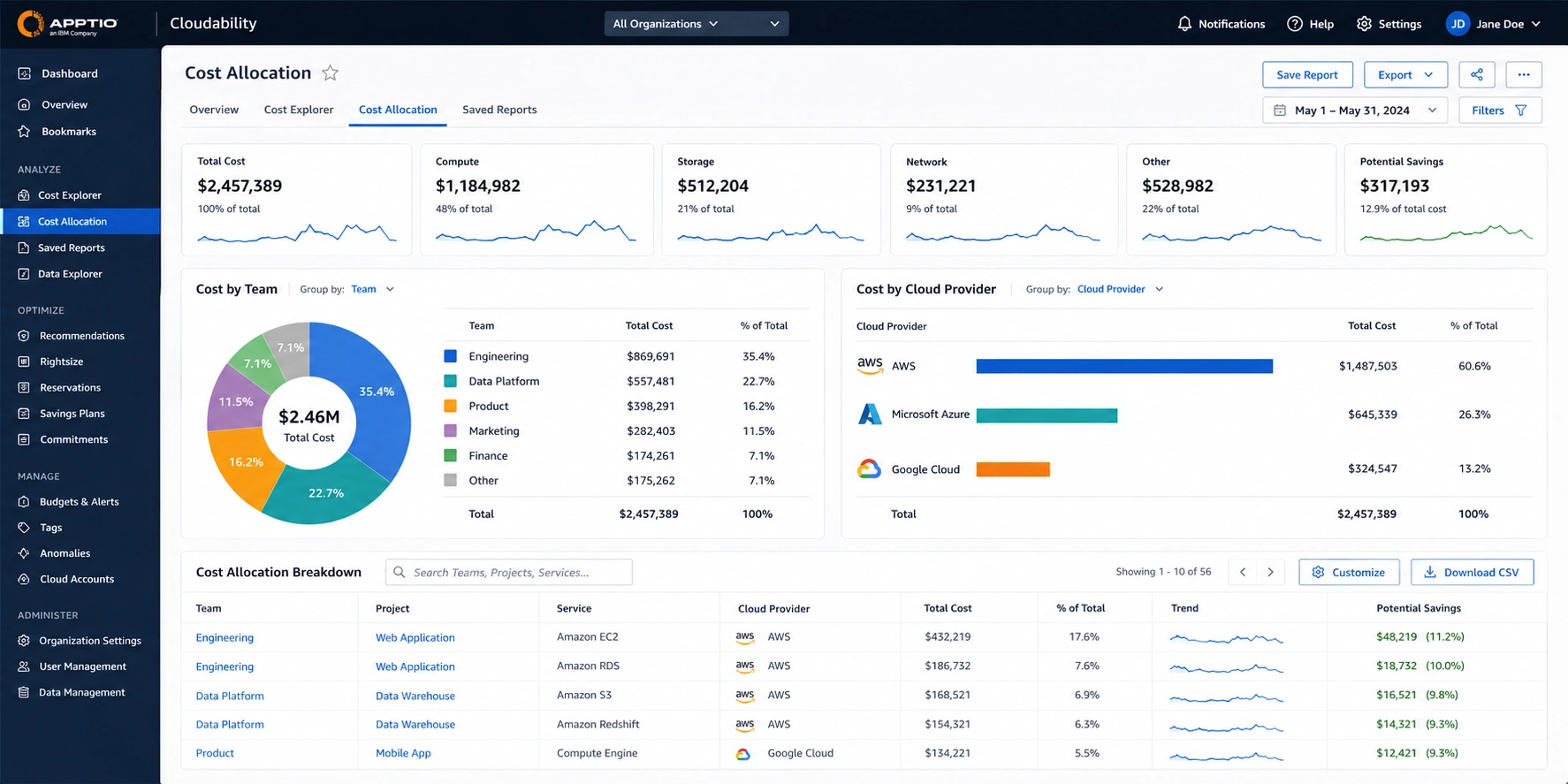
Apptio Cloudability is an IBM-owned cloud financial management platform. If you are evaluating alternatives, you have probably already identified the core issue: Cloudability shows you where your cloud spend is going, but does not automate the purchasing decisions that would actually reduce it.
That distinction matters more than any feature list. A team managing $5M in annual cloud spend can expect to pay Cloudability roughly $75,000-$132,000 per year (based on Vendr and nOps pricing research, May 2026 – verify with IBM directly) for visibility, allocation, and budgeting capabilities. What that pricing does not include is automated commitment purchasing, and the average enterprise wastes 30-40% of cloud spend through under-optimized reservations.
This guide separates the alternatives into two categories, gives you a head-to-head comparison table, and ends with a clear decision framework. The right tool depends on the problem you are actually trying to solve.
Why Are Teams Leaving Apptio Cloudability in 2026?
The reasons cluster into four issues:
Pricing model. Cloudability prices as a percentage of cloud spend under management. Reported ranges: approximately $30,000/year at $1M cloud spend, $76,000-$132,000 at $3M-$6M spend (Vendr, May 2026 data, verify at vendr.com). For teams spending under $3M annually, the cost-to-savings ratio is difficult to justify.
Rightsizing gaps. Multiple verified G2 reviews flag that rightsizing recommendations do not include memory utilization data, only CPU and network. This creates incomplete recommendations for memory-bound workloads: analytics, ML training, and in-memory databases.
Commitment automation depth. Cloudability offers visibility into savings plan and reserved instance coverage and some automation capabilities through Cloudwiry (renamed Cloudability Savings Automation in 2023). However, the automation layer does not match the continuous, hourly cadence of dedicated commitment management platforms.
IBM integration timeline. IBM acquired Apptio in 2023. Cloudability, Turbonomic, and Kubecost are converging inside the IBM FinOps Suite, but cross-module integrations are still rolling out. Some workflows currently span more than one console.
The Two Categories Every Cloudability Alternative Falls Into
Before comparing tools, get clear on the problem category. Every tool on this list solves one of these two problems and most solve only one well:
Category 1 – FinOps Visibility and Governance
- What it does: Cost allocation, chargeback, showback, budgeting, forecasting, anomaly detection, multi-cloud reporting.
- Who needs it: Finance teams, FinOps practitioners running a monthly close, organizations with complex cost allocation across business units.
- Tools in this category: Cloudability itself, CloudZero, Flexera One, Vantage, Finout, CloudHealth.
Category 2 – Commitment Automation and Rate Optimization
- What it does: Automatically purchases, trades, and manages Savings Plans, Reserved Instances, and Committed Use Discounts (CUDs) to reduce the effective rate per unit of compute.
- Who needs it: Engineering-led teams where the primary goal is reducing the line-item AWS/GCP/Azure invoice, not reporting on it.
- Tools in this category: Usage.ai, ProsperOps (now part of Flexera), nOps, Zesty, Archera.
Most teams above $1M monthly cloud spend benefit from one tool from each category rather than one platform that tries to do everything at average depth.
Full Comparison Table: Apptio Cloudability vs 7 Alternatives
| Platform | Primary Strength | Commitment Automation | Clouds Covered | Lock-in Terms | Pricing Model | Fee on No Savings |
| Apptio Cloudability | FinOps visibility, budgeting, chargeback | Limited (Cloudwiry-based automation) | AWS, Azure, GCP | Per IBM contract terms | % of cloud spend under management | Fee applies regardless of savings |
| Usage.ai | Automated commitment purchasing + cashback protection | Yes – autopilot SP/RI/CUD | AWS, Azure, GCP | Zero lock-in, cancel anytime, buyback guarantee | % of realized savings only | Zero fee if no savings delivered |
| ProsperOps (Flexera) | Autonomous AWS/GCP commitment management | Yes – continuous blending | AWS, GCP | Commitments purchased on your behalf; check Flexera contract terms | % of realized savings | Zero fee if no savings delivered |
| nOps | AWS commitment automation, hourly cadence | Yes – hourly optimization | AWS (primarily) | nOps manages commitments; check contract terms | Savings-share model | Zero fee if no savings delivered |
| CloudZero | Unit economics, cost per customer/feature | No automated purchasing | AWS, Azure, GCP | SaaS subscription | Subscription | Fee applies regardless of savings |
| Flexera One | IT asset management, multi-cloud governance | Via ProsperOps module | AWS, Azure, GCP | Enterprise contract | Subscription + savings-share for ProsperOps | Subscription fee applies |
| Vantage | Multi-cloud reporting, developer-friendly UI | Savings Plans only (AWS) | AWS, Azure, GCP | SaaS subscription | % of managed spend | Fee applies regardless of savings |
| Finout | Multi-cloud + SaaS cost unification | No automated purchasing | AWS, Azure, GCP + SaaS | SaaS subscription | Subscription | Fee applies regardless of savings |
Is Apptio Cloudability Still Worth It in 2026?
Cloudability earns its place in large enterprise FinOps programs that run a structured monthly close, need audit-ready chargeback, and require a single pane of glass across a complex multi-cloud environment. The IBM acquisition adds Turbonomic and Kubecost to the ecosystem, giving enterprises a path toward broader optimization coverage from a single vendor.
The platform is well-suited when: finance and FinOps own the program, the organization needs formal cost allocation across hundreds of accounts and business units, and the IT governance scope extends beyond cloud (on-premises, SaaS, licensing).
Where it falls short: teams that want automated commitment purchasing driving immediate savings, teams under $3M annual cloud spend where the pricing model is harder to justify, and engineering-led organizations that want cost data embedded in developer workflows rather than a separate reporting console.
“Users find IBM Cloudability’s missing features frustrating, particularly in rightsizing recommendations and limited cost analysis options” (20 mentions) and “Users find cost management capabilities lacking, particularly in rightsizing recommendations and cost allocation sophistication” (15 mentions). Source: G2
7 Apptio Cloudability Alternatives in 2026
1. Usage.ai – Best for Multi-Cloud Commitment Automation With Zero Lock-In
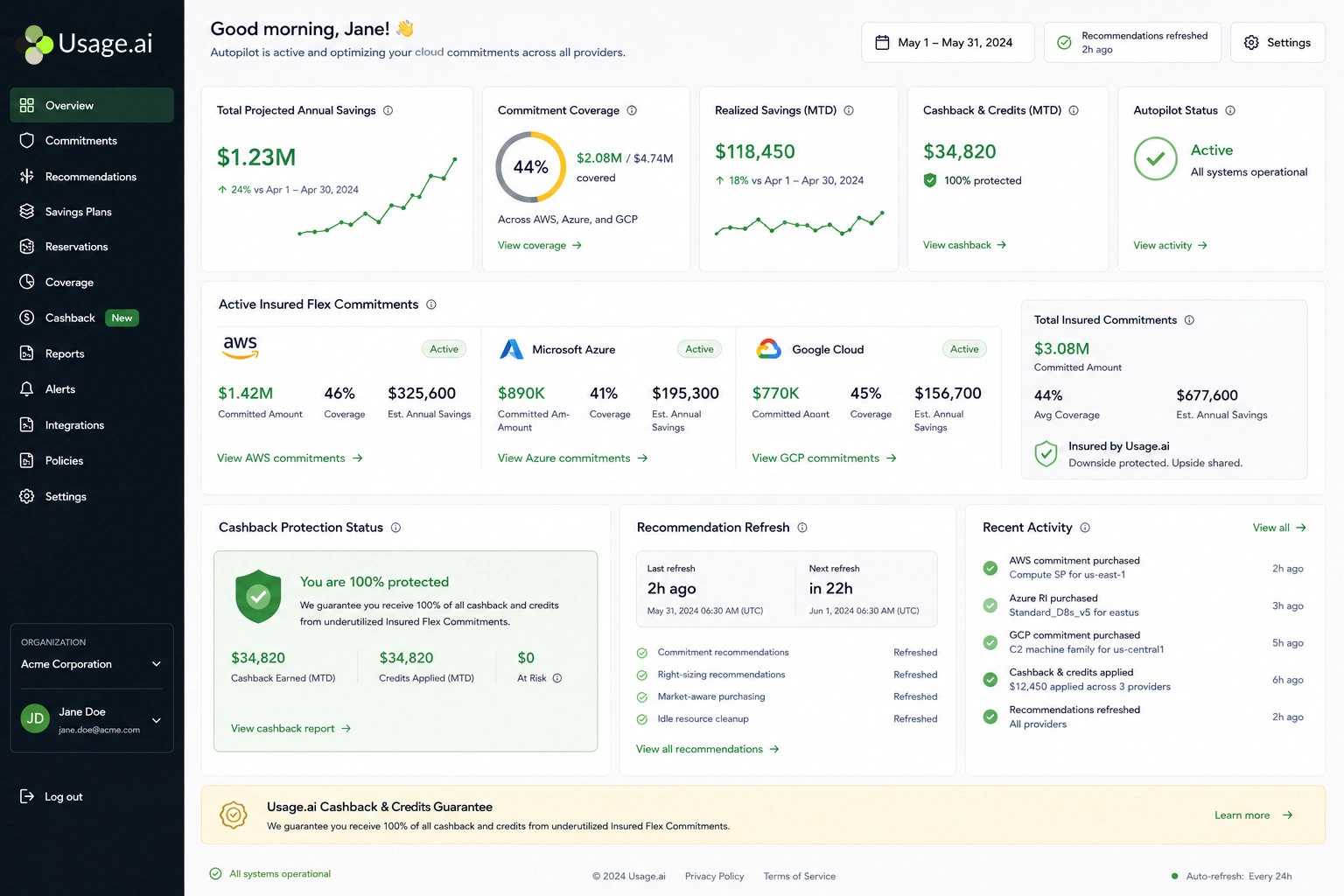
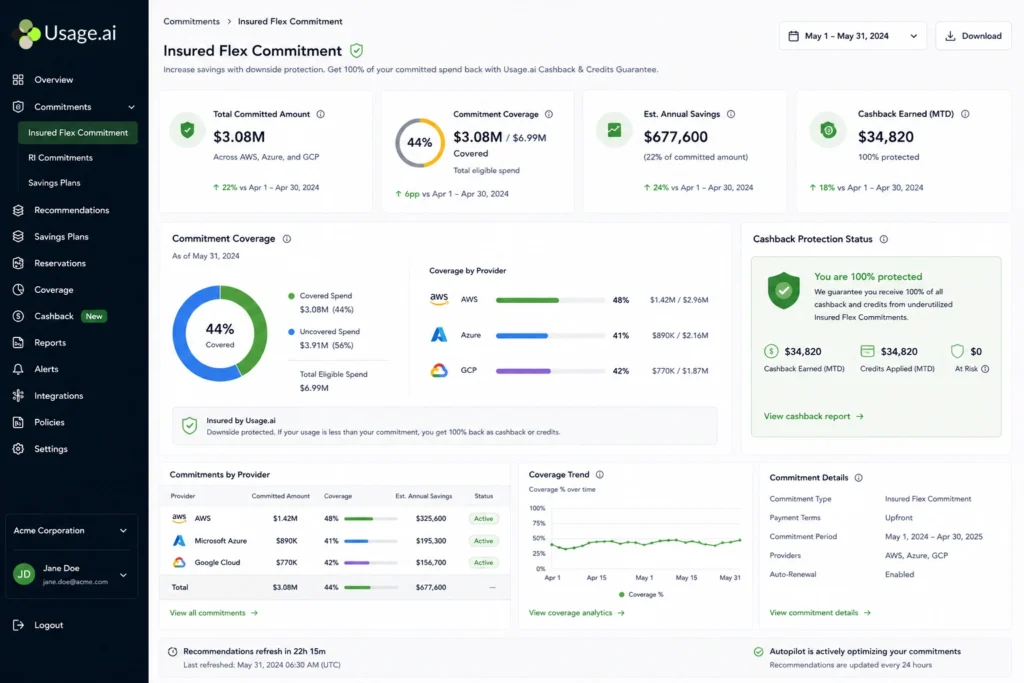
Usage.ai is a commitment automation platform covering AWS, Azure, and GCP from a single interface. The core product is the Insured Flex Commitment, a proprietary discount structure that delivers SP/RI-equivalent savings of 30-60% without requiring a multi-year commitment or upfront payment. Every commitment purchased through the platform includes a buyback guarantee: if utilization drops, Usage.ai buys the commitment back and returns the value as cashback, not credits.
Setup takes 30 minutes. The platform connects at the billing layer only – no infrastructure changes, no agent installation, no coordination with engineering teams required.
What it does well: Teams on AWS, Azure, or GCP who want automated commitment purchasing across all three clouds in a single platform. The zero lock-in structure is the clearest differentiator here: commitments adjust quarterly, and scale-down events carry no penalty. The 24-hour recommendation refresh catches commitment drift 3 days earlier than AWS Cost Explorer’s 72-hour cycle – at $6,000-$12,000/day in uncovered spend, that gap is measurable. The fee model charges a percentage of realized savings only, zero fee if nothing is saved.
What to check carefully: Usage.ai is a commitment automation platform, not a FinOps visibility or reporting tool. It does not offer chargeback, showback, or budgeting features. Teams that need governance and cost allocation reporting alongside commitment automation will need a separate visibility tool.
Lock-in terms: Zero multi-year lock-in. Cancel anytime. Buyback guarantee on every commitment. Underutilization returns as cashback (real money), not credits.
Pricing: Percentage of realized savings only. Zero fee if Usage.ai saves nothing. $0 upfront.
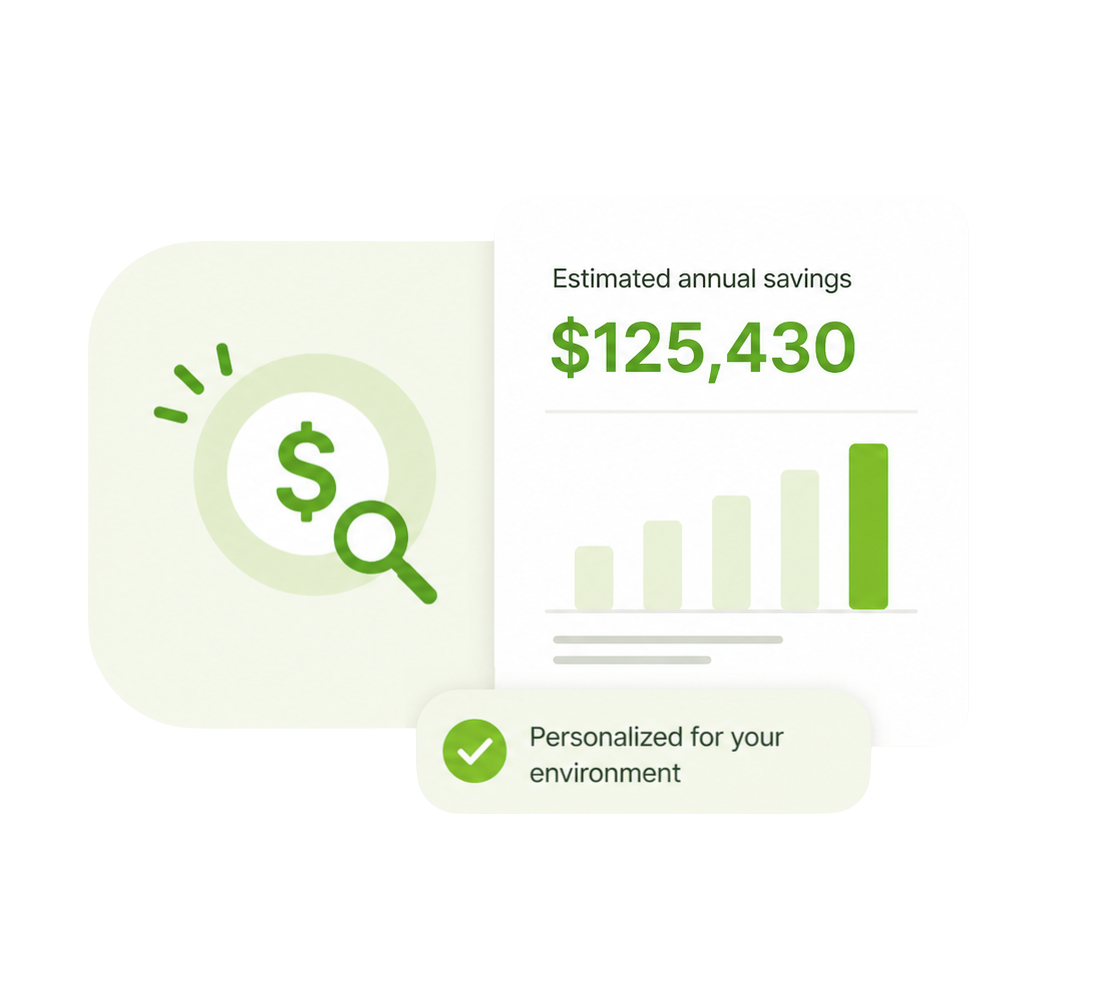
See exactly what you are overpaying AWS in under 60 seconds. Try the free Usage.ai Savings Calculator. Drop your AWS invoice or Cost Explorer CSV and get a precise savings figure with no account access or commitment required. Or explore the full platform.
2. ProsperOps (Now Part of Flexera) – Best for Autonomous AWS Commitment Management
ProsperOps was acquired by Flexera in early 2026, combining autonomous commitment management with Flexera’s broader IT asset management platform.
The core ProsperOps capability: continuous, automated blending of Reserved Instances and Savings Plans across AWS and GCP to maximize commitment coverage and minimize waste. The platform uses algorithms to determine the optimal mix at any given time based on actual usage patterns.
What it does well: AWS-first teams with predictable workloads get strong commitment optimization with minimal manual input. The savings-share model aligns incentives – no savings, no fee.
What to check carefully: The Flexera acquisition means pricing, contract terms, and feature packaging may be evolving. Verify current terms with Flexera directly. The platform historically focused on AWS; GCP coverage exists but confirm depth for your specific workload types.
Lock-in consideration: ProsperOps purchases commitments on your behalf through your AWS account. Unlike platforms with a buyback guarantee, underutilization risk handling varies by contract structure. Verify the terms for what happens if your usage drops significantly.
3. nOps – Best for AWS Teams That Want Hourly Commitment Optimization
nOps runs commitment lifecycle management on an hourly cadence based on actual usage data. The platform covers Savings Plans and Reserved Instances across AWS, with automation depth that goes further than most reporting-first platforms.
What it does well: Engineering-led AWS teams with variable workloads benefit from the hourly optimization cycle. The savings-share pricing model means you only pay on results. nOps also covers Kubernetes cost attribution, making it useful for EKS-heavy environments.
What to check carefully: nOps is primarily AWS-focused. Multi-cloud teams managing significant Azure or GCP spend alongside AWS will find coverage gaps. Verify GCP and Azure commitment automation depth for your specific use case.
Pricing note: nOps uses a savings-share model. The specific percentage varies by contract. Verify current pricing at nops.io.
4. CloudZero – Best for Unit Economics and Cost Attribution
CloudZero is purpose-built for mapping cloud spend to business outcomes: cost per customer, cost per feature, cost per AI inference. It is the strongest platform on the market for engineering-led FinOps organizations that want cost data embedded in how software is designed and deployed.
What it does well: Multi-tenant SaaS companies, AI/ML teams, and organizations tracking cost at the product or feature level. CloudZero does not require rigid resource tagging to attribute costs – it builds cost models from usage patterns.
What it does not do: CloudZero does not automate commitment purchasing. It identifies where to optimize; the purchasing decisions remain manual or require a separate commitment management tool.
Who should consider it: Teams where the primary problem is “we cannot tell which product, team, or customer is driving cost growth” rather than “we have too little commitment coverage.”
5. Flexera One – Best for Enterprise IT and Cloud Governance Together
Flexera One was built as an IT asset management platform before it moved into cloud cost optimization. Its DNA is governance: software license compliance, SaaS spend management, hybrid cloud visibility. The acquisition of ProsperOps in 2026 added autonomous commitment management to the stack.
What it does well: Large enterprises managing cloud alongside significant on-premises infrastructure, SaaS subscriptions, and software licensing. The ability to see cloud cost, software licenses, and on-prem assets in a single governance platform is a genuine differentiator for IT-heavy organizations.
What to check carefully: The ProsperOps integration is relatively new. Verify that commitment automation is fully integrated into the Flexera One console rather than operating as a parallel product.
Pricing: Enterprise subscription. Contact Flexera for current pricing.
6. Vantage – Best for Developer-Friendly Multi-Cloud Reporting
Vantage offers a modern, developer-friendly interface for cloud cost visibility across AWS, Azure, and GCP. It automates Savings Plans purchasing for AWS but leaves Reserved Instance management and most commitment optimization decisions to the user.
What it does well: Smaller engineering teams that want clean multi-cloud visibility without enterprise-grade complexity. The UI is notably better than many legacy platforms, and the pricing is more accessible than Cloudability for mid-market teams.
Where it falls short: Vantage is primarily a visibility and reporting tool. Commitment automation depth is limited compared to dedicated commitment management platforms. For teams where the primary goal is maximizing Savings Plan and RI coverage automatically, Vantage surfaces the recommendations but does not execute them.
7. Finout – Best for Multi-Cloud and SaaS Cost Unification
Finout takes a different angle: it unifies cloud spend across AWS, Azure, and GCP alongside SaaS costs (Snowflake, Datadog, Databricks, and others) in a single platform. The Virtual Tag capability attributes costs without requiring changes to existing resource tagging.
What it does well: Organizations with significant SaaS spend alongside cloud infrastructure. Kubernetes-heavy workloads transitioning from legacy tools to more granular metrics-driven FinOps. Teams that want multi-cloud and SaaS cost in the same view.
What it does not do: Finout does not automate commitment purchasing. Like CloudZero, it is a visibility and attribution platform.
What Separates Commitment Automation Tools From Each Other
For teams in Category 2, the meaningful differences are not features, they are commercial terms and risk structures.
Cashback vs Credits: What Happens When Commitments Go Underutilized
This is the most under-discussed dimension in every comparison post. When a commitment goes underutilized, the platforms handle it differently:
- Some platforms offer credits on underutilized commitments. Credits are locked to the platform or the cloud vendor. You cannot spend them elsewhere.
- Some platforms offer cashback on underutilized commitments. Real money, deposited back to you, spendable anywhere.
The distinction matters most when usage patterns shift – a downsizing event, a product pivot, a workload migration. Credits trap value. Cashback restores it.
Usage.ai Insured Flex Commitment: an SP/RI-equivalent discount structure delivering 30-60% savings without multi-year lock-in or upfront payment. Every commitment is fully insured. If a commitment goes underutilized, Usage.ai buys it back and returns the value as cashback – real money, not credits.
Usage.ai Insured Flex Commitments carry no multi-year lock-in. Commitments adjust quarterly. Scale down? No penalty. Underutilized? Cashback paid in real money – not credits.
This structure is verified from Usage.ai internal documentation. No other platform on this comparison list offers a buyback guarantee with cashback (real money) as the return mechanism.
Lock-In Terms: What You Are Actually Agreeing To
Standard AWS commitments carry 1-3 year lock-in with no third-party buyback option. Unused commitment value is forfeited.
| Platform | Lock-In Structure |
| AWS native commitments | 1-3 year lock-in, no buyback |
| Apptio Cloudability | Visibility only – commitment lock-in is on AWS terms |
| Usage.ai Insured Flex | Zero lock-in, cancel anytime, buyback guarantee, quarterly adjustment |
| ProsperOps (Flexera) | Commitments on AWS terms; verify Flexera contract for underutilization coverage |
| nOps | Commitments on AWS terms; verify nOps contract for underutilization coverage |
| Archera | Insured commitments model – verify current terms at archera.ai |
If usage patterns shift and you need to scale down, zero lock-in is not a feature – it is financial risk management.
Usage.ai Product Coverage: What Gets Optimized
Usage.ai covers the full stack of AWS commitment types, plus Azure VMs and GCP compute, from a single platform. The three product lines:
- Usage Flex Savings Plan – EC2, Fargate, Lambda. Saves 40-60% (verify at usage.ai – rates change).
- Usage Flex DB Savings Plan – RDS, ElastiCache, DocumentDB. Saves 20-35%.
- Usage Flex Reserved Instances – RDS, ElastiCache, OpenSearch, Redshift, DynamoDB. Saves 30-40%.
All three product lines carry the same zero lock-in terms, $0 upfront, and buyback guarantee described in the platform breakdown above. Full coverage in 60 days vs 6-9 months industry standard.
Decision Framework: Which Cloudability Alternative Should You Choose?
Choose Apptio Cloudability when:
- Your FinOps program is finance-led with structured monthly close requirements
- You need enterprise-grade chargeback and showback across hundreds of accounts
- IT governance includes on-premises, SaaS, and licensing alongside cloud
- You are already in the IBM ecosystem (Turbonomic, Kubecost integration is a roadmap benefit)
Choose ProsperOps (Flexera) when:
- AWS is your primary cloud (80%+ of spend)
- You want autonomous commitment blending without manual RI/SP decisions
- You are evaluating broader IT asset management alongside commitment optimization
Choose nOps when:
- You are AWS-heavy with variable, dynamic workloads
- Hourly commitment optimization cadence matters for your usage patterns
- Kubernetes cost attribution (EKS) is part of the requirement alongside commitment management
Choose CloudZero when:
- The core problem is unit economics: cost per customer, cost per feature, cost per AI inference
- You run a multi-tenant SaaS product where cost attribution at the product level is a business requirement
- Engineering ownership of cost data is a cultural priority
Choose Flexera One when:
- IT asset management, software licensing, and cloud cost need to live in a single governance platform
- You are a large enterprise with significant on-premises infrastructure alongside cloud
- The ProsperOps commitment automation module fits your AWS use case
Choose Vantage when:
- You want modern, developer-friendly multi-cloud visibility at a lower price point
- Your team is earlier in the FinOps maturity curve and needs better visibility before automation
- Savings Plan automation for AWS is sufficient (full RI automation is not required)
Choose Finout when:
- Multi-cloud and SaaS cost (Snowflake, Datadog, Databricks) need to live in the same view
- Kubernetes workloads are significant and you want metrics-driven cost attribution
- Virtual tagging without infrastructure changes is a requirement
Choose Usage.ai when:
- The primary goal is reducing the AWS, Azure, or GCP bill through automated commitment purchasing
- Zero lock-in is a hard requirement (scaling down without penalty, buyback guarantee on commitments)
- Cashback (real money) on underutilized commitments is preferable to credits
- You want full commitment coverage in 60 days at $0 upfront and zero fee if savings are not delivered
Want to optimize your cloud spend? Try the free savings calculator at Usage.ai.
What the Reddit FinOps Community Is Saying in 2026
A recent thread on r/FinOps comparing ProsperOps, Archera, and nOps surfaced the tension that none of the polished comparison sites address directly: commitment risk. The consensus: savings-share models align incentives, but the handling of underutilization risk varies significantly between platforms.
The specific question practitioners are asking: “What happens to our commitments if we cut headcount by 30% or migrate a workload?” A tool that gives you credits on stranded commitments is not the same as a tool that buys those commitments back and returns real money.
That question does not appear anywhere in the Gartner reviews or the standard alternatives posts. It is the right question.
Disclaimer: Competitor and third-party information in this article reflects publicly available data and Usage.ai’s analysis as of the date of publication. Product capabilities, pricing, and company ownership in the cloud cost optimization market change frequently. Readers should verify current competitor details directly with each vendor before making purchasing decisions. Usage.ai makes no warranties regarding the accuracy or completeness of third-party information contained herein.
Frequently Asked Questions
1. What is the main difference between Apptio Cloudability and commitment automation tools?
Apptio Cloudability is primarily a FinOps visibility and governance platform. It shows you where cloud spend is going, allocates costs across business units, and supports budgeting and forecasting. Commitment automation tools like Usage.ai, ProsperOps, and nOps go further: they actively purchase and manage Savings Plans, Reserved Instances, and Committed Use Discounts on your behalf to reduce the effective rate you pay per unit of compute. Most mature FinOps programs use both categories together.
2. Is Apptio Cloudability still independent after the IBM acquisition?
Cloudability was acquired by Apptio in 2019 and then became part of IBM when IBM acquired Apptio in 2023. Cloudability continues to operate as a core FinOps product under the IBM Apptio brand. IBM is converging Cloudability, Turbonomic, and Kubecost into an IBM FinOps Suite, though cross-module integrations are still in progress as of mid-2026. For current product roadmap details, contact IBM directly.
3. How much does Apptio Cloudability cost in 2026?
Cloudability prices as a percentage of cloud spend under management. Based on Vendr transaction data and nOps research (May 2026): approximately $30,000/year for $1M cloud spend, $76,000-$132,000 for $3M-$6M cloud spend. Larger enterprises ($50M+) may negotiate rates closer to 1%. These are estimates – verify current pricing with IBM directly, as rates change.
4. What happens to unused commitments if I switch FinOps tools?
Standard AWS Savings Plans and Reserved Instances are locked to your AWS account – they do not disappear if you change FinOps tools. The question is what happens to commitments that go underutilized while the tool is active. Some platforms offer credits on underutilized commitments; Usage.ai offers cashback (real money) through its buyback guarantee. Check the specific underutilization terms with any platform before committing.
5. Can I use a visibility tool and a commitment automation tool at the same time?
Yes, and this is the recommended architecture for mature FinOps programs. A visibility platform (Cloudability, CloudZero, Finout) handles reporting, allocation, budgeting, and showback. A commitment automation platform (Usage.ai, ProsperOps, nOps) handles the rate optimization layer. The two categories do not overlap – they cover different parts of the FinOps problem.
6. Do commitment automation tools require infrastructure access?
The better platforms require billing-layer access only. Usage.ai connects through billing data – no infrastructure changes, no agent installation, no code changes. Setup takes 30 minutes and does not require coordination with engineering teams. Verify the access model with any platform you evaluate.
7. What is a buyback guarantee in cloud cost management?
A buyback guarantee is a contractual commitment from a FinOps platform that if a commitment purchased through the platform goes underutilized, the platform will buy it back. Usage.ai’s buyback guarantee returns the value as cashback – real money, not credits. This protects against usage drops caused by layoffs, product changes, workload migrations, or demand shifts. Standard AWS commitments carry no buyback option. Most FinOps platforms offer credits at best. A buyback guarantee with cashback return is a specific Usage.ai differentiator.
8. How fast can a commitment automation tool deliver savings?
Usage.ai delivers full commitment coverage in 60 days. The industry standard for legacy platforms is 6-9 months. For a team spending $500,000/month on cloud, the 4-7 month difference represents $600,000-$1,050,000 in delayed savings at a 30% optimization rate. Speed to coverage is a measurable financial outcome, not a marketing claim.
9. What is the difference between Savings Plans and Reserved Instances?
Savings Plans offer flexible discounts of up to 66% off on-demand rates in exchange for a commitment to a consistent amount of compute usage (measured in $/hour) over 1 or 3 years (verify at aws.amazon.com/savingsplans — rates change). Reserved Instances offer similar discounts tied to a specific instance type, region, and operating system. Savings Plans are more flexible (they apply across instance families and sizes); Reserved Instances offer slightly higher discounts for specific workloads. Commitment automation platforms like Usage.ai continuously blend both to maximize coverage without manual decisions.