.png)


Executive buy-in for FinOps is the single biggest factor that determines whether cloud cost management becomes a strategic advantage or remains a reactive finance exercise.
Cloud spend has become one of the largest variable line items in modern engineering budgets. Yet most organizations fail to realize its full impact because FinOps efforts rarely gain consistent executive support. And without the leadership alignment, KPIs get lost around higher-visibility engineering priorities.
This gap persists even as cloud costs continue to rise. According to Gartner, public cloud spend is projected to reach $723B in 2025 and will be driven primarily by AI, GPU-intensive workloads, and accelerated multi-cloud adoption.
Therefore, securing your executive buy-in for FinOps requires shifting the conversation from tactical cost reduction to operational predictability and business enablement. Executives support FinOps when it improves financial accuracy, reduces variance, and provides clear visibility in how cloud investments translate into measurable business outcomes.
In this article, we’ll examine the technical and organizational barriers that limit FinOps adoption, understand what different executive stakeholders actually prioritize, and learn a data-driven framework you can use to earn long-term leadership commitment.
Why FinOps Initiatives Fail Without Leadership Support
FinOps programs often struggle because of organizational misalignment. Without consistent executive support, the discipline lacks the authority and prioritization required to influence cloud decision-making. The most common failure points appear in four areas.
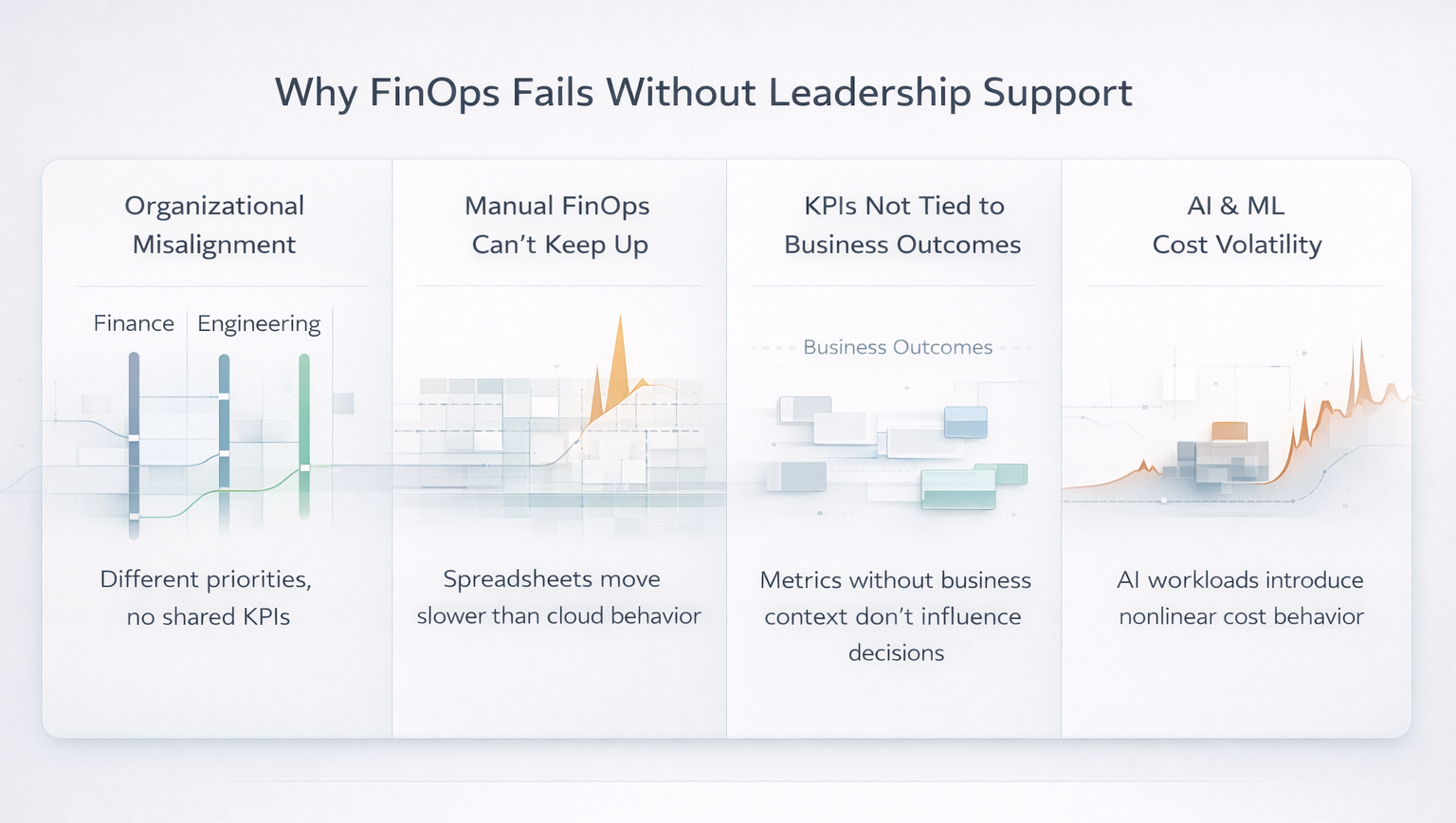
1. Misalignment between Finance, Engineering, and Product
FinOps depends on shared KPIs, yet each function evaluates cloud spend through a different lens.
- Finance emphasizes budget adherence and forecast accuracy,
- Engineering prioritizes velocity and reliability, and
- Product focuses on feature delivery and customer impact.
Without leadership enforcing unified objectives, each team optimizes for its own priorities, resulting in fragmented governance and inconsistent cost accountability.
2. Manual, spreadsheet-driven FinOps cannot keep up with modern cloud environments
Traditional FinOps workflows like monthly reviews, manual reporting, retroactive cleanup cycles operate too slowly for environments dominated by AI training jobs, GPU clusters, and ephemeral container workloads. Note that cost spikes can occur within hours. When processes remain manual, optimization becomes reactive and disconnected from real-time cloud behavior.
Also read: Multi-Cloud Cost Optimization Guide for AWS, Azure, GCP Savings
3. KPIs lack direct ties to business outcomes
Executives prioritize predictability and capital efficiency over tactical cost savings. Metrics such as forecast variance, unit economics, and workload cost-to-value ratios usually influence strategic decisions. When FinOps teams operate without these KPIs, their insights carry less weight, governance standards weaken, and optimization efforts compete with higher-profile engineering initiatives. Without executive buy-in for FinOps, accountability becomes optional.
4. AI and ML workloads introduce structural unpredictability
GPU-intensive jobs, large-scale inference pipelines, and distributed training runs introduce nonlinear spending patterns that are difficult to control at the team level. IDC reports that enterprises are experiencing 20–40% higher-than-anticipated cloud bills for AI workloads due to unpredictable scaling and resource saturation (IDC, 2024). Leadership oversight is required to enforce guardrails and ensure these workloads align with financial expectations.
What Executives Actually Care About (CFO, CTO, Product, CEO)
Securing executive buy-in for FinOps requires aligning the discipline with the priorities of each leadership role. Executives do not evaluate cloud spend through the lens of instance families or utilization percentages. They assess predictability, financial accuracy, operational risk, and the organization’s ability to scale efficiently. Each function has distinct decision drivers.
CFO: Predictability, Margins, and Financial Accuracy
CFOs evaluate cloud consumption as a variable cost structure that must map cleanly to revenue and margin expectations. Their primary concerns include forecast accuracy, cost-to-revenue ratios, variance reduction, and the financial risk associated with unbounded workloads, especially AI and GPU-heavy systems. FinOps gains CFO support when it demonstrates measurable improvements in spend predictability and reporting fidelity.
CTO and Engineering Leadership: Velocity Without Cost Instability
CTOs prioritize delivery speed, architectural flexibility, and reliability. Any FinOps practice that creates operational friction will be deprioritized. What resonates with technology leaders is not cost control, but the ability of FinOps to reduce unplanned spend events, provide real-time usage transparency, and ensure engineering teams can scale workloads without introducing financial surprises.
Product Leadership: Cost per Feature and AI-Driven Consumption
Product teams care about the economics of delivering features at scale. With AI workloads expanding, leaders increasingly monitor metrics such as cost per inference, cost per feature, and the financial viability of experimental workloads. FinOps earns product alignment when it produces clear visibility into how feature-level decisions influence long-term spend patterns.
CEO and Board: Capital Efficiency, Risk Reduction, and Valuation Signals
CEOs and boards evaluate cloud efficiency as part of broader business performance. Unpredictable cloud spend affects valuation, runway, M&A readiness, and overall capital allocation strategy. Executive leadership supports FinOps when it reduces financial volatility, enforces governance, and strengthens the organization’s ability to scale efficiently.
Understanding these priorities is foundational to winning sustained leadership commitment. FinOps becomes strategically relevant when it delivers outcomes that directly support financial accuracy, operational resilience, and long-term growth.
Also read: Cloud Cost Analysis: How to Measure, Reduce, and Optimize Spend
A Technical Framework for Securing Executive Buy-In (EATR Model)
Earning executive buy-in for FinOps requires more than presenting savings opportunities or showing cost anomalies. Leadership teams commit when FinOps provides a structured, repeatable mechanism for improving financial accuracy, and aligning cloud usage with business outcomes. The EATR model offers a technical framework for doing this with clarity and consistency.
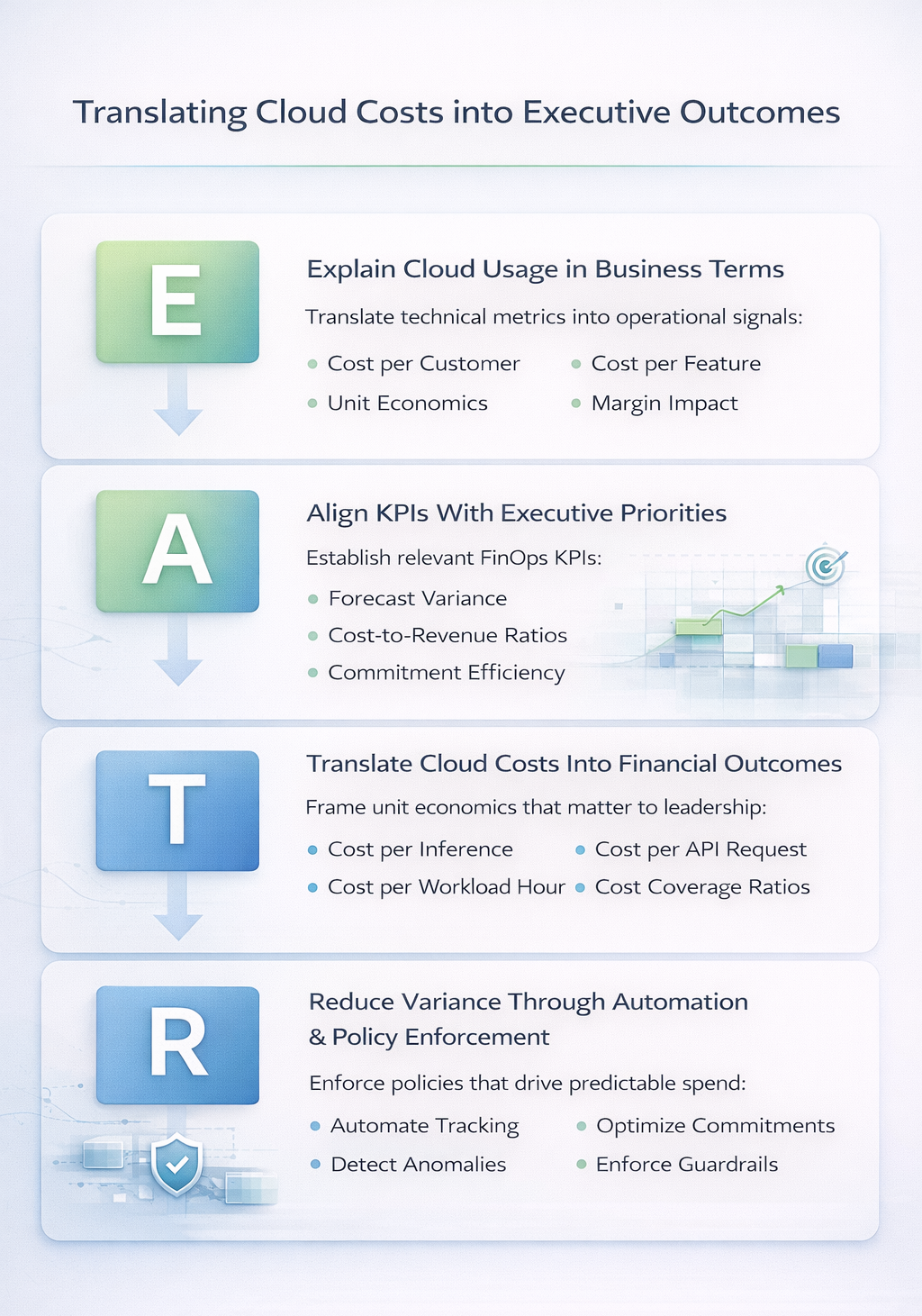
E — Explain Cloud Usage in Business Terms
Executives respond to the financial meaning of cloud behavior, not technical descriptions of services or utilization metrics. Effective FinOps programs translate consumption patterns into business-aligned categories, like cost per customer, cost per feature, margin impact, or unit economics tied to revenue segments. This reframing establishes cloud spend as an operational signal, and not a technical artifact.
A — Align KPIs With Executive Priorities
FinOps KPIs must reflect outcomes that leaders monitor at the financial and operational level.
These typically include:
- Forecast variance (accuracy and stability)
- Cost-to-revenue ratios
- Unit economics for key workloads
- Commitment efficiency and coverage
- AI/GPU workload utilization patterns
When KPIs match leadership’s metrics, FinOps gains immediacy and relevance, enabling governance standards to be enforced as part of broader business operations.
T — Translate Cloud Costs Into Financial Outcomes Using Unit Economics
Executives approve FinOps initiatives when cloud spend is framed in terms of measurable business trade-offs. Unit economics, such as cost per inference, cost per API request, or cost per workload hour connect cloud consumption directly to product value, profitability, and customer impact. This translation enables leadership to evaluate cloud investments with the same rigor applied to any capital-intensive function.
R — Reduce Variance Through Automation and Policy Enforcement
The effectiveness of FinOps ultimately depends on consistency. Manual workflows, periodic reviews, and spreadsheet-based analysis cannot keep pace with AI, GPU, and multi-cloud environments. Automation is required to enforce governance policies, optimize commitments, detect anomalies, and maintain predictable spend patterns. Reduced variance is one of the strongest drivers of executive confidence because it supports budgeting accuracy and capital planning.
The EATR framework provides the mechanism executives need to evaluate FinOps as a strategic capability rather than a cost-reduction exercise.
How to Build a FinOps Business Case Executives Actually Approve
A FinOps business case only gains traction when it quantifies risk, demonstrates predictability, and ties optimization directly to financial outcomes. Executives are not persuaded by lists of unused resources or generic cost-saving recommendations; they respond to structured models that show how cloud spend impacts margins, and the organization’s ability to scale efficiently. A strong business case addresses four technical components:
1. Establish a Baseline: Quantify Waste, Variance, and Architectural Inefficiencies
Most organizations maintain significant latent waste across their cloud footprint. These include idle compute, overprovisioned storage, misaligned commitments, and untagged resources. Studies from Flexera show that 72% of enterprises cite idle and underutilized resources as their top source of cloud waste (Flexera State of Cloud, 2024). Additionally, AI and GPU clusters introduce high-cost nodes that often run at suboptimal utilization.
A baseline analysis should measure:
- Idle EC2, RDS, and containerized workloads
- Underutilized GPU instances
- Commitment coverage gaps and discount inefficiency
- Forecast variance across business units
- Data transfer anomalies and persistent spikes
This baseline becomes the foundation for demonstrating both financial exposure and opportunity.
2. Build Forecast Scenarios: Expected, Best-Case, Worst-Case
Executives evaluate initiatives based on their impact on financial predictability. Scenario modeling is therefore essential. Effective FinOps business cases model:
- Expected scenario: current trajectory with existing governance
- Best-case scenario: improvements based on realistic optimization levers
- Worst-case scenario: risk exposure from AI scaling, seasonal demand, or architectural drift
This structure highlights uncertainty and creates a direct linkage between FinOps maturity and business stability.
3. Map Savings to Innovation Capacity and Operational Headroom
Cost reductions alone are rarely compelling for leadership. What resonates is the ability to redirect reclaimed spend into strategic initiatives, like AI development, latency reduction, resilience improvements, or expansion into new regions.
This requires quantifying:
- Dollars reclaimed from waste elimination
- Dollars recovered from improved commitment efficiency
- Runway extension gained from predictable spend
- Engineering capacity preserved by reducing manual cost-management effort
Reframing FinOps as a mechanism that increases innovation headroom strengthens executive buy-in.
Also read: AWS Savings Plans vs Reserved Instances: A Practical Guide to Buying Commitments
4. Quantify Risk Exposure: GPUs, Data Transfer, and Commitment Lock-In
Cloud financial risk is multi-dimensional. Modern workloads create unpredictable consumption patterns, especially in AI pipelines. IDC reports that enterprises see 20–40% higher cloud bills than planned for AI workloads due to scaling volatility and GPU saturation (IDC, 2024).
Executives require clarity on:
- GPU utilization volatility
- Cost per inference or training cycle
- Lock-in risk associated with long-term commitments
- Exposure from untagged or orphaned resources
- Data transfer cost patterns across regions and clouds
When risk is quantified instead of implied, FinOps shifts from a cost control function to a risk mitigation capability.
Common Executive Objections (and How to Respond With Data)
Even when FinOps programs demonstrate operational value, executive skepticism is common. Leadership teams evaluate cloud governance through the lens of financial accuracy, risk, and opportunity cost. Addressing objections with precise, data-backed responses is critical for sustaining executive buy-in for FinOps. The following objections are the ones most frequently raised at the CFO, CTO, and CEO level.
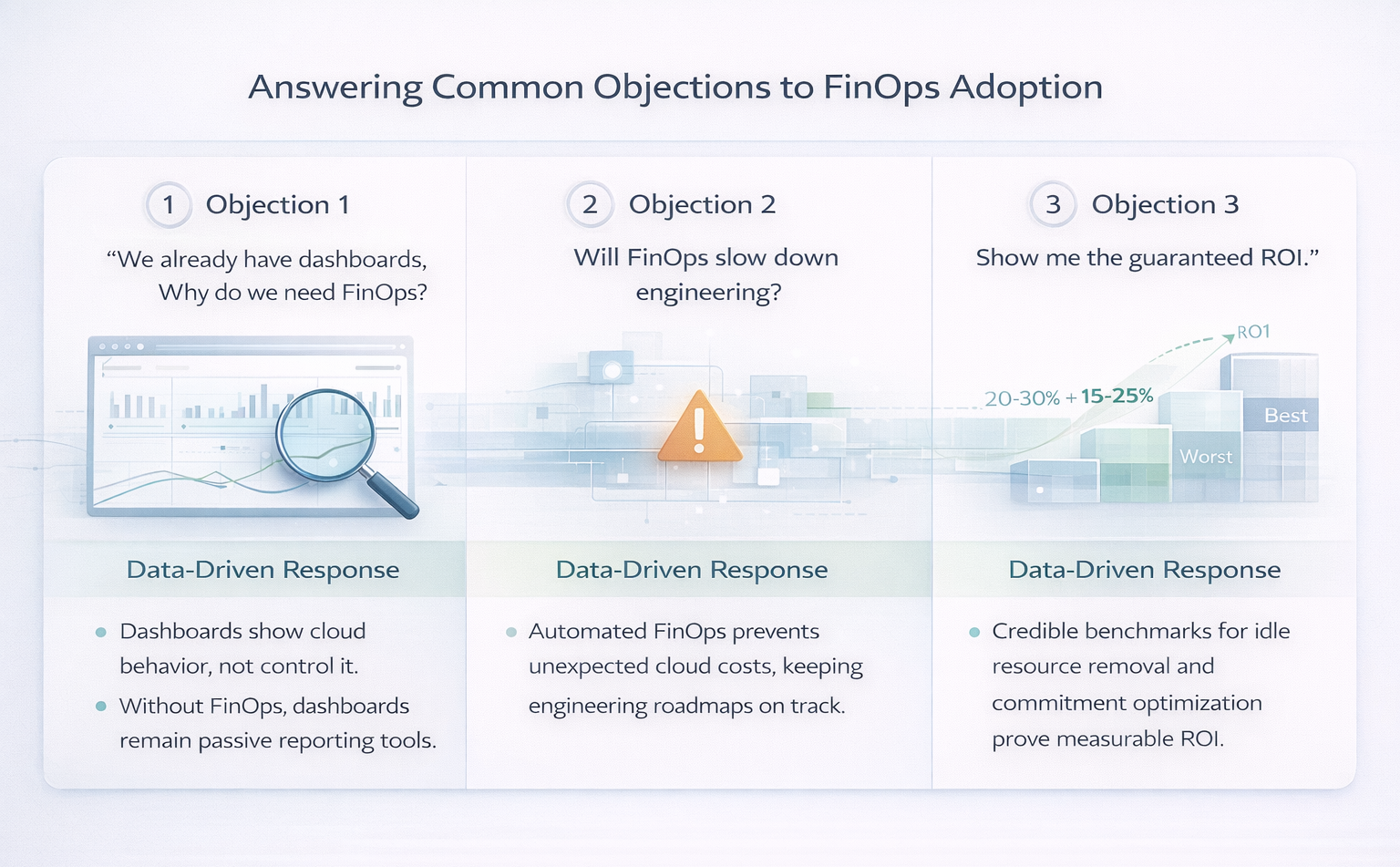
Objection 1: “We already have dashboards. Why do we need FinOps?”
Dashboards provide visibility, not control. Gartner reports that visibility alone does not reduce cloud spend variance, and organizations without active governance programs experience materially higher forecast deviations (Gartner Cloud Decisions, 2024).
Here’s a data-driven response: While dashboards surface information, FinOps operationalizes it. Without automated governance, policy enforcement, and cross-functional accountability, dashboards become passive reporting tools that do not affect spend behavior.
Objection 2: “Will FinOps slow down engineering?”
Engineering leaders worry that cost controls will restrict velocity or add review overhead. This concern is valid for manual processes but not for mature FinOps programs that emphasize automation and real-time usage insights.
Here’s a data-driven response: FinOps improves engineering velocity by reducing unplanned events. Studies show that unexpected cloud spend incidents are one of the top drivers of engineering rework in large organizations. Automated guardrails prevent financial surprises that directly disrupt roadmaps, allowing teams to scale workloads without introducing operational risk.
Objection 3: “Show me the guaranteed ROI.”
Executives prioritize predictable, repeatable outcomes. Traditional cost-saving estimates rely on point-in-time analysis, which leadership often views as subjective.
Here’s a data-driven response: Industry benchmarks consistently show that removing idle and underutilized resources yields 20–30% immediate savings, while commitment optimization adds another 15–25% depending on coverage gaps. When combined with automated governance and scenario modeling, ROI becomes measurable rather than theoretical. Presenting expected, best-case, and worst-case scenarios further aligns FinOps with financial planning norms.
Why Automation Is the Real Key to Sustaining Executive Buy-In
Long-term executive buy-in for FinOps depends on an organization’s ability to maintain predictable cloud spend at scale. Automation is the only mechanism capable of enforcing governance and reducing financial variance in real time.
1. Manual FinOps Cannot Keep Pace With Modern Cloud Behavior
Cloud environments now operate on time scales that are far shorter than traditional cost-management cycles. AI training pipelines can create multi-thousand-dollar cost swings in hours. Auto-scaling fleets generate unpredictable compute bursts. Multi-cloud traffic patterns shift dynamically throughout the day.
Manual reviews cannot detect or correct these deviations quickly enough. Automation enables continuous governance rather than point-in-time oversight.
2. Automation Reduces Forecast Variance, a Metric Executives Trust Most
Leadership relies on forecast accuracy to plan budgets, allocate capital, and assess operational health. Variance between forecast and actual spend is consistently cited as the highest-impact KPI for enterprise FinOps teams.
Automated optimization improves variance by:
- Enforcing right-sizing and idle cleanup continuously
- Adjusting commitments based on real usage patterns
- Flagging anomalies in minutes rather than days
- Normalizing multi-cloud consumption into comparable financial signals
3. Automated Governance Ensures Policies Are Enforced Consistently
Without automation, policy enforcement depends on human discipline and organizational bandwidth. This leads to:
- inconsistent tag hygiene
- delayed remediation
- orphaned resources
- runaway workloads
- unsupervised GPU jobs
Automation supports repeatability. Governance is applied uniformly across teams, workloads, and cloud environments, eliminating the variability that causes financial drift.
4. Automation Frees Engineering From Cost-Management Overhead
Engineering leaders support FinOps when it improves operational efficiency rather than creating work. Automation removes the need for:
- manual instance reviews
- ad-hoc data pulls
- commitment modeling
- reactive anomaly investigations
By reducing the operational load on engineering teams, automation aligns FinOps with engineering velocity instead of competing against it.
When variance decreases, governance becomes consistent, and financial signals stabilize, executives view FinOps as a strategic capability rather than a cost initiative. This stability is the core driver behind sustained executive buy-in for FinOps in modern cloud environments.
Strengthening Long-Term FinOps Confidence With Usage AI
Securing leadership alignment is only the first milestone. Maintaining confidence in FinOps over time requires consistent financial accuracy, continuous optimization, and the ability to govern rapidly evolving cloud environments without adding operational drag. As workloads become more dynamic, especially with AI training pipelines, GPU clusters, and multi-cloud architectures, manual processes cannot deliver the predictability executives expect.
Usage.ai provides the automation layer that enables FinOps to operate as a strategic, data-driven discipline rather than a reactive cost-management function. The platform continuously analyzes real usage patterns across AWS, Azure, and Google Cloud and autonomously adjusts cost levers in real time. This eliminates idle waste, optimizes commitments, and stabilizes spend behavior at a level manual workflows cannot achieve.
If your organization is serious about predictable cloud economics, request a technical walkthrough to see how automated cost governance can keep FinOps credible at enterprise scale.