.png)


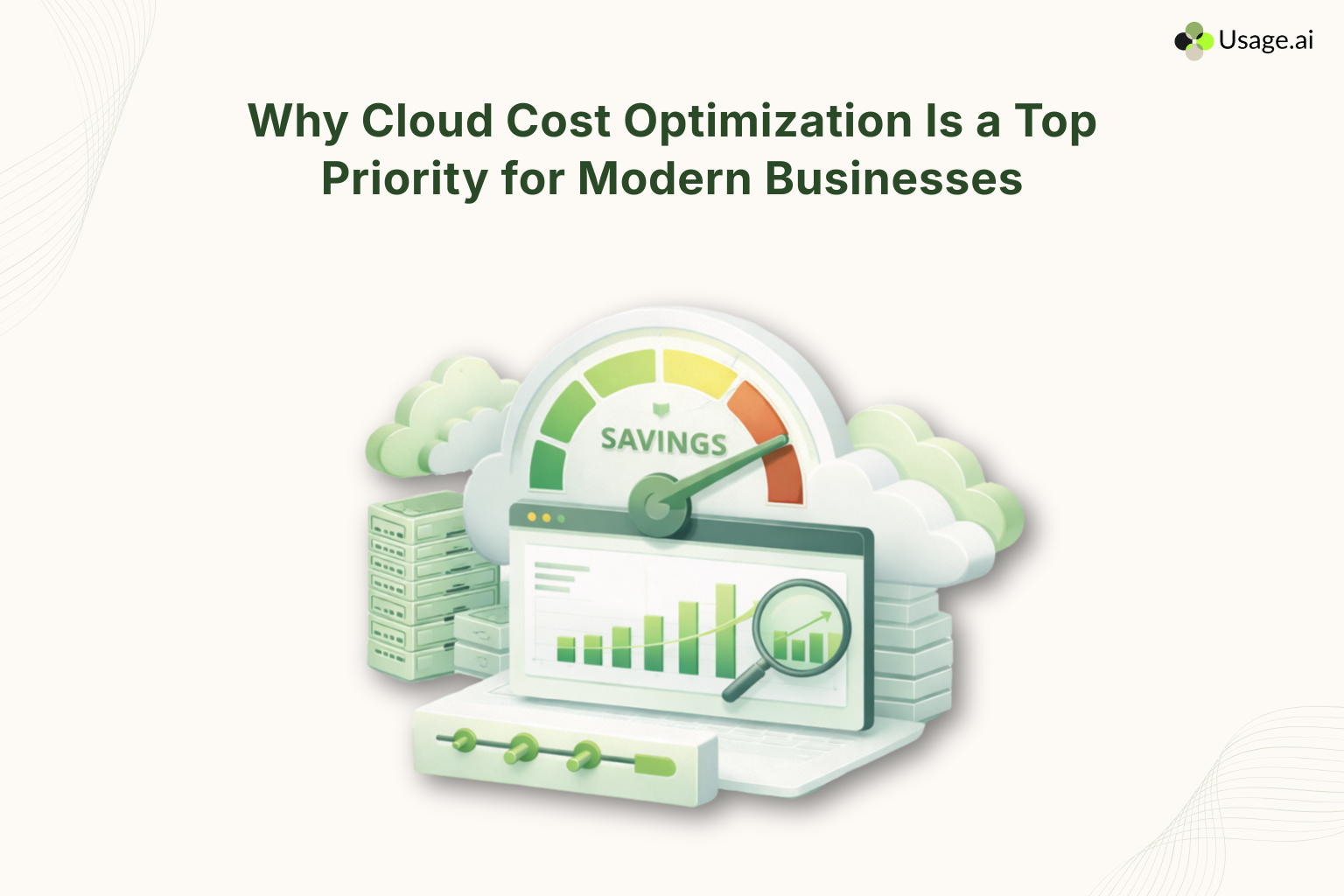
Cloud computing promised flexibility, speed, and scalability, but it also introduced a new operational challenge around unpredictable and rapidly growing cloud costs. As organizations scale their infrastructure across platforms like AWS, Azure, and Google Cloud, cloud spending can quickly become one of the largest line items in a company’s technology budget.
This is why cloud cost optimization has become a top priority for modern businesses. Companies are no longer focused only on building and deploying applications in the cloud; they are now equally focused on running those applications as efficiently and cost-effectively as possible.
In this guide, we’ll explore why cloud cost optimization has become a business priority, the challenges companies face when managing cloud spending, and the key strategies DevOps and FinOps teams use to control infrastructure costs at scale.
What Is Cloud Cost Optimization?
Cloud cost optimization is the process of reducing cloud infrastructure spending while maintaining application performance, scalability, and reliability.
For most organizations, cloud platforms like AWS, Azure, and Google Cloud operate on a pay-as-you-go pricing model, meaning businesses pay for every compute instance, storage volume, and network request they consume. While this flexibility enables rapid scaling and faster innovation, it can also lead to significant cost inefficiencies if resources are not actively managed.
In practice, cloud cost optimization involves continuously analyzing cloud usage patterns and applying strategies that ensure infrastructure is used as efficiently as possible. This includes identifying unused resources, rightsizing workloads, and purchasing discounted pricing commitments when usage patterns are predictable.
How Cloud Pricing Works
To understand optimization, it helps to understand how cloud infrastructure is billed.
Cloud providers typically offer two main pricing models:
1. On-Demand Pricing
On-demand pricing allows teams to launch infrastructure instantly and pay only for what they use. This provides maximum flexibility but comes at the highest cost per unit of compute or storage.
This model works well for unpredictable workloads, but relying entirely on on-demand pricing can significantly increase cloud bills as infrastructure usage grows.
2. Commitment-Based Discounts
To encourage predictable usage, cloud providers offer discounted pricing models such as Savings Plans or Reserved Instances. These require customers to commit to a certain level of cloud usage for a defined period (often one or three years) in exchange for lower rates.
The concept is similar to a subscription discount. If you commit to purchasing coffee every day for a year, the coffee shop can offer a lower price per cup. The same principle applies to cloud infrastructure commitments.
Why Optimization Matters to DevOps and FinOps teams
Without active optimization, organizations often experience several types of cloud waste:
- Overprovisioned resources that are larger than necessary
- Idle infrastructure that remains running but unused
- Uncovered usage that continues paying expensive on-demand rates
- Unused commitments when infrastructure usage changes unexpectedly
These inefficiencies are common in rapidly scaling environments where engineering teams prioritize speed and reliability over cost efficiency.
Cloud cost optimization ensures that infrastructure decisions align not only with performance requirements but also with financial efficiency, making it a critical discipline for both DevOps and FinOps teams.
Also read: Cloud Cost Monitoring vs Cost Control: What’s the Real Difference?
Why Cloud Cost Optimization Has Become a Business Priority
Over the past decade, cloud computing has transformed how companies build and scale software. Infrastructure that once required large upfront investments in hardware can now be provisioned instantly with a few API calls. However, this convenience comes with a trade-off. Cloud spending can grow extremely fast if it is not actively managed.
As a result, cloud cost optimization has shifted from being a technical afterthought to becoming a core business priority for modern organizations.
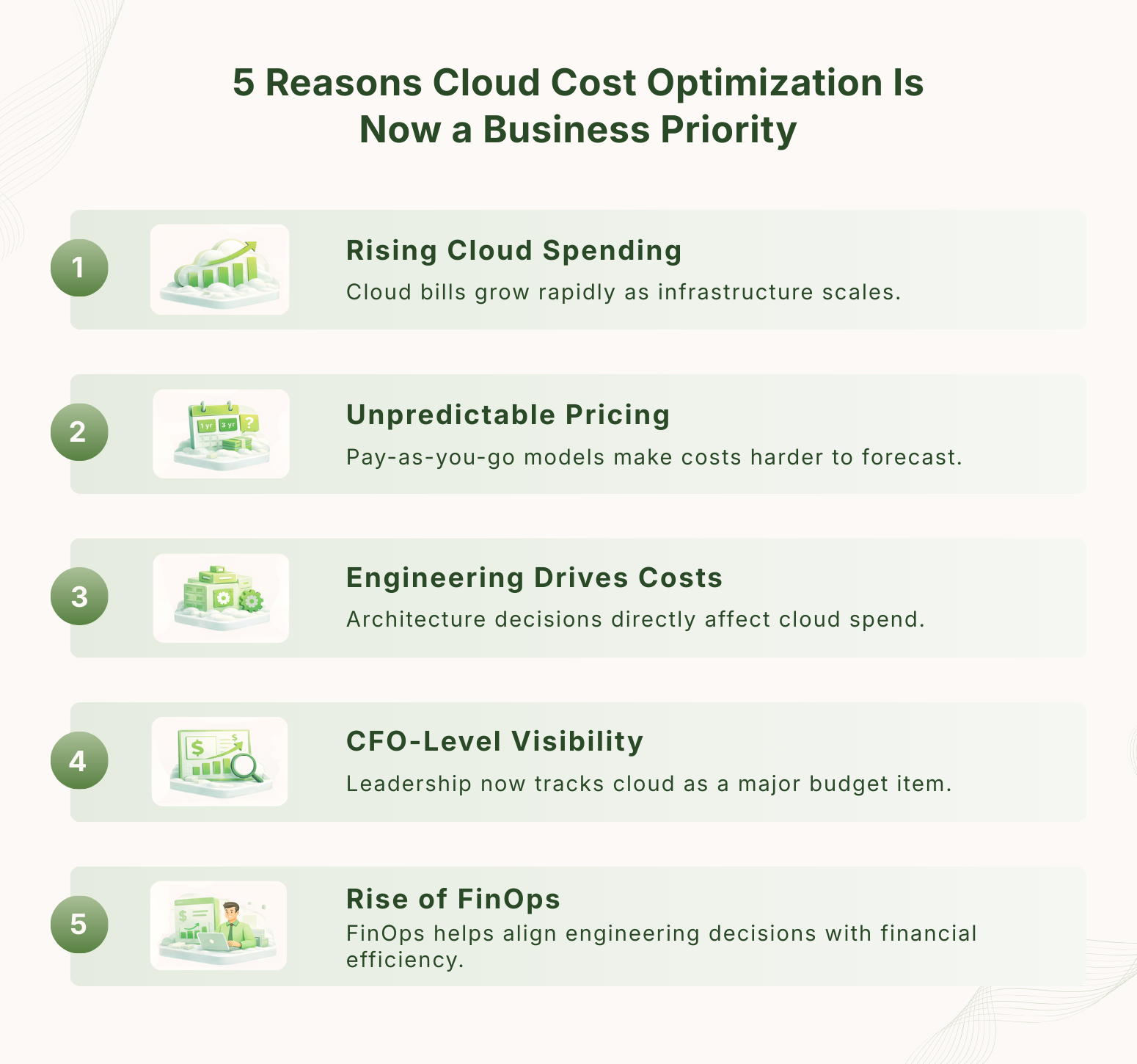
1. Rapid Growth in Cloud Spending
Cloud adoption has accelerated across nearly every industry. Companies are moving workloads, data pipelines, machine learning systems, and customer-facing applications to cloud platforms.
While this transition provides scalability and speed, it also introduces a new financial dynamic. Unlike traditional infrastructure, where hardware costs are largely fixed after purchase, cloud infrastructure is variable and continuously billed.
For many companies, cloud costs now represent one of the largest operational expenses in engineering budgets, often rivaling payroll and software licensing. Without optimization best practices in place, cloud spending can increase dramatically as usage grows.
2. Pay-As-You-Go Pricing Makes Costs Harder to Predict
One of the biggest advantages of the cloud is elasticity. Infrastructure can scale automatically based on demand, allowing applications to handle traffic spikes without manual intervention.
However, this same elasticity can make costs difficult to control.
When new services launch, workloads scale, or experiments run across multiple environments, cloud resources can multiply quickly. Each additional instance, storage volume, or data transfer adds to the overall bill.
Because cloud infrastructure behaves like renting thousands of computers in remote data centers, even small inefficiencies can accumulate into large financial impacts over time.
3. Engineering Decisions Directly Impact Cloud Spend
In traditional IT environments, financial teams often had clear control over infrastructure budgets. In the cloud, however, engineering teams directly influence spending through architectural decisions.
Choices such as instance types, autoscaling policies, container orchestration strategies, and database configurations all affect the final cloud bill.
For example:
- Selecting larger instance sizes than necessary increases compute costs
- Running development environments continuously instead of on demand wastes resources
- Launching workloads without discounted commitments leads to higher on-demand pricing
Because these decisions happen at the infrastructure and code level, cost management increasingly requires close collaboration between DevOps, engineering, and FinOps teams.
4. CFOs Now Treat Cloud Like a Strategic Financial Metric
As cloud spending grows, leadership teams are paying closer attention to infrastructure costs. Many organizations now track cloud efficiency metrics such as infrastructure utilization, commitment coverage, effective savings rate and cost per customer or transaction.
These metrics help businesses understand whether their cloud environment is operating efficiently or leaking unnecessary spend.
5. The Rise of FinOps
To address the complexity of managing cloud costs, many organizations have adopted FinOps, a practice that combines financial accountability with engineering operations.
FinOps teams work with engineering and platform teams to:
- monitor cloud usage and spending
- identify cost optimization opportunities
- improve commitment coverage
- ensure infrastructure investments align with business growth
This collaboration ensures that cloud infrastructure remains both technically efficient and financially sustainable as organizations scale.
The Biggest Challenges in Cloud Cost Optimization
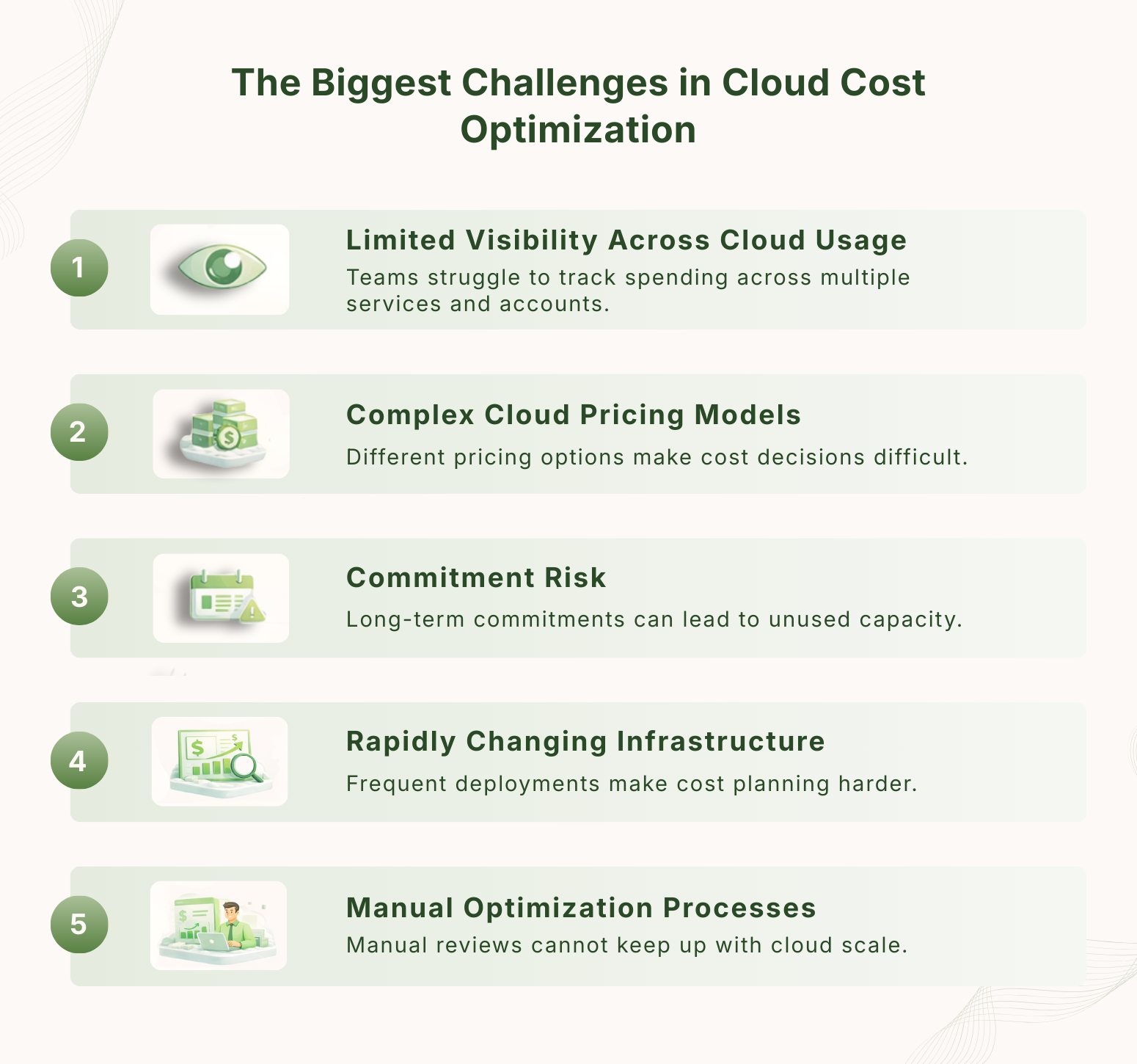
While most organizations recognize the importance of controlling cloud spending, actually optimizing cloud costs is far more complex than it appears. Modern cloud environments involve thousands of resources, dynamic scaling, and multiple pricing models, making it difficult for teams to maintain cost efficiency as infrastructure evolves.
Below are some of the most common challenges organizations face when trying to optimize cloud spending.
1. Limited Visibility Across Cloud Usage
One of the first obstacles companies encounter is limited visibility into how cloud resources are being used. In large organizations, infrastructure may span multiple cloud accounts, several regions, hundreds of services and multiple engineering teams.
Each team may deploy resources independently, which makes it difficult to understand where costs are coming from. Without centralized visibility into infrastructure usage and billing data, organizations often struggle to identify idle resources, underutilized instances and services that are no longer required. This lack of transparency leads to hidden cloud waste that accumulates over time.
2. Complexity of Cloud Pricing Models
Cloud providers offer a wide range of pricing options designed to support different workloads and usage patterns. While this flexibility is powerful, it also introduces complexity.
For example, compute infrastructure can be purchased using several pricing models, including on-demand pricing, short-term or long-term commitments with deeper discounts.
Each model offers different levels of flexibility and cost savings, and determining the right mix requires a deep understanding of workload behavior. Engineering teams must evaluate factors such as usage stability, workload predictability, growth patterns and regional infrastructure requirements.
Without the right data and analysis, many organizations default to on-demand pricing, which is the easiest option but also the most expensive over time.
3. Risk Associated With Long-Term Commitments
Commitment-based pricing models can provide significant discounts compared to on-demand pricing, but they also introduce financial risk.
When companies purchase long-term infrastructure commitments, they are essentially promising to use a certain level of cloud capacity over time. If their actual usage drops below that commitment level, they may end up paying for resources they no longer need.
This challenge is similar to purchasing a subscription discount for a product you expect to use regularly. If your usage decreases unexpectedly, the subscription may no longer deliver the expected value.
Because of this risk, many organizations hesitate to increase their commitment coverage even when the discounts could significantly reduce costs.
4. Rapidly Changing Infrastructure
Cloud environments are constantly evolving. Engineering teams frequently deploy new services, migrate workloads, change instance types and experiment with new architectures. These changes can make it difficult to maintain accurate forecasts of infrastructure usage.
For example, a workload that appears stable today may change significantly after a product launch, architectural shift, or new feature rollout. When usage patterns change, previously optimized infrastructure configurations may quickly become inefficient.
As a result, cloud cost analysis and optimization cannot be treated as a one-time activity. It must be a continuous process that adapts to changing infrastructure patterns.
5. Manual Optimization Processes
Many organizations initially rely on manual processes to manage cloud costs. Engineers periodically review dashboards, analyze usage reports, and attempt to identify opportunities for savings.
However, manual optimization quickly becomes impractical as cloud environments grow. Teams must constantly evaluate new workloads being deployed, changing usage patterns, opportunities for discounted commitments and infrastructure rightsizing opportunities.
Without automation, it becomes extremely difficult to keep pace with the scale and complexity of modern cloud environments.
These challenges explain why cloud cost optimization requires dedicated FinOps practices and specialized tooling.
Also read: What Is Cloud Cost Governance: Framework, Best Practices, and KPIs
Key Cloud Cost Optimization Strategies for DevOps and FinOps Teams
Once organizations understand the importance of managing cloud spending, the next step is implementing practical optimization strategies that reduce costs without sacrificing performance or scalability.
Below are some of the most effective strategies used by DevOps and FinOps teams.
1. Rightsizing Infrastructure
One of the most common sources of cloud waste is overprovisioned infrastructure. When applications are deployed, engineers often select larger instance types to ensure sufficient performance capacity. Over time, these instances may remain oversized even if the workload does not require that level of compute power.
Rightsizing involves analyzing resource utilization metrics such as CPU, memory, and network usage to determine whether workloads are using more resources than necessary.
For example, an application running on a large compute instance may consistently use only a fraction of its available capacity. By moving that workload to a smaller instance type, organizations can reduce costs while maintaining the same performance.
Rightsizing is particularly effective for long-running workloads such as backend services, APIs, and internal applications.
2. Eliminating Idle and Unused Resources
Another major source of unnecessary cloud spending is idle infrastructure. In dynamic environments where teams frequently create new resources for development, testing, or experimentation, it is common for unused infrastructure to remain active long after it is needed.
Examples of idle resources include:
- compute instances that are running but not actively used
- unattached storage volumes
- outdated snapshots or backups
- development environments left running overnight or during weekends
Even though these resources are not contributing to active workloads, they continue to generate costs. Regularly auditing infrastructure and removing unused resources can significantly reduce cloud spending without affecting application performance.
3. Increasing Commitment Coverage
One of the most impactful cost optimization strategies is increasing commitment coverage for predictable workloads.
Cloud providers offer discounted pricing models that reward customers who commit to using a certain level of infrastructure over time. These commitments can reduce compute costs substantially compared to standard pay-as-you-go pricing.
Coverage refers to the percentage of infrastructure usage that is protected by these discounted commitments. For example, if a company’s cloud environment consistently runs 100 compute instances and 60 of them are covered by discounted commitments, the commitment coverage would be 60%.
Higher commitment coverage generally results in lower overall infrastructure costs, provided that workloads remain relatively stable.
4. Automating Commitment Management
While commitment-based pricing offers substantial savings, managing these commitments manually can be difficult. Teams must evaluate several factors before purchasing commitments like current infrastructure usage, expected workload growth, potential architectural changes and historical usage trends.
If commitments are purchased incorrectly, organizations may either miss out on savings or end up with unused commitments.
Automation tools can analyze usage patterns continuously and recommend the optimal commitment purchases based on real infrastructure behavior. This helps organizations capture discounts more confidently while minimizing the risk of underutilization.
5. Continuously Monitoring Cost and Usage Trends
Cloud cost optimization is not a one-time project. Because infrastructure usage changes frequently, optimization strategies must be applied continuously.
Effective cloud cost management requires ongoing monitoring of:
- infrastructure utilization
- resource allocation across services
- commitment coverage and utilization rates
- cost anomalies and unexpected spikes
By tracking these metrics over time, organizations can quickly detect inefficiencies and adjust their infrastructure strategy before unnecessary costs accumulate.
Together, these strategies form the foundation of modern cloud cost optimization practices. However, implementing them manually can be difficult in large-scale environments.
Why Many Companies Are Turning to Automated Cloud Cost Optimization Platforms

As cloud infrastructure grows more complex, many organizations discover that manual cost optimization approaches no longer scale. Reviewing dashboards occasionally or running periodic cost audits may work for small environments, but larger organizations often manage thousands of cloud resources that change daily.
To keep cloud spending under control, DevOps and FinOps teams increasingly rely on automated cloud cost optimization platforms that continuously analyze infrastructure usage and recommend actions. Automation helps organizations move from reactive cost management to proactive optimization.
1. The Limits of Native Cloud Cost Tools
Cloud providers offer built-in cost management tools, but these solutions often focus primarily on visibility rather than action.
Native tools typically provide:
- cost dashboards
- usage reports
- historical spending analysis
- basic optimization recommendations
While these insights are useful, they often require manual interpretation and decision-making from engineers or FinOps teams.
For example, some native recommendation systems update relatively slowly, which can make it difficult to capture optimal commitment purchases in real time. Platforms designed specifically for cost optimization often provide more frequent recommendation updates, enabling faster decision-making.
2. Automating Commitment Discovery and Purchasing
One of the most complex areas of cloud cost optimization is managing infrastructure commitments.
To achieve meaningful savings, organizations must determine:
- how much infrastructure usage is stable enough for commitments
- which pricing models provide the best discounts
- when to purchase commitments as workloads evolve
These decisions require analyzing large volumes of historical usage data and predicting future infrastructure demand.
Automated optimization platforms like Usage.ai simplify this process by continuously analyzing billing and usage data, identifying opportunities for discounted commitments, and generating recommendations that align with real workload behavior.
Instead of relying on periodic manual analysis, teams can make data-driven purchasing decisions based on continuously updated insights.
3. Reducing Financial Risk From Commitment Purchases
While commitments provide significant discounts, many organizations hesitate to increase their commitment coverage because of the risk that future infrastructure usage might decline. If workloads change unexpectedly, unused commitments can reduce or eliminate the expected savings.
To address this challenge, some optimization platforms introduce cashback commitment models that help organizations manage this financial risk.
Under these models, if commitments become underutilized due to changing usage patterns, customers may receive cashback compensation based on the unused portion of their commitments, helping offset potential losses.
This approach allows companies to increase commitment coverage more confidently while maintaining flexibility as infrastructure evolves.
4. Enabling Continuous Optimization
Perhaps the biggest advantage of automated platforms is their ability to support continuous optimization.
Cloud environments evolve constantly as teams deploy new services, scale infrastructure, and adjust architectures. Automated systems can monitor these changes in real time and update optimization recommendations accordingly.
This enables organizations to:
- identify new savings opportunities faster
- maintain optimal commitment coverage
- respond quickly to infrastructure changes
- ensure that cost efficiency keeps pace with engineering velocity
For DevOps and FinOps teams, automation transforms cloud cost optimization from an occasional review into a continuous operational process.
Conclusion: Why Cloud Cost Optimization Is Now Essential for Modern Businesses
As cloud adoption accelerates, the future of infrastructure management will depend on how intelligently organizations control and optimize cloud spending. What began as simple cost monitoring is rapidly evolving into a core operational discipline driven by FinOps practices, automation, and data-driven infrastructure decisions.
In the coming years, businesses that treat cloud cost optimization as a strategic capability will gain a significant advantage. By combining engineering efficiency, smarter commitment strategies, and continuous optimization, organizations can scale their cloud environments without letting costs spiral out of control.
For DevOps and FinOps teams, the goal is clear and it is to build cloud architectures that are not only powerful and scalable, but also economically sustainable for the long term.
Frequently Asked Questions (FAQ)
1. What is cloud cost optimization?
Cloud cost optimization is the practice of reducing cloud infrastructure expenses while maintaining performance, scalability, and reliability. It involves analyzing usage patterns, eliminating unused resources, rightsizing workloads, and using discounted pricing models such as long-term commitments to lower overall cloud spending.
2. Why is cloud cost optimization important for businesses?
Cloud cost optimization is important because cloud infrastructure operates on a pay-as-you-go model, where costs scale with usage. Without proper optimization practices, organizations can overspend on idle resources, oversized instances, or uncovered usage. Optimizing cloud costs helps businesses improve financial efficiency while still maintaining high-performance infrastructure.
3. What are the most common cloud cost optimization strategies?
Some of the most effective cloud cost optimization strategies include rightsizing infrastructure based on workload utilization, removing idle or unused cloud resources, increasing commitment coverage for predictable workloads, monitoring cloud usage and spending trends continuously and automating infrastructure optimization processes.
4. What is commitment coverage in cloud computing?
Commitment coverage refers to the percentage of cloud usage that is covered by discounted pricing commitments such as long-term compute commitments. Higher coverage typically leads to lower infrastructure costs because more workloads benefit from discounted pricing rather than expensive on-demand rates.
5. How do long-term cloud commitments reduce costs?
Cloud providers offer discounted pricing when customers commit to using a certain amount of infrastructure over time. These commitments can significantly reduce costs compared to on-demand pricing because providers reward predictable usage. However, organizations must carefully manage commitments to ensure they align with actual infrastructure usage.
6. Who is responsible for cloud cost optimization?
Cloud cost optimization is typically a collaborative effort between DevOps and FinOps teams. DevOps teams design and operate cloud infrastructure, while FinOps teams focus on financial efficiency and cost visibility. Together, they ensure cloud environments are both technically efficient and financially sustainable.