
 AWS
 Microsoft Azure
 Google Cloud


This guide compares their mechanics, advertised discounts, coverage, capacity behavior, application order, and risk. It focuses on Compute and EC2 Instance Savings Plans versus EC2 RIs; Database and SageMaker AI Savings Plans and service-specific reservations are outside the core comparison.
The Short Answer
Choose a Compute Savings Plan when eligible usage may move across EC2 families or Regions, or between EC2, Fargate, and Lambda. Choose an EC2 Instance Savings Plan when durable EC2 usage will remain in one family and Region and its actual rate justifies the narrower scope.Choose an EC2 RI when matching attributes are highly predictable or you need a Zonal RI’s capacity reservation. Compare applicable rates, expected utilization, payment options, and planned architecture changes before committing.
Savings Plans vs RIs: Key Differences
Savings Plans are monetary commitments measured in dollars per hour. EC2 RIs are billing discounts that apply when running On-Demand instances that match the RI’s required attributes.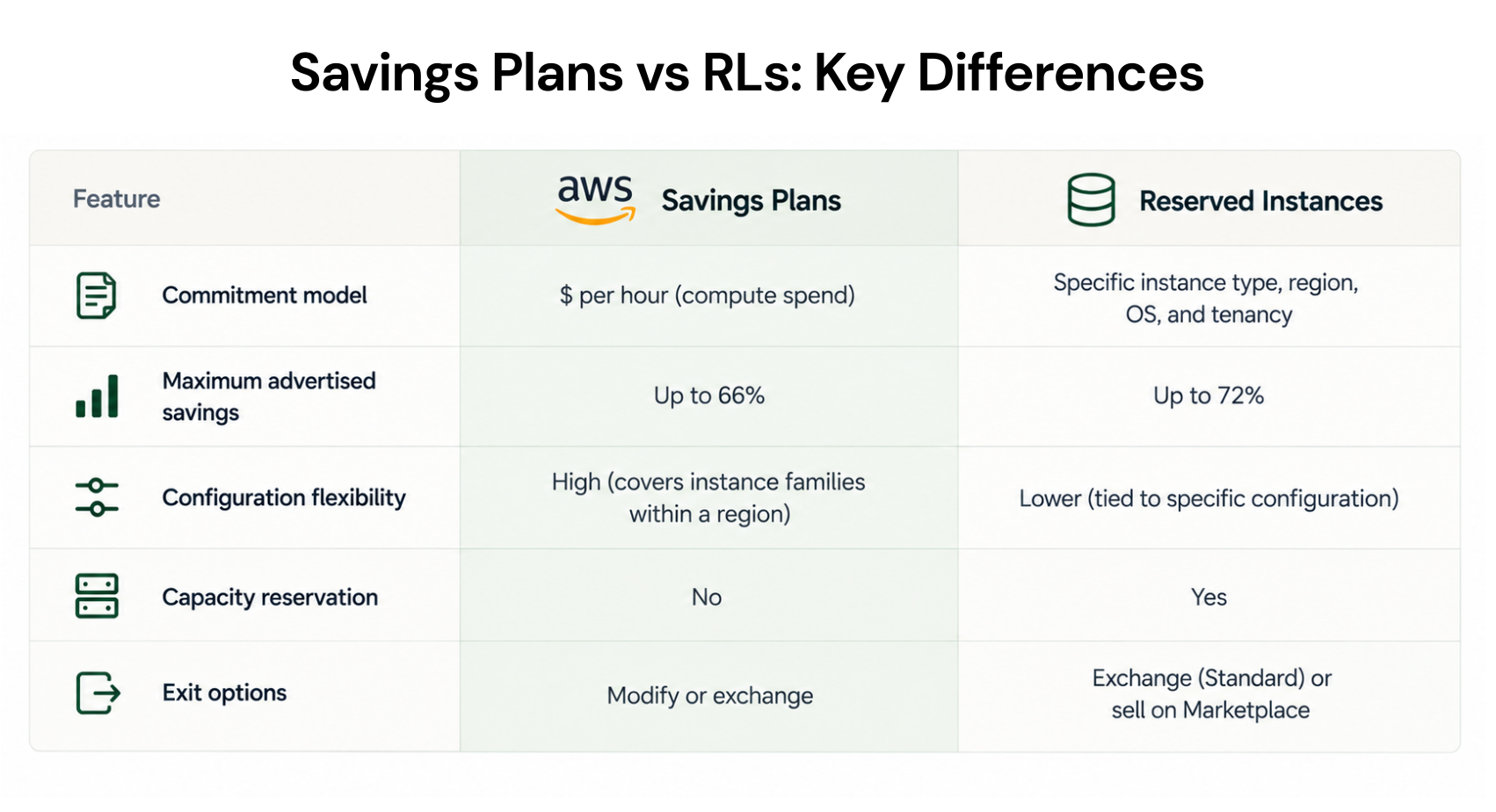
| Dimension | AWS Savings Plans | EC2 Reserved Instances |
|---|---|---|
| Commitment | Fixed $/hour at Savings Plan rates | Matching EC2 configuration |
| Maximum advertised savings | Compute: up to 66%; EC2 Instance: up to 72% | Standard: up to 72%; Convertible: up to 66% |
| Relevant coverage | Compute: EC2, Fargate, Lambda; EC2 Instance: one EC2 family and Region | Matching EC2 usage only |
| Terms | One or three years | AWS-issued: one or three years; Marketplace RIs may have shorter remaining terms |
| Payment options | No, Partial, or All Upfront | No, Partial, or All Upfront |
| Configuration flexibility | Broad for Compute; family-and-Region constrained for EC2 Instance | Depends on offering class, scope, platform, and tenancy |
| Capacity reservation | No; can be combined with an On-Demand Capacity Reservation | Zonal RI: yes; Regional RI: no |
| Exit options | Eligible plans of $100/hour or less: return within 7 days and the same UTC calendar month, subject to return limits | Eligible Standard RIs may be sold; Convertible RIs may be exchanged |
| Fargate and Lambda | Compute Savings Plans only | Not covered |
How AWS Savings Plans Work
A Savings Plan commits you to a consistent amount of eligible usage, measured in dollars per hour at Savings Plan rates. AWS automatically applies the plan to eligible usage until that hourly commitment is consumed; additional usage is charged at On-Demand rates unless another discount applies. Unused commitment does not carry into another hour.The two types relevant to this comparison are:
Compute Savings Plans: Apply to eligible EC2 instance usage regardless of family, size, Region, operating system, or tenancy. They also cover eligible Fargate and Lambda compute usage and offer savings of up to 66%.
EC2 Instance Savings Plans: Apply to EC2 usage in one selected instance family and Region. Within that scope, they remain flexible across instance size, Availability Zone, operating system, and tenancy and offer savings of up to 72%.
AWS also offers Database and SageMaker AI Savings Plans. See the complete AWS Savings Plans guide for their service eligibility and pricing models.
How EC2 Reserved Instances Work
An EC2 RI is not a physical instance. It is a billing discount applied automatically to eligible running On-Demand instances that match attributes such as instance family, platform, tenancy, Region, and, when applicable, instance size or Availability Zone.Standard RIs offer savings of up to 72% but provide limited configuration changes. Eligible Standard RIs may be listed on the EC2 Reserved Instance Marketplace, although eligibility restrictions, fees, and the availability of a buyer affect that exit route.
Convertible RIs offer savings of up to 66% and can be exchanged for another Convertible RI with a different family, operating system, or tenancy. The replacement must have an equal or higher value, and the Region remains fixed.
A Regional RI can discount matching usage across Availability Zones in its Region but does not reserve capacity.
A Zonal RI requires a specific Availability Zone and instance size and includes a capacity reservation there.
Flexibility, Coverage, and Underutilization Tradeoffs
Compute Savings Plans are the most adaptable option in this comparison. Their discounts can continue across EC2 family, size, architecture, Region, operating-system, and tenancy changes, as well as eligible moves from EC2 to Fargate or Lambda. That flexibility reduces configuration-mismatch risk during modernization, but it does not remove the hourly spending commitment.
EC2 Instance Savings Plans exchange some of that flexibility for a potentially lower rate. They suit a durable EC2 baseline in one family and Region, but migrations to another generation, processor family, Region, Fargate, or Lambda can leave insufficient matching usage.
EC2 RIs require the closest configuration alignment. They can fit long-lived fleets whose required attributes are expected to remain stable; Zonal RIs also serve the separate need for capacity assurance. Standard RIs cannot be exchanged, while Convertible RIs provide manual configuration changes in exchange for a lower maximum discount.
Rightsizing, seasonal demand, Spot adoption, workload retirement, or migration can therefore reduce realized savings even when the advertised rate is attractive.
Coverage and utilization answer different questions. Coverage measures how much eligible usage receives discounted pricing, while utilization measures how fully a purchased commitment is consumed.
High coverage with weak utilization can indicate overcommitment; high utilization with low coverage may indicate remaining On-Demand savings opportunities.
AWS permits a narrow return window for qualifying Savings Plans purchased in error. Eligible Standard RIs may be sold on the RI Marketplace, but a sale is not guaranteed, so neither route should replace conservative sizing.
Can You Use Savings Plans and RIs Together?
Yes. AWS first applies eligible EC2 RI benefits, then EC2 Instance Savings Plans, followed by Compute Savings Plans. Within Savings Plans, AWS prioritizes eligible usage that produces the highest savings percentage until the hourly commitment is exhausted.These discounts do not stack on the same usage. If an RI already covers an instance, a Savings Plan applies only to remaining eligible usage. Buying another commitment without accounting for existing coverage can therefore leave part of the broader plan unused.
A blended strategy can place RIs or EC2 Instance Savings Plans against the most durable EC2 baseline and use Compute Savings Plans for stable spend that may move across families, Regions, Fargate, or Lambda. Keep variable or interruptible demand On-Demand or Spot rather than assuming every current hour will persist throughout the term.
For deeper purchase sequencing and sizing, see the AWS Savings Plan buying strategy
Which Should You Choose?
Start with actual workload behavior rather than the headline discount.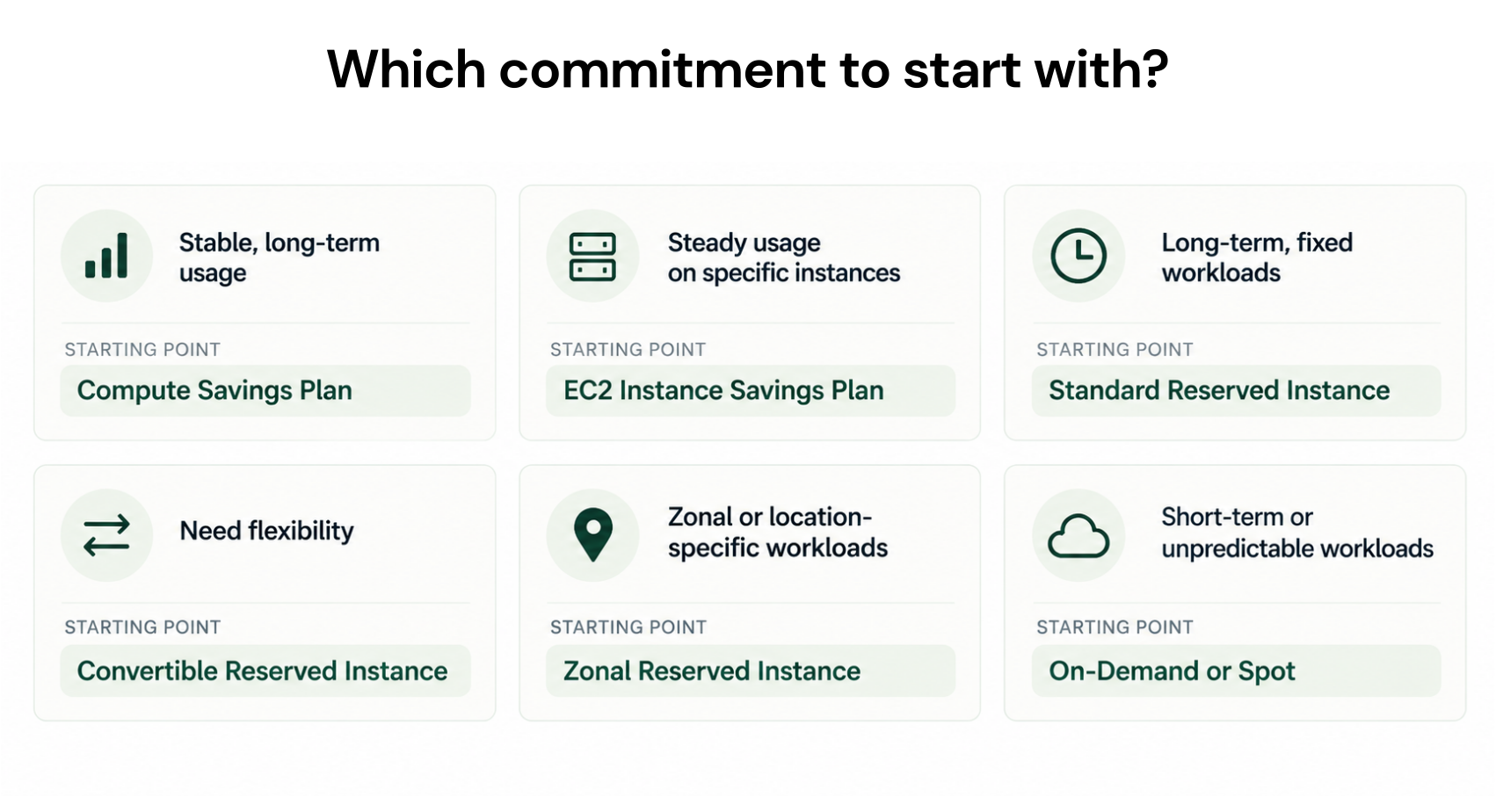
| Workload condition | Better starting point |
|---|---|
| EC2, Fargate, and Lambda are used together | Compute Savings Plan |
| EC2 family, processor, service, or Region may change | Compute Savings Plan or more On-Demand usage |
| EC2 usage is durable in one family and Region | EC2 Instance Savings Plan or matching Regional RI |
| A specific Availability Zone requires reserved capacity | Zonal RI |
| Configuration changes are expected but RI processes must remain | Convertible RI |
| Demand is temporary, declining, or highly uncertain | On-Demand or Spot before another commitment |
Choose a Compute Savings Plan when flexibility has meaningful value and the eligible hourly baseline is durable. Choose an EC2 Instance Savings Plan when usage is concentrated in one family and Region and its applicable rate produces better projected savings after accounting for mismatch risk.
Choose a Standard RI when the required EC2 attributes are highly stable and its rate or Marketplace option fits your objectives. Choose a Convertible RI when you need RI exchangeability, or a Zonal RI when capacity in a specific Availability Zone is part of the requirement.
There is no universal winner. The right answer is the commitment that produces the lowest projected cost under the architecture you expect to operate, not simply the option with the largest advertised percentage.
How Usage.ai Reduces Commitment Risk
Choosing the right AWS commitment option reduces mismatch risk, but it does not eliminate exposure when usage falls. We analyze your AWS billing data at the billing layer and recommend qualifying commitments. After you approve a recommendation, we purchase and manage the approved commitment.With Flex Insured Commitments, eligible teams can access up to 57% savings associated with a three-year AWS commitment with none of the commitment risk.
If eligible usage drops and a qualifying Flex Commitment costs more than the On-Demand rate for the same usage, we provide cashback protection on the covered difference, subject to program terms.
Our fee is a percentage of realized savings; if we do not save you money, you do not pay a fee.
Review usage, savings, coverage, and risk before choosing a Savings Plan or RI.
Frequently asked questions
Are Savings Plans better than Reserved Instances?
Not universally. Compute Savings Plans are generally better suited to changing or mixed-service compute, while EC2 Instance Savings Plans and RIs can fit stable EC2 usage when their applicable rates justify the narrower scope.
Can Savings Plans and RIs cover the same usage?
They can coexist, but their discounts do not stack on one unit of usage. Eligible RI benefits apply first, and Savings Plans apply afterward to remaining eligible usage.
What happens when a commitment is unused?
You remain responsible for the full Savings Plan commitment or RI cost during the term, whether that cost was paid upfront or continues through recurring charges. A qualifying Savings Plan may be returned within AWS’s limited purchase-error window, while eligible Standard RIs can be listed on the RI Marketplace without a guaranteed sale.
Can you change a Savings Plan or RI?
Savings Plan terms cannot be changed after purchase. Standard RIs allow limited modifications, while Convertible RIs can be exchanged for equal-or-higher-value Convertible RIs within the same Region.
Which option provides an EC2 capacity reservation?
Zonal EC2 RIs include a capacity reservation in a selected Availability Zone. Savings Plans and Regional RIs do not, although Savings Plans can discount eligible usage running in an On-Demand Capacity Reservation.