
 AWS
AWS Microsoft Azure
 Google Cloud

USD public rates checked October 16, 2026. Regional examples use US East (N. Virginia), unless stated otherwise; CloudFront uses US/Mexico/Canada delivery pricing. Monthly estimates use 730 hours and 1 TB = 1,024 GB, excluding taxes, credits, and negotiated discounts.
VPC Peering Price: What Will You Pay?
VPC Peering price by scenario| Traffic path | Transfer treatment |
|---|---|
| Same Region, same AZ | Free, including between different AWS accounts |
| Same Region, different AZs | $0.01/GB at each chargeable end: $0.02 combined per GB transferred |
| N. Virginia to Ohio | $0.01/GB outbound; price reverse traffic separately |
| N. Virginia to Oregon | $0.02/GB outbound; price reverse traffic separately |
Start by identifying the resources that exchange data, where they are located, and the bytes sent in each direction. A monthly application-traffic total is not enough when it combines routes with different prices. Separate those routes before applying a per-GB rate, especially when a shared service communicates with VPCs in multiple Regions.
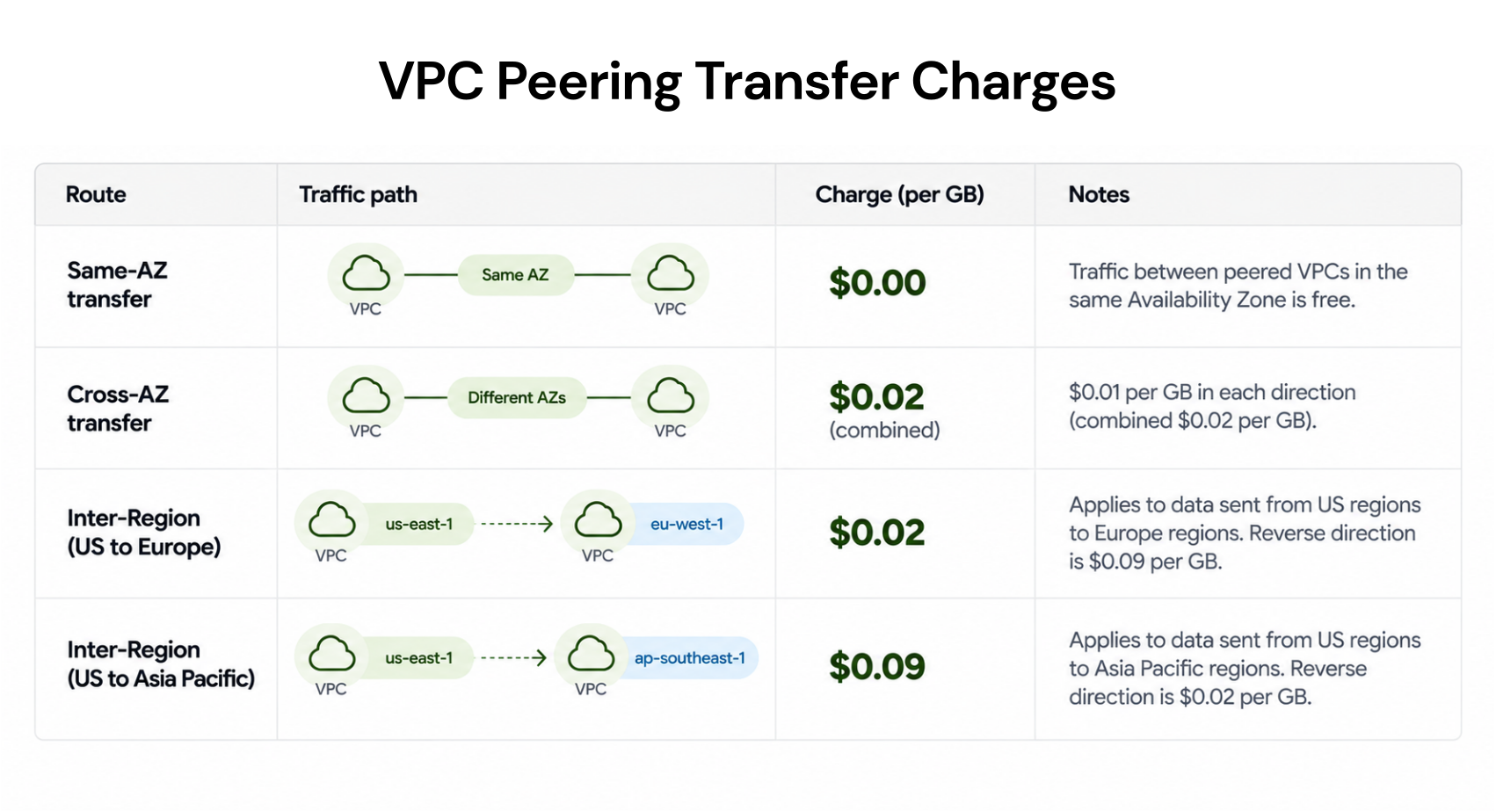
Count Each Direction Separately
For chargeable cross-AZ EC2 traffic, each GB sent incurs a sending-side charge and a receiving-side charge. Response traffic transfers additional bytes; it is not automatically included in the first GB.For inter-Region EC2 peering, apply the source Region’s outbound rate to the volume in each direction. Standard inter-Region ingress is free. Do not add the same-Region cross-AZ peering charge to that inter-Region hop.
Use the exact source and destination in AWS’s EC2 transfer pricing rather than treating one US route as universal. Our AWS data transfer cost guide explains the surrounding transfer paths when your estimate includes more than peering.
Calculate a Monthly Example
In this monthly VPC Peering price example, two EC2 instances communicate across different AZs in N. Virginia. Instance A sends 1,000 GB to B, and B sends 200 GB back.- A to B: 1,000 × ($0.01 + $0.01) = $20.
- B to A: 200 × ($0.01 + $0.01) = $4.
- Combined transfer charge: $24.
This example assumes direct EC2-to-EC2 communication over peering, without intermediary processing services. If you change the route or add appliances, rebuild the estimate for the complete path rather than carrying the $24 result forward.
How to Check VPC Peering Charges in AWS
You can verify VPC Peering costs using AWS Cost Explorer and the Cost and Usage Report (CUR).Open AWS Cost Explorer and select the billing period.
Group costs by usage type and identify relevant VPC Peering transfer records.
Look for usage types containing VpcPeering-In-Bytes and VpcPeering-Out-Bytes, including Regional prefixes.
Compare billed usage with the traffic paths, Regions, and accounts in your architecture.
For details, see AWS’s guide to VPC Peering charges.
VPC Pricing: Free Features and Additional Costs
A basic VPC has no hourly charge. Subnets, route tables, security groups, and network ACLs have no additional infrastructure charge. Instances, databases, load balancers, and optional networking features are billed separately.Gateway and Interface Endpoints
S3 and DynamoDB Gateway Endpoints have no hourly or processing fee. Their Region-specific endpoint routes avoid NAT processing only for supported traffic routed through them.For interface endpoints, AWS PrivateLink pricing starts at $0.01 per endpoint AZ-hour and $0.01/GB in the first processing tier. Three AZs cost $21.90 over 730 hours.
Processing tiers aggregate interface-endpoint traffic within a Region; the first tier covers 1 PB per month.
If NAT remains necessary and endpoint costs are incremental, processing savings are $0.045 − $0.01 = $0.035/GB. Break-even is $21.90 ÷ $0.035 = 625.71 GB/month. Include every required endpoint, transfer charges, and volume tiers before applying this illustration.
Public IPv4 Addresses
Standard chargeable AWS-provided public IPv4 addresses cost $0.005/address-hour, including idle addresses, or $3.65 over 730 hours. Count addresses rather than services using Public IP Insights or billing data; BYOIP and allowances need separate treatment.NAT Gateway Pricing: What to Include
A public NAT gateway enables private-subnet resources to initiate internet connections. Gateway hours, processing, public IPv4, and applicable transfer charges are separate cost components.Pricing Components
A zonal gateway in N. Virginia costs $0.045/hour, or $32.85 over 730 hours, plus $0.045/GB processed. AWS’s NAT Gateway pricing example shows why processing and data transfer must be assessed separately.A chargeable 1-GB internet transfer at the $0.09 tier adds $0.045 processing + $0.09 transfer = $0.135, before hours and IPv4. Remaining transfer allowances can reduce the transfer portion.
The Per-AZ Deployment Decision
Three zonal gateways cost $98.55 in monthly gateway hours, compared with $32.85 for one. Two additional gateways add $65.70, plus $7.30 if each adds one chargeable IPv4 address.At an explicitly assumed aggregate avoided cross-AZ cost of $0.02/GB, that $73 difference breaks even at 3,650 GB/month. Actual chargeable paths and availability requirements determine whether this comparison fits your architecture.
Reduce Charges on the Relevant Path
Evaluate Gateway Endpoints for eligible S3/DynamoDB traffic and interface endpoints for suitable service calls. Private ECR image pulls require the appropriate ECR endpoints and S3 endpoint path; AWS documents additional image-pull requirements and exceptions.Use subnet routing to avoid unnecessary cross-AZ NAT paths. Kubernetes service locality addresses service-to-service traffic separately. Our AWS egress cost reduction guide covers implementation choices in more depth.
In Cost Explorer, inspect NatGateway-Bytes alongside gateway hours and associated transfer usage. Compare processing volume with traffic you can actually reroute; an endpoint does not remove gateway-hour charges while NAT remains provisioned for other destinations.
Transit Gateway Pricing Compared With VPC Peering
Transit Gateway connects VPCs and on-premises networks through a central hub. It can simplify connectivity as the network grows, but that operational benefit comes at a price.Routing Fit: VPC Peering Is Not Transitive
VPC peering is point-to-point. If VPC A is peered with VPC B and VPC C, VPC B cannot route through VPC A to reach VPC C. It needs its own direct peering connection or another connectivity service. Consider that routing constraint before choosing peering solely because its direct charges are lower.N. Virginia VPC attachments cost $0.05/hour, or $36.50 over 730 hours, plus $0.02/GB sent from a VPC to the gateway. Ten attachments cost $365 before traffic; 5 TB, or 5,120 GB, adds $102.40 in processing in this simple VPC-to-VPC example. Other attachments and routes can have different treatment under Transit Gateway pricing.
Compare VPC Peering price with attachment hours, processing, transfer, and operating effort. A full peering mesh needs N × (N − 1) ÷ 2 connections: ten for five VPCs and 45 for ten. VPC count alone does not determine which option has the lower total cost.
Before choosing, compare the number of VPCs, need for transitive routing, on-premises connectivity, centralized inspection, account ownership, route-table operations, attachment hours, and directional traffic volume. Peering can suit a small set of direct connections; Transit Gateway can justify its attachment and processing charges when centralized routing reduces operational complexity.
Does CloudFront Affect VPC Peering Costs?
Amazon CloudFront delivers content to end users and is not a replacement for VPC Peering. Its pricing depends on data delivery, requests, and optional features rather than VPC Peering transfer rates.If your architecture also uses CloudFront, calculate those charges separately using AWS CloudFront pricing.
Choose Your Next Network Cost Optimization
Start with the largest chargeable path, then test the relevant alternative:Map the route. Record services, Regions, AZs, and request/response volumes.
Include every layer. Add gateway hours, processing, IPv4, transfer, and relevant delivery and request fees.
Check the operational fit. Preserve required availability and routing controls; prefer local traffic where appropriate without removing needed redundancy.
Validate against billing. After a change, compare equivalent periods and workloads using the actual service and usage-type records.
Evaluate VPC Peering price using your actual traffic path and monthly volumes, then compare the full cost of each alternative with the connectivity your teams need.
Where Usage.ai Fits in AWS Cost Optimization
Network design and purchasing decisions both shape your AWS bill. After reviewing peering, routing, and data-transfer costs, we help you assess eligible compute usage and manage commitments for potential additional savings. Compute Savings Plans do not discount the networking charges above.With Flex Insured Commitments, teams can get up to 57% savings from an eligible three-year AWS compute commitment with none of the commitment risk.
If an eligible Flex Commitment costs more than equivalent pay-as-you-go usage, we provide Cashback protection for the qualifying difference. Our protection does not cancel the underlying commitment, and we do not automatically protect existing customer-owned commitments as Flex Commitments.
Our fee is an agreed percentage of realized savings, billed monthly in arrears after provider billing data is finalized. If we do not generate savings through the program, there is no savings-based fee.
With your network costs mapped, check whether better commitment coverage could reduce your remaining AWS compute spend.
Assess commitments, uncovered compute usage, and potential savings with a read-only Savings Test.
Frequently asked questions
What is the VPC Peering price per GB?
Same-AZ peering transfers are free. Same-Region cross-AZ EC2 transfers cost $0.01/GB at each end, or $0.02/GB combined. Inter-Region rates depend on the source and destination Regions, so calculate each direction using its applicable outbound rate.
Is AWS VPC Peering free?
The peering connection itself has no setup or hourly fee. Transfer charges depend on the Regions and Availability Zones involved, so a free connection does not necessarily mean free traffic.
Does cross-account VPC Peering cost more?
Account ownership alone does not determine whether peering traffic is free or chargeable. Traffic within the same AZ is free even across accounts, while cross-AZ and inter-Region traffic follows the applicable transfer pricing. Across accounts, compare AZ IDs to confirm that resources occupy the same physical Availability Zone.
Is VPC Peering cheaper than Transit Gateway?
VPC peering can cost less for simple connections because it has no connection-hour or separate gateway-processing fee. Compare its transfer charges with Transit Gateway’s attachment and processing charges, applicable transfer costs, and your routing and operational requirements.