.png)



Amazon DocumentDB Serverless launched in general availability on July 31, 2025. It applies the auto-scaling model to DocumentDB — AWS’s MongoDB-compatible fully managed document database. Instead of choosing a fixed instance type (db.r5.large, db.r6g.xlarge), you let DocumentDB automatically adjust compute capacity in real time based on actual workload demand.
The billing unit is the DocumentDB Capacity Unit (DCU). You pay for the DCUs your cluster consumes, measured per second. When the workload spikes, the cluster scales up to the required DCU count within seconds. When load drops, capacity scales back down. You pay only for what is actually consumed, not for a fixed instance running 24 hours a day.
See exactly what you’re overpaying in under 60 seconds. Try the Calculator for free →
DocumentDB Serverless Pricing at a Glance
| Component | Rate | Notes |
| DCU (Standard storage) | $0.0822/DCU-hr | Billed per second. 1 DCU = ~2 GiB memory + CPU + networking. Minimum 0.5 DCU. |
| DCU (I/O-Optimized storage) | $0.0905/DCU-hr | Higher DCU rate, I/O charges included. Better price predictability for I/O-heavy apps. |
| Minimum capacity | 0.5 DCU | Always-on floor. At 0.5 DCU continuously: ~$30/month in compute. |
| Capacity granularity | 0.5 DCU increments | Fine-grained scaling. Smooth cost curve between min and peak. |
| Storage (Standard) | $0.10/GB-month | Includes 3-AZ replication. Pay for one logical copy. Auto-scales — no pre-provisioning. |
| Database I/O (Standard only) | Per million I/O requests | Read I/O: 8K pages = 1 I/O. Write I/O: 4K transaction log units. Verify rate at aws.amazon.com/documentdb/pricing/. |
| Storage (I/O-Optimized) | Higher than Standard | I/O charges included. Choose when I/O cost would exceed 25% of total cluster spend under Standard. |
| Backup storage (free tier) | Free to 100% of DB size | Automated backups free up to total cluster storage. Above free tier: $0.02/GB-month. |
| Backup storage (above free) | $0.02/GB-month | Only charged above the free tier threshold. |
| Inter-AZ data transfer | $0.00 | Data transferred between cluster instances across AZs is free. |
| T3/T4g CPU credit overage | $0.09/vCPU-hr | Applies to T3/T4g serverless instances in Unlimited mode if average CPU exceeds baseline over 24 hours. |
| Database Savings Plans | Eligible | DocumentDB is explicitly listed for Database Savings Plans on AWS pricing page. Up to 35% savings. |
| Free trial | 30 days | 750 hrs/month t3.medium, 30M IOs, 5 GB storage, 5 GB backup — for new DocumentDB customers. |
All rates: US East (N. Virginia), June 2026. Source: AWS official DocumentDB pricing page. Verify at aws.amazon.com/documentdb/pricing/ — rates change.
Source: AWS official DocumentDB pricing page (aws.amazon.com/documentdb/pricing/), June 2026. Minimum cost estimate: 0.5 DCU x $0.0822 x 730 hrs = $30/month compute only, Standard storage. Verify all current rates before estimating.
What Is a DCU?
A DocumentDB Capacity Unit (DCU) is the billing unit for DocumentDB Serverless. Each DCU provides approximately 2 GiB of memory with corresponding CPU and networking resources — similar to the resource allocation in DocumentDB provisioned instances. Source: AWS official DocumentDB pricing page.
The DCU model means you pay for memory-equivalent capacity, not for specific vCPU counts or network bandwidth separately. The cluster is billed per second at the current DCU level. If your cluster runs at 4 DCUs for exactly 15 minutes, the charge is 4 x $0.0822 x (15/60) = $0.0822.
DocumentDB Serverless scales capacity in fine-grained 0.5 DCU increments. The minimum is 0.5 DCU — there is no true scale-to-zero as of June 2026 for Serverless DocumentDB. Unlike Aurora DSQL (which scales to zero when idle), DocumentDB Serverless maintains a minimum of 0.5 DCU at all times. The minimum compute cost at 0.5 DCU running continuously: 0.5 x $0.0822 x 730 = approximately $30/month.
No scale-to-zero: unlike Aurora DSQL, DocumentDB Serverless does not scale to zero. The 0.5 DCU minimum means there is always a baseline compute charge. For applications that are truly idle for long periods, you can manually stop the cluster (up to 7 days) — storage charges continue but compute stops. Restart when needed.
Also read: Amazon Keyspaces Serverless: The Complete 2026 Guide
Standard vs I/O-Optimized: Which Storage Configuration?
DocumentDB Serverless offers two storage configurations, the same choice available for provisioned DocumentDB. The DCU rate differs between them.
Standard Storage ($0.0822/DCU-hr)
Standard is the default. You pay the lower DCU rate but are charged separately for I/O operations. Read I/Os are billed at 8K page granularity — one I/O per 8K page read from storage. Write I/Os are billed in 4K transaction log units. Choose Standard when your application reads its working set from memory most of the time (well-indexed, right-sized) and I/O costs stay below 25% of your total cluster spend.
I/O-Optimized Storage ($0.0905/DCU-hr)
I/O-Optimized charges the higher DCU rate but includes all I/O. No separate I/O line item on your bill. Choose I/O-Optimized when your I/O costs under Standard would exceed 25% of total cluster spend, or when you need cost predictability regardless of I/O patterns. The 10% higher DCU rate is offset by zero I/O charges at the 25% I/O-to-total crossover point. Source: AWS official DocumentDB pricing page.
Official Worked Examples (Directly from AWS)
Scenario: a workload that needs 7 DCUs, runs for 30 minutes, then scales down from 7 DCUs to 0.5 DCUs over approximately 3 minutes.
Example 1: Standard Storage
| Usage | Calculation | Cost |
| Scale to 7 DCUs instantly | ||
| Run at 7 DCUs for 30 minutes | 7 DCUs x $0.0822/hr x 30/60 hr | $0.29 |
| Scale down from 7 to 0.5 DCUs in 3 minutes | 7 DCUs x $0.0822/hr x 3/60 hr | $0.03 |
| Compute total (Standard) | $0.32 |
Example 2: I/O-Optimized Storage
| Usage | Calculation | Cost |
| Scale to 7 DCUs instantly | ||
| Run at 7 DCUs for 30 minutes | 7 DCUs x $0.0905/hr x 30/60 hr | $0.32 |
| Scale down from 7 to 0.5 DCUs in 3 minutes | 7 DCUs x $0.0905/hr x 3/60 hr | $0.03 |
| Compute total (I/O-Optimized) | $0.35 |
Note: these examples cover compute only — storage and I/O (for Standard) are additional. Storage at $0.10/GB-month and I/O at per-million rates are billed separately for Standard. I/O-Optimized has no separate I/O charge. Source: AWS official DocumentDB pricing page.
DocumentDB Serverless vs Provisioned: When Each Is Cheaper
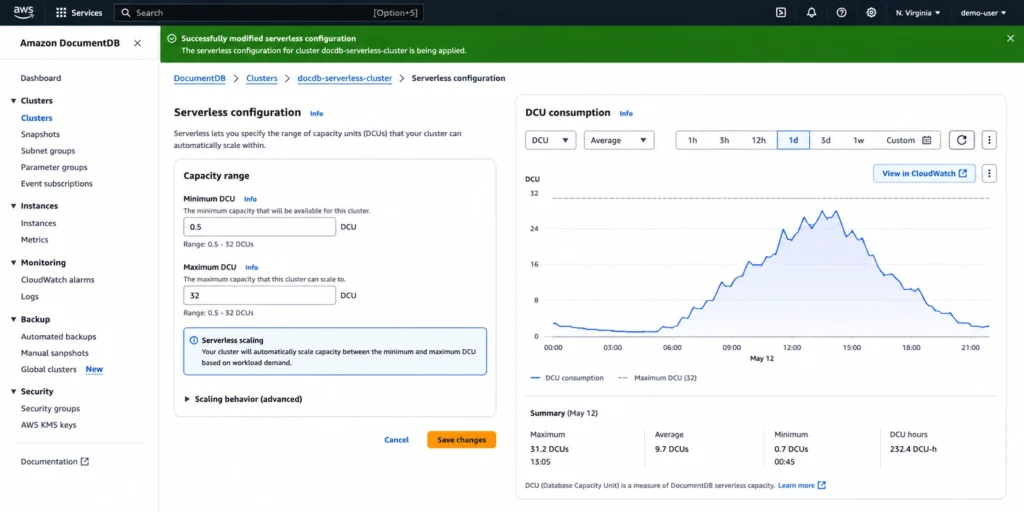
DocumentDB Serverless is cost-effective for variable workloads where average DCU utilization is significantly below the provisioned equivalent. For steady, predictable workloads, provisioned instances are typically cheaper because the fixed per-instance-hour rate is lower than the equivalent DCU cost at sustained high utilization.
Break-even example: a DocumentDB provisioned db.r5.large (2 vCPU, 16 GB) costs approximately $0.277/hr on-demand in US East. The equivalent DCU capacity for 16 GiB is approximately 8 DCUs (at 2 GiB/DCU). DocumentDB Serverless at sustained 8 DCUs: 8 x $0.0822 = $0.658/hr — 2.4x more expensive than the equivalent provisioned instance. Serverless saves money only when average DCU consumption is well below the provisioned equivalent.
Rule of thumb: if your average DCU consumption over the month is less than 50% of the provisioned equivalent, Serverless is likely cheaper. If average DCU consumption consistently approaches the provisioned equivalent (meaning the workload is steady), provisioned with Reserved Instances or Database Savings Plans delivers better unit economics.
| Scenario | Recommended | Reason | Monthly saving |
| Variable workload, 60-80% lower at night/weekends | Serverless | Scales down during off-peak, pay only for DCUs consumed. | 30-60% vs same-sized provisioned |
| Dev/test with intermittent queries | Serverless | Low DCU floor during idle periods. Stop cluster overnight for zero compute. | Up to 90% vs provisioned running 24/7 |
| New application, unknown workload | Serverless | No capacity planning needed. Set wide min/max bounds and observe CloudWatch DCU. | Avoids over-provisioning waste |
| Steady high-throughput production, 24/7 | Provisioned + RI or DSP | Sustained DCU cost exceeds provisioned rate. Fixed instance cheaper at high utilization. | Provisioned RI saves 30-60% vs Serverless at sustained load |
| Flash sales, gaming events, periodic promotions | Serverless | Scales instantly to handle peak without pre-provisioning. No idle waste between events. | Eliminates cost of provisioning for peak year-round |
Source: analysis from verified rates and AWS official DocumentDB Serverless use case documentation (docs.aws.amazon.com/documentdb/latest/developerguide/docdb-serverless-how-it-works.html). Verify rates at aws.amazon.com/documentdb/pricing/.
Also read: AWS Database Savings Plans
DocumentDB Version 3.6 Extended Support: The 2026 Cost Trap
If you are running DocumentDB version 3.6, this directly affects your bill starting July 1, 2026. Extended Support billing begins on that date.
Extended Support pricing adds a surcharge per vCPU-hour on top of the standard instance rate. For DocumentDB version 3.6: July 1, 2026 to March 31, 2028 — $0.111/vCPU-hour surcharge. April 1, 2028 to March 31, 2029 — $0.222/vCPU-hour surcharge. For a db.r4.large (2 vCPUs) normally at $0.277/hr: the surcharge adds $0.222/hr during Year 1-2 of Extended Support, making the effective rate $0.499/hr — an 80% increase. Source: AWS official DocumentDB pricing page, June 2026.
For DocumentDB Serverless specifically: Extended Support charges apply per DCU-hour consumed, not per vCPU-hour, when running version 3.6 after July 1, 2026. Upgrade to a supported version before July 1, 2026 to avoid Extended Support charges entirely.
How DocumentDB Serverless Scaling Works
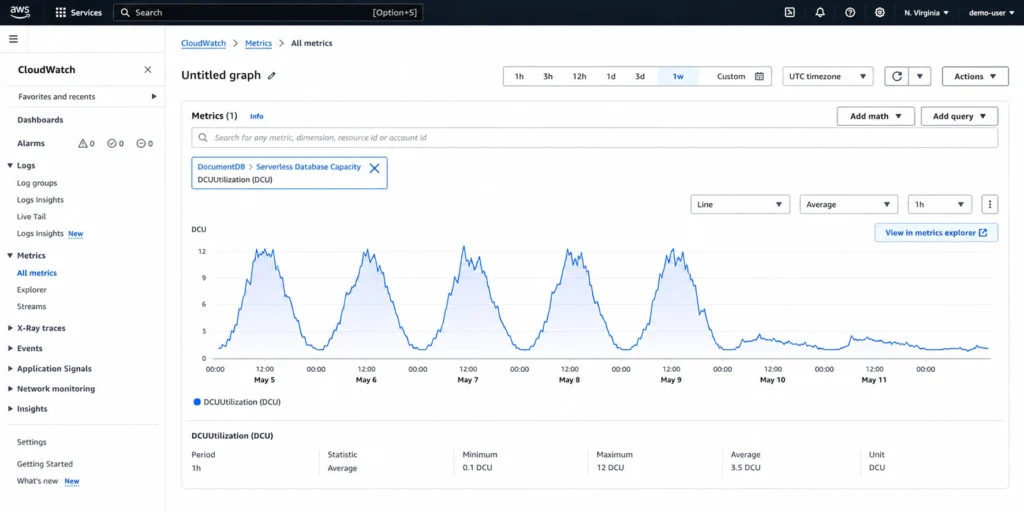
DocumentDB Serverless monitors your workload continuously and adjusts capacity in real time. The scaling mechanism is designed to have minimal overhead so it responds quickly to changes in query load. Source: AWS official DocumentDB Serverless documentation.
Scale-up happens instantly — the cluster can scale to handle hundreds of thousands of transactions per second without manual intervention or service interruption. Scale-down is gradual: returning to minimum capacity after peak load takes approximately 3 minutes, as shown in the AWS pricing examples. This prevents oscillation from brief traffic spikes while ensuring efficient cost tracking after sustained load drops.
The minimum capacity of 0.5 DCU is always maintained. This ensures the cluster can accept connections and respond to queries immediately without any resume latency — unlike true serverless products that require cold-start time after full scale-to-zero. The trade-off is the minimum $30/month baseline compute cost. For applications that go days or weeks between queries, manually stopping the cluster is the way to eliminate this baseline cost.
MongoDB Compatibility and Supported Features
DocumentDB Serverless is MongoDB API-compatible and supports all features of DocumentDB provisioned clusters. This means you can use existing MongoDB drivers, tools, and application code without changes. Source: AWS official announcement (July 31, 2025).
Supported features include: Multi-AZ deployments, read replicas (up to 15), Performance Insights, I/O-Optimized storage, change streams, TTL indexes, and full-text search. DocumentDB uses MongoDB 3.6, 4.0, and 5.0 compatible APIs depending on the engine version chosen.
DocumentDB is not a fully compatible MongoDB replacement — it supports a MongoDB-compatible API rather than the full MongoDB feature set. Applications using advanced MongoDB features (full MongoDB aggregation pipeline operators, certain index types) should verify compatibility before migrating. Use the AWS Schema Conversion Tool or test your specific queries against DocumentDB before committing.
See exactly what you’re overpaying in under 60 seconds. Try the Calculator for free →
How Usage.ai Handles DocumentDB Serverless Costs
Usage.ai monitors DocumentDB Serverless DCU consumption from CloudWatch and identifies two primary optimization opportunities: clusters running at sustained high DCU utilization where provisioned instances would be cheaper, and clusters eligible for Database Savings Plans commitment.
Database Savings Plans cover DocumentDB and provide up to 35% savings on a 1-year commitment. For teams running DocumentDB Serverless at consistent minimum spend patterns, the DSP commitment delivers savings on the stable floor of DCU spend without requiring a specific instance type commitment.
For teams running DocumentDB version 3.6, Usage.ai flags the Extended Support billing trigger (July 1, 2026) and surfaces the engine upgrade recommendation before the surcharge becomes active. A version upgrade that avoids 80% per-hour cost increase on existing clusters is a direct cost saving, not just operational hygiene.
If any DSP commitment for DocumentDB becomes underutilized — because a cluster is decommissioned or migrated — Usage.ai provides cashback on the unused commitment in real money. Fee: percentage of realized savings only.
Also read: See how Usage.ai optimizes DocumentDB Serverless and Database Savings Plans
Frequently Asked Questions
1. What is DocumentDB Serverless?
Amazon DocumentDB Serverless is an auto-scaling configuration for DocumentDB (MongoDB API-compatible) that launched in general availability on July 31, 2025. It automatically scales compute in DocumentDB Capacity Units (DCUs) based on workload demand, with no manual instance sizing required. Billing is per second at $0.0822/DCU-hour (Standard) or $0.0905/DCU-hour (I/O-Optimized). It supports all DocumentDB features including Multi-AZ, read replicas, and Performance Insights. Source: AWS official announcement and pricing page.
2. How much does DocumentDB Serverless cost?
$0.0822/DCU-hour for Standard storage or $0.0905/DCU-hour for I/O-Optimized, billed per second. Minimum 0.5 DCU at all times: approximately $30/month baseline compute (Standard). Storage: $0.10/GB-month (Standard) plus I/O charges, or higher rate with I/O included (I/O-Optimized). Backup storage: free up to 100% of cluster size, $0.02/GB-month above. Database Savings Plans eligible for up to 35% savings. Source: AWS official pricing page, June 2026.
3. Does DocumentDB Serverless scale to zero?
No. The minimum capacity is 0.5 DCU, which is always maintained. DocumentDB Serverless does not scale to zero — there is always a baseline compute charge of approximately $30/month (Standard) for continuous operation. To temporarily eliminate compute charges, you can manually stop the cluster for up to 7 days, after which AWS automatically restarts it. Storage charges continue while the cluster is stopped. Source: AWS official DocumentDB pricing page.
4. What is a DCU?
A DocumentDB Capacity Unit provides approximately 2 GiB of memory with corresponding CPU and networking resources. Capacity scales in 0.5 DCU increments, and billing is per second at the DCU count currently allocated. 4 DCUs provides approximately 8 GiB of memory — roughly comparable to a db.r5.large provisioned instance on compute resources. Source: AWS official DocumentDB pricing page.
5. When is DocumentDB Serverless cheaper than provisioned?
When average DCU consumption is significantly below the provisioned equivalent. A variable workload averaging 2 DCUs on a cluster that peaks at 8 DCUs costs approximately $120/month on Serverless (Standard) versus $202/month for a provisioned db.r5.large. For steady workloads averaging 8 DCUs continuously, Serverless at $0.658/hr exceeds a provisioned db.r5.large at $0.277/hr by 2.4x. Use CloudWatch DCU metrics after 30 days to determine your actual average utilization.
6. What changed with DocumentDB 3.6 in 2026?
DocumentDB version 3.6 entered Extended Support on March 31, 2026. Extended Support billing starts July 1, 2026 and adds $0.111/vCPU-hour (Year 1-2) and $0.222/vCPU-hour (Year 3) on top of standard rates. For Serverless, the surcharge applies per DCU-hour consumed. Upgrade to a supported DocumentDB version before July 1, 2026 to avoid Extended Support charges. Source: AWS official DocumentDB pricing page, June 2026.