.png)



How to Reduce Your AWS Bill in France: A FinOps Guide (2026)
AWS bills in France grow for the same reason they grow everywhere: elastic infrastructure makes it trivially easy to provision more and structurally difficult to provision less.
Add the 15-20% regional pricing premium that eu-west-3 (Paris) carries over equivalent US regions, layer in GDPR data residency constraints that eliminate migration to cheaper regions as a strategy, and compound with below-average commitment coverage rates across the French market, and the result is a cloud bill that is routinely 30-40% larger than it needs to be.
Gartner (2025) estimates organizations waste up to 30% of cloud spend on resources that deliver no business value. For a French enterprise running EUR 2M/year on AWS eu-west-3, that represents EUR 600,000 leaving the building annually through idle instances, oversized databases, unused Reserved Instances, and on-demand pricing on workloads that have been stable for 18 months.
None of this requires an architecture overhaul to fix. It requires a structured FinOps approach applied in the right sequence.
This guide covers every major lever for reducing an AWS bill in France in 2026, from the free native tools every team should configure on day one to the autonomous commitment optimization platforms that recover the largest percentage of spend in the shortest time.
What Does Reducing an AWS Bill in France Actually Mean?
Reducing an AWS bill is not a single action. It is a layered process that addresses three distinct categories of spend: waste (resources running with no utilization), overprovisioning (resources sized for peak loads that never materialize), and pricing model mismatch (stable workloads paying on-demand rates instead of committed rates). Each category requires different tactics and different tooling.
For French enterprises specifically, there is a fourth category: GDPR-driven architecture cost. Because General Data Protection Regulation (GDPR) Articles 44-49 restrict where personal data may be processed, French organizations are structurally constrained to AWS eu-west-3 or equivalent GDPR-compliant regions. This eliminates the cheapest optimization strategy (moving workloads to lower-cost US regions) and makes commitment optimization the single highest-leverage cost reduction tactic available.
What is AWS cost optimization? AWS cost optimization is the ongoing process of aligning cloud resource spend with actual business requirements by eliminating waste, right-sizing provisioned capacity, choosing the correct pricing model for each workload type, and automating commitment purchasing to maximize discounts on stable baseline usage. In France, this process must operate within GDPR data residency constraints and account for the regional pricing premium that eu-west-3 carries over US regions.
Why Reducing Your AWS Bill in France Is Harder Than in Other Markets
The tactics that reduce AWS spend in the US do not all translate directly to France. Four structural factors make cost optimization in the French market distinct from cost optimization in other enterprise cloud markets.
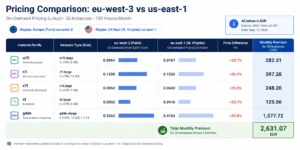
- eu-west-3 pricing premium: AWS on-demand pricing in eu-west-3 (Paris) runs approximately 15-20% above equivalent US-East-1 rates. An m7i.2xlarge instance costs $0.4032/hour on-demand in eu-west-3 versus $0.3648/hour in us-east-1. For a fleet of 50 instances running continuously, that premium adds approximately EUR 17,000/month in additional cost before any optimization is applied. This premium is structural and permanent, which means commitment optimization, not architectural migration, is the primary lever available to French enterprises.
- GDPR data residency lock-in: GDPR Articles 44-49 restrict transfers of personal data outside the European Economic Area (EEA) without adequate protection mechanisms. For most French enterprises handling EU resident data, this effectively mandates eu-west-3, Azure France Central, or GCP Europe-West workloads. Moving compute to cheaper US regions is not a viable optimization strategy, which concentrates the entire savings opportunity on pricing model improvements within GDPR-compliant regions.
- Low commitment coverage baseline: The FinOps Foundation’s 2025 State of FinOps report identifies France as having below-average commitment coverage compared to UK, Germany, and Nordic markets. French enterprises average 45-55% commitment coverage on eligible workloads versus a 65-75% benchmark for leading FinOps organizations. That 10-20 percentage point gap represents hundreds of thousands of euros per year in on-demand pricing paid on workloads that have been stable long enough to commit.
- Data transfer costs amplified by regional architecture: eu-west-3 sits geographically further from the hub of AWS infrastructure than US regions, and GDPR constraints often require French enterprises to replicate data within EEA boundaries rather than to lower-cost regions. Cross-AZ traffic at $0.01/GB per direction, NAT Gateway charges at $0.045/GB processed, and cross-region replication for EU-based disaster recovery add up to a data transfer bill that is commonly the third largest line item on a French enterprise AWS account, behind compute and storage.
- FinOps skills scarcity: France has a measurably smaller pool of FinOps-certified practitioners relative to cloud spend than UK or German markets, meaning many French engineering and finance teams are making commitment purchasing decisions without dedicated FinOps tooling or expertise. The result is either over-conservative commitment purchasing (leaving on-demand spend uncovered) or under-qualified manual purchasing that creates overcommitment risk.
Six Levers That Reduce Your AWS Bill in France
The following six levers are sequenced by time-to-impact. Levers 1 and 2 deliver results within 30 days. Levers 3, 4, and 5 take 30-90 days depending on team capacity. Lever 6 runs continuously and compounds over time.
Lever 1: Audit and eliminate idle resources (impact in 30 days)
The fastest money returned from any AWS bill comes from resources that are running and billing but delivering zero value. In a typical French enterprise eu-west-3 account, three categories account for 10-15% of monthly spend: idle EC2 instances (running below 5% average CPU utilization for 14+ days), unattached EBS volumes (no longer connected to any running instance), and orphaned Elastic IP addresses ($0.005/hour each, including when idle, a change AWS made in February 2024 that most teams have not fully reckoned with).
Using AWS Compute Optimizer for eu-west-3: AWS Compute Optimizer analyzes CloudWatch metrics and identifies over-provisioned EC2 and RDS instances in eu-west-3 at no additional cost. Enable it at the organization level to capture cross-account analysis. Compute Optimizer compares actual CPU, memory, network, and storage utilization against the provisioned instance type and recommends right-sized alternatives. For an m7i.4xlarge (8 vCPU, 32GB RAM) running at 15% average CPU utilization, Compute Optimizer will typically recommend downsizing to m7i.2xlarge (4 vCPU, 16GB RAM), cutting instance cost by 50% with no application impact.
Quick wins checklist for eu-west-3:
- Identify EC2 instances with <5% average CPU over 14 days using Compute Optimizer or Cost Explorer rightsizing recommendations
- List all EBS volumes with status “available” (unattached) using AWS CLI: aws ec2 describe-volumes –filters Name=status,Values=available –region eu-west-3
- Audit Elastic IPs: as of February 2024, all public IPv4 addresses cost $0.005/hour whether attached or idle. Release any EIP not actively in use
- Identify RDS instances with <10% average CPU over 30 days and right-size using Compute Optimizer RDS recommendations
- Check for idle Elastic Load Balancers (no active connections for 7+ days) at $0.0225/hour in eu-west-3 plus $0.008/LCU
Expected impact: 10-15% reduction in monthly AWS bill within 30 days of systematic idle resource cleanup. For a EUR 200,000/month eu-west-3 account, that represents EUR 20,000-30,000 recovered per month with zero application changes.
Also read: Best Cloud Cost Optimization Tools in France (2026)
Lever 2: Purchase Savings Plans and Reserved Instances (impact in 30-60 days)
Commitment purchasing is the single highest-impact AWS cost reduction lever for French enterprises, delivering 30-72% discounts on eligible compute spend in exchange for 1-year or 3-year usage commitments. It is also where the largest financial risk exists: an overcommitted Savings Plan or Reserved Instance on a workload that subsequently shrinks becomes a sunk cost that continues billing for 12-36 months.
How AWS commitment discounts work in eu-west-3: AWS applies commitment discounts in a specific hierarchy: Reserved Instances are applied first to matching usage, then EC2 Instance Savings Plans, then Compute Savings Plans, and finally on-demand pricing for any uncovered usage. Understanding this hierarchy is essential for purchasing the right mix. For French enterprises, the most common starting point is a 1-year, No Upfront Compute Savings Plan covering 50-60% of stable EC2 baseline in eu-west-3, delivering up to 66% savings on covered usage with no capacity restriction.
Compute Savings Plans vs Reserved Instances for French workloads: Compute Savings Plans commit to a fixed hourly spend (e.g., EUR 20/hour) and automatically apply discounts to any EC2, Fargate, or Lambda usage regardless of instance type, region, size, or operating system. This flexibility makes them the default recommendation for most French enterprises because GDPR-compliant workloads often evolve across instance generations and sizes without changing region. Reserved Instances offer higher maximum discounts (up to 72% for 3-year Standard RIs) but lock you into a specific instance family, size, region, and OS, which creates management overhead as architectures evolve.
The commitment risk problem and how Usage.ai solves it: Every FinOps team that manages commitments manually faces the same dilemma: purchase conservatively (covering 50-60% of baseline) and leave on-demand spend on the table, or purchase aggressively (70-80% coverage) and risk overcommitment if workloads contract. Usage.ai eliminates this dilemma entirely through its Cashback Guarantee. The platform purchases commitments autonomously at a 24-hour refresh cycle and guarantees that any underutilized commitment is refunded in real cash, not vendor credits. This allows Usage.ai customers to purchase at 70-80%+ coverage rates without absorbing the downside risk, which is why they consistently capture 30-50% savings versus the 15-25% that conservative manual purchasing delivers.
Usage.ai’s commitment product suite for French enterprises:
- Flex Savings Plans (EC2, Fargate, Lambda): 40-60% savings on compute. Purchased autonomously on a 24-hour cycle. Full cashback on any underutilized portion.
- Flex DB Savings Plans (RDS, ElastiCache, DocumentDB): 20-35% savings on database spend. RDS is typically the second largest AWS line item for French enterprises after EC2.
- Flex Reserved Instances (RDS, ElastiCache, OpenSearch, Redshift, DynamoDB): 30-40% savings on data services. Covers instance types where Savings Plans do not apply.
Expected impact: 30-50% reduction in covered compute and database spend within 60 days of full commitment coverage. For a EUR 100,000/month EC2 spend, full Compute Savings Plan coverage at 66% discount represents EUR 66,000/month in savings. Manual programs typically capture 40-50% of this opportunity in the first year. Usage.ai captures 85-95% within 60 days due to its 24-hour autonomous purchasing cycle.
Calculate your eu-west-3 Savings Plan savings with Usage.ai
Lever 3: Right-size over-provisioned instances (impact in 30-60 days)
AWS data indicates that 84% of EC2 instances are provisioned at 2x or more the capacity actually consumed under average production load. In eu-west-3, where on-demand pricing already carries a 15-20% regional premium, running an m7i.4xlarge at 20% CPU utilization means paying on-demand rates for 80% of the provisioned capacity you never use, in a region where that provisioned capacity costs 18% more to begin with.
Right-sizing is distinct from downsizing. The goal is not to reduce capacity to the minimum possible, but to match provisioned resources to actual peak demand plus a reasonable safety margin (typically 30-40% headroom above measured peak). AWS Compute Optimizer measures P99 CPU, memory, network, and storage utilization and recommends the instance type that would serve the observed load with appropriate headroom. For French enterprises, this analysis should be run separately for production, staging, and development environments, since non-production environments are routinely overprovisioned relative to their actual testing load.
Right-sizing RDS instances in eu-west-3: RDS is the second largest AWS cost category for most French enterprises, and it is routinely the most overprovisioned. Database instances are frequently sized for a projected peak load that was never reached, or sized when the application was first deployed and never revisited as the data access pattern evolved. An RDS db.r6g.2xlarge (8 vCPU, 64GB RAM) provisioned for a database using 15% average CPU and 40% memory should typically be right-sized to db.r6g.xlarge (4 vCPU, 32GB RAM), cutting RDS instance cost by 50% and making the instance eligible for a smaller, cheaper Reserved Instance commitment.
Expected impact: 15-25% reduction in EC2 and RDS spend after systematic right-sizing. Combined with Lever 1 (idle elimination), a French enterprise implementing Levers 1-3 sequentially will typically reduce total AWS spend by 25-35% before any commitment discounts are applied.
Lever 4: Reduce data transfer costs (impact in 30-90 days)
Data transfer is the most common billing surprise in French enterprise AWS accounts. Most teams model EC2 and RDS costs accurately but significantly underestimate data transfer, which LeanOps (2026) identifies as the third largest AWS cost driver for distributed architectures. For French enterprises running multi-AZ deployments in eu-west-3 for GDPR-compliant high availability, cross-AZ traffic at $0.01/GB per direction compounds rapidly in microservices and Kubernetes architectures.
The four data transfer levers for eu-west-3:
- Deploy VPC Endpoints for S3 and common AWS services: Any EC2 instance accessing S3, DynamoDB, SQS, SNS, or other AWS services through a NAT Gateway pays $0.045/GB in NAT processing fees plus $0.045/hour for the gateway. A VPC Gateway Endpoint for S3 routes traffic over AWS private infrastructure at $0 per GB. For a French enterprise processing 10TB/month of S3 traffic through a NAT Gateway, deploying a VPC Endpoint saves EUR 4,500/month in NAT processing charges with a single CloudFormation resource.
- Minimize cross-AZ traffic in Kubernetes and microservices: AWS charges $0.01/GB per direction for traffic between Availability Zones. An EKS cluster processing 10TB/month of inter-pod communication across AZs pays $200/month in cross-AZ fees that can be eliminated or reduced by configuring topology-aware routing, which directs pod-to-pod traffic to replicas in the same AZ whenever available. This is a Kubernetes configuration change, not an infrastructure change.
- Audit and optimize CloudFront for French user traffic: CloudFront distributions serving French users from the Paris edge location (CDG) route traffic through AWS private infrastructure rather than internet egress, reducing data transfer out charges from $0.085-0.09/GB (eu-west-3 internet egress) to $0.012-0.02/GB (CloudFront origin-to-edge transfer). For applications with high GET traffic, adding CloudFront reduces data transfer costs by 70-80% on cacheable content.
- Review cross-region replication for EU DR requirements: GDPR-compliant disaster recovery often requires French enterprises to maintain EU-region replicas of production data. Cross-region replication from eu-west-3 to eu-central-1 (Frankfurt) costs $0.02/GB. For a French enterprise replicating a 5TB RDS database for DR purposes, that represents EUR 100/month in ongoing replication traffic. Review whether full database replication is required for compliance or whether replicated backups satisfy the RTO/RPO and GDPR requirements at lower cost.
Expected impact: Data transfer optimization typically recovers 5-15% of total AWS spend for distributed French enterprise architectures. The VPC Endpoint for S3 is the highest-ROI single configuration change available, with zero application changes and payback measured in days.
Lever 5: Schedule non-production environments (impact in 7-14 days)
Non-production environments in eu-west-3 accumulate 720 hours of on-demand charges per month at full regional pricing rates. A typical French enterprise engineering organization runs 5-15 staging and development environments that replicate production instance types but serve traffic for 8-10 hours per weekday. The remaining 70% of runtime (evenings, weekends, bank holidays) is pure waste.
Scheduling automated shutdown of non-production environments from 20:00 to 08:00 on weekdays and all weekend reduces instance hours from 720/month to approximately 220/month, a 70% reduction in non-production compute spend. France observes 11 public bank holidays per year, and French enterprises running non-production environments over French bank holidays are paying full on-demand rates for idle instances on days when no development work occurs.
Implementation options:
- AWS Instance Scheduler: AWS-native solution that uses DynamoDB and Lambda to start and stop EC2 and RDS instances on a schedule. Configurable per environment tag. Supports French holiday calendars through custom period definitions. Free beyond Lambda and DynamoDB costs (typically under EUR 5/month).
- AWS Systems Manager Automation: For more complex stop/start workflows that include pre-shutdown tasks (cache flush, database checkpoint), Systems Manager provides runbook-based automation that executes cleanly before instance shutdown.
- Terraform/IaC schedule enforcement: For organizations managing infrastructure as code, enforcing schedule tags at the IaC layer prevents non-production environments from being deployed without cost controls attached.
Expected impact: For a French enterprise running 100 non-production m7i.xlarge instances in eu-west-3 at $0.2016/hour, scheduling reduces non-production compute from EUR 14,717/month to EUR 4,447/month, saving EUR 10,270/month or EUR 123,240/year. This is the fastest implementation-to-payback lever in this guide.
Lever 6: Automate commitment purchasing with Usage.ai (ongoing, compounds over time)
Levers 1-5 address discrete, one-time optimization opportunities. Lever 6 is the only lever that operates continuously, compounds over time, and handles the three-dimensional complexity of commitment optimization across AWS, GCP, and Azure simultaneously. For French enterprises spending EUR 500K+/year across multiple cloud providers, manual FinOps programs reliably fail to capture more than 40-50% of available commitment savings because the analysis required to maintain optimal coverage changes daily as workloads evolve.
Usage.ai is the only tri-cloud platform that purchases AWS, GCP, and Azure commitments autonomously with a 24-hour refresh cycle, a cashback guarantee on any underutilized commitment, and billing-layer-only access that never touches running infrastructure. For French enterprises, the billing-layer-only architecture is critical: Usage.ai connects exclusively to AWS Cost and Usage Report (CUR) APIs, Azure Cost Management APIs, and GCP Billing Export. None of these data sources contain personal data under GDPR. No agent installation, no infrastructure access, no Data Processing Agreement covering personal data is required.
Why manual FinOps programs stall out at 40-50% savings: Manual commitment purchasing operates on a 30-90 day review cycle. Workloads change daily. The gap between when a workload stabilizes and when a manual FinOps program identifies and purchases coverage for it represents on-demand pricing paid on fully stable capacity. At EUR 8,000-12,000/day in uncovered spend on a EUR 3M/year cloud bill, a 30-day manual review cycle means EUR 240,000-360,000 per cycle spent at on-demand rates on workloads that have been stable the entire time. Usage.ai’s 24-hour refresh cycle catches coverage opportunities three days earlier per cycle than AWS Cost Explorer’s 72-hour lag, worth EUR 24,000-36,000 per cycle in additional savings for that same account.
Usage.ai’s full offering for French enterprises:
- Autonomous purchasing: Savings Plan and Reserved Instance purchases executed automatically after initial approval. No FinOps analyst review required for routine coverage maintenance.
- 24-hour recommendation refresh: Analysis updated daily versus the 72-hour lag in AWS Cost Explorer. Coverage gaps caught and filled 3x faster.
- Cashback Guarantee: Real money (not AWS credits) refunded for any underutilized commitment. Usage.ai absorbs the overcommitment risk so French enterprises can purchase at 75-85% coverage rates safely.
- Tri-cloud coverage: AWS eu-west-3, Azure France Central, and GCP Europe-West all managed from a single platform. Savings Plans, Reserved Instances, Azure Reservations, and GCP Committed Use Discounts purchased and monitored together.
- GDPR-compliant by design: Billing-layer-only access. No infrastructure access, no application data, no personal data. Satisfies GDPR Article 5(1)(f) without a Data Processing Agreement covering personal data.
- $91M+ recovered for customers: Including enterprises similar to French organizations spending EUR 500K-10M/year on AWS, GCP, and Azure.
- Setup time: 30 minutes to connect all cloud accounts. First savings appear on first billing cycle. Full 30-50% optimization achieved within 60 days.
- Pricing: Percentage of realized savings only. Zero upfront cost, zero lock-in, cancel anytime. You pay nothing until savings appear.
See how Usage.ai reduces AWS bills for French enterprises in 30 minutes
GDPR and AWS Cost Optimization: What French FinOps Teams Must Know
The General Data Protection Regulation (GDPR) does not just constrain where French enterprises can run workloads. It also constrains which cloud cost optimization tools they can safely deploy. Any third-party tool that requires access to running EC2 instances, RDS databases, application configuration, or workload data creates a GDPR data processing obligation under Article 5(1)(f), which requires appropriate security measures for personal data processing.
The billing-layer-only requirement for GDPR-compliant cost tooling
The correct access model for cloud cost optimization in a GDPR environment is billing-layer-only: read-only access to AWS Cost and Usage Report (CUR) data, which contains instance types, hours consumed, and cost amounts, but no personal data, application data, or infrastructure configuration. CUR data is not classified as personal data under GDPR and can be processed under a standard data processing agreement without additional CNIL obligations.
Usage.ai accesses only three data sources: AWS Cost and Usage Report and billing APIs, Azure Cost Management REST APIs and billing export, and GCP Billing Export to BigQuery. None of these contain personal data. No agent installation. No EC2 SSH access. No infrastructure-level API credentials. The billing-layer-only model satisfies GDPR Article 5(1)(f) and eliminates the legal review that French enterprises typically require before deploying third-party tools with infrastructure access.
Actionable tip: Before deploying any AWS cost optimization tool in France, require the vendor to confirm in writing that their access model is billing-layer-only. Request confirmation that no Data Processing Agreement covering personal data is required. Any tool requiring agent installation, EC2 SSH access, or infrastructure-level IAM permissions with ec2:Describe* actions on running instances creates a GDPR exposure that billing-layer-only tools eliminate entirely.
Also read: Why Cloud Resource Optimization Alone Does Not Fix Cloud Costs
GDPR-driven architecture patterns and their AWS cost implications
GDPR data residency constraints create specific cost patterns that French FinOps teams must account for when modeling savings opportunities:
- Multi-AZ within eu-west-3 for HA: GDPR compliance combined with high availability requirements drives multi-AZ deployments within eu-west-3. Cross-AZ traffic ($0.01/GB/direction) accumulates in these architectures and should be minimized through topology-aware routing and VPC endpoint deployment as described in Lever 4.
- EU-only DR replication: GDPR-compliant disaster recovery requires European-region replicas. Replicating to eu-central-1 (Frankfurt) or eu-west-1 (Ireland) is cheaper than maintaining eu-west-3 secondary regions for DR purposes, and still satisfies EEA data transfer requirements.
- No US-region arbitrage: The single largest global cost optimization lever (moving workloads to cheaper US regions) is unavailable to French enterprises handling EU personal data. This concentrates the entire savings opportunity on commitment optimization and right-sizing within GDPR-compliant regions.
Also read: AWS Savings Plans vs Reserved Instances: A Practical Guide to Buying Commitments
Your 30-Day AWS Cost Reduction Checklist for France
The following checklist sequences the highest-impact actions in the first 30 days. Each item requires no application changes and no infrastructure downtime.
- Enable AWS Compute Optimizer for all eu-west-3 accounts (Day 1, 15 minutes): Go to AWS Compute Optimizer console, enable for your organization or individual account. Opt in for Enhanced Infrastructure Metrics (14-day lookback instead of default 14-day). Review EC2 and RDS rightsizing recommendations within 24 hours of enabling.
- Deploy VPC Endpoints for S3 and DynamoDB in eu-west-3 (Day 1-2, 30 minutes): Create Gateway Endpoints for S3 and DynamoDB via CloudFormation or the VPC console. Update route tables to direct S3 and DynamoDB traffic to the endpoint. Eliminates NAT Gateway processing charges on AWS service traffic. Payback measured in days for accounts with significant S3 activity.
- Audit and release idle Elastic IPs (Day 1-3, 30 minutes): Run aws ec2 describe-addresses –region eu-west-3 and identify EIPs not associated with running instances. Release each unassociated EIP. As of February 2024, AWS charges $0.005/hour for all public IPv4 addresses including idle ones.
- Configure non-production scheduling (Day 3-7, 2-4 hours): Tag all non-production instances with Environment=dev, Environment=staging, or equivalent. Deploy AWS Instance Scheduler with weekday-only schedule (08:00-20:00 CET). Apply to all non-production EC2 and RDS instances. Verify shutdown with CloudWatch metrics. Expect 70% reduction in non-production instance hours.
- Set budget alerts at 80% and 100% of monthly thresholds (Day 1, 20 minutes): In AWS Budgets, create a monthly cost budget for eu-west-3 at your expected spend level. Set alerts at 80% and 100% thresholds sending to finance and engineering leads. Enable AWS Cost Anomaly Detection with a EUR 500 daily threshold to catch runaway services within 24 hours instead of at month-end.
- Connect Usage.ai for autonomous commitment purchasing (Day 1, 30 minutes): Connect your AWS Cost and Usage Report to Usage.ai via read-only billing API access. Review initial savings analysis. Approve first Savings Plan purchases. Full optimization achieved within 60 days with cashback protection on every commitment purchased.
Ready to reduce your AWS eu-west-3 bill by 30-50%?
Usage.ai’s Autopilot handles AWS Savings Plans, Reserved Instances, Azure Reservations, and GCP Committed Use Discounts autonomously, with zero lock-in, a full cashback guarantee on any underutilized commitment, and billing-layer-only access that keeps your French enterprise GDPR-compliant from day one. Setup takes 30 minutes. First savings appear on your next bill. You pay nothing until Usage.ai saves you money.
Book a free 15-minute AWS savings assessment for your eu-west-3 account at usage.ai
Frequently Asked Questions
How much can a French enterprise realistically reduce its AWS bill?
A French enterprise implementing all six levers in this guide can realistically reduce total AWS eu-west-3 spend by 35-50% within 90 days. The breakdown: idle resource elimination (Lever 1) recovers 10-15%, commitment purchasing (Lever 2) delivers 30-50% on covered spend, right-sizing (Lever 3) adds 15-25% on remaining on-demand, data transfer optimization (Lever 4) reduces 5-15%, non-production scheduling (Lever 5) eliminates 65-70% of non-production compute, and autonomous optimization with Usage.ai (Lever 6) captures 85-95% of available commitment savings within 60 days versus 40-50% for manual programs. For a French enterprise spending EUR 2M/year on AWS, a 40% reduction represents EUR 800,000 in annual savings.
Do AWS Savings Plans work for eu-west-3 workloads?
Yes. Compute Savings Plans apply to any EC2, Fargate, or Lambda usage across all AWS regions including eu-west-3, regardless of instance type, size, or operating system. A Compute Savings Plan purchased for a 1-year No Upfront term delivers up to 66% savings on eligible compute usage in eu-west-3 relative to on-demand pricing. EC2 Instance Savings Plans are region-specific (you specify eu-west-3 at purchase) and deliver up to 72% savings for a specific instance family. Both Savings Plan types are the correct commitment vehicle for most French enterprise compute workloads. Database workloads running on RDS in eu-west-3 are covered by Database Savings Plans (Generation 7+ instances) or RDS Reserved Instances for older generations.
Does deploying a cloud cost tool in France require GDPR compliance assessment?
It depends on the tool’s access model. Any cloud cost tool requiring access to running EC2 instances, RDS databases, application data, or infrastructure configuration creates a GDPR data processing obligation requiring a Data Processing Agreement and potentially a DPIA (Data Protection Impact Assessment) under GDPR Article 35. Tools operating on a billing-layer-only model, accessing only AWS Cost and Usage Report, Azure Cost Management APIs, and GCP Billing Export, do not touch personal data and do not create these obligations. Usage.ai operates on a billing-layer-only model. No infrastructure access, no agent installation, no personal data processing. This is why French enterprise legal teams consistently approve Usage.ai deployments faster than tools with broader infrastructure access requirements.
How quickly does Usage.ai deliver savings on an AWS eu-west-3 account?
First savings appear on the first billing cycle after onboarding, typically within 30 days. Full optimization, meaning 30-50% savings across all eligible AWS, GCP, and Azure workloads, is reached within 60 days.
This is significantly faster than the 6-9 month timeline typical of manual FinOps optimization programs, which must cycle through discovery, analysis, purchase, and validation phases for each commitment cohort. Usage.ai’s 24-hour autonomous refresh cycle eliminates the waiting periods between each phase, and the Cashback Guarantee removes the conservative purchasing constraints that slow manual programs to 40-50% of available savings.