.png)
 AWS
AWS Microsoft Azure
 Google Cloud


Most guides to free AWS credits stop at the application form. They will tell you where to apply and how much you might get, then leave you to figure out the rest on your own. That is only half the story, and it is the easier half.
The part that actually matters for your runway is what happens after the credits land in your account. Credits offset your bill while they last, but they do not change your architecture, and they do not follow you past their expiration date. A lot of startups treat a six-figure credit grant as free infrastructure for two years, run everything on-demand because the bill reads close to zero, and then get hit with full retail pricing the month the credits disappear, usually right as usage is climbing rather than flat.
This guide covers where to actually find AWS credits, what the fine print restricts more than most teams realize, and the one thing you should be doing with your credit-covered spend from day one so the eventual cutoff does not blindside you.
%2017%20(4).svg)
Where the Legitimate AWS Credit Programs Actually Are
AWS runs several credit programs side by side, aimed at different kinds of organizations. Here is what is currently available and who actually qualifies.
AWS Activate, for startups
This is the largest and best-known program, and it has two main tiers. The Activate Founders package gives self-funded, early-stage startups $1,000 in credits with no investor or accelerator affiliation required. You need a paid-tier AWS account, a working company website, and to have been founded within the last 10 years.
The Activate Portfolio package goes much higher. AWS’s own startup pages currently list the cap differently depending on which page you land on: some show up to $100,000, others show up to $200,000. Either way, it requires an Organization ID from a participating accelerator, VC, or incubator, and your most recent funding round needs to be within the last 12 months if you have raised before. Because the published ceiling varies by source page, confirm the current figure directly on your provider’s specific Activate offer before you plan around a number.
There is also a Generative AI tier layered on top for eligible startups training or fine-tuning large models, and Activate credits apply across more than 200 AWS services including Amazon Bedrock’s third-party foundation models.
AWS Marketplace credit bundles
Some third-party listings on AWS Marketplace come with promotional credits attached when you subscribe, usually in the data, security, or networking categories. These are vendor-specific offers rather than an AWS-wide program, so the terms vary by listing. Worth checking before you subscribe to a Marketplace product you were going to buy anyway.
Nonprofits and research institutions
AWS runs separate credit programs for nonprofits and for academic or research-focused projects, each with its own terms. Both are explicitly scoped: nonprofit credits require registration under the nonprofit’s institutional domain, and research credits are restricted to academic research use, not general administrative workloads. Both expire one year from the date the credits are issued or redeemed, whichever comes first.
AWS Lift, for early-stage usage outside the US
A separate program for businesses in select countries, largely across Asia-Pacific, with low existing AWS spend, structured as a tiered unlock rather than a single grant: an initial credit amount with the opportunity to unlock more as monthly usage thresholds are hit, up to a published cap over a 12-month window. It is mutually exclusive with Activate, so you cannot combine the two.
Partner and event-driven credits
AWS occasionally ties smaller promotional credits to specific partner offers, webinars, or conference attendance. These tend to be modest, inconsistently available, and not something to build a cost strategy around. Worth grabbing opportunistically, not worth chasing.
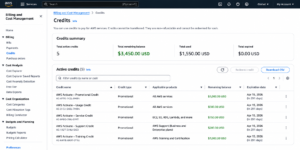
[SCREENSHOT: AWS Billing and Cost Management console Credits page showing a list of active promotional credits with their applicable products, remaining balance, and expiration date columns visible for an account enrolled in AWS Activate.]
Image alt text: AWS Billing and Cost Management console Credits page listing active promotional credits with applicable products, remaining balance, and expiration date for an AWS Activate enrolled account.
Also read: AWS Savings Plans vs Reserved Instances: Which Saves More in 2026
What the Fine Print Actually Restricts
Every AWS credit program runs on the same underlying Promotional Credit Terms and Conditions, and a few restrictions in there matter a lot more than the marketing pages let on.
Credits do not cover upfront commitment fees
This is the one that catches teams off guard the most. AWS’s own documentation states it plainly: credits cannot be applied to any upfront fee for Reserved Instances or Savings Plans. If you want to lock in a Partial Upfront or All Upfront Savings Plan, that upfront payment comes out of your card, not your credit balance. Credits can offset the ongoing hourly or monthly charges on a No Upfront or Partial Upfront commitment, but the upfront portion is always real money.
This shapes the entire decision around when to commit. If you are trying to preserve credit balance for as long as possible, a No Upfront Savings Plan lets the credits keep absorbing the hourly rate while you also lock in the commitment discount underneath, instead of choosing between the two.
Credits do not retroactively cover past bills
AWS Lift’s terms make this explicit, and it is true across other credit programs too: credits issued in a given month cannot be applied against bills from before that month. If your credit grant lands in May, your April invoice is unaffected no matter how much credit balance you are sitting on.
A specific list of services is excluded entirely
Across AWS Activate, AWS Lift, and the general Promotional Credit Terms, the same categories show up as ineligible: AWS Marketplace charges, with a specific carve-out for Bedrock third-party models under Activate, Professional Services, Training, Certification, Route 53 domain registration, and AWS Support beyond the standard tiers. If a meaningful share of your spend runs through one of these, your credits will not touch it.
They expire on a hard date, not a usage-based one
Activate sends expiration warnings at 60 days, 30 days, and on expiration itself, plus separate alerts at 75% and 100% exhausted. That is a genuinely useful safety net, but it is also a signal that AWS expects people to lose track of this by default. Nonprofit and research credits expire exactly one year from issuance or redemption, whichever happens first, with no extensions built into the standard terms.
The credit cliff in plain numbers: a startup running $8,000/month in on-demand EC2 spend that gets a $100,000 Activate Portfolio grant will burn through it in roughly 12-13 months at that run rate, faster if usage grows along the way, which it usually does. If nothing about the underlying architecture or commitment coverage changes in that window, month 13 brings the exact same $8,000+ bill, except now it is invoiced in full instead of absorbed by credit. The credits bought time. They did not buy efficiency.
%2019.svg)
The Right Way to Use Credit-Covered Time
Since credits cannot be applied to upfront commitment fees, and since they are explicitly designed to be a temporary runway extension rather than a permanent subsidy, the highest-leverage thing to do with credit-covered spend is to use that window to build the commitment coverage that will carry you once the credits are gone, not to defer that work until the balance hits zero.
Start commitment coverage while credits are still active
Because AWS Activate credits do apply to the ongoing hourly charges on No Upfront Savings Plans, you can layer a commitment discount on top of credit coverage from day one with no upfront cash outlay. The credits absorb the discounted hourly rate while it is running, and when the credits expire, the commitment discount is already in place and the bill jumps far less than it would from a pure on-demand baseline.
This is the opposite of how most teams instinctively behave with free money. The instinct is to run everything on-demand because credits are covering it anyway, and there is no perceived urgency to optimize a bill reading close to zero. That instinct is exactly what produces the painful cliff: zero commitment coverage built up by the time the safety net disappears.
Track real spend, not credit-adjusted spend
Your invoiced total and your actual infrastructure cost are two different numbers while credits are active, and only one of them tells you anything about sustainability. Pull your Cost and Usage Report and look at gross usage before credit offsets, not the net amount AWS is charging your card. That gross number is what you will be paying in full once the credit balance runs out, and it is the number that should drive every architecture and commitment decision you make during the credit window.
Reassess as funding stage and usage both shift
Activate Portfolio credits can be reapplied for at a higher tier if your funding stage advances and you have not hit the lifetime cap, but the new application has to request more than your previous award, and previously claimed amounts are netted out rather than stacked. Treat each funding milestone as a trigger to check whether you qualify for a higher tier, rather than assuming your original grant is the only one available to you.
Also read: AWS Cost Optimization: Practical Strategies for Engineering Teams
How Usage.ai Helps Once the Credits Are Running Out
Usage.ai does not manage credit applications, that part is genuinely worth doing directly through AWS Activate or your provider. Where Usage.ai comes in is the part the credit programs were never built to handle: making sure your commitment coverage is already in place before the credit balance hits zero.
The platform analyzes your actual usage, not your credit-adjusted invoice, and builds out Savings Plan and Reserved Instance coverage sized to your real, stable spend. Because Usage.ai’s Insured Flex Commitments come with a buyback guarantee, you can commit earlier and with more confidence than you would otherwise be comfortable doing on a startup budget. If your usage drops or your architecture changes before a commitment term ends, the unused portion comes back to you as cashback instead of sunk cost.
For a startup running on Activate credits, that means the commitment-building work that should happen during the credit window actually happens, without the team having to track expiration dates, recalculate baselines, or guess at the right commitment size manually.
$91M+ in savings delivered to 300+ customers across AWS, Azure, and GCP. Fee is a percentage of realized savings only. If Usage.ai does not save you money, you do not pay.
%2015%20(1).svg)
Frequently Asked Questions
How much can a startup get in free AWS credits?
Self-funded startups can get $1,000 through the AWS Activate Founders package with no investor affiliation required. Startups backed by a participating accelerator or VC can apply for the Activate Portfolio package, with AWS’s own pages currently showing caps as high as $200,000 depending on the specific page and provider. There is also a Generative AI tier offering additional credits for eligible AI startups. Confirm the exact current cap with your specific Activate Provider, since published figures vary across AWS’s own materials.
Can I use AWS credits to pay for a Reserved Instance or Savings Plan?
Partially. Credits can offset the ongoing hourly or monthly charges on a No Upfront or Partial Upfront commitment, but they cannot be applied to any upfront payment. If you choose an All Upfront Savings Plan or Reserved Instance, that entire upfront cost has to be paid with real money regardless of your credit balance.
Do AWS credits expire?
Yes, on a fixed schedule that does not depend on how much you have used. Activate credits typically run on a fixed expiration window with advance email warnings at 60 days, 30 days, and on expiration. Nonprofit and research program credits expire exactly one year from issuance or redemption, whichever comes first. Unused credit is simply forfeited at expiration with no extension under standard terms.
What happens to my AWS bill after my credits run out?
You are billed in full for whatever usage is not covered by an existing commitment discount. If all of your credit-covered spend was running on standard on-demand pricing, your invoice jumps from near-zero to your full gross usage cost the month the credits expire. Building Savings Plan or Reserved Instance coverage during the credit period, using credits to offset the no-upfront hourly charges, significantly softens that transition.
Can I apply for AWS Activate credits more than once?
Yes, if you still meet the program requirements and your new application requests a higher amount than you previously received, and you have not hit the lifetime credit cap. Previously claimed amounts are netted against the new award rather than stacked, so a startup with $10,000 already claimed that becomes eligible for $200,000 would receive the $190,000 difference, not the full $200,000 again.