.png)



This guide breaks down the key AWS April 2026 updates, including pricing and commitment changes, and explains what they mean for cloud cost planning and optimization.
Short answer
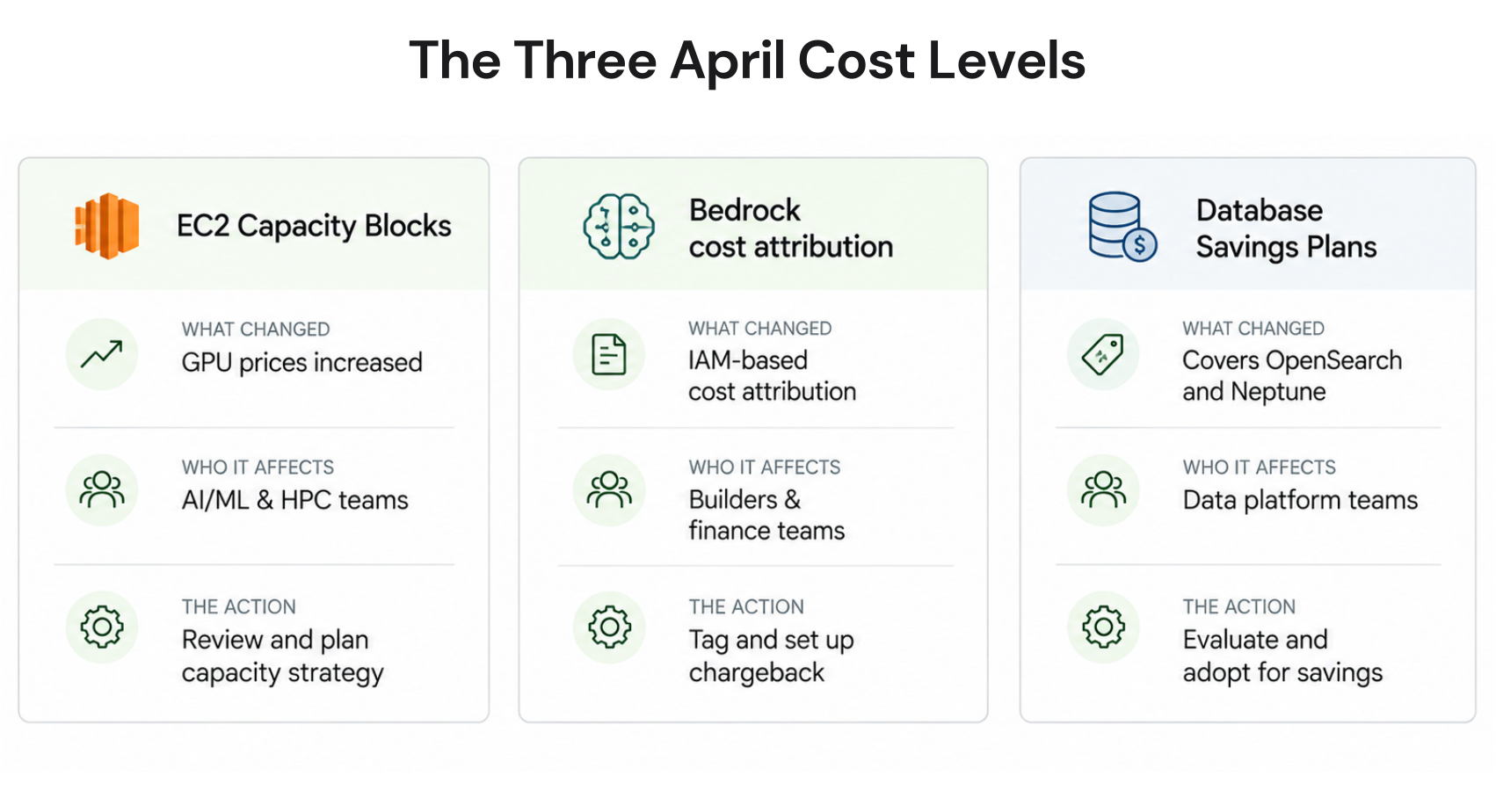
The April updates that matter most to FinOps teams are better Bedrock cost attribution, changing accelerator economics, broader Database Savings Plans coverage, and AWS’s growing AI portfolio.Enable IAM-principal attribution for Bedrock to improve chargeback. Check current Capacity Block rates before reserving GPU or Trainium capacity. Review existing Database Savings Plans to see whether OpenSearch and Neptune Analytics usage is already covered. Finally, treat new AI services and model upgrades as new cost baselines rather than assuming existing workloads will cost the same.
What changed at What’s Next 2026
On April 28, AWS used its What’s Next 2026 event to expand its focus from infrastructure toward application and agentic AI. According to AWS’s own top announcements from What’s Next 2026, several announcements stood out for organizations evaluating AI adoption and cloud costs.Amazon Quick, AWS’s AI assistant for work, expanded with a desktop app for macOS and Windows, Free and Plus plans, visual asset generation, and connectors for services including Google Workspace, Zoom, Airtable, Dropbox, and Microsoft Teams.
For FinOps teams, Quick introduces another AI spend category to evaluate alongside internally built Bedrock applications. Its Free and Plus plans do not require an AWS account, making it relevant to organizations managing AI usage outside traditional AWS infrastructure.
Amazon Connect also expanded into four agentic AI solutions: Connect Decisions for supply chain, Connect Talent for hiring, Connect Customer for customer experience, and Connect Health for healthcare. Organizations should evaluate pricing, availability, and expected usage against the specific workload before deployment.
AWS also expanded its OpenAI partnership. GPT-5.5, GPT-5.4, Codex, and Bedrock Managed Agents powered by OpenAI entered limited preview through Bedrock.
For FinOps teams, the broader implication is that AI consumption is becoming more distributed across managed services, assistants, agents, and foundation models. Cost governance therefore needs to extend beyond infrastructure utilization into model usage, application ownership, and business outcomes.
Claude Opus 4.7 lands on Bedrock
Claude Opus 4.7 became available in Amazon Bedrock on April 16, 2026, in select AWS Regions. AWS describes it as an upgrade from Claude Opus 4.6 with improvements across coding, professional work, long-running tasks, and visual capabilities.For FinOps teams, a model upgrade should trigger a new cost baseline. Compare:
Input and output token consumption
Cache usage
Reasoning or thinking-token consumption
Cost per successful task
Latency and throughput
Cost by application or team
AWS’s Claude Opus 4.7 announcement also notes that the model runs on Bedrock’s next-generation inference engine, which dynamically allocates capacity to requests.
Teams migrating from Opus 4.6 should therefore benchmark actual workload economics rather than comparing published token rates alone. AWS’s Claude Opus 4.7 model documentation also notes migration considerations such as the move to adaptive thinking.
For broader optimization strategies, see our LLM cost optimization on AWS guide.
EC2 Capacity Block prices reset
The EC2 Capacity Block increase is important to date correctly: the increase happened in January 2026, not April.AWS’s Capacity Block pricing is dynamic and depends on available supply and demand when the offering is purchased. The January 2026 increase affected selected Capacity Block offerings, including supported GPU and Trainium capacity.
For example, the January p5e.48xlarge reservation rate was about $39.80 per hour in most Regions and about $49.75 per hour in US West (N. California). These figures should be treated as historical reference points, not current quotes.
AWS’s EC2 Capacity Blocks pricing documentation explains that Capacity Block prices are dynamic and can vary based on supply and demand.
Before booking another Capacity Block:
Check the current rate for the target Region and instance.
Include the applicable operating system fee.
Compare the cost with On-Demand and other commitment options.
Confirm whether the workload actually needs guaranteed short-term capacity.
Recalculate the effective cost before approving the reservation.
For accelerator workloads, see our Trainium versus GPU training cost comparison.
Bedrock cost attribution goes live
One of April’s most important FinOps changes was granular cost attribution for Amazon Bedrock.According to AWS’s announcement introducing granular cost attribution for Amazon Bedrock, Bedrock can automatically attribute inference costs to the IAM principal that made the call.
An IAM principal can be an IAM user, an application-assumed role, or a federated identity. The resulting attribution flows into AWS billing data, including Cost and Usage Reports (CUR 2.0), while optional cost allocation tags can help aggregate spending by team, project, department, or cost center.
AWS’s IAM principal attribution documentation explains that identity-level attribution is captured automatically for Bedrock inference requests and can be analyzed through Cost Explorer and CUR 2.0.
This gives FinOps teams a clearer way to answer:
Which team is driving Bedrock spend?
Which application consumes the most AI resources?
How much does each project spend?
Which workloads need optimization?
To add organizational dimensions such as team or cost center, teams can tag their IAM principals and activate those tags as cost allocation tags.
For governance, see our guides to showback versus chargeback and AWS cost allocation tags.
Database Savings Plans add OpenSearch and Neptune
Database Savings Plans expanded on March 5, 2026, to include Amazon OpenSearch Service and Amazon Neptune Analytics.This was a March update rather than an April launch, but it belongs in an April FinOps review because it changes commitment coverage.
According to AWS’s announcement on Database Savings Plans support for OpenSearch Service and Neptune Analytics, eligible usage from these services can now receive Database Savings Plan benefits.
The important point for existing customers is that a new commitment is not necessarily required.
If an existing Database Savings Plan has unused commitment capacity, eligible OpenSearch and Neptune Analytics usage can consume that capacity. Additional commitment becomes relevant when eligible usage consistently exceeds the existing hourly commitment.
AWS’s Database Savings Plans pricing documentation provides the current supported services and discount details.
For the complete eligibility and discount details, see our AWS Database Savings Plans guide.
Other April updates worth scanning
Several infrastructure updates are also relevant to FinOps planning.AWS Interconnect reached general availability with managed private connectivity options for multicloud and last-mile connectivity.
EC2 C8in and C8ib instances also became generally available. AWS says these instances can deliver up to 43% higher performance than the previous C6in generation, with C8in scaling to 600 Gbps of network bandwidth and C8ib offering up to 300 Gbps of EBS bandwidth.
The AWS Weekly Roundup covering Claude Opus 4.7, AWS Interconnect GA, and other April announcements provides the broader list of infrastructure updates.
These are not direct pricing changes, but new infrastructure generations can change the cost-performance equation. Review workload performance and utilization before simply moving to a newer instance family.
What changed after April?
Two April developments subsequently moved forward.GPT-5.5, GPT-5.4, and Codex moved from limited preview to general availability on Amazon Bedrock on June 1, 2026. Their availability changed the production AI model landscape for teams already using Bedrock.
AWS’s announcement on the general availability of OpenAI models and Codex on Amazon Bedrock provides the current availability details.
For FinOps teams, general availability matters because production adoption can quickly turn an experimental AI workload into a material recurring cloud expense.
Claude Opus 4.7 also stopped being the newest Opus option as newer model availability followed later in 2026. For new workloads, evaluate the currently available Bedrock model and its workload-specific economics rather than treating the April launch as the latest model baseline.
Your AWS April 2026 FinOps checklist
Enable Bedrock attribution: Turn on IAM-principal allocation data in CUR 2.0 for accounts using Bedrock.
Build chargeback views: Use IAM principal and cost allocation tags to map AI spend to teams and projects.
Recheck Capacity Blocks: Pull current GPU and Trainium rates before booking.
Include all charges: Account for applicable operating system fees and other workload costs.
Review Database Savings Plans: Check whether existing commitments already cover OpenSearch and Neptune Analytics usage.
Turn AWS changes into lower commitment risk
AWS’s April updates were not just about new AI features. They changed how teams should measure AI spend, evaluate accelerator capacity, and use existing commitments.Bedrock’s IAM attribution makes AI chargeback more practical. Expanded Database Savings Plans coverage can improve commitment utilization. Dynamic Capacity Block pricing makes current-rate validation essential before reserving accelerator capacity.
Usage.ai helps teams identify AWS commitment opportunities based on actual usage patterns. With Flex Insured Commitments, teams can get the 57% savings of a 3-year commitment with none of the commitment risk.
If eligible usage drops and a qualifying EC2 Flex Commitment ends up costing more than the On-Demand rate for that usage, we provide cashback protection on that difference, subject to program terms.
Our fee is a percentage of realized savings only. If we don’t save you money, you don’t pay anything.
See where GPU, Bedrock, and database commitments cost you more.
Frequently asked questions
Did the EC2 Capacity Block increase happen in April?
No. The notable Capacity Block price increase occurred in January 2026, not April. Capacity Block prices are dynamic and can change based on supply and demand, so current rates may differ from historical January figures.
AWS's Capacity Blocks pricing documentation should be checked before making a new reservation.
Do OpenSearch and Neptune require a new Database Savings Plan?
Not necessarily. Existing Database Savings Plans can apply to eligible OpenSearch Service and Neptune Analytics usage up to the existing committed hourly amount. Additional commitment may be appropriate when eligible usage consistently exceeds the current commitment.
AWS's Database Savings Plans documentation provides the current eligibility and pricing details.
What does Bedrock IAM cost attribution provide?
It links Bedrock inference costs to the IAM principal making the API call and makes that information available through CUR 2.0 and Cost Explorer. Optional principal tags can further organize spending by team, department, project, or cost center.
AWS explains the capability in its IAM principal attribution documentation.
Are GPT-5.5 and GPT-5.4 available on Bedrock?
Yes. They entered limited preview at What's Next 2026 and later became generally available on Amazon Bedrock alongside Codex.
For production planning, check the current AWS Bedrock OpenAI model availability announcement and current Bedrock pricing before estimating workload costs.
Is Claude Opus 4.7 still the latest Opus model?
No. Opus 4.7 launched in April, but newer Opus availability followed later in 2026. For new workloads, evaluate the currently available Bedrock model, its regional availability, and its workload-specific cost.