
 AWS
AWS Microsoft Azure
 Google Cloud

Key takeaways
1
Deep Archive has the lowest S3 storage rate in this comparison, but retrieving a large dataset can outweigh months of storage savings. Estimate the portion you might restore, not just the volume you archive.
2
The 180-day minimum, per-object metadata, and lifecycle transition requests matter most for short-lived or small-object collections. A low per-GB rate alone does not make every bucket a good candidate.
3
Choose by recovery time as well as price. Flexible Retrieval offers free Bulk data retrieval, while Instant Retrieval serves objects immediately at a higher storage rate.
S3 Glacier Deep Archive makes long-term storage inexpensive, but the listed rate is only the starting point. Retrieval, object count, and retention determine the bill. This guide uses public US East (N. Virginia) rates to help you decide when Deep Archive fits.
Each archived object has 40 KB of billable metadata, and a 180-day minimum storage duration applies. Add restore-request charges, temporary restored-copy storage, and any applicable data transfer before treating a storage-only estimate as the total cost.
In the US East, Standard retrieval costs $0.02/GB and typically finishes within 12 hours; Bulk costs $0.0025/GB and typically finishes within 48 hours. There is no Expedited option, and large restores can take longer.
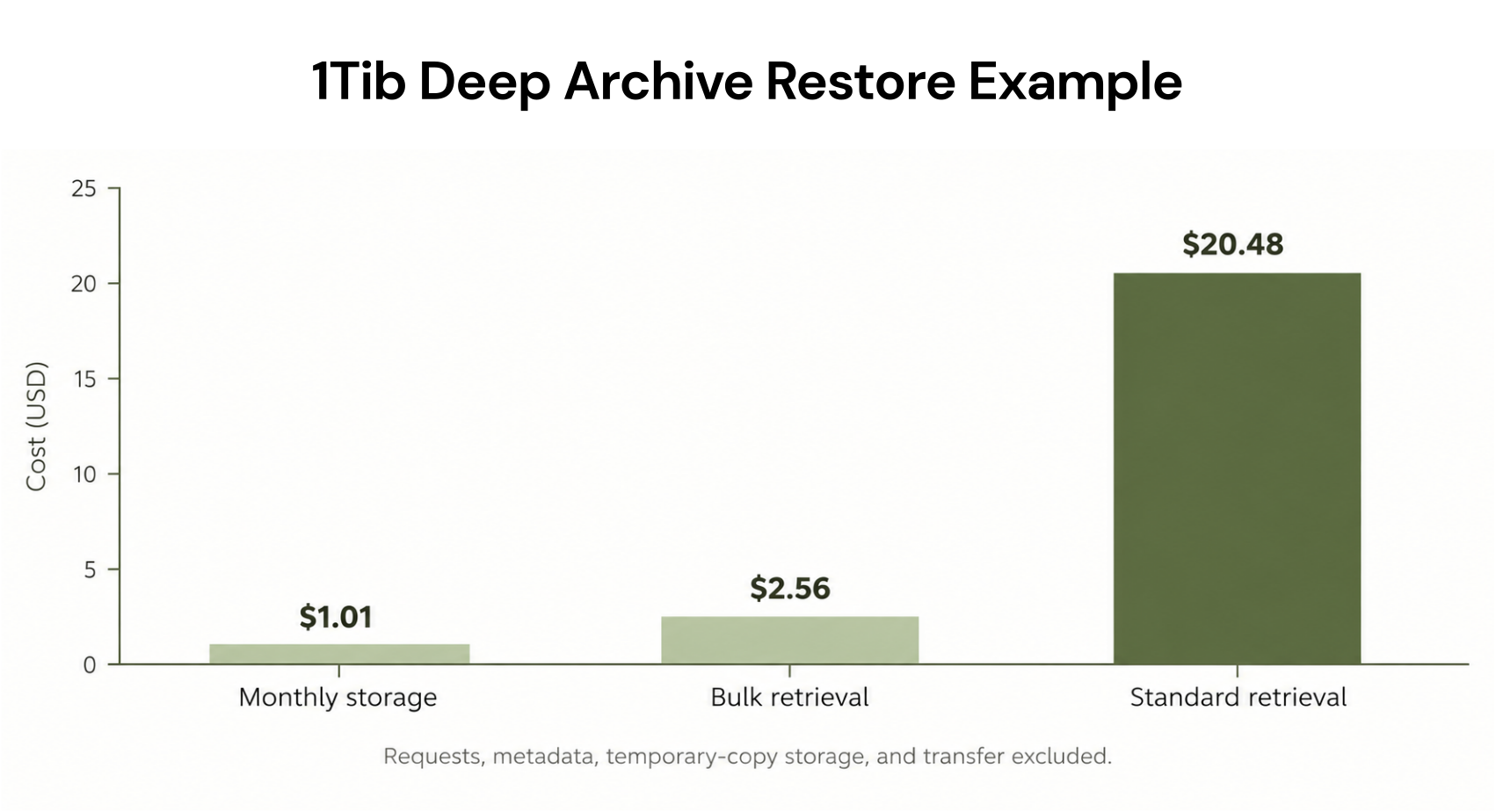
Restoring 1 TiB costs $20.48 with Standard or $2.56 with Bulk in per-GB retrieval fees. Bulk suits a planned restore; neither mode meets a minutes-long recovery deadline.
The Short Answer
S3 Glacier Deep Archive storage is $0.00099 per GB-month in US East (N. Virginia), or about $1 per 1,000 GB per month. Standard retrieval is $0.02/GB and typically completes within 12 hours; Bulk retrieval is $0.0025/GB and typically completes within 48 hours.Each archived object has 40 KB of billable metadata, and a 180-day minimum storage duration applies. Add restore-request charges, temporary restored-copy storage, and any applicable data transfer before treating a storage-only estimate as the total cost.
Deep Archive Storage and Retrieval Costs
At $0.00099/GB-month, 1,000 GB costs $0.99 per month before metadata and requests; 1 TiB (1,024 GB) costs about $1.01. Worked examples here use 1 TiB = 1,024 GB.In the US East, Standard retrieval costs $0.02/GB and typically finishes within 12 hours; Bulk costs $0.0025/GB and typically finishes within 48 hours. There is no Expedited option, and large restores can take longer.
Restoring 1 TiB costs $20.48 with Standard or $2.56 with Bulk in per-GB retrieval fees. Bulk suits a planned restore; neither mode meets a minutes-long recovery deadline.
Those figures cover retrieval data only. AWS separately prices restore requests. A restore also creates a temporary copy charged at S3 Standard rates for the days you choose, while the archive remains billed. GET requests and transfers may add costs.
The number of objects restored matters as much as their combined size. In the US East example, AWS lists Deep Archive Standard restore requests at $0.10 per 1,000 and Bulk requests at $0.025 per 1,000. One large file and thousands of tiny files can therefore have the same per-GB retrieval charge but different request totals. These request prices are separate from the $0.02/GB and $0.0025/GB data-retrieval rates.
The 180-day minimum applies if you delete, overwrite, or move an object out early. A file removed after 30 days still incurs the equivalent of another 150 days of Deep Archive storage charges. AWS explains the minimum-duration rule alongside its rates.
For a full bill estimate, including transfer and other S3 charges, see our S3 cost calculator guide.
Worked examples use 1 TiB = 1,024 GB. Check the AWS S3 pricing page for current rates and terms in your Region.
The number of objects restored matters as much as their combined size. In the US East example, AWS lists Deep Archive Standard restore requests at $0.10 per 1,000 and Bulk requests at $0.025 per 1,000. One large file and thousands of tiny files can therefore have the same per-GB retrieval charge but different request totals. These request prices are separate from the $0.02/GB and $0.0025/GB data-retrieval rates.
The 180-day minimum applies if you delete, overwrite, or move an object out early. A file removed after 30 days still incurs the equivalent of another 150 days of Deep Archive storage charges. AWS explains the minimum-duration rule alongside its rates.
For a full bill estimate, including transfer and other S3 charges, see our S3 cost calculator guide.
Deep Archive vs Other S3 Classes
Pricing scope: Table 1 and the worked examples use public US East (N. Virginia) rates checked on September 28, 2026. They exclude taxes, data transfer, requests, metadata, lifecycle transitions, and temporary restored-copy storage unless stated otherwise.Worked examples use 1 TiB = 1,024 GB. Check the AWS S3 pricing page for current rates and terms in your Region.
| Storage class | Storage/GB-month | Per-GB retrieval | Access time | Minimum duration |
|---|---|---|---|---|
| S3 Standard | $0.023 for the first 50 TB/month | None | Milliseconds | None |
| S3 Standard-IA | $0.0125 | $0.01/GB | Milliseconds | 30 days |
| S3 One Zone-IA | $0.01 | $0.01/GB | Milliseconds | 30 days |
| S3 Glacier Instant Retrieval | $0.004 | $0.03/GB | Milliseconds | 90 days |
| S3 Glacier Flexible Retrieval | $0.0036 | Bulk: free; Standard: $0.01/GB; Expedited: $0.03/GB | Typically 5–12 hours; 3–5 hours; 1–5 minutes, respectively | 90 days |
| S3 Glacier Deep Archive | $0.00099 | Bulk: $0.0025/GB; Standard: $0.02/GB | Typically within 48 hours; within 12 hours, respectively | 180 days |
How to read the table: Standard-IA, One Zone-IA, and Glacier Instant Retrieval bill smaller objects as 128 KB. Flexible Retrieval and Deep Archive add 40 KB of metadata per object. One Zone-IA stores data in one Availability Zone; review AWS’s class comparison before choosing it on price alone.
The table covers relevant cold-data alternatives rather than every S3 class. Intelligent-Tiering is discussed below because its rate depends on the access tier.
Do not multiply S3 Standard’s first-tier rate across a very large archive without checking its volume tiers. The 1 TiB comparison below stays within that first tier; a larger S3 Standard baseline can have a lower marginal rate. For any class, the table shows the storage and per-GB retrieval price, not an all-in cost per object or a guaranteed monthly bill.
For 1 TiB, the storage difference is $22.54 monthly. One full Standard retrieval costs $20.48, leaving $2.06 in first-month savings before other charges. Over five years, the difference would be $1,331.81 after one such retrieval, assuming constant volume, unchanged rates, and the first-tier Standard rate throughout.
Monthly full restores nearly erase the storage-rate advantage; restoring only 10% once a year is different because retrieval is charged on the portion restored. Use actual restore history where available.
For a working estimate, record four inputs: average GB stored each month, the number and average size of objects, GB expected to be restored, and how long each restored copy must remain available.
Then add the likely retrieval mode and the number of restore requests. The calculation should reflect an actual retention policy and recovery deadline: the cheapest retrieval mode is not useful if it misses the deadline.
Also model how many days the temporary copy remains available and any internet or cross-Region transfer using AWS’s transfer rates.
There is no one-number break-even for Flexible Retrieval against Standard-IA based on retrieval fees: both charge $0.01/GB for the compared reads. Storage duration, requests, temporary-copy costs, and acceptable delay decide the result.
For 10 million objects of 5 KB each stored in Deep Archive, whether uploaded directly or transitioned under a rule configured to allow small objects, about 47.7 GB of data costs $0.05 monthly. Using 1 GB = 1,024 × 1,024 KB, metadata adds $2.06: about $1.75 at Standard rates and $0.30 at Deep Archive rates. Unrounded, that is 44 times the data storage cost, before requests.
At $0.05 per 1,000 lifecycle transitions, moving 100 million objects into Deep Archive costs $5,000 in transition requests. Check the AWS request table for your Region and destination class.
Since September 2024, the default for new or modified S3 Lifecycle configurations prevents transitions of objects under 128 KB. Older configurations can retain the previous behavior, which permitted their transition to Flexible Retrieval and Deep Archive.
An object-size filter can override the default; model requests and metadata first. Before editing an older configuration, check whether it transitions to small objects and test the revised rules with nonproduction data; an edit can change that behavior unless you explicitly preserve or override it.
Grouping small files can lower per-object costs, but may complicate retrieval of individual records.
The table covers relevant cold-data alternatives rather than every S3 class. Intelligent-Tiering is discussed below because its rate depends on the access tier.
Do not multiply S3 Standard’s first-tier rate across a very large archive without checking its volume tiers. The 1 TiB comparison below stays within that first tier; a larger S3 Standard baseline can have a lower marginal rate. For any class, the table shows the storage and per-GB retrieval price, not an all-in cost per object or a guaranteed monthly bill.
When Does Deep Archive Stop Saving?
Start with the volume you expect to restore. Moving a GB from S3 Standard’s first tier to Deep Archive saves $0.02201 per month in storage. One full Standard retrieval costs $0.02/GB, nearly a month’s storage difference; Bulk costs $0.0025/GB.For 1 TiB, the storage difference is $22.54 monthly. One full Standard retrieval costs $20.48, leaving $2.06 in first-month savings before other charges. Over five years, the difference would be $1,331.81 after one such retrieval, assuming constant volume, unchanged rates, and the first-tier Standard rate throughout.
Monthly full restores nearly erase the storage-rate advantage; restoring only 10% once a year is different because retrieval is charged on the portion restored. Use actual restore history where available.
For a working estimate, record four inputs: average GB stored each month, the number and average size of objects, GB expected to be restored, and how long each restored copy must remain available.
Then add the likely retrieval mode and the number of restore requests. The calculation should reflect an actual retention policy and recovery deadline: the cheapest retrieval mode is not useful if it misses the deadline.
Also model how many days the temporary copy remains available and any internet or cross-Region transfer using AWS’s transfer rates.
There is no one-number break-even for Flexible Retrieval against Standard-IA based on retrieval fees: both charge $0.01/GB for the compared reads. Storage duration, requests, temporary-copy costs, and acceptable delay decide the result.
Check Small Objects and Transition Costs
Each object in Deep Archive or Flexible Retrieval adds 8 KB of metadata at S3 Standard rates and 32 KB at its archive rate. With millions of tiny files, overhead can dominate data storage. AWS documents the split.For 10 million objects of 5 KB each stored in Deep Archive, whether uploaded directly or transitioned under a rule configured to allow small objects, about 47.7 GB of data costs $0.05 monthly. Using 1 GB = 1,024 × 1,024 KB, metadata adds $2.06: about $1.75 at Standard rates and $0.30 at Deep Archive rates. Unrounded, that is 44 times the data storage cost, before requests.
At $0.05 per 1,000 lifecycle transitions, moving 100 million objects into Deep Archive costs $5,000 in transition requests. Check the AWS request table for your Region and destination class.
Since September 2024, the default for new or modified S3 Lifecycle configurations prevents transitions of objects under 128 KB. Older configurations can retain the previous behavior, which permitted their transition to Flexible Retrieval and Deep Archive.
An object-size filter can override the default; model requests and metadata first. Before editing an older configuration, check whether it transitions to small objects and test the revised rules with nonproduction data; an edit can change that behavior unless you explicitly preserve or override it.
Grouping small files can lower per-object costs, but may complicate retrieval of individual records.
Choose Deep Archive or Another S3 Class
Deep Archive fits records kept for months or years that are rarely restored and can wait for Standard or Bulk retrieval. AWS lists compliance records and long-term backups among its use cases; seven-year retention is an example, not a requirement. AWS’s Glacier guide explains the fit.| If you need | Consider | Check before deciding |
|---|---|---|
| Lowest long-term storage rate; recovery can wait | Glacier Deep Archive | 180-day minimum, restore volume, requests, and temporary-copy storage |
| Planned restores within hours | Glacier Flexible Retrieval | 90-day minimum; Bulk data retrieval is free, but restored-copy storage still applies |
| Immediate access to rarely used data | Glacier Instant Retrieval | Higher per-GB retrieval price and 90-day minimum |
| Immediate access with shorter retention | S3 Standard-IA or Standard | Retrieval charge and 30-day minimum for Standard-IA; Standard has neither |
| Uncertain access pattern | S3 Intelligent-Tiering | Monitoring cost, object size, and whether optional archive tiers are enabled |
Flexible Retrieval is a closer fit when recovery time is the constraint. Bulk data retrieval is free and typically takes 5–12 hours; Standard takes 3–5 hours. Expedited is typically 1–5 minutes for smaller objects, but predictable availability may require provisioned capacity. All three require a restore.
Instant Retrieval serves data in milliseconds without a restore job. Its storage is 68% cheaper than Standard-IA at these rates, but retrieval costs $0.02/GB more. For full-dataset reads, that storage difference is offset at roughly one read every 10 weeks, before requests, retention effects, or partial reads. It suits rare, time-sensitive access.
Intelligent-Tiering helps when access is unpredictable. Its three immediate-access tiers auto-tier eligible objects; Archive Access and Deep Archive Access are optional and require restoration. Standard and Bulk retrieval has no per-GB fee, but monitoring and archive metadata can apply. Objects under 128 KB remain in Frequent Access without a monitoring charge.
The optional Deep Archive Access tier can reach Deep Archive-class storage pricing after its inactivity threshold. Its advantage is automatic tier management without Deep Archive’s minimum storage duration; the trade-off includes monitoring charges for eligible objects and the time spent in warmer tiers before archival.
It still does not give immediate access once an object is in the asynchronous archive tier. Compare the object’s likely path through those tiers with placing it directly in the Deep Archive.
Choose using your restore deadline, likely volume, retention, and object count, then test a realistic scenario in your Region.
For the broader AWS bill, we analyze commitment-eligible usage at the billing layer, separately from S3. Once you approve a recommendation, we call the provider API to purchase it; the Flex Insured Commitment remains visible beside existing commitments. Customer-owned commitments are not automatically protected.
With Flex Insured Commitments, teams can get up to 57% savings associated with a three-year AWS commitment with none of the commitment risk.
If a Flex Commitment becomes more expensive than equivalent On-Demand usage, we provide cashback protection to help cover the difference, subject to current program terms.
Our fee is an agreed percentage of realized savings, billed monthly in arrears after provider billing data is finalized. If we do not generate savings through the program, there is no savings-based fee.
Instant Retrieval serves data in milliseconds without a restore job. Its storage is 68% cheaper than Standard-IA at these rates, but retrieval costs $0.02/GB more. For full-dataset reads, that storage difference is offset at roughly one read every 10 weeks, before requests, retention effects, or partial reads. It suits rare, time-sensitive access.
Intelligent-Tiering helps when access is unpredictable. Its three immediate-access tiers auto-tier eligible objects; Archive Access and Deep Archive Access are optional and require restoration. Standard and Bulk retrieval has no per-GB fee, but monitoring and archive metadata can apply. Objects under 128 KB remain in Frequent Access without a monitoring charge.
The optional Deep Archive Access tier can reach Deep Archive-class storage pricing after its inactivity threshold. Its advantage is automatic tier management without Deep Archive’s minimum storage duration; the trade-off includes monitoring charges for eligible objects and the time spent in warmer tiers before archival.
It still does not give immediate access once an object is in the asynchronous archive tier. Compare the object’s likely path through those tiers with placing it directly in the Deep Archive.
Choose using your restore deadline, likely volume, retention, and object count, then test a realistic scenario in your Region.
How Usage.ai Manages AWS Commitments Beyond S3
Choosing Deep Archive changes your S3 storage and retrieval costs. The commitments we manage are a separate opportunity on eligible AWS usage.For the broader AWS bill, we analyze commitment-eligible usage at the billing layer, separately from S3. Once you approve a recommendation, we call the provider API to purchase it; the Flex Insured Commitment remains visible beside existing commitments. Customer-owned commitments are not automatically protected.
With Flex Insured Commitments, teams can get up to 57% savings associated with a three-year AWS commitment with none of the commitment risk.
If a Flex Commitment becomes more expensive than equivalent On-Demand usage, we provide cashback protection to help cover the difference, subject to current program terms.
Our fee is an agreed percentage of realized savings, billed monthly in arrears after provider billing data is finalized. If we do not generate savings through the program, there is no savings-based fee.
AWS COST REVIEW
Make sense of your full AWS bill
Review your S3 cost drivers and separately assess where eligible commitments could lower other AWS spend.
S3 cost drivers
Next steps
Frequently asked questions
Is Deep Archive about $1 per TB per month?
At the public US East rate, 1,000 GB costs $0.99 monthly; 1 TiB costs $1.01 before other charges.
Is retrieval free?
No. Bulk costs $0.0025/GB and Standard $0.02/GB in US East, plus applicable request, copy-storage, and transfer charges.
Can I delete an object early?
Yes, but deleting, overwriting, or transitioning it out before 180 days triggers a charge for the remaining minimum duration.
Is a restore immediate?
No. Standard typically finishes within 12 hours and Bulk within 48 hours; large restores may take longer.
Share
Facebook
X
LinkedIn
Reddit