 AWS
 Microsoft Azure
 Google Cloud



A dashboard might show $200,000 in savings. But is that an estimate or a realized financial result? Does it include discounts you already had? Are platform fees included? What happens if committed usage falls?
For FinOps, Finance, procurement, engineering, and cloud leaders evaluating optimization software, those distinctions are crucial than the biggest savings percentage on a dashboard.
So, can you reproduce the savings number from your underlying cloud billing data and explain what the software actually contributed?
If not, you may have a useful optimization metric. You do not yet have a defensible software ROI calculation.
The five tests of a credible cloud savings claim
Before getting into the formulas, a credible software savings number should pass five tests.Comparable
Use a realistic baseline for what the same cloud usage would have cost without the optimization.
Incremental
Count only the savings created by the new platform, not discounts or commitments you already had.
Realized
Base ROI on savings that actually occurred, not just projected or recommended savings.
Fully loaded
Include platform fees, implementation costs, operating effort, and commitment underutilization where relevant.
Reproducible
FinOps or Finance should be able to trace the savings back to cloud-provider billing data and understand how the number was calculated.
Net savings and ROI are not the same thing
A practical starting point is:ROI measures the net benefit relative to the cost of the investment:
ROI = $135,000 ÷ $40,000 × 100 = 337.5%
For more on the underlying measurement layer, see our cloud cost analysis guide.
1. Start with a comparable baseline
Once you know whether you are measuring net savings or ROI, the next question is what you are measuring those savings against.A useful baseline asks:
For rate optimization, a better baseline is often the economic cost of the same eligible consumption without the new commitment strategy.
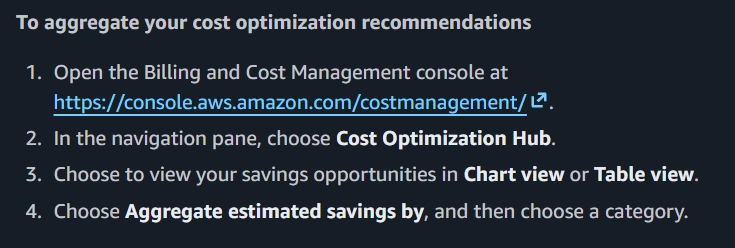
AWS makes this distinction explicit in its Cost Optimization Hub savings estimation settings. Buyers can view savings before discounts, using public On-Demand pricing, or after discounts, incorporating pricing benefits such as Reserved Instances and Savings Plans.
AWS also describes estimated monthly savings as an approximation of future savings, noting that actual realized savings depend on future usage patterns.
2. Separate existing savings from incremental savings
Once the baseline is clear, the next step is to isolate what the new optimization actually added.Consider an environment with these economics:
Public list-price equivalent: $1,000,000
Cost after negotiated pricing: $850,000
Effective cost with existing commitments: $760,000
Effective cost after the new optimization: $700,000
But a new optimization platform did not necessarily create all $300,000.
If the organization was already operating at an effective cost of $760,000, the incremental improvement from the new intervention is closer to:
The practical lesson is: Do not use public list price as the software’s savings baseline if your company was never going to pay public list price.
For more context on where commitments fit within a broader optimization strategy, see our complete cloud cost optimization guide.
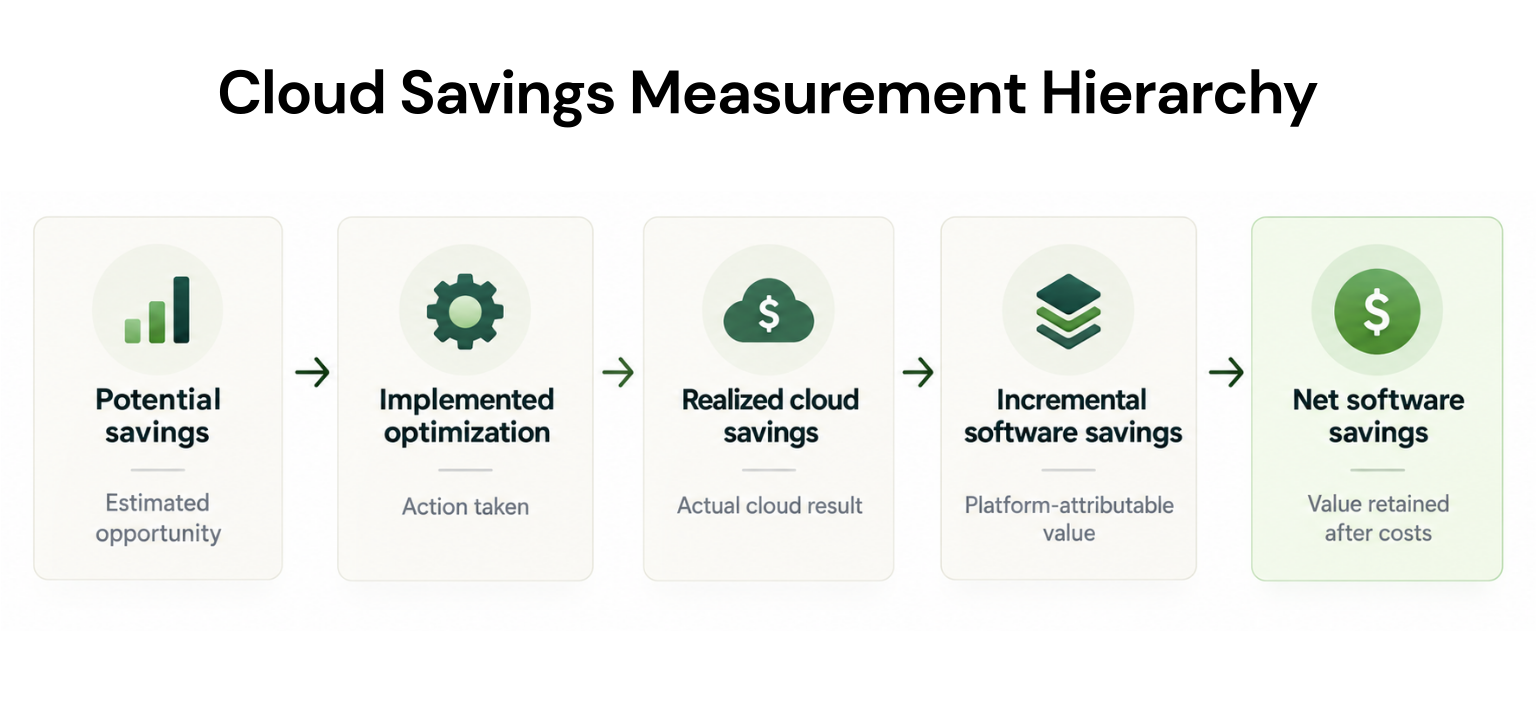
3. Use realized outcomes, not recommendation values
Once you have isolated the platform’s incremental contribution, the next question is whether those savings were actually realized.An optimization recommendation is an opportunity. It is not yet money saved.
AWS describes Cost Optimization Hub estimated monthly savings as an approximation of future savings, with actual results depending on future usage.
Google Cloud also separates realized savings from potential savings, making the distinction between savings already achieved and opportunities that still depend on future action and usage.
That creates a useful measurement hierarchy:
4. Measure the full economics
Once savings are realized, the next step is to account for what it actually costs to produce them.Account for commitment underutilization
A high nominal discount does not always translate into strong realized savings.Microsoft’s Azure Savings Plan savings methodology accounts for unused Savings Plan value, while amortized cost reporting helps surface unused commitment charges.
Commitment underutilization should appear once in the economics. If your effective or amortized cloud cost already includes unused commitment value, do not subtract it again.
Look beyond the headline platform fee
Percentage pricing can be misleading if you do not know what the percentage applies to.For example:
- Vendor A: 2% of $20 million in managed cloud spend = $400,000
- Vendor B: 15% of $1 million in incremental realized savings = $150,000
Buyers should ask: What is the fee, and what is it calculated against?
Usage.ai uses performance-based pricing tied to realized savings generated through the Flex Insured Commitment Program rather than estimated recommendation value. You can review the methodology in our pricing documentation.
Include meaningful operating costs
Software fees are only part of the economics.Depending on the platform, savings may also require engineering analysis, FinOps administration, professional services, testing, migration work, approval workflows, or manual commitment management.
You do not need to price every hour of internal effort. Include the costs that are large enough to affect the buying decision.
Two platforms can generate similar savings while creating very different operational burdens.
5. Stress-test what happens when usage changes
Commitment economics should not be evaluated only against the expected forecast.Usage can fall after a migration, application retirement, rightsizing effort, architecture change, business slowdown, or shift between services.
Suppose a strategy performs well at forecasted demand, but usage falls 25% six months later.
Then the important questions are:
How much of the commitment can still be used?
Who absorbs the cost of underutilization?
Can the commitment be modified, exchanged, rebalanced, or otherwise protected?
Does any contractual recovery mechanism apply?
For long-lived commitments, compare both expected savings and downside exposure.
6. Make the savings number reproducible
A credible savings number should be traceable from the optimization action to the final financial result.Ideally, FinOps or Finance should be able to follow this path:
A third-party platform may use a different methodology, but the final number should still be clear enough for FinOps and Finance to understand and reproduce.
A worked net-savings example
- Suppose an organization’s comparable pre-platform cloud cost is: $1,000,000
- After optimization, the comparable effective cloud cost is: $825,000
Realized cloud savings
Platform fee: $25,000
Implementation and services: $8,000
Material internal effort: $7,000
Applicable recovery not already reflected in cloud cost: +$5,000
Net software savings
- Gross attributable realized savings: $175,000
- Net software savings: $140,000
- Net savings rate: 14% of the comparable $1 million baseline
The biggest gross savings number may not produce the best economics
Consider two platforms evaluated against the same comparable baseline:| Platform A | Platform B | |
|---|---|---|
| Comparable baseline | $1,000,000 | $1,000,000 |
| Realized cloud savings | $200,000 | $180,000 |
| Software and implementation cost | $60,000 | $25,000 |
| Separate applicable recovery | $0 | $5,000 |
| Net software savings | $140,000 | $160,000 |
Where ESR and ICR fit
Net savings and ROI tell you how much value the organization ultimately retained.But for commitment-based optimization, buyers may also want to understand how efficiently the commitments themselves performed. That is where Effective Savings Rate, or ESR, fits.
The FOCUS specification defines ESR using Contracted Cost and Effective Cost. It helps measure the savings efficiency of commitment discounts, but it does not include every cost that may affect software ROI.
Usage.ai also uses a supplemental metric called Insured Commitment Rate, or ICR, when eligible cashback recovery is part of the commitment economics.
The practical distinction is:
- Use ESR to understand commitment savings efficiency.
- Use net savings and ROI to understand overall economic value.
- Use ICR as an additional view when eligible cashback recovery is part of the model.
A cloud optimization ROI checklist for buyers
Before accepting a vendor’s savings number, ask:| Question | What a strong answer should show |
|---|---|
| What baseline do you use? | A realistic baseline that reflects comparable usage, existing discounts, and current commitments |
| Are these savings potential or realized? | A clear separation between projected opportunity and actual financial results |
| Do you take credit for savings we already had? | Existing discounts and commitments are excluded from newly attributed value |
| How do you handle changes in usage? | Growth, decline, migrations, architecture changes, and seasonality are reflected in the methodology |
| How do you prevent double counting? | Overlapping recommendations and commitment benefits are reconciled before savings are reported |
| How is underutilization reflected? | Unused commitment cost appears once, and its treatment is clearly documented |
| What is the fee calculated against? | The pricing denominator is explicit, whether it is managed spend, realized savings, or another basis |
| What does the savings number exclude? | Fees, services, implementation costs, and other material exclusions are clearly disclosed |
| What happens if usage falls or we leave? | Remaining obligations, downside exposure, exit terms, and applicable protections are clear |
| Can we reproduce the number? | The result can be traced back to provider billing data and a documented methodology |
How we apply this framework at Usage.ai
At Usage.ai, we focus on commitment optimization across AWS, Azure, and Google Cloud.Under our Flex Insured Commitment Program, eligible commitments are purchased through your cloud-provider API and managed by Usage.ai. Our pricing is tied to realized savings generated through the program, while eligible Flex Commitments can receive cashback protection under applicable terms.
Before changing your purchasing process, you can run a read-only Usage.ai Savings Test to evaluate your existing commitment position and potential opportunity.
In production, you can keep commitment decisions behind approval workflows or automate them through Autopilot, depending on how you want to govern purchasing.
Our reporting separates Total Savings, Usage Fee, and Cashback Accrued, so you can see the components behind the economics rather than relying on one headline savings percentage.
You can review the Flex Commitment Program documentation and Flex Commitment eligibility requirements.
We believe the same standard should apply to us as to any platform:
Run the Usage.ai Savings Test to see where your current commitment economics stand.
Run My Savings Test
Connect in 15 minutes to compare current commitment coverage, risk, and potential savings before choosing a platform.
Frequently asked questions
What is a good ROI for cloud cost optimization software?
There is no universal benchmark. A good ROI depends on your cloud spend, existing discounts, platform fees, implementation effort, and how much incremental savings the software actually creates.
Should cloud optimization ROI use projected or realized savings?
Realized savings are more useful for ROI because they reflect actual financial outcomes. Projected savings are better treated as opportunity estimates.
How do you calculate net cloud savings?
Start with incremental realized savings, subtract platform and operating costs, and add any applicable recoveries that are not already reflected in cloud cost.
Do unused Savings Plans or Reserved Instances reduce ROI?
Yes. Underutilized commitments can reduce realized savings. The key is to make sure unused commitment cost is reflected once in the calculation, not double counted.
What should buyers ask a cloud optimization vendor about savings?
Ask how the baseline is set, whether savings are realized or projected, what the vendor takes credit for, how fees are calculated, how underutilization is treated, and whether the result can be traced back to provider billing data.