
Effective Savings Rate (ESR) vs Insured Commitment Rate (ICR): The Savings Metric That Does Not Go Negative

Updated May 7, 2026
17 min read
On this page
Key Takeaways

  • Effective Savings Rate (ESR) is the standard FinOps metric for measuring cloud commitment ROI. It combines coverage, utilization, and discount rate into one number. The problem is, it ignores your exit cost exposure, and it does not account for whether underutilized commitments are protected. Half of all AWS organizations use zero cloud commitments and achieve an ESR of 0%.
  • Insured Commitment Rate (ICR) is a new metric introduced by Usage.ai that extends ESR by adding cashback recovery on underutilized commitments to the numerator. ICR cannot go negative when cashback fully covers underutilized commitment costs. It floors your real savings performance, even when usage shifts.
  • The practical difference is a company with a -9% ESR has a positive ICR if cashback protection is active. The gap between them is real money returned to your budget.

Effective Savings Rate (ESR) is the cloud savings metric everyone tracks. It can also go negative, expose you to 12 months of future fees when you cancel, and tell you nothing about whether your commitments are actually protected. Here is the metric that fixes all three problems.

What Is Effective Savings Rate (ESR) and Why Did the FinOps World Adopt It?

Effective Savings Rate was introduced by ProsperOps in 2019 by co-founder and CPO Erik Carlin. The logic behind it was clear and important. Before ESR, FinOps teams tracked coverage (what percentage of resources carry a discount instrument) and utilization (what percentage of purchased commitments are being consumed). Both are useful input metrics. Neither tells you the actual ROI on your commitment portfolio.

ESR solved that by collapsing all three relevant dimensions, coverage, utilization, and discount rate, into one output number. The FinOps Foundation adopted it as a standard KPI under the Rate Optimization capability, and AWS embedded it natively in the Cost and Usage Dashboard’s Summary Billing tab.

Standard Definition: Effective Savings Rate (ESR)

ESR = Cloud Savings Generated / On-Demand Equivalent Spend. It measures the aggregate discount off the on-demand rate across all eligible cloud resources, accounting simultaneously for coverage, utilization, and the discount rate of each commitment instrument deployed.

Source: FinOps Foundation. Playbook authored with contribution from ProsperOps.

ESR Formula

ESR =  Cloud Savings Generated

On-Demand Equivalent (ODE) Spend

ODE Spend = what you would have paid with zero discounts applied.

Verify current on-demand rates at aws.amazon.com/pricing , rates change frequently.

Where the industry actually sits on ESR

ProsperOps published a 2024 benchmarking report analyzing $1.5B+ in annualized AWS compute spend across hundreds of organizations. All data was collected from prospect accounts before they began using ProsperOps, making it a reasonably unbiased look at how the market actually performs.

Percentile Monthly Compute ESR What it means in practice
98th 46% World-class. Requires sophisticated automation and portfolio management.
75th 23% Above average. Most large enterprises with active FinOps land here.
50th (median) 0% Half of all organizations have no commitments in place. ESR is 0%, not negative.
25th 0% No commitments in use at all.
Minimum observed -9% Overcommitment made cloud more expensive than on-demand.

 Source: ProsperOps 2024 AWS Compute ESR Benchmarking Report.


That bottom row is worth noting. ESR can go negative, and has been recorded in real enterprise AWS accounts at -9%. This is the minimum observed across the dataset, not a typical outcome. It represents the worst-case scenario when aggressive overcommitment meets a sharp usage drop.

AWS compute Effective Savings Rate ESR percentile benchmarks: median 0 percent, 75th percentile 23 percent, world-class 46 percent, minimum negative 9 percent — ProsperOps 2024 data

When usage drops and commitments stay in place, the cost of stranded commitment hours exceeds the discount benefit. ESR records the damage precisely and helpfully. But it offers no information about whether any recovery mechanism exists. Also see, Usage.ai vs ProsperOps: Which Tool Saves More?

What ESR Cannot Measure: The Three Blind Spots

ESR unifies coverage, utilization, and discount rate into one number and does that job well. But it has three blind spots that matter enormously to any FinOps team running a dynamic cloud environment.

Blind spot 1: Downside risk has no floor

ESR has no mathematical lower bound. A company can be at 40% ESR in Q1 and -9% in Q2 when a major workload is deprecated and usage drops. The metric shows the performance change accurately but does not distinguish between a company with zero protection and one with full cashback coverage. Two companies at -9% ESR can have fundamentally different financial outcomes depending on whether any cashback mechanism exists.

Blind spot 2: Exit cost exposure is invisible

ESR measures the savings you achieve while the tool is running. It does not measure the financial obligation you incur by using a platform that owns long-term commitments on your behalf. As the next section shows, this is a material contract risk with at least one major competitor in this space, and ESR will never surface it.

Blind spot 3: The type of recovery matters

When commitments go underutilized, some platforms compensate with credits locked to specific cloud vendor spend. Others pay real money. ESR treats both identically because it only measures what you saved, not what you recovered or how flexible that recovery is. A dollar of cashback spendable anywhere is worth more than a dollar of credits locked to AWS compute, but ESR cannot express that difference.

What ESR Does Not Show You: Five Questions to Ask Any Vendor

ESR measures your savings rate while a commitment management tool is running. It does not measure the financial obligations that may exist outside the savings calculation. Before signing with any commitment automation platform, ask these five questions directly.


  1. What do I owe if I cancel before commitments expire? Some platforms that own commitments on your behalf may include termination clauses that create fee obligations on future unrealized savings. Ask for the specific termination terms in writing before you sign.


  1. Who holds the commitment risk when utilization drops? If the platform purchases commitments on your behalf, clarify whether underutilization is your exposure or theirs, and whether compensation is paid in real money or vendor-locked credits.


  1. Is recovery paid in real money or platform credits? These are not equivalent. Credits locked to a specific cloud vendor cannot be used anywhere else. Real-money cashback can. ESR treats both identically. Your finance team should not.


  1. What is the fee model when savings drop to zero? A platform that charges a percentage of realized savings only aligns its incentives with yours. One that charges a flat fee or retainer does not.


  1. Is the platform independent or part of a larger enterprise software company? Product roadmap, FinOps focus, and support quality can all shift after an acquisition. It is a reasonable question for any long-term vendor relationship.


Usage.ai’s answers to all five: cancel anytime with a buyback guarantee, zero future fee liability on termination, real-money cashback on underutilized commitments, zero fee if nothing is saved, and an independent FinOps-native platform. Verify the specifics of any vendor’s terms directly before signing.

What Is Insured Commitment Rate (ICR)?

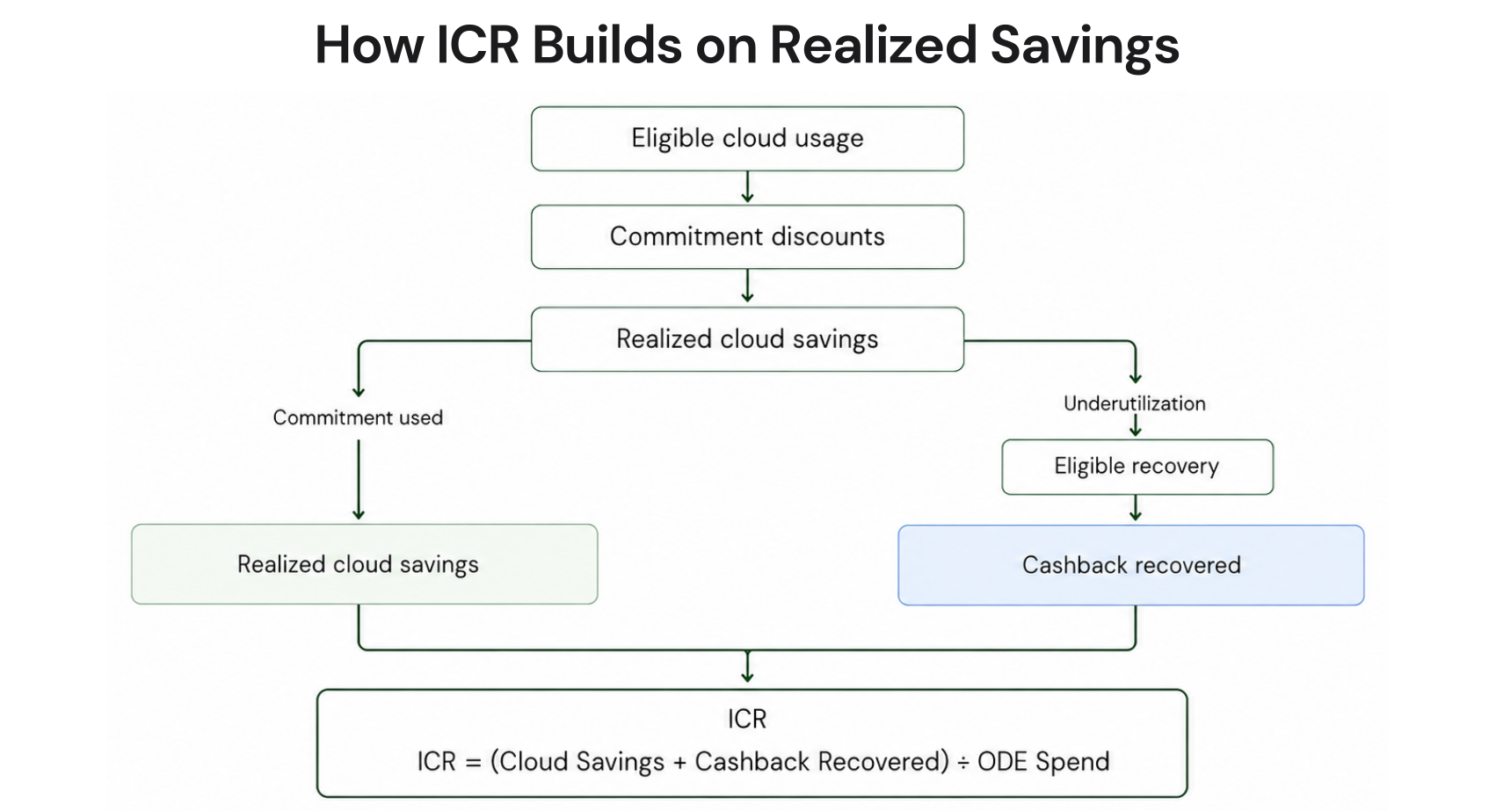
Insured Commitment Rate (ICR) is a cloud FinOps metric that measures your actual, risk-protected savings rate from cloud commitments, accounting for both the discounts you earned and the cashback you recovered when commitments went underutilized.

Unlike Effective Savings Rate (ESR), ICR cannot go negative when cashback fully covers underutilized commitment costs. In practice this means ICR floors at or near zero in scenarios where ESR would go negative, because the cashback offsets the loss rather than letting it compound.


The math is simple.

ICR Formula: Introduced by Usage.ai

ICR = Cloud Savings + Cashback Recovered

On-Demand Equivalent (ODE) Spend

Cashback Recovered = real-money cashback paid by Usage.ai on underutilized commitments. Not credits or vendor-locked. Spendable anywhere.

  • ICR equals ESR when every commitment is fully utilized because Cashback Recovered equals zero.
  • ICR exceeds ESR whenever any underutilization occurs and cashback is applied.
  • ICR cannot fall below ESR because the cashback term is additive, never subtractive.

ICR is always greater than or equal to ESR

This property makes ICR the savings floor. While ESR is your performance under ideal conditions, ICR is your performance under all conditions, including the conditions that make ESR go negative.

For organizations with stable, growing usage, the gap between ICR and ESR may be small because underutilization is rare. But, for organizations with cyclical workloads, seasonal traffic, or frequent architectural changes, the gap can be substantial. And that gap is real money returned to the cloud budget rather than absorbed as a loss.

Worked Example: What Happens When Usage Drops 25% Mid-Quarter

Worked example comparing ESR at 17 percent versus ICR at 22 percent after Usage.ai issues 42 thousand dollars cashback on underutilized AWS commitments following a 25 percent usage drop

Consider a company spending $1M per month in AWS compute at on-demand rates. In Q1, they purchased Savings Plans through Usage.ai covering 70% of their compute at a 40% discount. Mid-Q2, an engineering team shuts down a major service and usage falls 25%.

What ESR shows after the drop:

Value
Actual spend with discounts $680K
On-demand equivalent (ODE) spend $820K
ESR 17%

ESR dropped from 28% in Q1 to 17% in Q2. That’s an 11 percentage point collapse overnight. The commitments are still charging for compute that are no longer running. ESR records the damage accurately, but shows nothing about whether any of that loss is recoverable.

What ICR shows with cashback protection:

Usage.ai issues cashback on the underutilized commitment hours. The derivation: 25% usage drop on the covered 70% of compute means approximately 25% of those commitment hours go unused. 25% x $700K covered ODE x 40% discount rate x 60% approximate commitment cost factor = approximately $42K in cashback on stranded hours. Usage.ai issues $42K in cashback.

Value
Cloud savings generated $140K
Cashback recovered $42K
Total numerator $182K
ODE spend $820K
ICR 22%

That 5 percentage point gap between ICR (22%) and ESR (17%) is $41K returned to the budget every month in real money. Annualized, that is $492K in recovered savings that ESR never captures.


Note: Numbers above are illustrative. Based on $1M/month ODE spend, 70% coverage, 40% discount rate, 25% usage drop scenario. Cashback figure is illustrative. Verify actual cashback terms and calculations with Usage.ai directly.

ESR vs ICR: Complete Side-by-Side Comparison

Dimension Effective Savings Rate (ESR) Insured Commitment Rate (ICR)
What it measures Discount ROI from commitments vs. on-demand Risk-adjusted net savings including cashback recovery
Formula Savings / ODE Spend (Savings + Cashback Recovered) / ODE Spend
Can go negative? Yes; Observed at -9% in real-world data No; Cashback absorbs the downside
Measures commitment risk No; Shows damage, not protection Yes; Cashback in the numerator
Captures exit cost exposure No; Exit fees and future obligations invisible Yes; Cancel-anytime model, no future fee liability
Multi-cloud applicability Partial; AWS-native focus in benchmarks Full; AWS, Azure, GCP covered
Cashback vs. credits Does not distinguish Requires real-money cashback. Not credits. Spendable anywhere.
Dynamic/cyclical workloads Penalized; ESR collapses on usage drops Protected; Cashback stabilizes the rate
Fee model alignment Depends on the platform being used Usage.ai: % of realized savings only. Zero fee if nothing saved.
Introduced by ProsperOps, Usage.ai

The Four Components of ICR vs. the Three Components of ESR

ESR as defined by the FinOps Foundation unifies three input dimensions: coverage, utilization, and discount rate. Together they produce a single ROI output. This is a genuine improvement on tracking any one of them in isolation.

ICR extends the model with a fourth component that ESR structurally cannot include.

  1. Coverage: What percentage of eligible compute is covered by a discount instrument. Used identically in both ESR and ICR.
  2. Utilization: What percentage of purchased commitments are actively consumed. Used in both metrics, but ICR’s cashback mechanism compensates for low utilization rather than simply recording it as a drag on performance.
  3. Discount Rate: The percentage off on-demand price delivered by each commitment instrument. Used identically in both metrics.
  4. Protection Rate (ICR-exclusive): The percentage of underutilized commitment cost recovered through cashback. Formula: Protection Rate = Cashback Recovered / Stranded Commitment Cost, where Stranded Commitment Cost = (1 minus Utilization Rate) x Total Commitment Spend. A 100% Protection Rate means every dollar of stranded commitment cost is returned as cashback. This is the dimension ESR cannot capture. A high Protection Rate transforms a negative utilization event from a sunk cost into a partial or full recovery. It is only calculable when the platform managing your commitments offers real-money cashback on underutilization, which is what Usage.ai’s insured commitment product provides.

How Usage.ai Makes ICR a Calculable Metric

ICR requires a specific mechanism to exist: real-money cashback on underutilized commitments. Without that mechanism, the Cashback Recovered term equals zero and ICR collapses to ESR. The metric is only useful when the protection is real.

Usage.ai is a unique cloud cost optimization platform providing both cashback and credits on underutilized commitments across AWS, GCP, and Azure. This is not a credit program or a vendor-locked rebate. The cashback is real money.

The three mechanisms that make ICR calculable through Usage.ai:

Usage.ai owns the commitments

Usage.ai purchases commitments on behalf of customers, and not with customer capital. The customer receives the savings discount. This is the structural position that enables cashback to be paid when utilization drops, because Usage.ai holds the commitment risk, not the customer.

Cashback on underutilization in real money

When a commitment goes underutilized, Usage.ai issues a cashback payment. This is the Cashback Recovered term in the ICR formula. This is the mechanism that makes ICR exceed ESR in any scenario where utilization drops below 100%. Other cloud cost optimization platforms offer credits and they are locked to specific vendor spend. Cashback from Usage.ai’s fee model is real money.

Cancel-anytime with zero future liability

Usage.ai’s terms include a buyback guarantee and no future fee exposure on termination. Contrast with the ProsperOps Service Terms reviewed above, where termination before a Discount Instrument’s end date triggers up to 12 months of future savings share fees. That fee exposure is not visible in ESR. ICR accounts for it implicitly through Usage.ai’s fee structure.

How Usage.ai insured commitments work: Usage.ai purchases the commitment, if usage drops and commitments go underutilized, Usage.ai issues real-money cashback to the customer

Motive recovered $5.2M annually. EVGo (NASDAQ: EVGO) saved $2.3M. Secureframe saved $480K and reinvested it into growth. Across 300+ enterprise customers, Usage.ai has delivered $91M+ in verified savings, all without customers owning a single commitment.

When to Track ESR vs. When to Track ICR

Track ESR when

  •     You want to benchmark against industry peers using published data
  •     Usage is stable and growing predictably
  •     You are evaluating a FinOps tool’s raw discount performance
  •     You are presenting to a FinOps audience familiar with the FinOps Foundation framework
  •     You manage commitments manually or with AWS-native tools

Track ICR when

  •     Workloads are dynamic, cyclical, or seasonal
  •     Coverage exceeds 70% and future usage is uncertain
  •     Managing commitments across AWS, Azure, and GCP simultaneously
  •     Finance team needs a savings metric that cannot floor at negative
  •     You want to report true net savings, not just gross discount performance
  •     You use Usage.ai and have cashback protection on every commitment

The two metrics are complementary and not mutually exclusive. Track ESR to benchmark against peers because ProsperOps has produced the only published large-scale ESR dataset available (2024 report, $1.5B+ in annualized compute spend). Track ICR to report actual savings performance to finance teams, because ICR is the number that accounts for what actually landed in the budget, including cashback recovery and the absence of exit cost liability.

Scale down? No penalty. Scale up? We adjust. You get savings without betting the company.

Get a Complimentary Savings Test

Five Questions to Ask Any Commitment Management Vendor Before Signing

ESR will not surface the answers to these questions. Read the contract terms or ask them directly.

1. What do I owe if I cancel before commitment terms end?

  • Some platforms: termination before commitment term expiry may trigger fee obligations on unrealized future savings. Ask for termination terms in writing before signing.
  • Usage.ai: cancel anytime, buyback guaranteed, zero future fee liability.

2. Who holds the risk when a commitment goes underutilized?

  • ProsperOps: manages risk via automation; underutilization reduces your ESR.
  • Usage.ai: holds the commitment and issues real-money cashback on underutilization, which is the mechanism that produces ICR greater than ESR.

3. Is recovery paid in real money or platform credits?

This is the distinction ESR completely ignores. Real-money cashback is worth more than credits locked to specific cloud vendor spend. Ask this question explicitly.

4. What is the fee model if my savings drop to zero?

Usage.ai: zero fee if nothing is saved. The fee is a percentage of realized savings only. Verify the specifics of any vendor’s fee model in their published pricing or service terms.

5. Is the vendor an independent FinOps-native platform or part of a larger enterprise software company?

Usage.ai is independent and FinOps-native. Neither fact is visible in ESR. Both are relevant to long-term vendor evaluation.

Bottom Line

ESR tells you what you earned. ICR tells you what you kept. That distinction only matters when something changes; and in the cloud, something always changes. Usage drops. Services get deprecated. Teams restructure. The commitment you purchased last quarter does not know any of that.

A savings metric that can go negative tells you how far you fell. ICR tells you how much of that fall was cushioned. That is not the same number, and the difference is real money.

ESR is still the right benchmark for comparing your performance against the industry. Use it. Track it. But the next time your CFO asks what your cloud savings are actually worth under pressure, ESR will not have that answer. Insured Commitment Rate (ICR) will. And now you know how to calculate it.


Set up Usage AI in 30 minutes. Save from day one.No infrastructure changes. No lock-in. If Usage.ai doesn’t save you money, you pay nothing.FIND MY SAVINGS


Frequently Asked Questions

1. What is Insured Commitment Rate (ICR)?

Insured Commitment Rate (ICR) is a cloud FinOps metric that measures your actual, risk-protected savings rate from cloud commitments. It accounts for both the discounts you earned and the cashback you recovered when commitments went underutilized. Unlike ESR, ICR cannot go negative. Formula: ICR = (Cloud Savings Generated + Cashback Recovered on Underutilization) / On-Demand Equivalent Spend.


2. What is the difference between ESR and ICR?

ESR measures your discount ROI from cloud commitments. ICR extends ESR by adding real-money cashback recovered on underutilized commitments to the numerator. The key difference is ESR can go negative when usage drops and commitments go underutilized. ICR cannot, because the cashback offsets the loss. Both use the same denominator, so they are directly comparable.


3. Can Effective Savings Rate go negative?

Yes. ESR goes negative when underutilized commitments cost more than the discount they deliver. ProsperOps’ 2024 benchmarking data recorded a minimum ESR of -9% across hundreds of real AWS organizations. This happens when usage drops but Savings Plans or Reserved Instances keep charging. ICR prevents this outcome because cashback offsets the underutilization cost.


4. Does ProsperOps charge fees when you cancel before commitment terms end?

It depends entirely on the platform. Some commitment automation platforms include termination clauses that create fee obligations on unrealized future savings if you exit before commitment terms expire. Always ask for the specific termination terms in writing before signing. Usage.ai offers cancel-anytime terms with a buyback guarantee and zero future fee liability on termination.


5. Who introduced the Insured Commitment Rate (ICR) metric?

Insured Commitment Rate (ICR) was introduced by Usage.ai. Usage.ai is a unique cloud cost optimization platform providing real-money cashback on underutilized commitments across AWS, GCP, and Azure, which is the mechanism that makes ICR calculable. ESR, by comparison, was introduced by ProsperOps and is now a FinOps Foundation standard.


6. How does cashback insurance work for cloud commitments?

Cashback insurance means that when a cloud commitment goes underutilized, the platform pays real money back to the customer and not vendor credits locked to specific cloud spend. Usage.ai holds the commitment on the customer’s behalf and issues cashback when utilization drops. This is what makes ICR calculable and prevents a savings rate from going negative.


7. Is ESR or ICR better for benchmarking cloud savings?

Use ESR for external benchmarking. ProsperOps’ 2024 report, based on $1.5B+ in AWS compute spend, puts the industry median ESR at 0% and world-class at 46%. Use ICR for internal reporting. ICR shows the savings floor your organization can count on after accounting for cashback protection, and not just the rate achieved under ideal conditions.

Cut cloud cost with automation
Latest from our blogs