.png)
 AWS
AWS Microsoft Azure
 Google Cloud


We put this guide together to make that evaluation easier. It walks through how Archera pricing works, the costs buyers should consider, and the terms worth reviewing before signing.
It also draws on Archera’s published pricing and terms and independent customer feedback to give you a balanced view of the pricing model.
The goal isn’t to tell you whether Archera is right or wrong for your business. It’s to give you a clear picture of what Archera costs, what its Insured Commitment premium covers, and what to look at when comparing it with alternatives. You can then decide whether the model makes sense for your cloud environment.
How does Archera pricing work?
Archera’s pricing model starts with a free commitment-management platform. Customers can plan, purchase, and manage native commitments across AWS, Azure, and Google Cloud without a platform fee or percentage-of-cloud-spend charge. See Archera pricing.Customers can then choose Archera’s optional Insured Commitments. These are designed to provide commitment savings with additional flexibility and protection against eligible underutilization. Eligible Insured Commitments can have terms as short as 30 days. See Archera Insured Commitments.
| Archera offering | Pricing approach |
|---|---|
| Core platform | Free |
| Native commitment management | Free |
| Insured Commitments | Premium based on savings |
| Additional services | May carry separate charges under applicable terms |
What Does an Archera Insured Commitment Cost?
Archera’s current pricing page states that Insured Commitment premiums range from 2% to 30% of savings, depending on the commitment term, with the applicable premium shown before purchase. Archera’s pricing page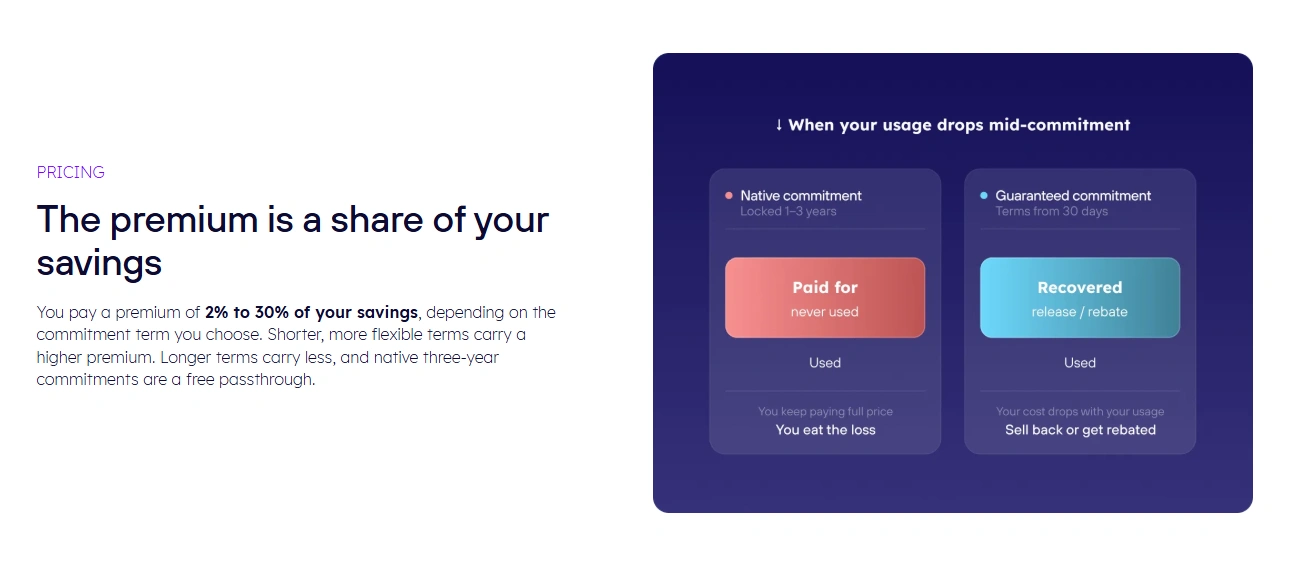
There is one point buyers should clarify, however. Archera’s pricing page shows the 2%–30% range in its main pricing section, while a separate pricing graphic on the same page displays 50% / 25% / 0% of savings by term. The page does not explain how these figures relate to one another.
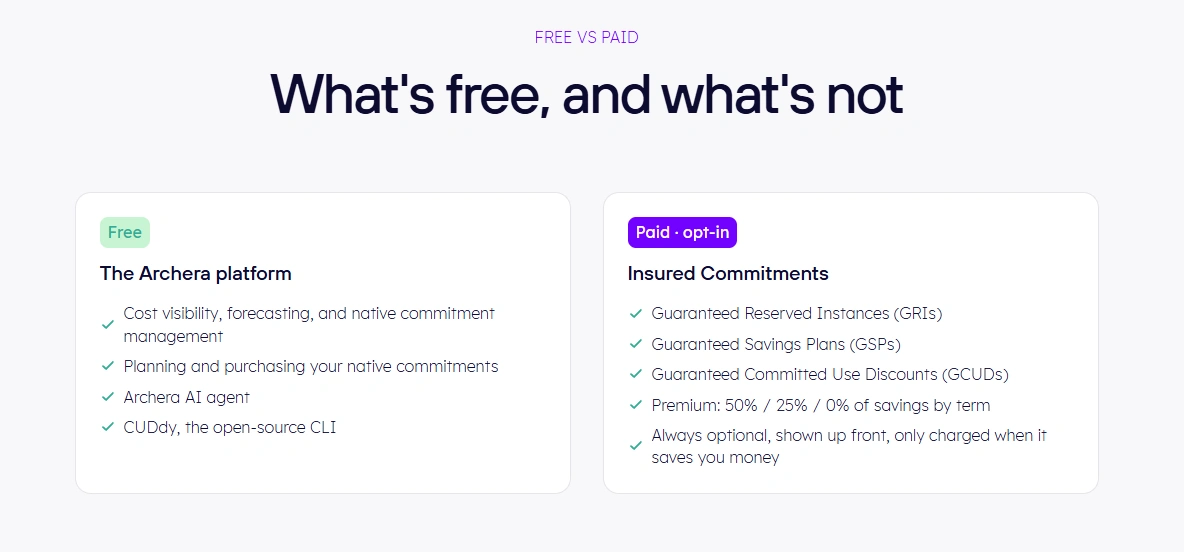
Before purchasing, ask Archera to confirm the exact premium for your commitment, how it is calculated, and whether the quoted savings figure is gross or net of that premium.
What are Archera’s hidden costs?
Most of the costs aren’t hidden in the traditional sense. They come from the Insured Commitment premium and the terms that govern your agreement, rather than from a separate fee for using Archera’s core platform.Insured Commitment premium
The main cost is the premium attached to an Insured Commitment. It is calculated as a percentage of the savings generated by the commitment, with the applicable premium shown before purchase.Because this premium reduces the savings you keep, it should be included when comparing Archera with a native commitment or another optimization provider.
Renewal and other contractual charges
Archera’s SaaS terms allow fees to be changed or new charges to be introduced at the end of an initial or renewal service term, provided the customer receives the required notice.The agreement also makes customers responsible for applicable taxes and allows a 1.5% monthly finance charge on overdue invoiced amounts, subject to the limits in the agreement.

What happens if you want to exit?
This is more relevant to a FinOps or procurement buyer.Archera’s terms distinguish between releasing an eligible Guaranteed Commitment and terminating the broader services agreement. Certain customer-initiated terminations can leave outstanding fees calculated under the applicable GRI Premium Calculation. See Archera SaaS Terms
The Release Guarantee is a separate mechanism. Its eligible Guaranteed Commitments can be released under its guarantee terms, so buyers shouldn’t treat the commitment’s release provisions as the same thing as a general contract cancellation right. See Archera Insured Commitments.
Archera doesn’t appear to have a simple list of “hidden fees.” The bigger issue is understanding the Insured Commitment premium, renewal provisions, and what happens if you need to exit before comparing the total cost with alternatives.
What does an Archera premium mean for your actual savings?
The easiest way to understand Archera’s economics is to separate gross savings from net savings.Suppose an Insured Commitment generates:
The simplified calculation is: Gross savings − premium = net savings
The premium therefore needs to be evaluated against what it buys you.
A conventional cloud commitment can provide a discount but may expose the customer to underutilization if usage changes. Archera’s Insured Commitments are designed to exchange part of that potential savings for additional flexibility and protection under the applicable guarantee terms.
So instead of asking: “Is a 20% premium expensive?” ask:“After the premium, is my risk-adjusted net saving better than the native commitment alternative?”
That’s the more useful FinOps calculation.
What do customers say about Archera?
Customer feedback on Archera is generally positive, particularly around savings, support, commitment management, and visibility.G2 currently lists Archera at 4.6/5 from 35 reviews, with reviewers highlighting the platform’s ease of setup, forecasting capabilities, and support experience. Some reviews also mention a learning curve or areas of the interface that could be easier to navigate. See Archera reviews on G2.
For buyers evaluating Archera pricing, the reviews provide useful context: customers generally focus on the value of the savings and the overall platform experience, rather than describing pricing as a major source of friction.
That aligns with Archera’s published pricing model. The core platform is free, while customers choosing Insured Commitments pay a premium tied to the savings generated.
How Does Archera Pricing Compare With Alternatives?
Cloud commitment platforms don’t all charge for the same thing.Archera keeps its core commitment-management platform free and charges a premium for optional Insured Commitments, while other alternatives may charge a percentage of realized savings for ongoing commitment optimization.
| If your priority is... | Model to investigate |
|---|---|
| Free commitment management with optional commitment protection | Archera |
| Autonomous commitment optimization | ProsperOps |
| Broader cloud infrastructure optimization | Zesty |
| Commitment optimization with Insured Flex Commitments | Usage.ai |
| Direct control over commitments | Native cloud-provider tools |
Archera vs Usage.ai
Archera and Usage.ai address a similar problem: cloud commitments can lower costs, but committing too much can create exposure when usage changes.As already mentioned, Archera combines a free commitment-management platform with optional Insured Commitments.
Usage.ai takes a different commercial approach. Our Flex Insured Commitments are designed to provide commitment-level savings without requiring customers to take on a conventional multi-year commitment.
We charge a percentage of the savings you actually realize, billed monthly in arrears. If an eligible Flex Commitment is underutilized, we provide cashback to help protect you from that unused commitment cost.
Learn more about What Is an Insured Cloud Commitment?
| Archera | Usage.ai | |
|---|---|---|
| Core model | Free commitment-management platform | Commitment optimization |
| Optional commitment product | Insured Commitments | Insured Flex Commitments |
| Risk approach | Rebate and Release Guarantees for eligible commitments | Cashback protection for eligible commitments |
| Fee basis | Premium on Insured Commitments | Percentage of realized savings |
| Underutilization | Rebate under applicable guarantee terms | Cashback under applicable Flex Commitment terms |
| Primary pricing question | Is the premium worth the protection and flexibility? | How much savings remain after the realized-savings fee and applicable protection terms? |
How to evaluate Archera’s true cost before buying
Before purchasing an Insured Commitment, ask Archera for:Gross savings before the premium
Exact premium for each proposed commitment
Net savings after the premium
Eligible services and workloads
Rebate and Release Guarantee conditions
What happens if utilization falls
Termination and outstanding-fee economics
Any additional charges under your commercial agreement
Renewal pricing and terms
Bring your current commitment inventory, 12 months of normalized billing data, and one realistic downside scenario. Usage.ai can model commitment coverage, net savings, cashback protection, and exit economics against your alternatives.
Talk to an Expert
Connect in 15 minutes. No contracts, no infrastructure changes. See your savings before committing.
Frequently asked questions
Is Archera really free?
Yes. Archera’s core platform for planning, purchasing, and managing native cloud commitments has no platform fee. Optional Insured Commitments carry a separate premium.
How much does Archera charge?
Archera's current pricing page states that Insured Commitment premiums range from 2% to 30% of savings, depending on the commitment term. The applicable premium should be confirmed before purchase.
Does Archera charge a percentage of cloud spend?
Not for its core platform. Archera says it does not charge a percentage of total cloud spend; its optional Insured Commitments use a premium based on savings.
Are Archera Insured Commitments worth the premium?
It depends on your usage stability and the value you place on flexibility and protection. Compare the premium against the additional net savings and downside risk you would retain with a native commitment.
Is Usage.ai an alternative to Archera?
Yes. Usage.ai offers commitment optimization through Insured Flex Commitments, with fees based on realized savings and cashback protection for eligible underutilization.
If you notice any material information that is incorrect, outdated, or no longer applicable, please contact us at [email protected]. We’ll review the information and update the article where appropriate.