 AWS
AWS Microsoft Azure
 Google Cloud
This review examines current customer feedback, how the automation works, what it requires inside a running cluster, public pricing evidence, and where the platform fits against native and specialist alternatives.
Our assessment: CAST AI is credible for teams wanting continuous Kubernetes optimization.
CAST AI at a Glance
| Our assessment | |
|---|---|
| Best for | Platform, SRE, DevOps, and FinOps teams operating material Kubernetes estates |
| Primary value | Automated workload and infrastructure optimization |
| Environments | EKS, GKE, and AKS through standard integrations; OCI and other Kubernetes environments through CAST AI Anywhere |
| Automation | Strong, with separate workload and node automation paths |
| Pricing | Custom quotes; some public AWS Marketplace dimensions |
| Customer sentiment | Strongly positive, with important pricing and control concerns |
| Main strengths | Rightsizing, node provisioning, bin-packing, Spot automation, reduced manual effort |
| Main questions | Net value, permissions, explainability, workload behavior, and environment compatibility |
| 2026 verdict | Worth considering for sufficiently large and automation-ready Kubernetes environments |
This review centers on Kubernetes monitoring and optimization, where documentation and independent customer evidence are clearest.
What CAST AI Customers Say
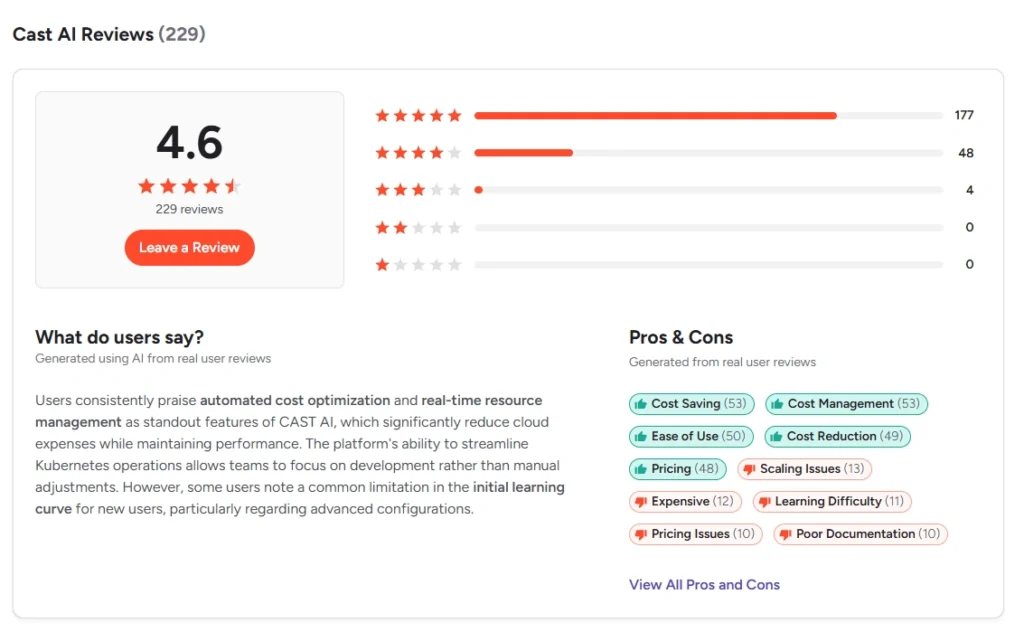
Public sentiment is positive, but the review totals require careful interpretation. As of September 2026, G2 listed CAST AI at 4.6/5 from more than 200 reviews.AWS Marketplace displayed 4.6/5 from 204 ratings, but only nine were native AWS reviews; 195 came from G2. These are not two independent pools.
What Customers Consistently Praise
The recurring positives are:Kubernetes compute savings through automated rightsizing and node selection;
less manual capacity planning and cluster maintenance;
easier onboarding than building an internal optimization stack;
Spot Instance automation and on-demand fallback;
useful initial visibility into overprovisioning; and
responsive implementation and customer support.
What Buyers Should Scrutinize
Criticism concentrates around small-cluster pricing, reporting, customization, documentation, and advanced-policy complexity. Some reviewers also want clearer explanations and better forecasting before changes are applied.Once automation is active, buyers must be able to understand, govern, and troubleshoot production changes.
How Strong Is the Evidence?
PeerSpot shows 4.3/5 from eight reviews. Several request deeper reporting and policy customization, while the sample includes multiple reviewers from the same organizations.The customer evidence is also more visible for AWS than for other clouds. That does not prove weaker GCP or Azure functionality. It means buyers should request references that match their provider, cluster type, and workload profile.
How CAST AI Produces Savings
CAST AI connects workload and infrastructure decisions. Rightsizing a pod creates little financial value unless the node layer can remove the freed capacity.Read-Only Versus Active Automation
Teams can begin with the CAST AI read-only agent, which collects cluster state for cost monitoring and savings analysis without executing infrastructure changes.Its cost monitoring breaks spend down by cluster, namespace, workload, and allocation group, with organization and storage views. Network-cost monitoring is also available, but it requires the separate Kvisor component rather than the read-only agent alone.
This is useful Kubernetes-level visibility, but buyers needing deeper forecasting or enterprise FinOps reporting should validate the fit.
Active optimization installs additional components. Depending on the selected mode, these can adjust workload resources, evict or migrate eligible workloads, provision nodes, and remove underutilized capacity.
The distinction is important: a read-only savings estimate is not the same as realized savings after automation.
Workload and Node Optimization
The Workload Autoscaler changes CPU and memory requests using observed utilization. Its configuration supports minimums, maximums, look-back periods, optimization thresholds, and startup handling.CAST AI can use Kubernetes in-place resizing when version and workload requirements are met. Otherwise, the configured application mode may require pod recreation.
At the infrastructure layer, CAST AI selects instance types, provisions capacity, improves workload placement, and removes unnecessary nodes. Its Evictor consolidates pods through bin-packing.
On compatible clusters, eligible workloads can use Container Live Migration. CAST AI documents full support on EKS and partial support on GKE and AKS, subject to Kubernetes, node, runtime, and networking requirements.
If migration fails, the outcome may be eviction, restoration, or remaining on the source node, depending on workload type and protections.
Spot, Commitments, and Karpenter
CAST AI can provision and manage Spot capacity, predict interruption risk, rebalance affected nodes, and use temporary on-demand fallback when Spot capacity is unavailable. This reduces manual Spot management, but application resilience, replicas, disruption budgets, and fallback policies still matter.The platform can also import supported commitments: AWS Reserved Instances and Savings Plans, Azure Reserved Instances and Savings Plans, and GCP resource-based and flexible CUDs. The node autoscaler can then consider existing discounts.
This is commitment-aware provisioning, not a complete substitute for commitment procurement, downside protection, or enterprise rate management.
For Karpenter environments, CAST AI works with Karpenter’s CRDs and provisioning logic through its Karpenter Enterprise components rather than simply replacing Karpenter’s core functionality.
CAST AI’s Operational Trade-Offs
The same automation that makes CAST AI valuable creates its most important evaluation questions.Permissions and Autoscaler Ownership
CAST AI’s standard node automation must be the sole node autoscaler. Running it beside another node autoscaler can create conflicting and unpredictable scaling behavior.Full automation requires more than billing access. CAST AI deploys in-cluster components and needs permissions to change workload or node state. Its read-only, workload-autoscaler, node-autoscaler, and full modes allow phased adoption.
CAST AI states that it holds ISO 27001 certification and a SOC 2 Type II attestation and encrypts data in transit and at rest. It also states that it does not access Kubernetes Secrets or ConfigMaps.
Buyers should still review RBAC, cloud permissions, data location, retention, and component updates.
Compatibility and Feature Differences
Standard node automation is incompatible with GKE Autopilot, EKS Auto Mode, EKS Fargate, and AKS Automatic because the provider controls node provisioning. They can use CAST AI Anywhere for workload optimization and monitoring, but not the same node-management path.CAST AI Anywhere also does not provide every capability available through the directly supported major-cloud integrations. “Supports Kubernetes anywhere” should therefore not be interpreted as universal feature parity.
Workload Suitability and Disruption
Buyers should test startup-heavy services, stateful applications, strict PodDisruptionBudgets, specialized hardware, tight scheduling constraints, and traffic that rises faster than replicas or nodes can start.Resource boundaries, protected workloads, fallback capacity, replicas, and staged rollout are part of implementation. CAST AI reduces operational work; it does not remove the need for safe operating constraints.
What Does CAST AI Cost?
Public Rates Versus Custom Quotes
CAST AI’s current pricing page requests a custom quote. Its AWS Marketplace listing provides more detail for EKS buyers:free monitoring and cost-reduction insights;
a $200-per-month Cost Monitoring dimension;
Growth options starting at $1,000 per month;
an Enterprise dimension at $5,000 per month; and
additional managed CPU usage listed at $0.00694444 per CPU-hour.
Marketplace dimensions are not universal quotes. Product, managed CPU, cluster count, GPU requirements, contract duration, and negotiated terms affect the total.
Calculate Net Value
The useful calculation is:Ask CAST AI to separate savings from workload rightsizing, node consolidation, instance selection, and Spot. Then compare those results with what the existing team and native tooling already achieve.
Contract and Exit Questions
AWS Marketplace exposes one- and 12-month options. Unless different terms are agreed, CAST AI’s standard terms describe a one-year initial Order Form. They also specify automatic renewal and a 60-day non-renewal notice.Procurement should confirm the controlling Order Form, overage calculation, support level, renewal notice, data handling, and offboarding responsibilities. Leaving also means deciding what will replace CAST AI’s workload and node-management functions.
How CAST AI Compares to Alternatives
| If your priority is | Model to investigate |
|---|---|
| Kubernetes cost visibility | Kubecost or OpenCost-style tooling |
| Automated workload rightsizing | CAST AI, ScaleOps, or PerfectScale |
| Native infrastructure control | Karpenter, HPA/VPA, and provider tools |
| Broad FinOps governance | Enterprise cloud financial management platforms |
| Commitment pricing and downside | Usage.ai |
Those functions can be complementary: first reduce inefficient consumption, then evaluate safe commitment coverage against the remaining baseline.
Who Should Consider CAST AI?
CAST AI is worth evaluating if you:operate material production Kubernetes spend;
manage multiple or dynamically changing clusters;
have measurable overprovisioning or manual scaling work;
want optimization executed continuously;
can grant and govern the required operational permissions; and
can validate positive net value after fees.
have little Kubernetes usage or small, stable clusters;
already run an efficient internal optimization stack;
primarily use provider-managed compute modes;
cannot permit automated infrastructure changes; or
need broad financial reporting more than Kubernetes execution.
Is CAST AI Worth It?
Yes, for the right Kubernetes environment.CAST AI is a credible choice when overprovisioning, changing demand, Spot management, and repetitive cluster work create enough waste to justify automated optimization.
Customer evidence consistently supports its ability to reduce infrastructure cost and operational effort.
The decision becomes less obvious when projected incremental value is limited. Buyers must also be comfortable with the permissions, autoscaler ownership, workload movement, and policy design required to realize the projected savings.
How to Evaluate CAST AI
Run the proof of value on representative production-like clusters. Comparebaseline and optimized compute cost;
requested, provisioned, and used resources;
node utilization and Spot behavior;
application reliability and scaling latency;
engineering time recovered;
CAST AI fees and implementation effort; and
rollback and offboarding requirements.
Connect in 15 minutes to compare current commitment coverage, risk, and potential savings before choosing a platform.
Frequently asked questions
Is CAST AI worth it in 2026?
Yes, when meaningful Kubernetes spend and inefficiency justify automated optimization after fees and implementation costs.
What do customers say?
Reviews praise savings, automation, onboarding, Spot management, and support. Concerns include pricing, reporting, documentation, customization, and explainability.
How much does CAST AI cost?
CAST AI uses custom quotes. AWS Marketplace lists public dimensions, but products, managed CPUs, clusters, GPU requirements, and contract terms affect the price.
Does CAST AI replace Cluster Autoscaler?
Yes, for standard node automation. CAST AI must be the sole node autoscaler to prevent conflicting decisions.
Are all clouds supported equally?
No. Node automation, integrations, and features vary by provider and cluster type. CAST AI Anywhere has a more limited capability set.
If you notice any material information that is incorrect, outdated, or no longer applicable, please contact us at [email protected]. We’ll review the information and update the article where appropriate.