 AWS
AWS Microsoft Azure
 Google Cloud

The practical question is whether that layer can improve allocation, planning, governance, and optimization enough to justify its commercial and operational cost.
This review examines what customers report, what changed in 2026, where Cloudability stops between insight and execution, and which organizations are most likely to realize its value.
Cloudability at a Glance
| Evaluation area | Buyer assessment |
|---|---|
| Best suited for | Larger organizations with complex cloud ownership and mature FinOps needs |
| Core value | Allocation, normalized reporting, planning, governance, and optimization visibility |
| Commercial model | Quote-led, with public AWS Marketplace spend-tier examples |
| Deployment burden | Meaningful data, mapping, access, reconciliation, and process design |
| Automation boundary | Depends on the workflow and product purchased |
| Main strength | A shared financial operating layer across accounts, clouds, and stakeholders |
| Main risk | Paying for enterprise breadth that the organization cannot operationalize |
| Initial verdict | Worth shortlisting for complex use cases, subject to proof of value |
What Cloudability Customers Say
Review Snapshot
The following ratings were visible on September 1, 2026. Counts and scores can change.| Review platform | Visible rating | Important caveat |
|---|---|---|
| G2 | 4.2/5 from 211 reviews | Dedicated IBM Cloudability profile |
| Gartner Peer Insights | 4.2/5 from 131 ratings | Broader IBM or market pages use different scopes |
| TrustRadius | 8.9/10 from 251 reviews and ratings | 155 written reviews; insights based on 43 verified reviews from the last 18 months |
| PeerSpot | 7.6/10 from 19 reviews | Smaller sample and older Apptio naming |
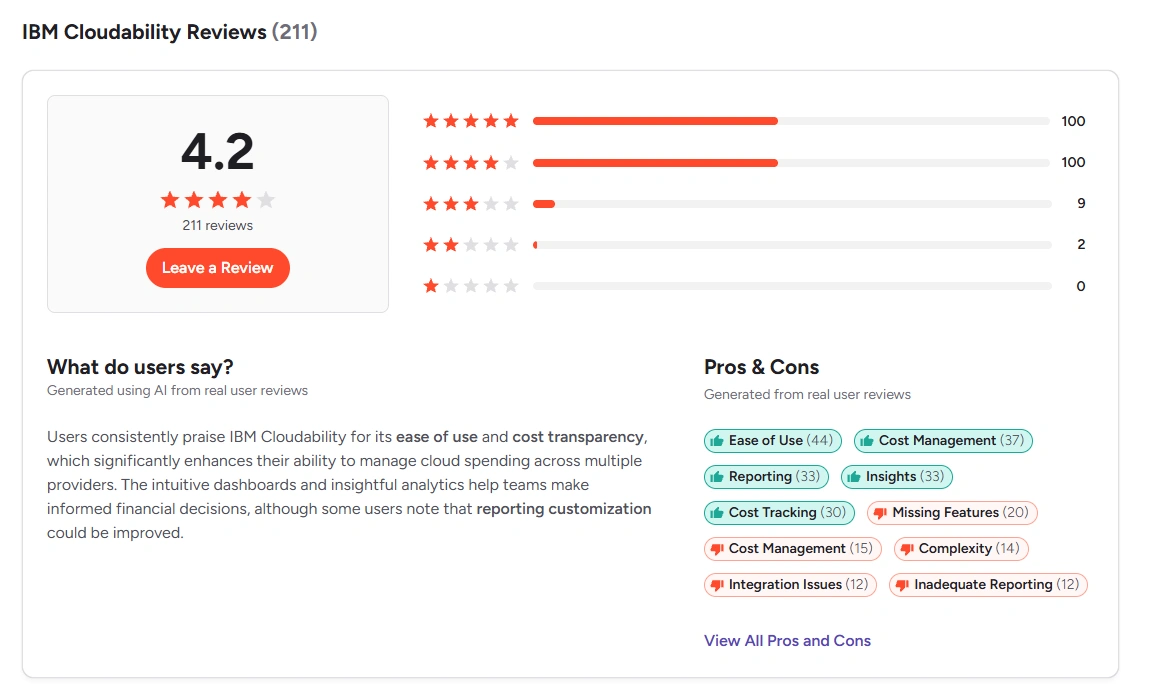
Several visible TrustRadius reviews were clustered around March 11–12, 2026, and many were labeled incentivized. Each site also applies different verification and scoring methods.
Consistent Strengths
The strongest recurring theme across G2, Gartner Peer Insights, TrustRadius, and PeerSpot is consolidated visibility across accounts and clouds.Reviewers value translating provider billing data into views that finance, application owners, and engineering teams can use without entering multiple cloud consoles.
Business Mapping and allocation also receive consistent praise. They help connect raw tags, accounts, and services to applications, products, teams, or business units.
Reviewers additionally cite executive dashboards, normalized data, anomaly and optimization visibility, and support for established enterprise FinOps processes.
Recurring Friction
Customer-reported concerns across G2, TrustRadius, and PeerSpot include:Report-loading performance
Dashboard customization
Difficult drill-through
Exports
Onboarding
Data freshness
Several recent TrustRadius reviewers report stronger AWS functionality than Azure or other-cloud optimization.
That is customer feedback, not proof of universal provider inequality. IBM’s 2026 releases show continued Azure and GCP development, so buyers should validate their own services rather than rely on a platform-wide parity assumption.
What Changed in 2026?
IBM’s 2026 Cloudability release notes show three material directions.Deeper Kubernetes economics: Advanced Containers, powered by Kubecost, adds granular allocation, GPU visibility, rightsizing, and on-premises Kubernetes support.
Stronger financial analysis: Enhanced Forecasting evaluates multiple forecast models and supports user-selectable spend drivers, while Calculated Metrics supports reusable unit-economics and KPI formulas. Business Mapping gained import, export, and change-diff workflows.
Broader optimization: Releases added Azure VM Scale Set rightsizing, improved Azure memory recommendations, AWS Commitment Management 2.0, more configurable anomalies, and additional GCP pricing visibility and Business Mapping permission controls.
What Are You Buying?
Core FinOps Layer
IBM Cloudability ingests and normalizes billing and usage data, then applies Business Mapping and cost-sharing rules. That foundation supports reporting, showback or chargeback, budgeting, forecasting, anomaly detection, unit economics, rightsizing, and commitment analysis.The operating sequence matters. Trustworthy mappings create accountable reporting.
Accountable reporting supports planning and ownership. Only then can an optimization recommendation be evaluated against application performance, migration plans, and engineering priorities.
Recommendations Versus Savings
Buyers should distinguish five stages:Opportunity identified
Recommendation accepted
Action approved
Change implemented
Savings verified
Core commitment management provides portfolio analysis and recommendations. Cloudability Savings Automation is separately positioned for automated commitment-portfolio management.
IBM also says the automated commitment-management functionality that powers Savings Automation is available to all new and existing Cloudability Premium customers.
Premium packaging can incorporate IBM Turbonomic capabilities for advanced optimization and actions, subject to configuration and granted permissions. None of this means every Cloudability recommendation is implemented autonomously.
Packages and Add-ons
| Offering | Decision-relevant scope |
|---|---|
| Essentials | Multi-cloud visibility and rightsizing fundamentals |
| Standard | Adds deeper allocation, unit economics, financial planning, and workload planning |
| Premium | Adds the fullest feature set and Turbonomic-enabled optimization capabilities |
| Savings Automation | Separately presented offering; underlying automated commitment-management functionality is available to Premium customers |
| Advanced Containers | Paid Kubecost-powered add-on requiring an agent in monitored clusters |
| Cloudability MSP | Packaging for service providers and resellers |
What Cloudability Requires
Data and Reconciliation
Cloudability still needs reliable inputs and operating decisions. Buyers must connect required billing feeds and, depending on scope, may also need to:Design account and tag standards
Maintain Business Mapping rules
Define shared-cost policy
Ingest relevant utilization metrics
Reconcile outputs with finance
Proof-of-value testing should measure actual refresh times for each required provider and dataset.
Permissions and Ownership
Cloudability roles and permissions govern reporting, mappings, cost sharing, planning, and optimization access.Provider credentials also differ across billing ingestion, metrics, rightsizing, Turbonomic actions, and commitment execution.
Organizations need named owners across FinOps, finance, engineering, and procurement. A useful operating funnel is:
IBM Cloudability Pricing
Public Pricing Signals
IBM’s product page is quote-led, but the AWS Marketplace Cloudability listing provides directional 12-month examples:| Managed annual cloud spend | Listed annual price |
|---|---|
| Up to $1 million | $30,000 |
| Up to $3 million | $76,680 |
| Up to $6 million | $132,480 |
The listing also shows additional-usage dimensions for Essentials, Standard, and Premium, but the visible table does not define the “unit” clearly enough to calculate averages. Its $6 million row also references additional fees above $7 million, an apparent discrepancy buyers should ask IBM to resolve.
Model package level, managed-spend growth, overages, Savings Automation terms, Advanced Containers, services, support, integrations, and internal administration before comparing proposals.
Test Net Value
Headline opportunity is not the same as platform value. A more useful model is:Billing reconciliation
Allocation coverage
Forecast error
Useful anomaly alerts
Recommendation acceptance
Realized savings
Hours of administration
Who Should Choose Cloudability?
Strong Fit
Cloudability is most compelling when an organization has complex multi-account or multi-cloud spend, material shared-cost allocation, several reporting audiences, and a dedicated FinOps function. It also needs engineering teams that will evaluate and implement optimization work.Consider Alternatives
The case weakens for smaller estates, simple single-cloud environments already served by native tooling, teams without implementation capacity, or buyers primarily seeking commitment execution. Enterprise breadth adds little value when the associated processes will not be adopted.Alternatives by Priority
| Primary buying problem | Model to evaluate |
|---|---|
| Enterprise FinOps governance | Cloudability and comparable enterprise platforms |
| Provider-native visibility | AWS, Azure, or Google Cloud cost tools |
| Kubernetes-first allocation | Kubecost-focused or container-specialist tools |
| Commitment execution and downside protection | Usage.ai or another commitment-automation model |
| Engineering-led resource optimization | Infrastructure-efficiency and automation platforms |
The products may coexist, but teams should define the source of truth for commitment inventory, savings attribution, and approvals.
Verdict: Is Cloudability Worth It?
Yes, for larger, mature organizations that need governed allocation, financial planning, and accountability across complex cloud estates.Cloudability’s breadth can justify its cost when the organization can maintain the data model and turn recommendations into verified outcomes.
It is not an automatic fit for simpler environments or commitment-only buying problems. Before signing, run a scoped proof of value and contractually confirm packages, add-ons, overages, data access, services, success criteria, and exit terms.
Compare your current commitment coverage, risk, and potential savings before choosing a platform.
Frequently asked questions
Is Cloudability worth it in 2026?
It can be for mature organizations with complex allocation, reporting, planning, and governance requirements. Value is less certain when cloud operations are simple or the organization cannot operationalize its recommendations.
How much does Cloudability cost?
IBM uses quote-led pricing. Public AWS Marketplace examples range from $30,000 annually for up to $1 million in managed spend to $132,480 for up to $6 million. Add-ons, services, overages, and private offers can change total cost.
Does Cloudability execute savings automatically?
Not every recommendation. Automation depends on the workflow, package, integration, and permissions. Core recommendations, Turbonomic-enabled actions, governance workflows, and Cloudability Savings Automation should be evaluated separately.
Are Savings Automation and Advanced Containers included?
IBM documents the automated commitment-management functionality behind Savings Automation as available to Cloudability Premium customers, while Savings Automation is also presented as a distinct offering. Advanced Containers is an optional paid Kubecost-powered add-on across Essentials, Standard, and Premium. Confirm the exact entitlement and commercial terms in the proposal.
Is Usage.ai a complete alternative?
No. Usage.ai is purpose-built for commitment execution and risk management, while Cloudability covers a broader FinOps operating scope. They may compete for a commitment use case or operate together.
If you notice any material information that is incorrect, outdated, or no longer applicable, please contact us at [email protected]. We’ll review the information and update the article where appropriate.