.png)



The harder question is whether connecting cost and observability data creates enough value to justify the total cost. That depends on your Datadog footprint, allocation maturity, required automation, and ability to act on its findings.
Our assessment: Datadog CCM is a credible option for engineering-led FinOps, particularly in organizations already using Datadog. It becomes a less obvious choice when the need is simple standalone reporting or automated commitment execution rather than broad cost observability.
Datadog CCM at a Glance
| Our assessment | |
|---|---|
| Best for | Existing Datadog customers building engineering-led FinOps workflows |
| Cost coverage | AWS, Azure, Google Cloud, OCI, containers, SaaS, AI, Datadog, and custom costs |
| Core strength | Connecting cost, ownership, usage, and performance data |
| Optimization | Recommendations, integrated actions, and selected recurring automations |
| Commitments | Coverage, utilization, inventory, expiration, and Savings Plan simulation |
| Pricing | Free Datadog cost visibility; paid Pro and Enterprise tiers based on analyzed spend |
| Main dependencies | Some allocation and compute recommendations require other Datadog products |
| Customer sentiment | Positive overall, with cost and interface complexity worth scrutinizing |
| 2026 verdict | Worth considering for the right Datadog-centered operating model |
What Customers Actually Say
Among the sources reviewed, Gartner Peer Insights provides the clearest product-specific review signal. As of September 1, 2026, it lists Datadog CCM at 4.5/5 from 54 ratings.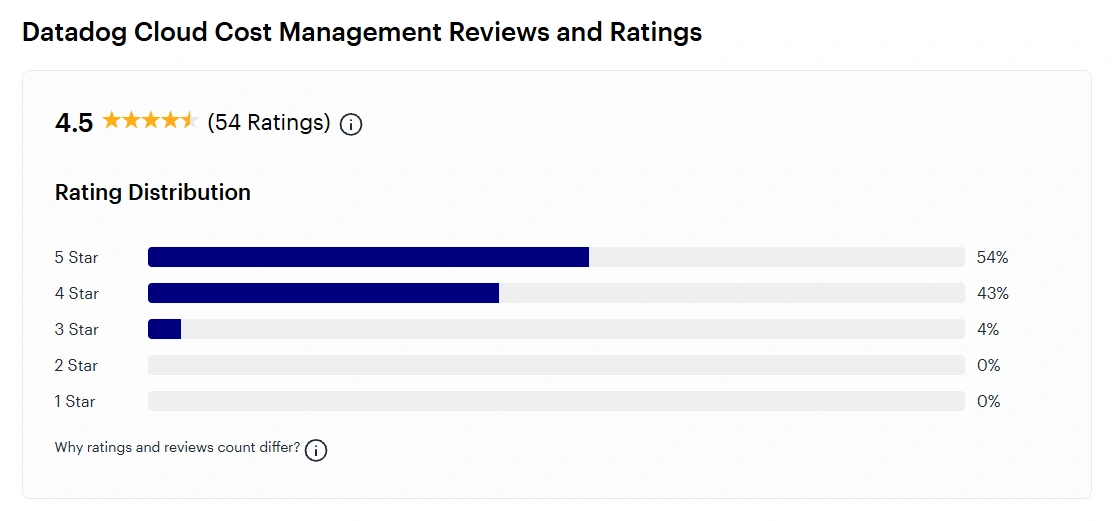
What Customers Value
The visible customer comments and supporting product materials point to:breaking costs down across providers, teams, and services;
showing engineers cost and operational data together;
customizable dashboards and reporting;
easier collaboration between FinOps and engineering; and
integration with existing Datadog workflows.
These are individual experiences, not representative benchmarks. They support the value of placing cost data where engineers already investigate systems.
Where Users Encounter Friction
The clearest concerns are cost and complexity. Gartner displays a critical review describing useful cost visibility alongside a complex interface.Broader TrustRadius reviews of Datadog also raise pricing, learning-curve, query, and dashboard-customization concerns.
That wider feedback matters because CCM lives inside Datadog, but it does not prove every CCM user has the same experience.
How Much Weight Ratings Deserve
G2’s Datadog profile shows a strong overall rating from more than 700 reviews, but that pool spans observability, APM, logging, infrastructure, security, and other use cases. It should not be presented as a CCM-specific score.The safest conclusion is that customer sentiment is encouraging. Buyers should still validate CCM’s specific workflows, entitlements, and economics in their own environment.
Beyond Cloud-Bill Visibility
Cost Meets Engineering Context
Datadog CCM’s main advantage is not another summary of a cloud bill. It brings cost data into dashboards, Notebooks, Software Catalog, Resource Catalog, and container workflows alongside infrastructure and application signals.That can shorten the path from “spend increased” to “this service, deployment, or resource drove the change.” Engineers can investigate within familiar tools, while FinOps teams gain operational context for recommendations and anomalies.
Datadog’s current CCM overview positions this shared context as the platform’s central differentiator.
CCM also supports budgets, forecasting, cost anomalies, monitors, and scheduled reports, including alerts when actual or forecasted spend may exceed budget. These workflows add planning and governance beyond investigation.
Allocation Across Cost Sources
CCM covers AWS, Azure, Google Cloud, and OCI bills, plus supported SaaS and AI providers. Custom Costs can bring additional sources into Datadog, while FOCUS tags normalize dimensions across providers.For cost allocation across AWS, Azure, and Google Cloud, teams can use native tags, Datadog tags, Tag Pipelines, and Custom Allocation Rules. Shared costs can be divided using defined percentages. Advanced allocation in Enterprise can use Datadog metrics to reflect consumption more closely.
Container allocation extends the model to Kubernetes and Amazon ECS.
However, a license does not create trusted allocation by itself. Teams still need reliable ownership metadata, sensible rules, relevant metrics, and a process for resolving unallocated spend.
What Real-Time Actually Means
Most provider billing data is not real time. During AWS setup, Datadog says it automatically ingests backfilled Cost and Usage Report data within 24 hours after AWS makes it available. Its cost monitors use a 48-hour delayed evaluation window because billing data can arrive late.Enterprise also includes Real-Time Costs in preview. These are estimates updated approximately every five minutes for selected Amazon EC2 costs, including Kubernetes allocation.
That is valuable for detecting compute changes quickly, but it is not five-minute finalized billing across every cloud and service.
How Far Automation Goes
Recommendations, Actions, and Automation
Cloud Cost Recommendations combines billing and observability data to identify downsizing, deletion, configuration, storage, and AI-spend opportunities across supported environments. Buyers should distinguish three workflow levels:CCM identifies a recommendation for engineers to evaluate.
A user initiates a supported action through an integrated workflow.
A Cost Optimization Automation repeatedly acts on an eligible recommendation.
Safeguards and permissions still require deliberate configuration. The automation catalog does not cover every recommendation or every cloud resource.
Commitment Reporting Is Not Execution
Commitment Programs tracks AWS EC2, RDS, and ElastiCache commitments and Azure Reserved Virtual Machine Instances. Teams can analyze inventory, coverage, utilization, expirations, effective savings, and potential Savings Plan purchases.The available documentation does not establish that CCM autonomously purchases, continuously rebalances, or financially protects those commitments. It helps teams make and monitor decisions; the commitments and their downside remain with the customer.
Implementation and Ongoing Ownership
CCM is not simply enabled with one universal connection. The setup depends on the provider:AWS requires Cost and Usage Report access, S3 permissions, and an appropriate IAM policy.
Azure requires the Datadog integration plus actual and amortized cost exports.
Google Cloud requires detailed billing export to BigQuery and service-account access.
SaaS, AI, and custom costs require the relevant integration, export, API, or upload path.
Teams still own tag normalization, allocation rules, access controls, recommendation validation, automation safeguards, and finance reconciliation. Existing Datadog customers may already have much of the required telemetry and ownership model.
Pricing and Actual Value
Free, Pro, and Enterprise
Datadog publishes spend-based CCM pricing:| Plan | Annual billing | Month-to-month | On-demand |
|---|---|---|---|
| Datadog Cost Visibility | Free | Free | Free |
| CCM Pro | $5 per $1,000 of spend/month | $6 | $7.20 |
| CCM Enterprise | $10 per $1,000 of spend/month | $12 | $15 |
At annual list price, Pro equals approximately 0.5% of analyzed spend and Enterprise approximately 1%.
For $1 million in monthly cloud and SaaS spend, that is about $5,000 or $10,000 per month respectively before negotiated discounts.
Account for the Complete Cost
The CCM line item may not be the complete deployment cost. Buyers should include any required Infrastructure Monitoring, Container Monitoring, implementation work, and ongoing FinOps and engineering ownership.This matters most when the business case depends on observability-enriched recommendations or granular container allocation rather than reporting alone.
Measure Net Value
The right question is not how much savings CCM identifies. It is how much value the organization realizes after fees and implementation:How Alternatives Differ
The useful comparison is not which platform has the longest feature list. It is which operating model matches the buyer’s primary problem.| If your priority is | Model to investigate |
|---|---|
| Low-cost reporting for one cloud | Native cloud-provider tools |
| Cost and performance in engineering workflows | Datadog CCM |
| Broad finance, allocation, and governance workflows | Full FinOps platforms |
| Autonomous infrastructure changes | Execution-focused optimizers |
| Executed commitment savings and downside treatment | Specialized commitment platforms |
Teams can use Autopilot for automated management or CoPilot for recommendations and greater decision control. The Flex Insured Commitment Program may provide cashback protection for eligible Flex Insured Commitments, subject to program terms.
The distinction is not visibility versus savings. It is broad engineering cost context versus specialized commitment execution and risk treatment.
Who Should Consider Datadog CCM?
Datadog CCM Fits If
Datadog is already central to engineering operations.
Costs span multiple clouds, containers, SaaS, or AI providers.
Engineers actively participate in FinOps.
Cost-performance correlation and shared-cost allocation matter.
Tagging and service ownership are reasonably mature.
Platform consolidation can justify spend-based pricing.
Consider Alternatives If
Native tools already meet a simple reporting need.
Cloud spend is small or operationally straightforward.
The organization lacks ownership and allocation maturity.
Teams want a lightweight standalone cost dashboard.
The primary requirement is autonomous commitment purchasing, continuous portfolio adjustment, or explicit downside protection.
Verdict: Is Datadog CCM Worth It?
Yes, for the right organization.Datadog Cloud Cost Management is worth considering when its operational context changes how engineers and FinOps teams investigate, allocate, and optimize spend. That case is strongest for existing Datadog customers with complex cloud environments and an engineering-led FinOps model.
It is less compelling when purchased only to reproduce native billing reports. The economics also become more demanding when Enterprise capabilities, supporting Datadog products, and implementation work are required.
Before buying, validate the required tier, product dependencies, provider-data latency, automation coverage, and net value using your own cost and operational data.
Compare your current commitment coverage, risk, and potential savings before choosing a platform.
Frequently asked questions
Is Datadog Cloud Cost Management worth it?
It is worth considering when teams need cloud costs connected with Datadog’s engineering workflows. Value depends on the tier, supporting products, implementation effort, and realized benefit.
How much does Datadog CCM cost?
Annual list pricing starts at $5 per $1,000 of analyzed cloud and SaaS spend per month for Pro and $10 for Enterprise. Month-to-month and on-demand rates are higher. Datadog cost visibility alone is free.
Can CCM work without other products?
Yes. Datadog offers CCM as a standalone product. However, some capabilities, including container cost allocation and certain compute recommendations, require Infrastructure Monitoring or Container Monitoring.
Does CCM automatically reduce costs?
CCM provides recommendations, integrated actions, and recurring automations for selected recommendation types. It does not automatically implement every optimization or autonomously manage the complete commitment portfolio.
Which cost sources are supported?
CCM supports AWS, Azure, Google Cloud, OCI, Datadog, containers, supported SaaS and AI providers, and custom cost sources.