
 AWS
AWS Microsoft Azure
 Google Cloud


One promises smaller workloads. Another helps engineering teams allocate Kubernetes spending. A third manages Google Cloud commitments to reduce eligible compute costs.
All three address Kubernetes cost optimization, but they solve different financial problems.
For CTOs, platform engineering leaders, and FinOps teams, the question is not which platform has the most features. It is which capability delivers measurable value beyond what Google Cloud already provides.
In this guide, we compare GKE cost optimization platforms, including our own GCP commitment-management offering. We focus on capabilities and purchasing evidence rather than numerical vendor rankings because these platforms address different financial problems.
Short answer
Choose rightsizing software when unnecessary workload requests or excess node capacity drive spending. Choose allocation software when teams cannot attribute or reconcile Kubernetes costs. Choose commitment optimization when stable, eligible GCP usage lacks appropriate discount coverage.Some enterprises need multiple capabilities. Others can rely on native Google Cloud services.
The right platform closes a verified financial or operational gap.
Start with your existing Google Cloud capabilities.
Can native GKE tools solve the problem without another platform?
Google Cloud already provides workload recommendations, utilization metrics, Standard-cluster cost allocation, Cloud Billing reports, and Committed Use Discount (CUD) analysis.Its GKE cost allocation documentation explains how to attribute Standard-cluster costs to Kubernetes resources using detailed Cloud Billing exports to BigQuery.
However, native allocation uses resource requests rather than actual consumption. Historical allocation is not backfilled, and some shared discount costs may require reconciliation.
Google also provides GKE cost optimization metrics and workload recommendations for engineering teams to evaluate.
Complete this native baseline before procurement
Enable the appropriate Cloud Billing export and confirm data availability.
Review GKE cost allocation coverage and identify unallocated spending.
Inspect workload requests, utilization, and current rightsizing recommendations.
Review existing CUD coverage, utilization, and uncovered eligible usage.
Document what the current tools cannot reliably accomplish.
Our GKE cost optimization guide covers the underlying technical methods in more detail.
Match the platform to your GKE billing model
Before comparing software, determine how your workloads generate charges.| GKE configuration | What is billed | What to validate |
|---|---|---|
| Standard | Underlying Compute Engine instances | Does optimization reduce billable node capacity? |
| General-purpose Autopilot | Billable Pod resource requests, subject to defaults, minimums, and adjustments | Do changes reduce effective billable requests? |
| Autopilot with specific hardware | Underlying hardware and applicable node management premiums | Does optimization reduce billable hardware usage? |
Autopilot workloads can also run in Standard clusters using supported ComputeClasses. Evaluate the billing model for each workload rather than relying solely on the cluster’s operating mode.
Buying implication: Require vendors to demonstrate support for your exact GKE operating configuration. Kubernetes compatibility alone does not establish equivalent optimization or savings capabilities across every billing model.
Compare GKE cost optimization platforms before shortlisting
How we evaluated platforms: This comparison uses official Google Cloud and vendor product documentation reviewed in October 2026. Entries reflect documented primary capabilities, not independent performance rankings. Confirm GKE-mode support, execution permissions, pricing, and product-edition differences during evaluation.| Platform | Documented focus | What buyers should verify |
|---|---|---|
| Google Cloud native tools | GKE allocation, recommendations, billing and CUD analysis | Whether native features meet existing requirements |
| CAST AI | Kubernetes infrastructure and workload optimization | GKE support, automation controls, savings realization |
| IBM Kubecost | Kubernetes cost allocation and analysis | Product edition, billing integration, reconciliation |
| CloudZero | Cost intelligence, allocation, unit economics | Shared costs and CUD treatment |
| StormForge | Workload CPU and memory rightsizing | Recommendation execution and rollback controls |
| OpenCost | Open-source Kubernetes cost allocation | Maintenance and actual-billing reconciliation |
| Harness | Cloud cost visibility and reporting | GKE-specific optimization and execution scope |
| Usage.ai | Eligible GCP commitment optimization | Supported commitments, realized savings, protection terms |
These products address overlapping but distinct requirements. Broad cloud support does not mean every GKE workload, optimization action, or commitment type is supported.
For buyers evaluating tools beyond Kubernetes, our GCP cost optimization tools comparison covers the wider software landscape.
Rightsizing software: Will it reduce actual infrastructure spending?
Rightsizing platforms identify excessive CPU and memory requests. Some also support automated workload adjustments, node optimization, and capacity management.CAST AI and StormForge are relevant candidates when workload efficiency is the main requirement.
The financial outcome, however, depends on the underlying GKE billing model.
In Standard clusters, reducing Pod requests does not necessarily reduce charges until billable node capacity changes.
For general-purpose Autopilot workloads, reducing effective resource requests can affect Pod-based charges, provided the changes remain within Google’s resource requirements.
Usage.ai role is different. We do not modify GKE Pods or nodes. Instead, we help evaluate eligible GCP commitment opportunities against the resulting cloud usage baseline.
Before approving a platform, require a representative test that establishes performance impact, actual resource changes, node or Pod billing reductions, and rollback procedures.
Approve rightsizing software when demonstrated financial and operational benefits exceed licensing, deployment, and reliability costs.
Allocation software: Can finance explain Kubernetes spending?
Allocation platforms connect shared infrastructure costs to workloads, namespaces, applications, or business units.OpenCost, IBM Kubecost, and CloudZero offer Kubernetes cost-allocation capabilities, but their integration requirements and reporting depth differ.
For example, CloudZero’s Kubernetes documentation describes GKE integration through either its agent or native GKE allocation data.
The documentation identifies native allocation limitations involving resource usage, idle costs, and Flexible CUD reporting.
This matters because calculated workload allocations may differ from actual financial charges.
Ask vendors to reconcile a completed billing period, identify unallocated costs, and explain how they distribute shared resources and commitment discounts.
Usage.ai complements Kubernetes allocation tools by focusing on eligible GCP commitment coverage and savings. We do not replace workload-level allocation or chargeback reporting.
Approve allocation software when its added accuracy, accountability, or reporting capabilities support a measurable organizational requirement.
Commitment savings: Is your eligible GCP usage appropriately covered?
Commitment management addresses cloud pricing rather than Kubernetes workload configuration.Google Cloud offers resource-based Compute Engine CUDs and spend-based Compute Flexible CUDs.
Resource-based CUDs cover specified eligible Compute Engine resource commitments, with matching requirements that vary by resource and commitment type.
Compute Flexible CUDs provide broader eligible-spend coverage across supported Compute Engine, GKE, and Cloud Run usage within a Cloud Billing account.
According to Google’s GKE CUD documentation, Compute Flexible CUDs provide a 28% discount for eligible covered usage under a one-year commitment and 46% under a three-year commitment, compared with applicable On-Demand pricing. The customer commits to a minimum discounted hourly spend.
These percentages do not apply to every GKE SKU. Compute Flexible coverage excludes the Scale-Out ComputeClass, GPU Pods that do not use the Accelerator class, Spot Pods, and GKE cluster management fees.
Commitment charges continue throughout the term even if eligible demand decreases.
This is where Usage.ai fits. Through our GCP cost optimization platform, we analyze existing commitments and eligible usage, identify additional savings opportunities, and help manage approved commitment purchases within your Google Cloud billing account.
Our Flex Insured Commitment Program can provide cashback protection for qualifying managed commitments when their cost exceeds equivalent On-Demand usage for the same usage, subject to program eligibility and terms. Google’s underlying CUD obligation remains in place.
Test the financial impact after rightsizing
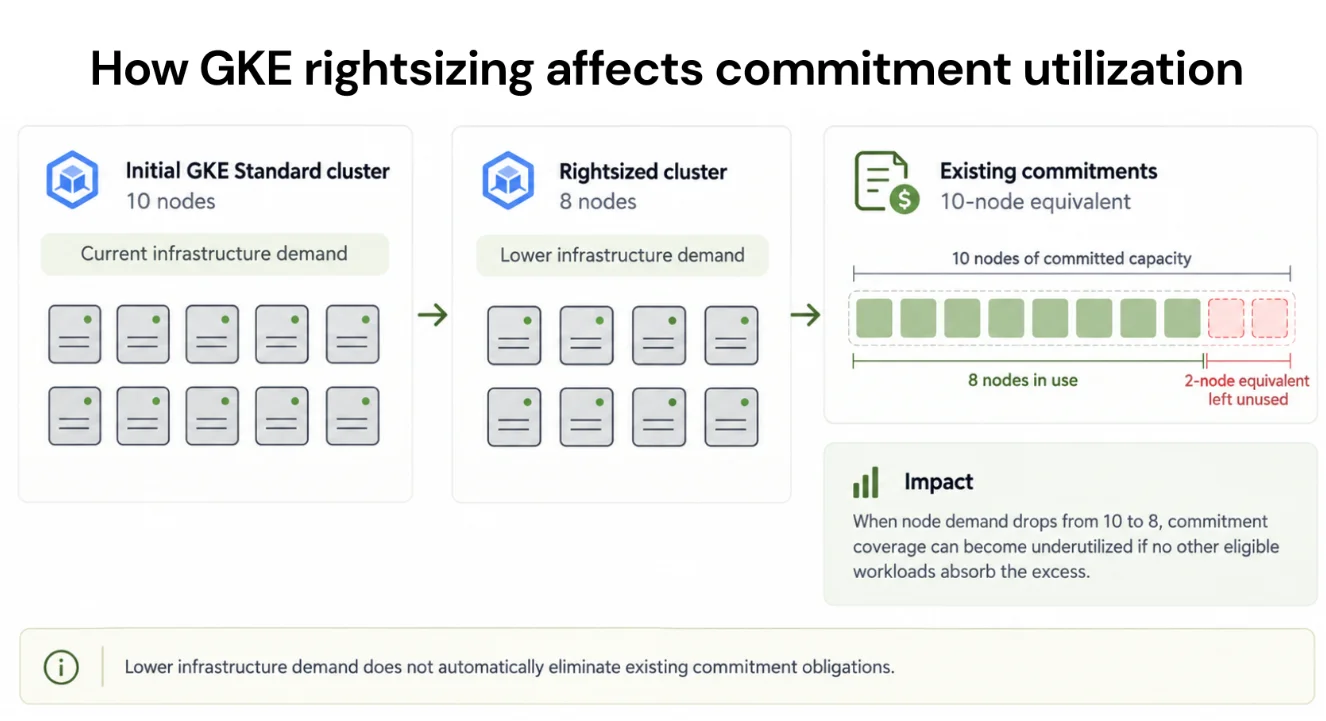
Consider a hypothetical GKE Standard cluster operating ten identical eligible nodes.Existing resource-based commitments cover the equivalent resources of all ten nodes.
After rightsizing, the cluster needs only eight.
The infrastructure requirement decreases, but the original commitments remain payable.
Whether this creates unused commitment exposure depends on the commitment type, eligible replacement workloads, matching requirements, and discount-sharing configuration.
Before purchasing additional commitments, verify the existing commitment portfolio, model post-rightsizing demand, identify eligible usage outside GKE, and calculate potential underutilization exposure.
Google’s CUD analysis documentation provides native tools for reviewing commitment effectiveness.
Our GCP commitment automation guide covers the separate commitment-management workflow.
Approve commitment-management software when it demonstrates incremental net savings after existing discounts, fees, and downside exposure.
What must a GKE platform prove before purchase?
A vendor demonstration should reflect your actual workloads and financial baseline.| Evaluation criterion | Required evidence | Suggested weight |
|---|---|---|
| Capability fit | Required GKE modes, integrations, supported workflows | 25% |
| Net financial outcome | Validated benefits after existing discounts and fees | 25% |
| Billing accuracy | Reconciliation to Google Cloud charges | 20% |
| Security and governance | Permissions, approvals, auditability | 15% |
| Commercial and implementation effort | Fees, deployment, support, exit requirements | 15% |
Validate incremental savings
Use consistent time periods, workloads, existing discounts, and billing assumptions.Do not count recommendations as realized savings or add overlapping infrastructure and commitment savings estimates.
Review automation permissions
Rightsizing automation may require permission to modify workloads or infrastructure.Commitment execution requires separate purchasing authority. Billing-data access alone does not grant the right to purchase commitments or modify workloads.
Check approval controls, access scope, audit records, and revocation procedures.
Compare contract obligations
Request a complete quote covering fees, minimum terms, support, implementation responsibilities, renewal, and offboarding.For commitment-management platforms, establish who owns commitments, how purchases are approved, and what happens to those commitments after the vendor relationship ends.
A platform should pass procurement only when the evidence supports its claimed value.
Where Usage.ai fit into GKE cost optimization
Through our GCP cost optimization platform, we analyze eligible usage, identify commitment opportunities, and help manage qualifying commitments within the customer’s Google Cloud billing account.Our read-only Savings Test evaluates existing commitments, uncovered eligible usage, and potential incremental savings before purchasing authority is enabled. Review the exact integration permissions for the selected configuration.
With Flex Insured Commitments, teams can get the 46% discount available with a three-year Compute Flexible CUD on eligible GKE usage with none of the commitment risk.
If a covered Flex Commitment costs more than the equivalent on-demand usage, we calculate that loss and provide cashback protection according to the applicable program terms; accrued cashback is paid after 90 days.
For procurement, the meaningful result is projected and subsequently verified savings in your own environment after applicable fees.
Final verdict:
The right GKE cost optimization platform depends on the financial outcome you need. Rightsizing must demonstrate lower billable resource costs. Allocation must improve accountability and reconciliation. Commitment management must prove incremental savings without hiding existing obligations or underutilization risk.If native tooling already delivers those results, another platform may not be necessary.
Base the purchasing decision on validated financial outcomes, supported capabilities, and acceptable operational risk.
For teams with uncovered, eligible GCP spend, we can evaluate potential commitment savings through a read-only Savings Test before your team authorizes new purchases.
Explore 30–50% GCP savings with eligible cashback protection, subject to terms.
Frequently asked questions
Which GKE cost optimization platform should an enterprise choose?
Choose the platform category that addresses the main unmet need. CAST AI and StormForge are relevant for workload optimization, while IBM Kubecost, CloudZero, and OpenCost provide allocation capabilities. We focus on eligible GCP commitment management. Require a representative evaluation before purchasing.
Can native Google Cloud tools replace paid GKE optimization software?
Yes, in some environments. Native Google Cloud services already provide utilization insights, cost allocation, recommendations, and CUD analysis. Commercial platforms must demonstrate value beyond those capabilities.
Does reducing Kubernetes CPU requests always reduce GKE costs?
No. Standard clusters generally bill underlying Compute Engine nodes, so reducing Pod requests does not automatically reduce infrastructure charges. General-purpose Autopilot uses effective Pod resource requests, subject to defaults, minimums, and adjustments.
Can rightsizing reduce existing CUD utilization?
Yes. If eligible demand decreases and other workloads cannot absorb the released coverage, utilization may decline. Existing commitment charges remain payable under the applicable Google Cloud commitment terms.
Can one platform manage rightsizing, allocation, and commitments?
Some platforms offer multiple capabilities, but their GKE support and execution depth vary. Verify each required workflow individually, including supported billing modes, data sources, permissions, and commitment types.