
 AWS
 Microsoft Azure
 Google Cloud


If your team still reconciles shared costs in spreadsheets, better allocation and chargeback may justify the subscription, even when another tool manages commitments. If those needs are already covered, the buying decision depends on the further cloud savings or reductions in manual work Finout could deliver.
This guide explains the public prices and what to confirm in a quote, with an illustrative calculation to help assess first-year value.
Finout Pricing at a Glance
Finout’s website requires a quote. Its public AWS Marketplace offer publishes these 12-month contract prices:| Plan | Annual AWS spend covered | Published 12-month price |
|---|---|---|
| Business | Up to $500,000 | $12,000 |
| Pro | Up to $2 million | $40,000 |
| Enterprise | Scope agreed through a private offer | Contact sales |
How Finout Pricing Works
Finout sets a flat fee against a committed cloud and AI spend tier and the environment it monitors. Cost centers, data volume and required integrations influence the quote. Ordinary monthly spend fluctuations do not change the contracted fee.Finout also states that it charges neither per seat nor a share of savings. That makes the software fee different from both a percentage-of-spend charge and a savings-share service.
Your quote should identify the monitored spend basis, connected sources and purchased capabilities. Ask how credits, negotiated cloud discounts and existing commitments affect the spend figure used to scope it.
Why Public Prices Differ
G2’s pricing entry displays Pro at $2,000 monthly, but the underlying pricing information is dated October 9, 2024. It differs from the current Marketplace reference.Do not average conflicting figures or assume the lower one is available. Record the source, date, purchasing channel and scope, then compare those with the written proposal.
What Does Finout Include?
The value depends on what your team needs to do with the billing data:Consolidate: MegaBill brings supported cloud, Kubernetes, data-platform and AI costs into a unified view.
Allocate: Virtual Tags group costs through rules without requiring changes to original infrastructure tags. Shared Cost distributes common expenses across their consumers.
Plan and investigate: Financial Plans, dashboards, reporting and anomaly detection support budgets, forecasts and cost ownership.
Optimize: CostGuard surfaces waste and optimization recommendations. CostOptimizer is also listed; confirm the actions supported for your clouds and commitment instruments.
Finout uses cost centers to describe cloud or service bills connected to MegaBill. Do not assume these equal departments in your finance hierarchy. Have sales map your providers and billing accounts to the allowance in your quote.
Also confirm SAML access, support channels and historical-data requirements before choosing a package. A low reference price is less useful if the quoted package cannot meet a mandatory requirement.
Finout says AI cost management is included without an additional charge. Still, establish which providers and overall monitored scope your subscription covers. An included capability does not mean unlimited spend or connections are covered.
What Adds to Finout’s Cost?
Start with disclosed additions rather than assuming unspecified “hidden fees.”| Published addition | Business | Pro | Enterprise |
|---|---|---|---|
| Kubernetes | 25% price increase | 25% price increase | Included |
| Cost Per Customer | $250 increase | $500 increase | Included |
Cost Per Customer deserves particular attention if customer-level margins or customer-specific chargeback are central to your business case. Distinguish that packaged capability from general allocation and unit-economics functionality.
Implementation and Internal Effort
Request a written breakdown of onboarding, historical imports, custom work, training and support. Public information does not establish a universal separate onboarding fee.Your own team may still need to approve billing access, reconcile totals, design allocation rules and assign owners. Ask who maintains those rules when accounts, products or organizational structures change.
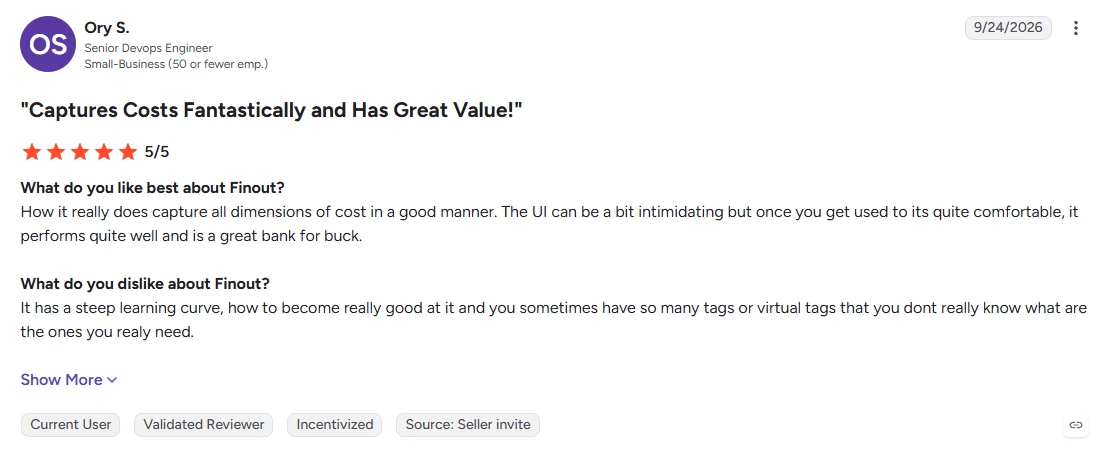
In a September 24, 2026 G2 review, a reviewer praised Finout’s cost visibility while describing a learning curve and difficulty navigating many tags. The review is marked incentivized. This is one customer’s experience, not a standard implementation estimate.
Finout Contract, Renewal and Exit Terms
A predictable subscription still needs a clear agreement about changes and renewal.Finout’s website terms, revised October 21, 2026, publish the following provisions. A separate written agreement takes precedence over conflicting terms.
| Issue | Website terms | What to confirm |
|---|---|---|
| Expanded scope | Additional capacity or subscription purchases required | What triggers an amended quote |
| Renewal | Successive one-year renewals; at least 30 days’ written non-renewal notice | Deadline and notice recipient |
| Renewal fee | 5% increase for the spend tier and year defined in the Order Form | Your next-term amount |
| Payment and cancellation | Advance payment by default; generally no cancellation for convenience or refunds, with stated exceptions | Payment schedule and termination rights |
The Marketplace listing requires acceptance of the vendor’s EULA. The document currently linked allows termination for convenience, but entitlement-priced subscriptions (usage quantities bought upfront) retain payment obligations for the unused period and do not receive a refund for that cancellation.
Ending access and ending payment obligations can therefore be different events. Ask which agreement, amendments and offer terms govern your purchase.
Data history also affects usefulness. The website terms describe onboarding the current calendar year and preceding calendar year of approved-cloud historical data unless otherwise agreed. They permit data deletion within 30 days after non-renewal.
Historical import coverage is not the same as an unlimited retention promise. Confirm the reporting history, export process and exit window your team requires before signing.
Is Finout Worth the Cost?
Begin with the reporting or optimization gap you are purchasing it to close. If your existing tools already produce trusted allocation, another dashboard needs a stronger justification. If shared costs prevent product-margin reporting, judge that requirement explicitly.An Illustrative Quote Evaluation
The following figures are hypothetical. They are not a Finout quote, customer result or typical savings benchmark.Assume an all-in annual subscription of $30,000. A team identifies $100,000 in annualized savings opportunities, but some would happen without the platform.
| Evaluation step | Illustrative amount |
|---|---|
| Annualized opportunities identified | $100,000 |
| Already expected from existing work | −$40,000 |
| Additional annualized opportunity | $60,000 |
| Captured over nine months after rollout | $45,000 |
| Assumed annual subscription | −$30,000 |
| Additional cash implementation cost | −$5,000 |
| First-year cash benefit remaining | $10,000 |
The $10,000 result is before valuing internal staff time and reporting benefits. At only six months of realized savings, the same assumptions produce a $5,000 cash shortfall.
Keep allocation benefits separate: fewer reconciliation cycles, clearer ownership or usable customer margins may matter even when the savings-only case is weak. Record the work removed and who benefits rather than assigning an unsupported dollar value.
Before accepting the proposal, agree on the baseline, implementation owner and success measure. Compare it with keeping your current tools, not with doing nothing.
Also read: Our cloud cost optimization evaluation scorecard helps organize that assessment.
When Usage.ai Fits Your Evaluation
After assessing Finout’s quote, consider whether you need broader cost allocation, commitment management, or both.At Usage.ai, we manage supported AWS, Azure and Google Cloud commitments. Our Autopilot and CoPilot controls let your team choose automated purchasing within approved settings or recommendations requiring approval.
With Flex Insured Commitments, teams can access 30–50% savings on covered workloads through supported one- or three-year commitments with none of the commitment risk.
For eligible Flex Commitments, we assess qualifying losses monthly when commitment costs exceed the equivalent On-Demand cost for the same usage and provide cashback.
Under our savings-based model, we charge an agreed percentage of realized savings and bill monthly in arrears after provider billing is finalized.
Finout also offers commitment-related capabilities. Compare the actions, coverage and value after fees your team needs; Usage.ai does not replace its complete allocation and planning platform. Our Usage.ai–Finout comparison explains the overlap and responsibilities when using both.
Final Verdict on Finout Pricing
Use the public rate as a reference, then judge the written proposal against your required sources, workflows and operating effort.Finout deserves evaluation when its allocation and planning capabilities solve a material gap. Before committing, establish the complete fee, add-on periods, scope-change rules, renewal amount and measurable outcomes. A fixed subscription is useful only when the purchased scope fits the job.
If commitment management is the remaining gap in your current setup, assess what you could save beyond your existing discounts before deciding whether to add another service.
Review usage and existing commitments with our read-only Savings Test. Your team authorizes purchasing separately.
Frequently asked questions
Does Finout Offer a Trial?
Yes. Finout advertises a free trial. Confirm its duration and include scope before starting. Test a difficult shared-cost allocation, reconcile totals to billing data and reproduce a report your finance team needs. A successful demonstration should validate the requirements behind your proposed subscription.
Can You Pay Finout Monthly?
Confirm the payment schedule in your offer. The published Marketplace figures above are 12-month contract totals, not evidence of a cancellable monthly subscription. Dividing an annual fee by twelve produces a budgeting equivalent; it does not establish monthly billing or termination rights.
Does the Tier Require Cloud Commitments?
Finout’s committed spend tier reflects the forecasted cloud and AI spend its subscription will cover. It is distinct from buying AWS Savings Plans, Reserved Instances or Google Cloud CUDs. If commitment purchasing is part of your proposal, confirm the instruments, permissions and provider obligations separately.
Does Marketplace Count Toward AWS Commitments?
Possibly. AWS says certain Marketplace purchases contribute toward customer spend commitments. Ask your AWS account team to confirm this Finout offers treatment under your agreement, including limits and timing. Do not deduct an assumed credit from the subscription price.
Can We Keep Our Commitment Tool?
Potentially, if it serves a distinct need. Define which system can purchase each instrument and who monitors existing commitments. Confirm Finout’s quoted execution scope, reconcile both tools against provider bills and avoid attributing the same savings twice. Budget for both subscriptions unless one is actually retired.