.png)



A useful evaluation must test fit, incremental value, work, risk, and whether the vendor can prove its claims.
This editable scorecard organizes that decision around six dimensions: scope, net value, controls, effort, reporting, and terms.
The Short Answer
Evaluate cloud cost optimization software in three layers: pass/fail gates for non-negotiable requirements, buyer-weighted scores, and validation using documentation, contract terms, and your data. A high total should never override a failed security, data-integrity, regulatory, or contractual requirement.How to Set Up the Scorecard Before Comparing Vendors
Complete the following work before product demonstrations:Define the outcomes the software must improve.
Record your current costs, savings, tools, and operating effort.
Involve FinOps, engineering, finance, procurement, and security where relevant.
Separate mandatory requirements from preferences.
Assign weights totaling 100% before vendors influence the criteria.
Give each vendor the same definitions, dataset, and evaluation period.
Use gates sparingly. Appropriate gates include essential coverage, data residency, acceptable IAM permissions, invoice reconciliation, and contract terms. Dashboard preferences belong in the weighted score.
Cloud Cost Optimization Software Evaluation Scorecard
Use the blank downloadable worksheet once for each vendor and enter your own weights totaling 100%. The illustrative example below shows how one hypothetical enterprise might complete the weighted portion of the scorecard for a shortlisted vendor.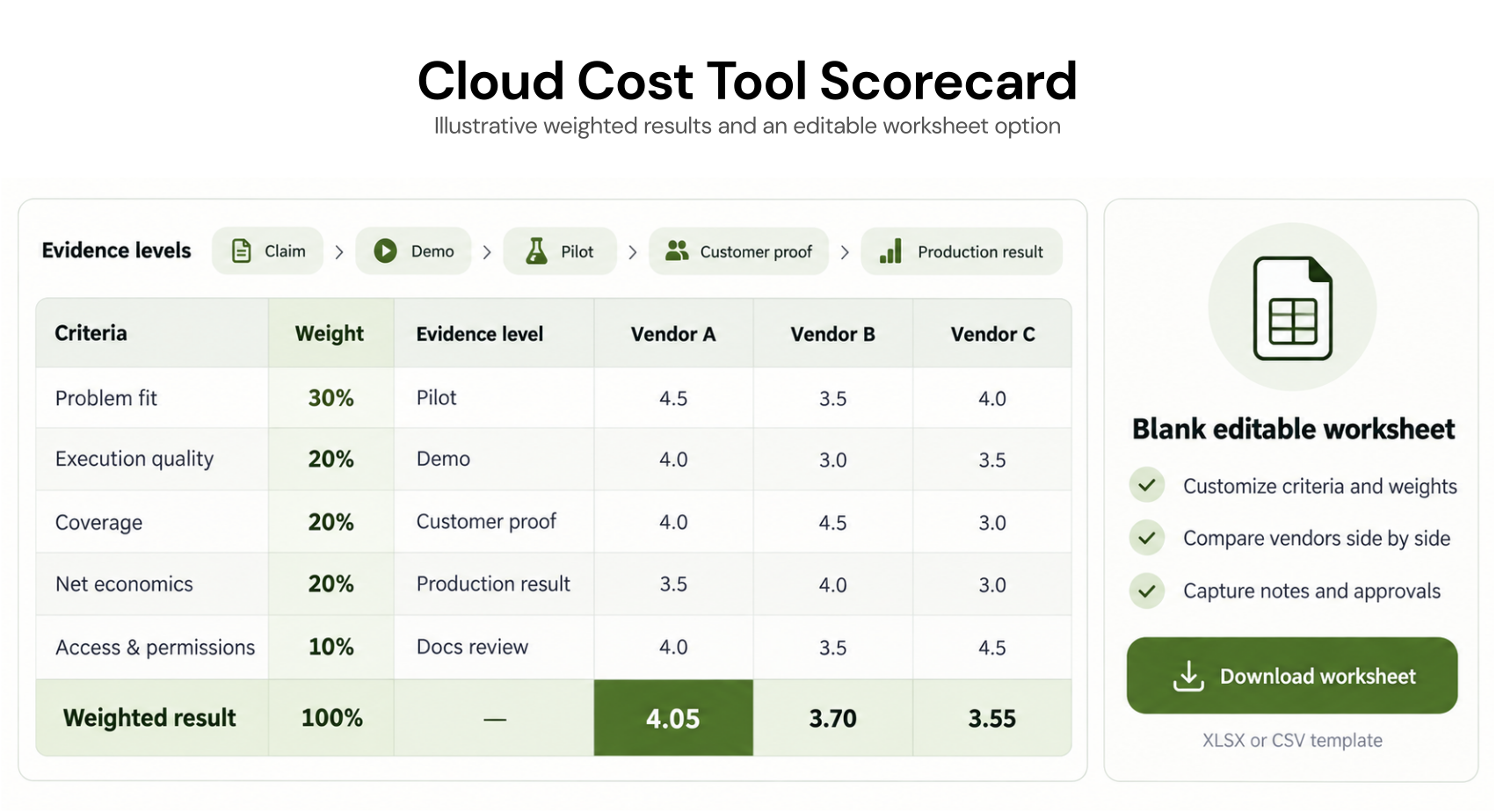
Mandatory gates
| Requirement | Pass criteria | Evidence | Result |
|---|---|---|---|
| Required coverage | Supports every essential provider, service, account, and cost type | Documentation and pilot | Pass / Fail |
| Data integrity | Reconciles to provider billing data within the agreed tolerance | Reconciliation test | Pass / Fail |
| Security and compliance | Meets required IAM, residency, audit, and regulatory controls | Security review | Pass / Fail |
| Automation boundaries | Required actions can operate within approved permissions and limits | Role policy and workflow test | Pass / Fail |
| Contract acceptability | No disqualifying pricing, liability, renewal, or exit term | Executable agreement | Pass / Fail |
Illustrative weighted scorecard
The following weights and results are examples only. Replace them with your organization’s requirements and evidence when completing the downloadable worksheet.| Category | Weight | Score 0–5 | Evidence level | Weighted score | Example finding |
|---|---|---|---|---|---|
| Scope | 20% | 4 | Representative-data demonstration | 16 | Required cloud coverage demonstrated; some secondary services remain unsupported |
| Net value | 25% | 4 | Customer-data pilot | 20 | Pilot indicates incremental savings after fees and internal costs |
| Controls | 20% | 3 | Product documentation | 12 | RBAC and approval controls are documented; the complete workflow still requires validation |
| Effort | 15% | 3 | Customer-data pilot | 9 | Onboarding is straightforward but some remediation remains manual |
| Reporting | 10% | 4 | Customer-data pilot | 8 | Invoice reconciliation and required exports were demonstrated |
| Terms | 10% | 3 | Contractual language | 6 | Pricing is clear, but exit and data-export terms require further review |
| Total | 100% | 71/100 |
Score each category from 0 (unsupported) to 5 (proven, differentiated fit), record the strongest available evidence, and calculate:
How to Score the Six Evaluation Categories
Scope
Score only the scope your organization needs. Examine cloud providers, account structures, billing sources, services, cost types, commitments, Kubernetes, SaaS or AI costs, allocation depth, and historical backfill.Ask the vendor to demonstrate full workflows, not logos on an integration page. Support for the FOCUS specification can improve billing-data portability and normalization, but it does not prove complete service coverage, allocation accuracy, or optimization depth.
Do not automatically penalize a specialty product for narrower scope. Penalize it when the missing scope prevents the outcome you are buying it to deliver.
Net Value
Vendor savings projections are inputs, not outcomes. Establish what you already save, then estimate the additional value attributable to the productControls
Distinguish five modes: read-only observation, recommendations, approval-based action, autonomous purchasing, and autonomous infrastructure changes. Each requires different permissions and governance.Score SSO, RBAC, least-privilege roles, approval routing, account or service exclusions, purchasing limits, audit logs, overrides, and emergency stops.
The FinOps Foundation notes that billing data can contain sensitive resource names, account names, tags, and business context. It recommends mapping tool access and autonomous permissions explicitly rather than treating security certification as sufficient on its own.
Effort
Measure work across the full operating lifecycle. Include onboarding, historical imports, tag or allocation cleanup, configuration, recommendation review, change implementation, training, support, and ongoing administration.Separate time to first insight from time to realized value. A tool may identify savings quickly while leaving testing, approvals, remediation, and verification to your teams. Ask which activities disappear and which require new skills.
Reporting
Test whether the product can reconcile provider invoices, allocate shared costs, report realized savings, and serve different audiences without parallel spreadsheets. Evaluate showback or chargeback, forecasts, unit economics, coverage and utilization, custom dimensions, exports, APIs, and retention.Define “real time” as measurable source-to-availability latency. AWS, Azure, and Google Cloud exports differ in delivery, corrections, and schema behavior, so test freshness against each source.
Terms
Normalize quotes before comparing them. Record whether fees use total spend, eligible spend, managed resources, realized savings, or a fixed subscription. Then assess minimums, overages, implementation charges, included modules, renewal, price increases, termination, data export, and obligations that survive cancellation.For guarantees or financial protection, verify eligible purchases, exclusions, calculation rules, payout timing, offsets, claim requirements, and what happens at termination. Score the executable agreement, not the sales summary.
How to Validate Vendor Scores With Evidence and a Pilot
Use an evidence ladder. Confidence should increase from verbal claim, to marketing material, product documentation, contractual language, a representative-data demonstration, a customer-data pilot, and finally a measured production result.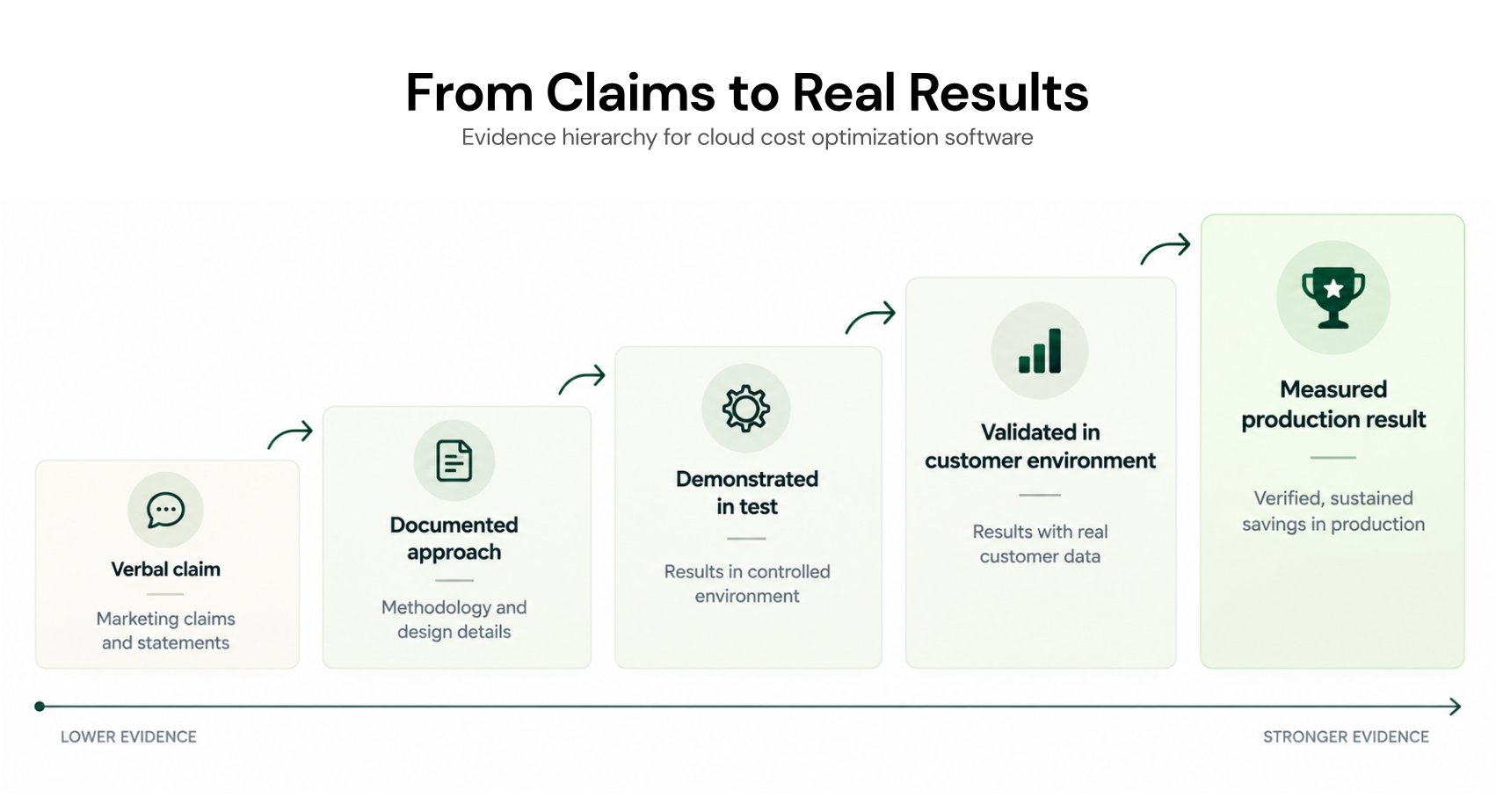
Reconcile cost to provider billing data.
Reproduce required allocation rules.
Find several known optimization opportunities.
Separate existing savings from incremental value.
Demonstrate approval, permissions, and audit workflows.
Quantify the internal work remaining after recommendations.
Export usable cost and savings data.
Explain false positives and unsupported resources.
Model net value after fees and downside.
Questions to Ask Vendors
Ask every shortlisted vendor:Which required costs, services, or actions are unsupported?
What remains manual after implementation?
How do you calculate and reconcile realized savings?
Which permissions are required at each automation level?
How do existing discounts and commitments affect attribution?
What happens when usage declines or architecture changes?
What fees, data rights, or obligations continue after termination?
How Usage.ai Fits Into This Evaluation
The scorecard should not reward breadth for its own sake. When the buying problem includes cloud commitment optimization, our specialist approach should be evaluated on the same six categories as a broader FinOps platform.We analyze billing and usage data at the billing layer, where our read-only Savings Test identifies savings opportunities without changing infrastructure. If a customer proceeds, approved recommendations use separate permissions to purchase and manage commitments across supported AWS, Azure, or Google Cloud scopes.
With Flex Insured Commitments, teams can access 30–50% savings through eligible one- or three-year cloud commitments with none of the commitment risk.
If an eligible Flex Insured Commitment becomes more expensive than equivalent On-Demand usage, we provide cashback protection to help cover the difference, subject to current program eligibility and terms.
We charge a percentage of the realized savings generated through commitments we optimize. Our reporting covers savings, fees, cashback accrual, coverage, forecasting, and history.
Evaluate these capabilities using the same evidence and contract rules applied to every vendor; specialization should not be assumed to equal fit.
Also read: Best AWS Savings Plans Management Tools in 2026
Final Verdict: Choose the Best Proven Fit, Not the Longest Feature List
Pause consideration of any vendor that does not meet a mandatory gate until the gap is resolved and verified. For the remaining options, compare weighted scores, evidence strength, and material stakeholder concerns. Prefer the option that demonstrates the strongest net value within your operational and risk constraints, then document the assumptions and set a future reassessment date.Review requirements, vendor fit, commitment economics, and risk before choosing a platform.
Frequently asked questions
How should we choose weights for a cloud cost optimization scorecard?
Start with the outcomes and constraints agreed by the buying group. Increase the weight of criteria that can materially affect value, risk, or adoption in your environment. Set the weights before vendor demonstrations and document why they differ from any suggested defaults.
Should mandatory security and contract requirements receive a weighted score?
No. A non-negotiable requirement should be a pass/fail gate. Otherwise, a vendor could compensate for an unacceptable security permission or termination term by scoring highly on dashboards and secondary features.
What is considered a good vendor score?
There is no universal threshold. A score is useful for comparing qualified vendors under the same requirements. Review category-level differences and evidence quality instead of selecting a product solely because its total is a few points higher.
How long should a cloud cost optimization proof of value run?
Run it long enough to observe representative billing data, corrections, workload patterns, and required workflows. The appropriate period depends on billing cadence, seasonality, and the capability being tested. Define acceptance criteria and the evaluation window before the pilot begins.
Should native cloud cost tools be included in the comparison?
Yes. Native tools provide a legitimate baseline and may be sufficient for some single-cloud organizations. Score the current native or internally built approach alongside paid options so the business case reflects incremental capability, savings, effort, and risk rather than assuming a new platform is necessary.