.png)



But terms like cashback, credits, buyback, and guarantees can describe very different risk models.
For FinOps and procurement leaders, the real question is not whether a platform offers “protection.” It is who carries the downside when usage falls, what obligation remains, and how much financial exposure the protection actually removes.
In this guide, we compare how cashback, credits, and buyback models work, and what to verify around eligibility, loss calculations, ownership, and termination terms.
Cashback vs credits vs buyback: What’s the difference?
| Protection | What it generally means | Key question |
|---|---|---|
| Cashback | Eligible losses are reimbursed in cash | How is the loss calculated, and when is it paid? |
| Credits | Value is applied to qualifying future charges | Who issues the credits, and where can they be used? |
| Buyback | A vendor provides a remedy for an unwanted or underutilized commitment | What happens to the underlying commitment? |
Buyback is a good example. It does not necessarily mean AWS, Azure, or Google Cloud has cancelled the original commitment. Depending on the agreement, it could mean resale, reimbursement, credits, release, or another vendor-funded remedy.
Start with the native cloud commitment
Before comparing protection, let’s start with the commitment itself.Cloud commitments lower rates in exchange for a longer-term obligation. If usage later falls, that obligation does not automatically shrink with it.
Microsoft states in its Azure savings plan documentation that savings plan purchases cannot be cancelled or refunded. Google Cloud makes a similar point in its spend-based committed use discount documentation, where customers remain responsible for the agreed commitment during its term.
AWS provides some flexibility for certain instruments. Eligible Standard EC2 Reserved Instances can be sold through the AWS Reserved Instance Marketplace, but that option does not apply across all AWS commitment types.
A vendor may absorb some of the economic downside without changing the original provider obligation. That’s the distinction that matters when you compare cashback, credits, buyback, or release mechanisms.
What is cashback protection?
Cashback is a financial reimbursement for an eligible commitment loss.If a commitment costs more than the equivalent eligible usage would have cost without it, a protection program may calculate that difference and reimburse some or all of the qualifying loss in cash.
That can be more flexible than receiving credits, but cashback is only as valuable as the rules behind it.
Before comparing programs, check:
which commitments qualify;
how a loss is defined;
whether losses are measured per commitment or across a portfolio;
how often they are calculated;
whether reimbursement is automatic;
when the cash is actually paid.
Learn more about Usage.ai vs Archera: Which Cloud Platform Delivers Better Value.
The comparison is useful because even when two programs reimburse losses in cash, the eligibility rules, calculation method, payout timing, and treatment of the underlying commitment can still differ.
Timing matters too. Recovering $10,000 later is not economically identical to avoiding the $10,000 exposure in the first place.
What are cloud commitment credits?
Cloud commitment credits are monetary credits applied against eligible future cloud or vendor charges rather than paid to the customer as cash.The important part is understanding what the credit can actually offset.
Cloud-provider credits
Cloud-provider credits reduce eligible charges on the cloud bill, subject to the provider’s rules. Their value depends on where they can be applied, whether they expire, and whether your organization will generate enough qualifying spend to use them.Google Cloud provides a useful example. Under its legacy spend-based CUD model, eligible usage was charged at list price and an offsetting commitment credit reduced the bill. Google has since moved many spend-based CUDs toward direct discounted pricing instead.
Vendor credits
A cloud optimization vendor may instead issue credits against its own future invoices.That creates a different economic outcome. A $20,000 credit is only worth $20,000 if your organization can actually use all of it.
So when evaluating a credit-based remedy, ask:
who issues the credit,
what can it pay for,
when does it expire,
what happens to unused value if the relationship ends
Reporting: Includes savings, Effective Savings Rate, utilization, coverage, showback, and Commitment Lock-In Risk.
What does a buyback guarantee actually mean?
A cloud commitment buyback is a remedy for an unwanted or underutilized commitment. Depending on the program, that may mean resale, reimbursement, refund, release, or another form of financial protection.The important part is understanding how the exit actually works.
Resale
AWS provides a native resale route for certain Standard EC2 Reserved Instances through the Reserved Instance Marketplace. But that route has important restrictions, particularly for RIs purchased under volume or other discount programs.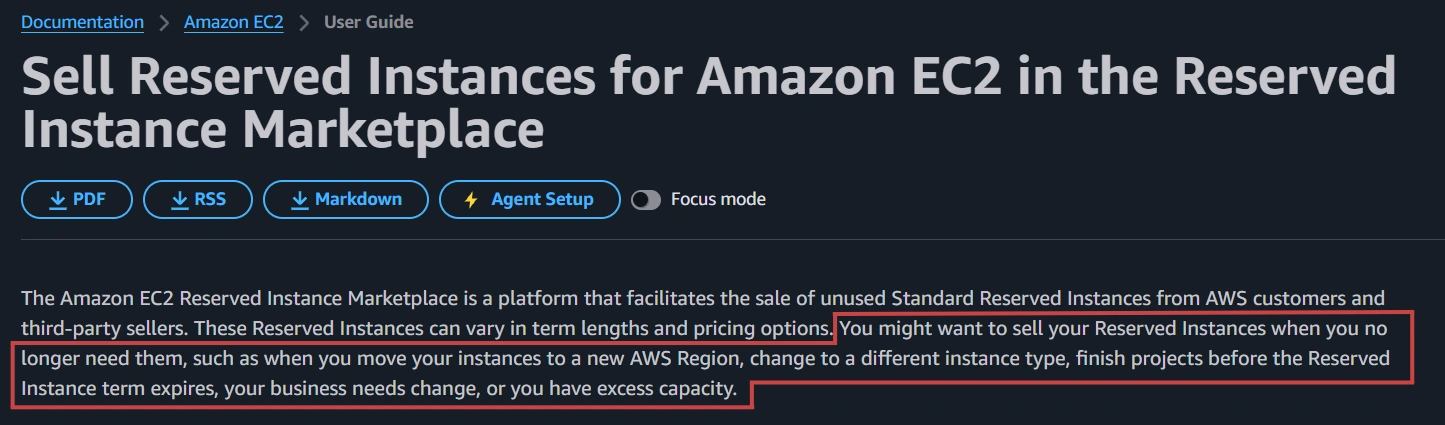
Refund or reimbursement
Some programs return value directly rather than relying on resale.Microsoft Azure, for example, allows eligible Azure Reservations to be returned for a prorated refund, subject to refund rules and annual limits. This flexibility does not extend to Azure Savings Plans, which follow different commitment rules.
A vendor may also reimburse a qualifying underutilization loss without removing the original cloud-provider obligation. In that case, the financial remedy and the commitment itself need to be evaluated separately.
Release
Some programs go further by allowing eligible commitments to be removed or released under defined conditions.Archera is one example. Its Guaranteed Commitments can include a release option that removes eligible commitments from the customer’s account under the applicable program terms.
So when a provider uses the word buyback, always ask what exactly happens when we trigger it:
do you get reimbursed,
does the commitment move elsewhere, or
are you released from the remaining obligation?
Eligibility can matter more than the headline guarantee
A protection program is only as strong as the commitments it actually covers.That sounds obvious, but it is where many comparisons break down. A vendor may advertise protection against underutilization, while the protection applies only to commitments it recommended, purchased, or manages under a specific program.
That means two customers using the same platform can have very different levels of protection depending on which commitments are in scope.
Eligibility may depend on:
who recommended or purchased the commitment;
commitment type and purchase date;
cloud provider and billing scope;
utilization thresholds;
how long the commitment remains underutilized;
whether required mitigation steps were followed.
If your organization already holds a large portfolio of Savings Plans, Reserved Instances, or CUDs, do not assume those commitments inherit the same protection as new purchases made through the platform.
At Usage.ai, for example, our Flex Insured Commitment distinguishes existing customer commitments from eligible Flex Commitments.
Archera takes a similar commitment-specific approach. Its Guaranteed Commitments are opt-in, and the protection applies to commitments purchased with the guarantee rather than automatically extending across every native commitment in a customer’s portfolio.
Learn more about Archera Pricing & Hidden Costs Explained.
How is the protected loss calculated?
Two protection programs can cover the same underutilized commitment and still reimburse very different amounts. The difference often comes down to how each program defines a loss.A provider may calculate protection using:
unused commitment dollars or hours;
commitment cost versus equivalent On-Demand cost;
performance of the individual commitment;
performance across the broader portfolio;
savings already generated before the loss occurred.
One program might treat the $2,500 difference as the qualifying loss. Another might first offset that amount against savings generated elsewhere in the portfolio, resulting in a smaller reimbursement.
At Usage.ai, for example, our cashback methodology evaluates eligible Flex Insured Commitments by comparing the commitment cost with the On-Demand cost for the same usage.
For FinOps and Finance teams, this is why a protection percentage on its own tells you very little. You need to understand the baseline, the calculation scope, and whether gains elsewhere can reduce the loss being protected.
What documentation is required?
Protection terms often include procedural conditions that can affect whether a remedy is actually payable.Before relying on one, check:
whether the remedy is automatic or must be formally claimed;
whether the claim window starts from the loss event, billing cycle, invoice date, or when underutilization is identified;
whether supporting evidence must come from the cloud bill, the vendor platform, or both;
whether the vendor can require mitigation steps before approving the remedy;
whether continued use of the platform is required while the claim is being reviewed;
whether termination, non-renewal, or an overdue invoice can affect an unpaid claim;
whether claims are assessed per commitment, per billing period, or across the portfolio;
whether there is a minimum loss threshold before a claim becomes eligible;
whether the vendor can offset a claim against fees, credits, prior savings, or other amounts owed;
whether the agreement sets a deadline for disputing the vendor's calculation.
Before relying on commitment protection, check these 7 terms
By this point, the broad mechanics should be clear. The remaining diligence is in the details that can change the financial outcome:Can savings elsewhere offset a protected loss?
A portfolio-level calculation may produce a different recovery from commitment-level protection.
Does protection survive termination or non-renewal?
Check what happens to accrued but unpaid cashback, credits, refunds, or claims.
Can the vendor change eligibility for commitments already purchased?
Review whether protection terms are fixed at purchase or governed by terms that may later change.
Is there a cap on total recovery?
Some programs may limit payouts by period, commitment, account, or contract value.
What happens after the first protected loss?
Confirm whether the commitment remains protected for future periods or whether a payout, release, or claim changes its status.
Who benefits from any resale or recovery value?
If an RI or other commitment is resold, transferred, or otherwise monetized, understand how proceeds are allocated.
What happens during an acquisition, account migration, billing-consolidation change, or cloud-contract renegotiation?
These events can change ownership, billing scope, or eligibility even when the workload itself has not changed.
Compare protection against your actual commitment portfolio
The right protection model depends on the commitments you already hold, the obligations that remain with the cloud provider, and the type of downside you want to limit.If you are evaluating Usage.ai, we can help you review how our protection applies to your current commitment strategy.
Review your commitment downside with Usage.ai →
Connect in 15 minutes to compare current commitment coverage, risk, and potential savings before choosing a platform.
Frequently asked questions
Is cashback better than cloud credits?
Not automatically. Cash generally has fewer spending restrictions, while credits can still have meaningful value when you expect enough qualifying future spend. Compare restrictions, expiry, timing, and termination treatment.
Is a cloud commitment buyback the same as a refund?
Not necessarily. Depending on the agreement, buyback may mean reimbursement, resale, release, credits, or another mechanism.
Does a buyback cancel an AWS Savings Plan?
Do not assume so. A vendor's buyback program and AWS's underlying commitment rules are separate. Verify exactly what happens to the provider obligation.
Can existing cloud commitments receive protection?
It depends on the provider and agreement. Some programs cover only commitments purchased, recommended, or managed through the platform.
What should FinOps teams compare first?
Start with eligibility, loss calculation, form and timing of recovery, and what obligation remains after protection is applied.
If you notice any material information that is incorrect, outdated, or no longer applicable, please contact us at [email protected]. We’ll review the information and update the article where appropriate.